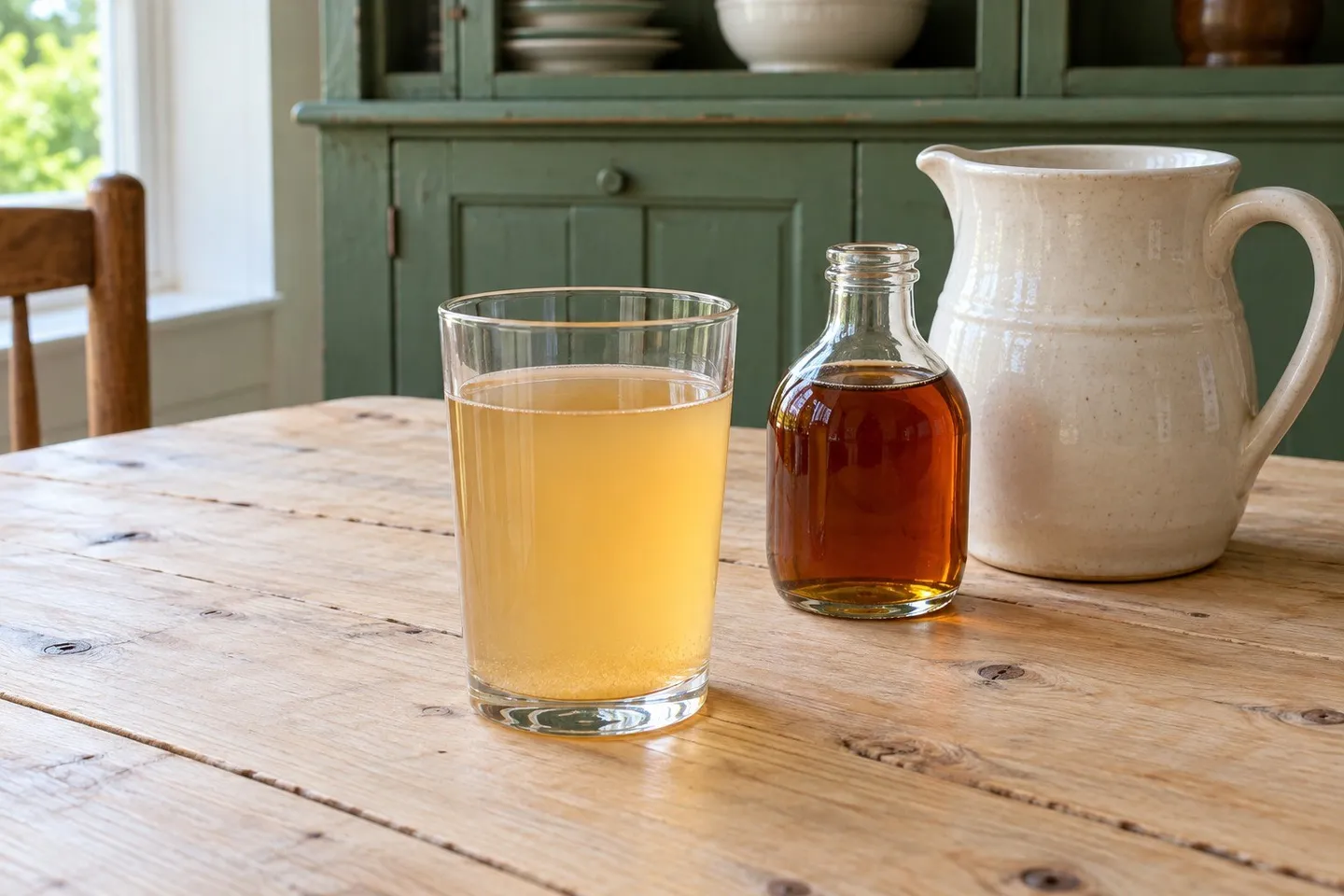
Maple Switchel with Ginger and Cider Vinegar
Reader ratingsSwitchel sweetened with maple syrup in place of molasses, with cider vinegar and ginger: a modern combination of two period versions of the haymakers’ drink.
- Recipe makes
- About 1.1 liters, 5 glasses
- Prep
- Total
Maple switchel in a tall glass, with a stoneware pitcher and a bottle of maple syrup.
The story behind the recipe
This is a modern switchel, put together from two period ones. The oldest known farm advice on the drink, a Philadelphia column of 1805 telling haymakers what to drink in the heat, gives it as “molasses or maple sugar mixed with water,” with no vinegar or ginger at all. Every later recipe we found uses molasses, and adds the vinegar and ginger. No period source joins maple to the other two, so this version does it for them, and the amounts are ours.
Maple in the hayfield
That 1805 column, “Attention, Hay-Makers!” in The Evening Fire-Side, belongs to an early push to get rum out of the harvest. It tells the mowers to give up flip and toddy and drink switchel, whey, small beer or watered cider. No later printing we found mentions maple; from here on the recipes settle on molasses.
The ginger and vinegar came later. John Russell Bartlett’s Dictionary of Americanisms defined switchel in 1848 as plain molasses and water, and only in 1859 added that “sometimes, a little vinegar is added.” By 1870 the Maryland Farmer gave a full recipe with “one quart of cider vinegar” and “a quarter of a pound of ground ginger” to ten gallons of water.
Read more about this recipe
Lighter than molasses
Maple syrup is lighter in flavor than molasses, so this switchel uses a little less and comes out paler, a hazy gold, with the vinegar and ginger more forward than in the molasses version. Any pure maple syrup works; a darker, stronger grade holds its own better against the vinegar. If you have maple sugar, as the 1805 writer did, dissolve about 100 g in a little warm water first.
Switchel, the 1856 Harvest Drink keeps the molasses and the printed proportions. How switchel came to be the temperance drink of the hayfield is told in What Did Early Americans Drink at Harvest?, and vinegar and water as a working drink goes back much further: the Roman soldier’s posca had no sweetener at all.
Recipe makes: About 1.1 liters, 5 glasses
Ingredients
For About 1.1 liters, 5 glasses. Quantities are shown as written.
Quantities as written here, for About 1.1 liters, 5 glasses.
- Cold water1 l
- Maple syrup, or to taste80 ml
- Cider vinegar25 ml
- Ground ginger3 gAuthor measures: about 1 1/2 metric tsp (5 ml per tsp).
Measurement notes
Ingredients as written here
- 1 l cold water
- 80 ml maple syrup, or to taste
- 25 ml cider vinegar
- 3 g ground ginger (about 1 1/2 tsp)
Equipment
 Large jug or jar with a lid, about 1.5 liters
 Measuring jug and spoons
Instructions
Put the ground ginger in the jug with a spoonful of the maple syrup and stir to a smooth paste, so the ginger doesn’t clump.
Add the rest of the maple syrup, the cider vinegar and the cold water. Cover the jug and shake it until the syrup no longer sits in a layer at the bottom.
Taste, and add a little more maple syrup if you want it sweeter.
Leave it somewhere cool. The ginger sinks as it stands, so give the jug a swirl before each glass, and pour it cool rather than over ice.
Nutrition
55calories per serving
- Recipe makes
- About 1.1 liters, 5 glasses
- Servings
- 5
Roughly estimated from USDA FoodData Central values for maple syrup; the vinegar, ginger and water add almost nothing.
Recipe notes
When adjusting quantities
Keep about 12 parts water to 1 of maple syrup by volume when you scale, and taste as you go.
Notes
Quantities mentioned in these notes don’t change when you adjust the batch.
No period amount exists for maple switchel. The 80 ml of maple syrup per liter of water is our choice, a little less than the 100 ml of molasses in the 1856 recipe, and the vinegar and ginger follow that recipe scaled to a liter.
For the 1805 version, leave out the vinegar and ginger: maple syrup or maple sugar stirred into cold water, and nothing else.
Nothing in it ferments, so the maple version is as alcohol-free as the plain one.
Storage
Keep it covered in the fridge and drink it within two days.
Scaling changes the ingredients only; glassware, ice and timings need their own judgment. To adapt this recipe further, try the recipe tool at TuneMyRecipe (opens in a new tab), our sister site.
Sources and attribution
Modern combination after “Attention, Hay-Makers!”, The Evening Fire-Side (Philadelphia), June 22, 1805, p. 222, and “Harvest Drink,” Maryland Farmer, July 1870, p. 195
Recipe details
- Drink
- Alcohol-free
- Drink family
- Sodas & Soft Drinks
- Region
- American
- Era
- 19th century
- Difficulty
- Easy
- Occasion
- Dry January
- Season
- Summer