What Was Aqua Vitae?
Distilled spirit sold as medicine: what Gessner’s 1559 handbook and Markham’s 1623 manual say aqua vitae was made from, how strong it was and how it was tested.
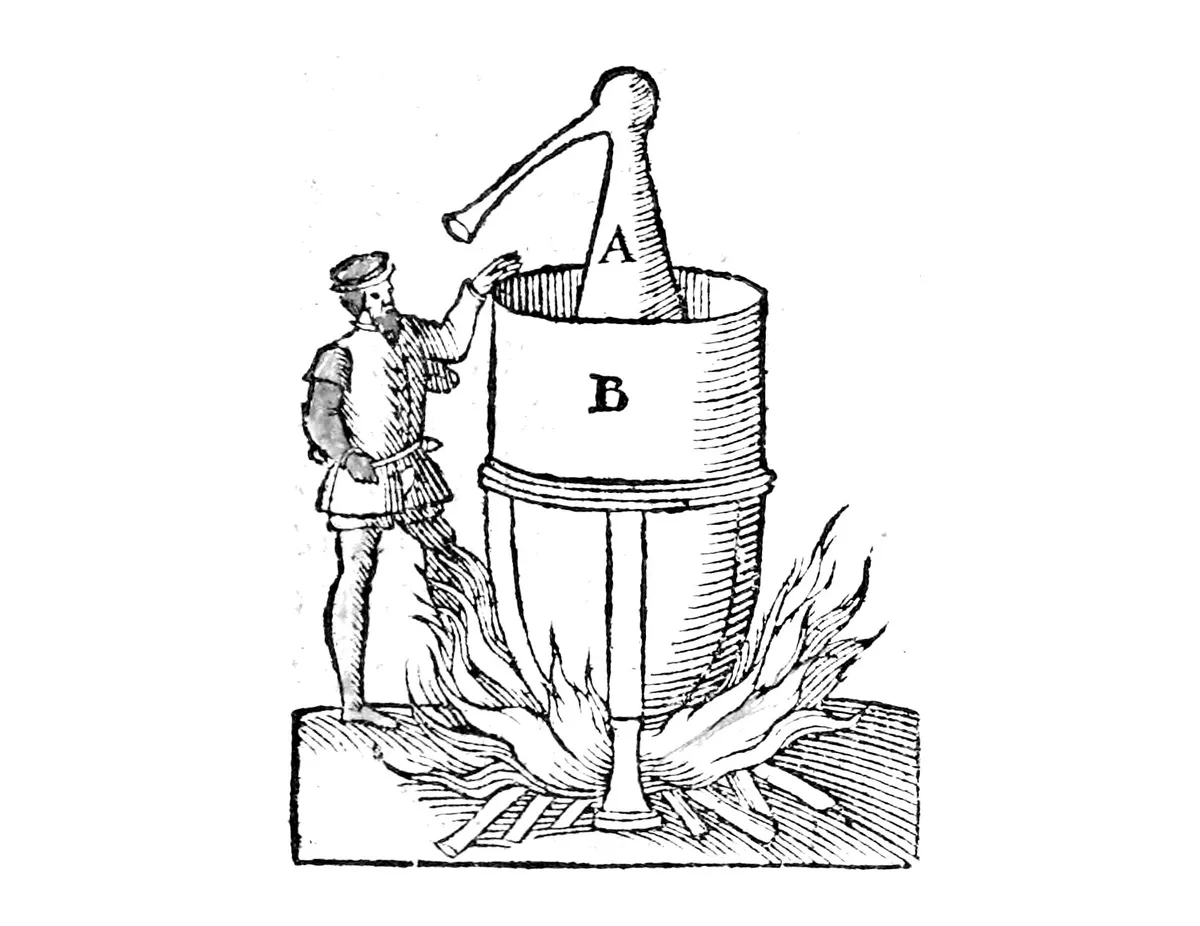
Aqua vitae was distilled spirit. The Latin means “water of life,” and in the 1500s and 1600s the name covered the clear “burning water” drawn by distilling wine, the dregs of wine casks or, in English kitchens, strong ale. It was sold and kept as a medicine and a cordial, taken by the spoonful, and no number on a label said how strong it was: buyers judged it by fire, by oil and by the palm of the hand.
This story is part of our Medieval and Tudor Drinks guide.
It is the drink behind “a little Bottle of aquavite” that the Pilgrims carried on their first march at Cape Cod in 1620, and the “strong water” they poured for their guests, two bottles that What Did the Pilgrims Drink? traces through the colony’s first printed account. The best account of what that bottle held comes from a handbook printed in London sixty years earlier.
Burning water
In 1559 the London printer John Day published The Treasure of Euonymus, Peter Morwyng’s English translation of a Latin book on distilled medicines by the Zurich physician Conrad Gessner. Its chapter “Of burninge water or single Aqua vitæ” opens with the plain facts: “Burnynge water or Aqua vitæ is drawne oute of wine, but wyth vs out of the wine lies only, speciallye of them that sell it, and by this onli almost get their liuing.”
“Wyth vs” is Gessner speaking of his own Switzerland, and “lies” are lees, the yeasty sludge left at the bottom of a wine cask. Spirit from lees was the sellers’ product, and Gessner allowed that “parauenture it is neuer a whit þ worse that it is drawne oute of lies.” All the same, he thought spirit from wine itself was better, “the swieter, and more plesaunt bothe in smell and taste, and without all brent taste,” meaning without the burnt note of the lees. A few pages on he gives the name its poetry: the water drawn from wine “is surnamed burning, or the soul and life of the wine.”
One passage in the same chapter trips modern readers. Between those two lines, the book says that “Burning water is called also water of sapa,” that soap is made from it with oil, that it is made “as lie” from ashes and lime, and that the strongest kind will make an egg float. That burning water is lye, the caustic used for soap and for “searing or burning of woundes,” and its egg test has nothing to do with drinking spirit. Someone underlined the whole passage in the Wellcome Library copy.
Twice for sale, ten times for perfection
The name promised no fixed strength. Each distillation made the spirit stronger, and Gessner’s sources disagreed about how many were enough. “This is commonly known,” he writes: “they that sell it commonly are wont to destil it only twise.” Glaziers, who used spirit to burn colors into their glass, wanted it run four times, “except I be deceiued.”
At the top end, Gessner reports, “at the ninth or tenth destillacion, it shal come out most perfect.” Few bothered. “For as much as to the repeting of destillinge so ofte: a man must bestow both more time and more coste, for the most part we are content with the third or the fourthe destillacion, and call it perfecte.” Pushed too far, it stopped being a drink: “Burning water oft destilled, is broughte into such sharpnes þ it can not be drunk,” he adds, on the authority of the Italian physician Cardano.
So a bottle sold as aqua vitae might hold anything from a twice-run spirit off the lees to one run nine or ten times, and the buyer had to find out which.
A drop in the palm
Gessner gives the tests. Well-made aqua vitae, set alight, “wyll consume euery whit wyth the flame, that no token of moysture be lefte in the bottome of the vessell.” A linen cloth dipped in it and set on fire should not burn, “whyche is a greatter token of perfectyon.” And a drop of oil let fall into it “goeth to the bottome,” since good spirit was lighter than oil.
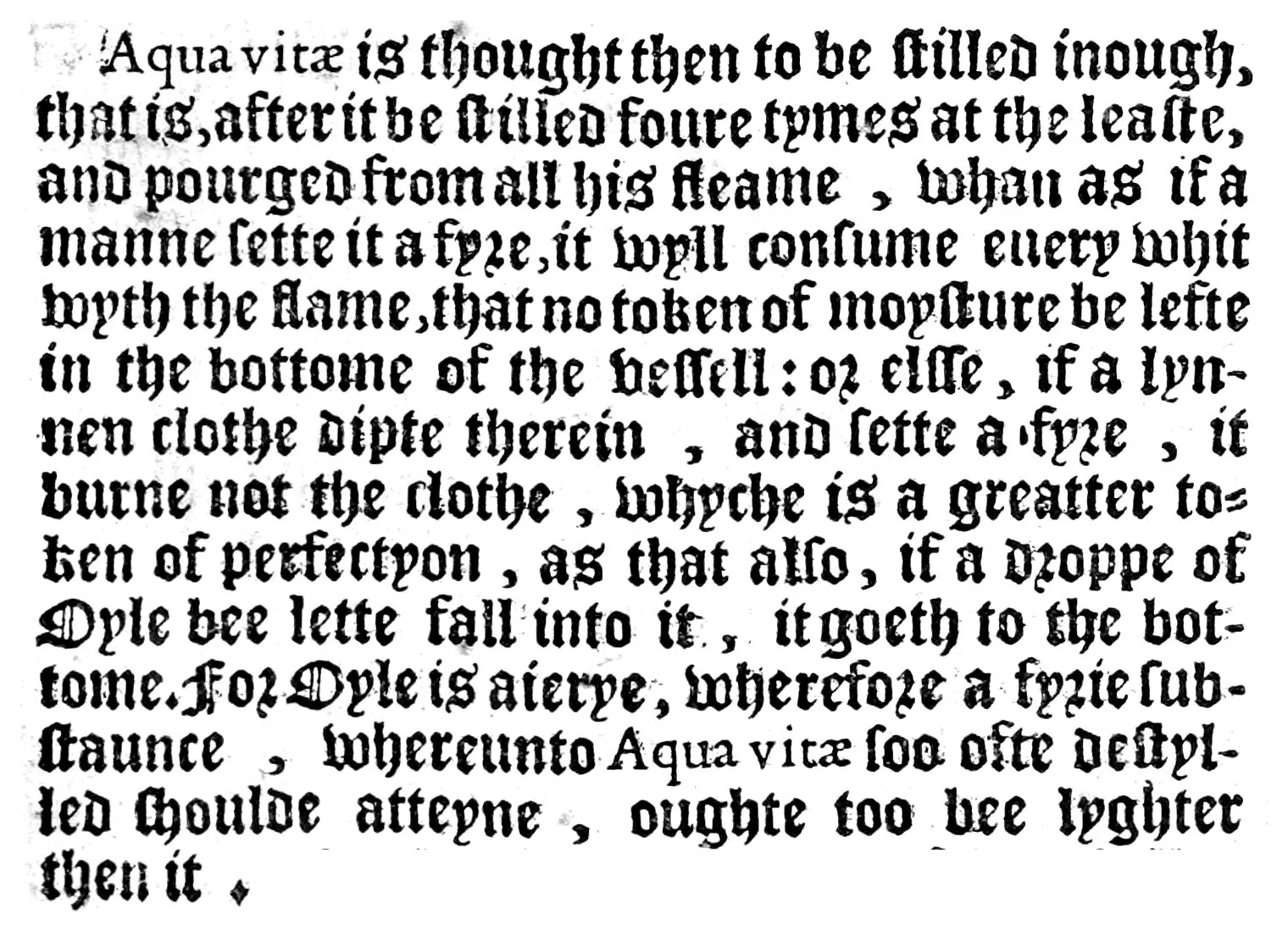 Conrad Gessner, The Treasure of Euonymus, trans. Peter Morwyng (London: John Day, 1559), p. 79.
Nor did a bigger flame mean a better spirit. Of every fire, the chapter says, “the thicker and grosser it is, the more it burneth,” and the thinnest “should burn leaste of all.” The simplest test needed no fire at all. “A drop of Aqua vitæ poured in the palme of a mans hand, the better it is, the soner it vanisheth awaye and is consumed.” The drop simply evaporates. Gessner’s Latin, printed at Zurich in 1554, says the same, “quò melior fuerit eò citius euanescit & consumitur,” and then opens a new sentence with Audio, “I hear.” Morwyng’s English keeps the turn: “I heare that this is a laudable note of this water,” it goes on, and the test it reports, a piece of burning amber that should keep burning in a spoonful of the spirit, comes to Gessner as hearsay.
Gessner also passes on, without vouching for it, the list of virtues that Arnold of Villanova, the medieval physician, had given aqua vitae “simple and alone.” It helps red and dusky eyes, cures the palsy if rubbed on, “It sharpneth þ wit it restoreth memori. It maketh mē mery & preserueth youth.” Even the smell of it burning “killeth flies.” Gessner’s own verdict on the list is a shrug: “how true I iudge it, I wil not say at this time.”
Strong ale and sack lees
English still rooms also drew spirit from strong ale and sack lees. Gervase Markham’s The English Hus-wife (1623), a household manual, has a chapter of “Skill in Distillations” for the country housewife. Its cinnamon water starts from “a pottle of the best Ale and a pottle of sacke lees,” the dregs of sweet Spanish wine. An aqua composita, the herb-flavored spirit of the still room, starts from “foure gallons and more of stronge Ale, & one gallon of Sack-lees” with some thirty herbs and spices, finished with sugar and gold leaf, and Markham doses it small: “a spoonefull or two at a time is sufficient, and the vertues are infinite.” A second aqua composita calls for “two gallands of the best Ale that can be brewed.” The ordinary beer in the same book is a much humbler brew.
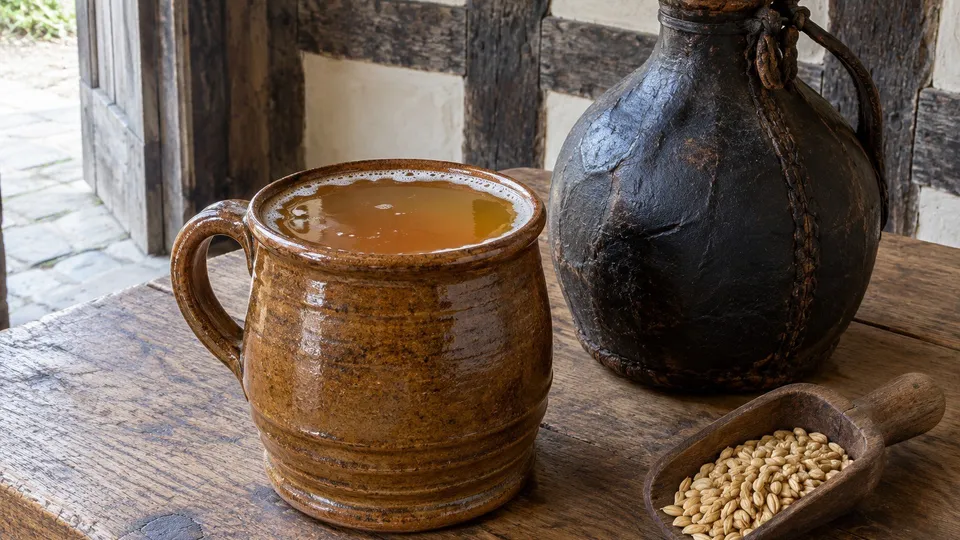 Make it todayOrdinary Beer, the Household Brew of 1623
For the real thing Markham turns to wine. His “excelent aqua-vitæ” begins “Fill a pot with red wine cleane and strong,” and he gives it the old name outright.
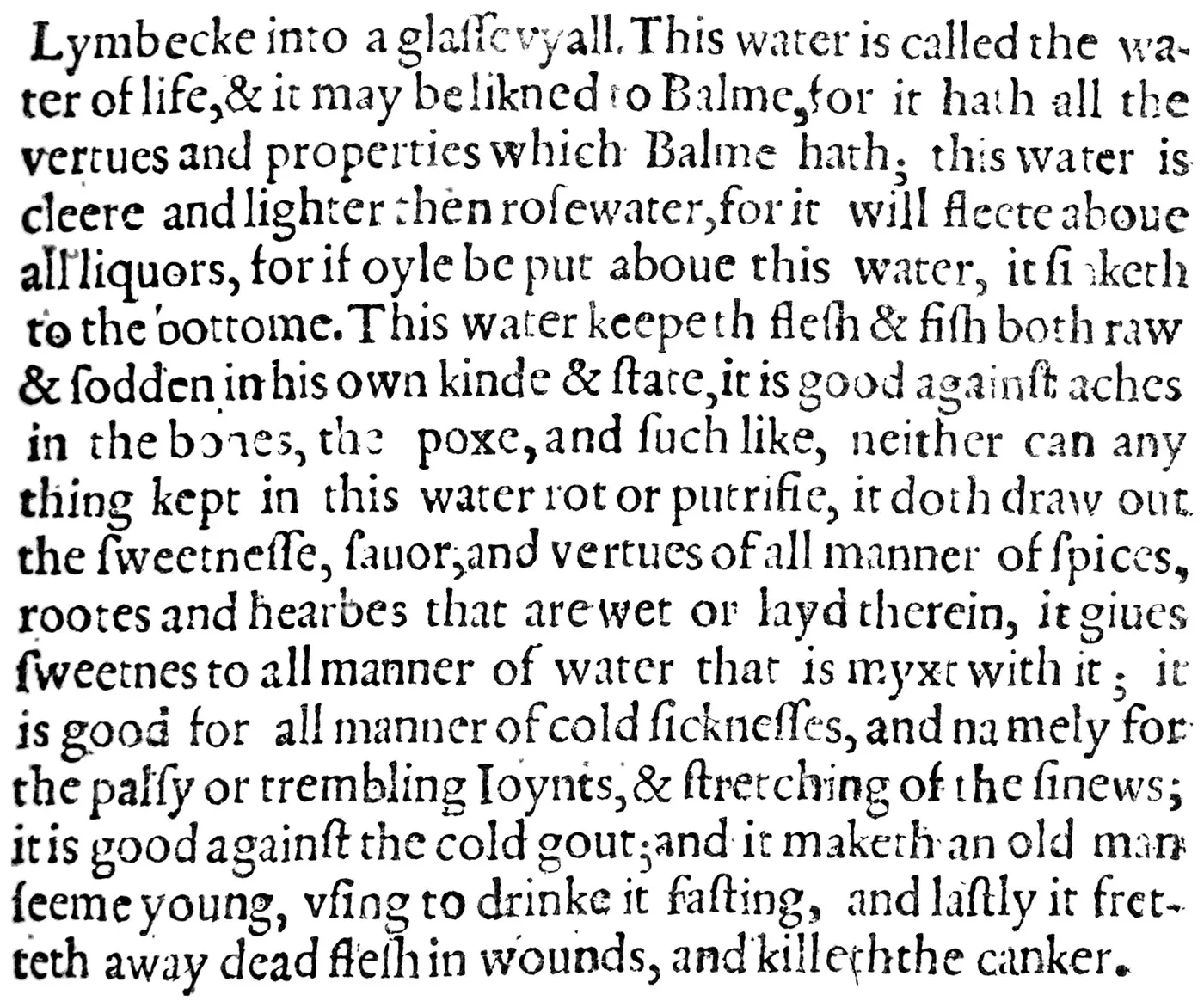 Gervase Markham, The English Hus-wife, in Countrey Contentments (London: J. B. for R. Jackson, 1623), p. 131.
“This water is called the water of life,” he writes, “cleere and lighter then rosewater,” and “if oyle be put aboue this water, it sinketh to the bottome.” That is Gessner’s oil test again, sixty years on. So is the promise: it “maketh an old man seeme young, vsing to drinke it fasting,” which is Arnold’s “preserueth youth” in English dress. The same claims were copied from book to book for a century, so Markham’s page shows only that the old list was still being printed.
By the spoonful and by the bottle
Markham’s “spoonefull or two” was a dose of medicine, and medicine was the main use: the virtues he lists are for “all manner of cold sicknesses,” the palsy and the gout. Aqua vitae also kept and traveled, and a small bottle of it went on the march.
Cooks used it to strengthen other drinks. In The Closet of Sir Kenelm Digby Opened (1669), one of Digby’s metheglins, a spiced mead, gets “one pint of Aqua-vitæ, or a quart of Sack” to every six gallons once it is in the cask. A pint of spirit could do the work of twice as much sweet wine. Other honey drinks in the same book needed no still at all. Gower’s metheglin takes all its strength from the honey, and Sir Thomas Gower’s ordinary drink makes a very small ale strong with a gallon of honey to every eight.
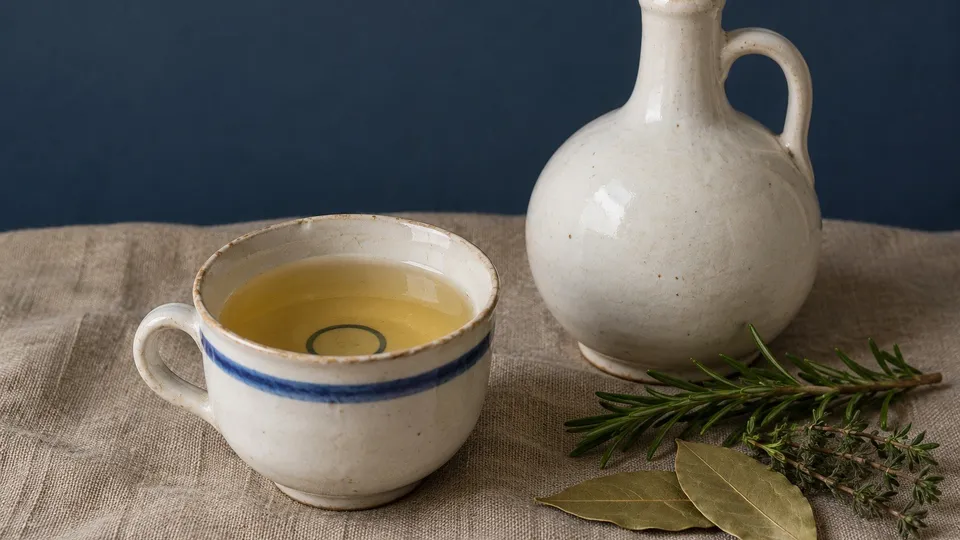 Make it todayGower’s Metheglin, a Herb Mead of 1669
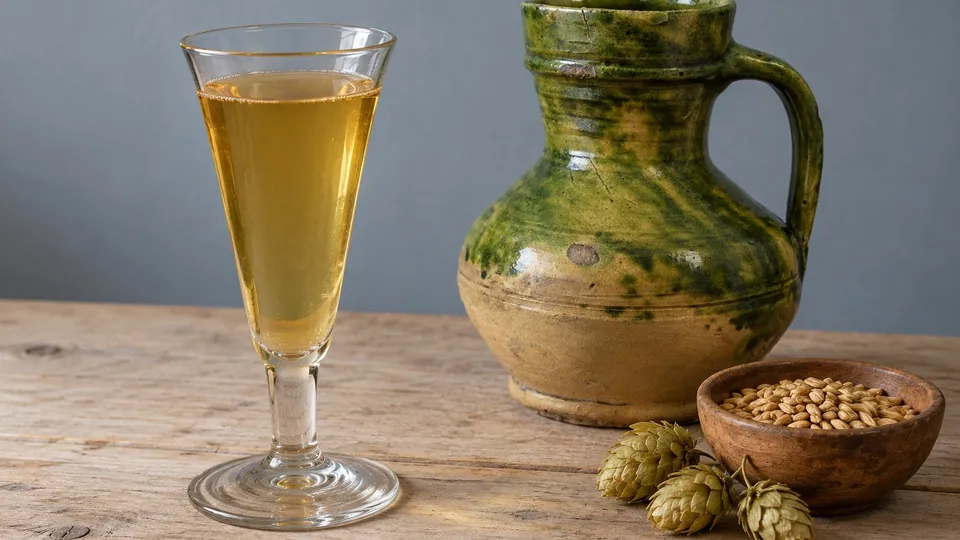 Make it todayGower’s Ordinary Drink, Small Ale and Honey
The word itself drifted. In 1730 Nathan Bailey’s dictionary, quoted by Henry Martyn Dexter in his 1865 edition of Mourt’s Relation, defined aqua vitae as “a sort of cordial Liquor formerly made of brewed Beer strongly hopp’d, well fermented; now (1730) it is commonly understood of Spirits, Geneva, and the like.” That beer sense is Bailey’s own; the 16th- and 17th-century books above make their aqua vitae from wine, lees and strong ale. His “Beer strongly hopp’d” also belongs to a later England, since in 1542 an English physician still called hopped beer a Dutchman’s drink, as When Did English Beer Get Its Hops? shows. By Bailey’s day the name meant spirits in general, gin among them.
Waters with no spirit in them
The same still rooms made a gentler kind of water, and it was drunk. Hieronymus Brunschwig’s The Vertuose Boke of Distyllacyon of the Waters of All Maner of Herbes, printed in English in 1527, distills herbs and flowers with no wine at all. His water of mint is taken “in the mornyng and at nyght,” an ounce and a half at a time, and his rose water by the ounce. When Brunschwig wants something stronger to compare a water with, he names spirit as a separate thing: it works “lyke wyse as aqua vite / or other dystylled wyne doth.” “Water” in these books could mean either, which is why a medieval or Tudor “water” is not always plain water, as Did Medieval People Really Drink Beer Instead of Water? explains.
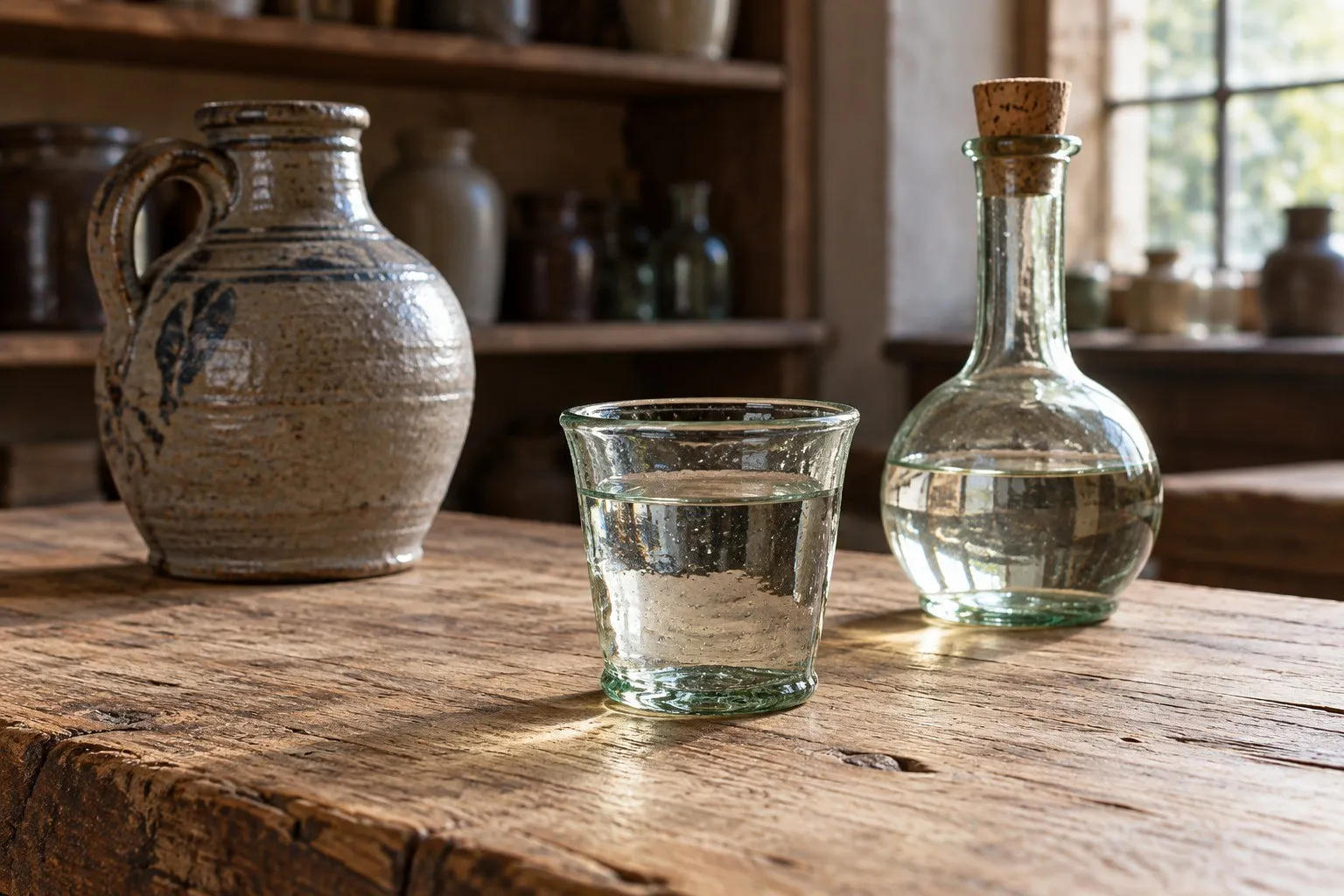 Rose water lengthened with cold water in a small glass beaker, with the corked phial of rose water and a stoneware jug.
A bottle of food-grade rose water and a jug of cold water are the whole shopping list for the Tudor rose water: an ounce of rose water, the dose Brunschwig gives, lengthened with cold water into a pale, scented drink with no spirit in it.
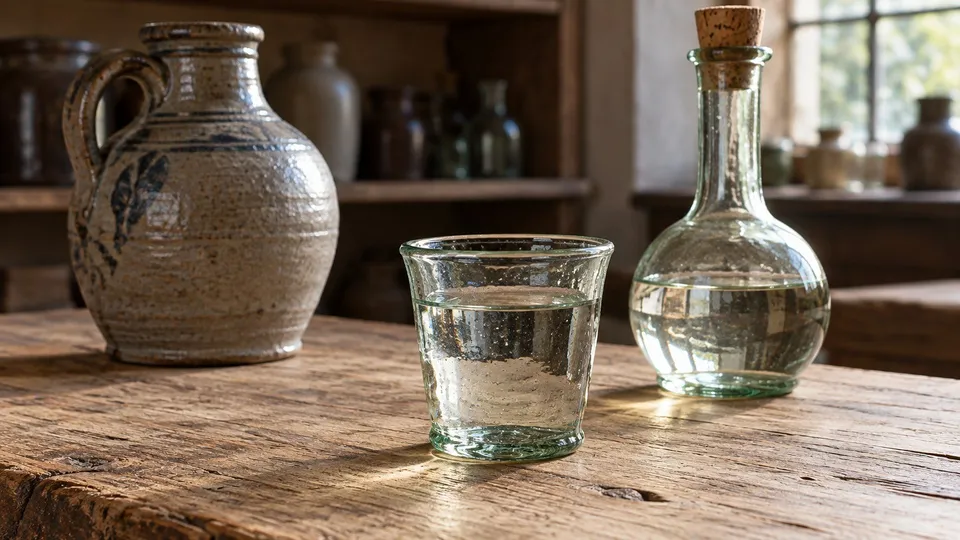 Always alcohol-freeRose Water, a Tudor Still-Room Drink
Sources
- Hieronymus Brunschwig, The Vertuose Boke of Distyllacyon of the Waters of All Maner of Herbes (London: Laurens Andrewe, 1527), ch. “Water of mynte,” c.lxxiii, and the May-dew chapter.
- Conrad Gessner, The Treasure of Euonymus, trans. Peter Morwyng (London: John Day, 1559), pp. 76–83.
- Conrad Gessner, Thesaurus Euonymi Philiatri (Zurich, 1554), pp. 110–111, Zentralbibliothek Zürich, Gal Tz 1050, e-rara (opens in a new tab).
- Gervase Markham, The English Hus-wife, in Countrey Contentments (London: J. B. for R. Jackson, 1623), pp. 116, 130–131.
- [William Bradford and Edward Winslow], A Relation or Iournall of the beginning and proceedings of the English Plantation setled at Plimoth (“Mourt’s Relation”) (London: John Bellamie, 1622), p. 5.
- Mourt’s Relation or Journal of the Plantation at Plymouth, ed. Henry Martyn Dexter (Boston: John Kimball Wiggin, 1865), p. 17, note 56, quoting Nathan Bailey’s dictionary (1730).
- Sir Kenelm Digby, The Closet of the Eminently Learned Sir Kenelme Digby Kt. Opened (London, 1669), p. 81.