Gower’s Ordinary Drink, Small Ale and Honey
Reader ratingsA very small ale with a gallon of honey to every eight, worked with yeast and left three months: Sir Thomas Gower’s everyday drink from Digby’s 1669 book, at about 8% ABV.
- Recipe makes
- About 3.5 liters, 10 bottles of 330 ml
- Prep
- Cook
- Total
Brew day is about 4 hours. The ale ferments 2 to 4 days before the honey goes in, then 1 to 2 weeks more. Gower’s three months in a closed vessel follow, here in the bottle.
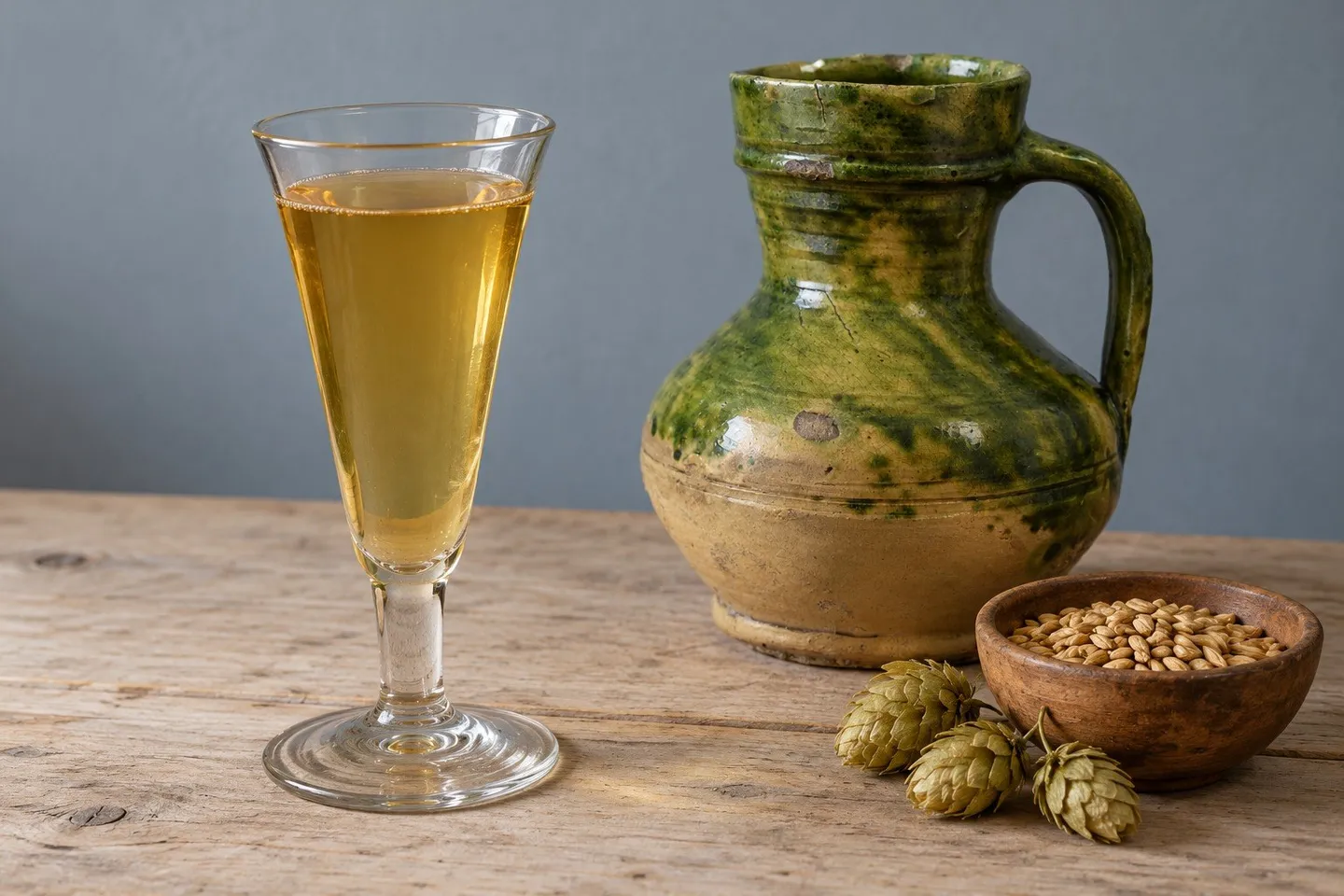
Gower’s honey ale in a narrow stemmed ale glass, with a green-glazed jug, pale malt and dried hops.
The story behind the recipe
Sir Thomas Gower’s ordinary drink was small ale made strong with honey: one gallon of honey to eight of ale, worked with barm and shut up for three months. The Closet of the Eminently Learned Sir Kenelme Digby Kt. Opened (1669) gives it in five lines, and the name undersells it. By our arithmetic the honey takes an ale of about 2% to roughly 8% ABV, the strength of a strong beer today.
A still above, a barrel below
Digby’s page puts the receipt directly under “The Spirit of Barm,” which is yeast and water distilled “as you do other Spirits.” Gower’s drink got its strength the other way, from honey and a second fermentation.
Ninety pages on, the book returns to Gower’s “pleasant and wholesom drink of Ale and Honey,” at the same proportion, forty gallons of small ale to five of honey, with the method spelled out. A quarter of the warm new ale takes all the honey, stirred “with a clean arm till they be perfectly incorporated,” and waits covered while the rest works with barm. Once “the strong working of the other is over,” after two to four days, the honey goes in and sets the whole working afresh. “He makes it about Michaelmas for Lent”: brewed in late September, drunk in the weeks before Easter. On the same page Doctor Harvey drinks so much of his water-cider that he is “making it His Ordinary Drink,” which is what the word meant: the everyday drink.
Gower never describes his “very small” ale, so we borrow Digby’s own: the “Small Ale for the Stone” that he “used to drink constantly of,” fourteen gallons of water boiled near an hour with half an ounce of hops, then poured on a peck of malt.
Read more about this recipe
A gallon of it now
Digby’s malt and hops, Gower’s eight to one and the staged honey all stay, scaled to a one-gallon demijohn. Our changes: the hop water cools to about 68°C before the malt goes in, for a modern mash at about 66 to 67°C; dried ale yeast replaces barm; and the honey portion waits in the fridge, not on the bench. The small ale starts near 1.020 and the whole near 1.065, finishing around 8% ABV.
Gower stopped up his cask. Here it is bottled still, only after fermentation has finished, and then gets his three months. It contains alcohol and honey, so it is not for children, and honey is never for babies under one. For the malt without the alcohol there is Sweet Wort; Gower’s herb mead from the same page is Gower’s Metheglin. For the distilled spirit it never was, read What Was Aqua Vitae?
Sir Thomas Gower maketh his ordinary drink thus: Make very small well Brewed Ale. To eight Gallons of this put one Gallon of honey; when it is well dissolved and clarified, tun up the Liquor, making it work in due manner with barm. When it hath done working, stop it up close, and in three months it will be fit to drink.

Recipe makes: About 3.5 liters, 10 bottles of 330 ml
Ingredients
For About 3.5 liters, 10 bottles of 330 ml. Quantities are shown as written.
Quantities as written here, for About 3.5 liters, 10 bottles of 330 ml.
Small ale
- Water4.5 l
- Whole dried hops, an English variety such as East Kent Golding or Fuggle1 g
- Crushed pale ale malt330 g
- Dry English ale yeast5 g
Honey
- Runny honey450 ml
Measurement notes
Ingredients as written here
- 4.5 l water
- 1 g whole dried hops, an English variety such as East Kent Golding or Fuggle
- 330 g crushed pale ale malt
- 5 g dry English ale yeast
- 450 ml runny honey
Equipment
 Large saucepan
- Small saucepan
 Mesh brewing bag
 Kitchen scale that weighs to 1 g
 Thermometer
 Wooden spoon
 Fine sieve
 Funnel
 Large jug or jar with a lid, about 1.5 liters
 Glass demijohn with an airlock, 4.5 liters
 Hydrometer
 No-rinse sanitizer
 Siphon tube
 Swing-top bottles or jugs
Instructions
Clean the demijohn, airlock, jar, funnel, sieve, siphon tube and bottles well, without soap, and sanitize them with a no-rinse brewing sanitizer, following its label. Everything that touches the cooled ale must be sanitized.
Bring the water to the boil in the large saucepan with the whole dried hops and boil it uncovered for 1 hour, as Digby does.
Take the pan off the heat and let it cool to about 68°C. Put the crushed pale ale malt in the mesh brewing bag, lower it into the pan and stir; the mash should settle at about 66 to 67°C. Cover and leave it for 1½ hours, Digby’s “near two hours” shortened a little, warming it gently if it drops below 63°C.
Lift out the bag and let it drain over the pan without squeezing it hard. Bring the liquid back to the boil for a minute or two, Digby’s “one walm or two.”
Pour a quarter of the hot small ale into the small saucepan and stir in the runny honey until no honey lies on the bottom. Bring it just to the boil, take it off the heat and let it stand 10 minutes, then skim off any foam, as Gower did once it had “stood a while from the fire to cool.” Cover it.
Cover the large pan and stand it in a sink of cold water, changing the water as it warms, until the small ale is at 20°C. Strain it through the sieve and funnel into the demijohn, sprinkle in the dry English ale yeast, fit the airlock and set it somewhere at 18 to 20°C. The demijohn will be well under full, which leaves room for the foam.
Cool the covered honey portion the same way, pour it into the jar, close it and keep it in the fridge.
After 2 to 4 days, when the foam has fallen and the airlock bubbles only slowly, take the honey portion out and let it come up to room temperature. Pour it through the funnel into the demijohn and refit the airlock. It will start working hard again: watch the airlock for the first day, and if foam climbs into it, take it off, rinse and sanitize it and fit it back.
Leave it until fermentation has finished, usually 1 to 2 weeks more. Check with the hydrometer: when two readings taken three days apart are the same, and at about 1.008 or below, it is done. If it stops higher, wait another week and check again before bottling.
Siphon the ale into beer-grade swing-top bottles, made to hold pressure, leaving the yeast sediment behind, and close them. Add no sugar.
Keep the bottles somewhere cool for 3 months, as Gower did, before drinking. Serve cool, in small glasses.
Nutrition
200calories per serving
- Recipe makes
- About 3.5 liters, 10 bottles of 330 ml
- Servings
- 10
Estimated from the expected starting and finishing gravities (about 1.065 and 1.005) with the standard brewers’ calorie formula, for one 330 ml bottle.
Recipe notes
When adjusting quantities
Keep Gower’s eight parts small ale to one part honey by volume, and Digby’s proportions of malt and hops to water. These amounts fill one 4.5 liter demijohn.
Notes
Quantities mentioned in these notes don’t change when you adjust the batch.
The amounts and the brewing method are our modern adaptation of Digby’s proportions.
The strength depends on how far the yeast takes the malt sugars: expect about 7.5 to 8.5% ABV. Expect about 0.6 l to boil off in the hour and 0.3 l to stay in the grain, and another 0.3 l with the sediment.
One gram of whole hops is only three or four cones, which is why the scale needs to weigh to 1 g. Ale in Gower’s day may have had no hops at all; Digby’s own small ale had a light hand of them, and we follow him.
Bottling before fermentation has finished is what makes bottles burst. Wait for the steady hydrometer readings.
Digby’s gallon of honey was a measure of volume, so the honey here is measured by volume too: 450 ml is about 640 g.
Every ale starts as Sweet Wort, malt boiled with a few hops, and drunk before the yeast goes in it is alcohol-free.
Storage
Keep the bottles somewhere cool and dark. Once a bottle is open, keep it in the fridge and finish it within a few days.
Scaling changes the ingredients only; glassware, ice and timings need their own judgment. To adapt this recipe further, try the recipe tool at TuneMyRecipe (opens in a new tab), our sister site.
Sources and attribution
Sir Kenelm Digby, The Closet of the Eminently Learned Sir Kenelme Digby Kt. Opened (London, 1669), “Sir Thomas Gower maketh his ordinary drink thus”, p. 29; method after “Ale with Honey”, pp. 120–122; small ale after “Small Ale for the Stone”, p. 122
See the original pages (scan at Internet Archive) (opens in a new tab)
Recipe details
- Drink family
- Wine, Beer & Mead
- Region
- British
- Era
- 17th century
- Base
- Beer & aleHoney
- Difficulty
- Advanced
- Season
- Autumn