Gower’s Metheglin, a Herb Mead of 1669
Reader ratingsHoney stirred into a decoction of rosemary, bay, thyme and marjoram, boiled slowly, skimmed clear and fermented: Sir Thomas Gower’s pale metheglin from Digby’s 1669 book, at about 8% ABV.
- Recipe makes
- About 3.2 liters, 9 to 10 bottles of 330 ml
- Prep
- Cook
- Total
Brew day is about 4 hours, including 30 minutes for the decoction to settle and about 2 hours to cool. It ferments 3 to 4 weeks, then rests about 6 weeks in the bottle, our choice since Digby gives no time.
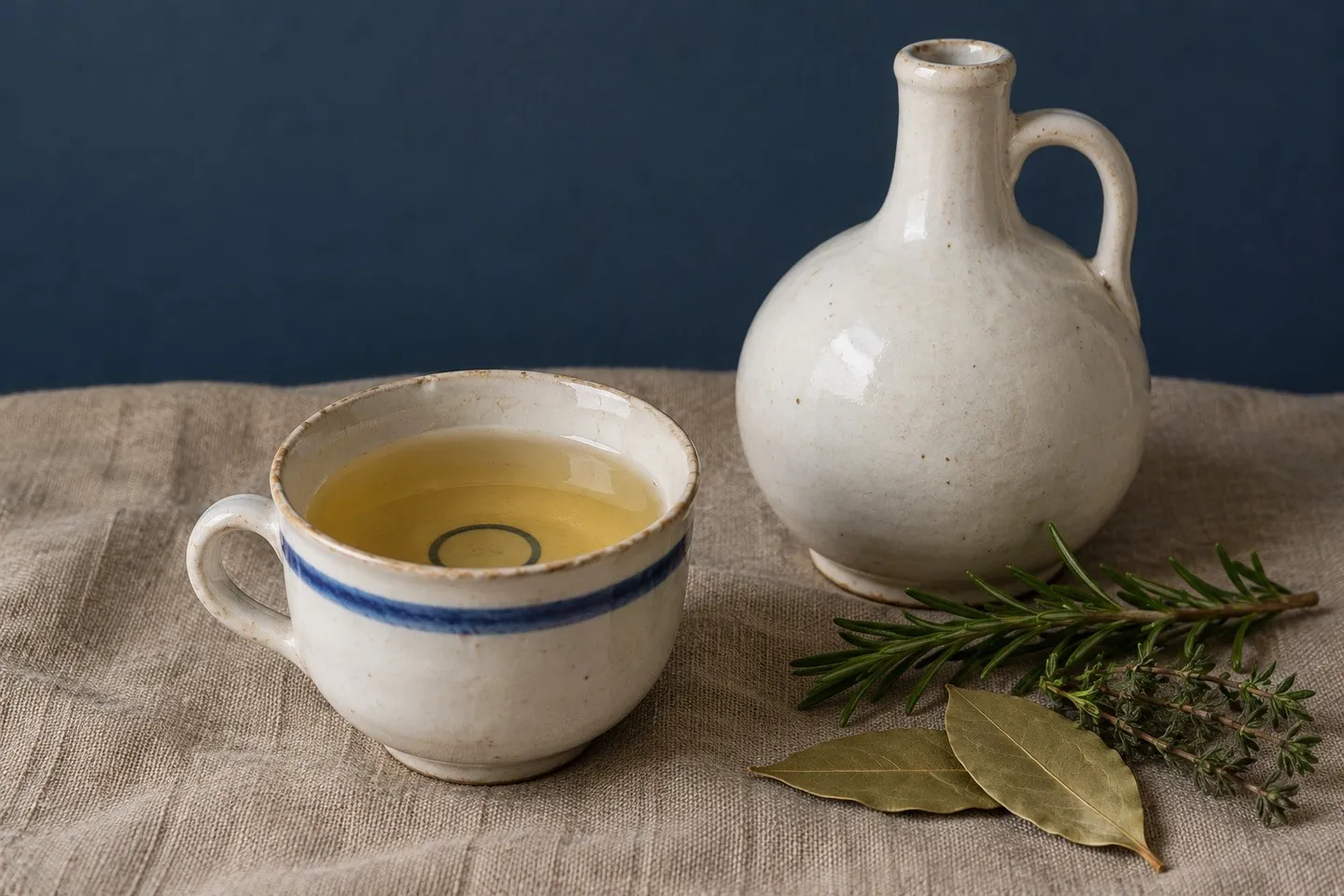
Gower’s metheglin in a small white delftware cup, with a tin-glazed wine bottle, rosemary and bay leaves.
The story behind the recipe
Gower’s metheglin let the drinker choose its strength. Honey goes into a herb decoction at “⅓ or ¼ or ⅕ or ⅙ part,” Digby writes, “according as you would have it strong, and soon ready”: more honey for a stronger drink, less for one ready sooner. This version takes the lightest, one part honey to six, which by our arithmetic ferments out at about 8% ABV.
Arms, fire and a pale result
It follows Sir Thomas Gower’s ordinary drink in The Closet of the Eminently Learned Sir Kenelme Digby Kt. Opened (1669), introduced only as “He makes Metheglin thus.” The decoction starts from eglantine leaves and cowslip flowers, “a good handful” of each to the gallon, with sweet marjoram, rosemary, bay, betony, scabious and thyme. Then comes the labor. The honey is stirred in “with stripped arms 4 or 5 hours,” and “Much of the perfection consisteth in stirring it long.” Two pages earlier, Gower’s metheglin “for health” handed the same job to “a lusty Servant (his Arms well washed),” for at least an hour “without intermission.”
The boil has its own trick: “order your fire so, that the scum may rise and drive all to one side.” The promised result is “exceeding pale clear and pleasant Metheglin.” Elsewhere in the book Digby strengthens one of his metheglins with aqua vitae poured into the cask. Gower’s gets all of its strength from the honey.
Read more about this recipe
What changes here
Eglantine (sweet briar) leaves and cowslip flowers are hard to buy as food, and we can’t vouch for betony or scabious in a drink, so we leave all four out and keep the kitchen herbs: rosemary, bay, thyme and sweet marjoram. That makes a lighter-scented drink than Gower’s, honey first. We read “⅙ part” as one volume of honey to six of decoction. Ten minutes of stirring dissolves modern runny honey. Digby’s “tun it up, &c.” names no yeast, so we add a wine yeast and a little nutrient, which honey lacks. The tilted-fire skimming stays.
It is a much stronger and more herbal drink than Digby’s Weak Hydromel, with three times the honey and no ginger or clove. For a glass without alcohol, the recipe notes stop it before the yeast; even that one keeps the honey, which no baby under one should have, and the finished mead is for adults only. Gower’s honeyed ale is Gower’s Ordinary Drink, and the distilled spirit his metheglin did without is in What Was Aqua Vitae?
He makes Metheglin thus. Make a good Decoction of Eglantine-leaves, Cowslip flowers, a little Sweet-marjoram, and some Rosemary and Bayleaves, Betony, and Scabious, and a little Thyme. After the sediment hath settled, put ⅓ or ¼ or ⅕ or ⅙ part of honey, (according as you would have it strong, and soon ready) to the clear severed from the settlement, and stir it exceeding well with stripped arms 4 or 5 hours, till it be perfectly incorporated. Then boil and scum it; let it then cool and tun it up, &c. After it hath cooled, lade the clean from the settlement, so that it may not trouble it, and tun up the clear thus severed from the settlings. Much of the perfection consisteth in stirring it long with stripped arms before you boil it. Then to boil it very leisurely till all the scum be off. And order your fire so, that the scum may rise and drive all to one side. This will be exceeding pale clear and pleasant Metheglin. He useth to every Gallon of water, a good handful of Eglantine-leaves, and as much Cowslip flowers; but onely a Pugil of Thyme or Marjoram.

Recipe makes: About 3.2 liters, 9 to 10 bottles of 330 ml
Ingredients
For About 3.2 liters, 9 to 10 bottles of 330 ml. Quantities are shown as written.
Quantities as written here, for About 3.2 liters, 9 to 10 bottles of 330 ml.
- Water3.3 l
- Small sprig fresh thyme1Author measures: about 1 g.
- Small sprig fresh sweet marjoram1Author measures: about 1 g.
- Fresh rosemary, about 5 cm1 sprigAuthor measures: about 1 g.
- Dried bay leaves2
- Runny honey500 ml
- Yeast nutrient1 metric tsp (5 ml per tsp)
- Dried white wine yeast5 g
Measurement notes
Ingredients as written here
- 3.3 l water
- 1 small sprig fresh thyme (about 1 g)
- 1 small sprig fresh sweet marjoram (about 1 g)
- 1 sprig fresh rosemary, about 5 cm (about 1 g)
- 2 dried bay leaves
- 500 ml runny honey
- 1 tsp yeast nutrient
- 5 g dried white wine yeast
Equipment
 Large saucepan
 Wooden spoon
 Fine sieve
 Large bowl
 Ladle
 Thermometer
 Funnel
 Glass demijohn with an airlock, 4.5 liters
 Hydrometer
 No-rinse sanitizer
 Siphon tube
 Swing-top bottles or jugs
Instructions
Clean the demijohn, airlock, funnel, ladle, siphon tube and bottles well, without soap, and sanitize them with a no-rinse brewing sanitizer, following its label.
Put the water in the large saucepan with the thyme, sweet marjoram, rosemary and bay leaves. Bring it to the boil, cover and simmer gently for 15 minutes.
Take the pan off the heat and leave it covered for 30 minutes so the sediment settles. Pour the clear decoction through the sieve into the large bowl, stopping when you reach the sediment, and rinse the pan.
Return the decoction to the pan off the heat and pour in the runny honey. Stir for at least 10 minutes, until no honey lies on the bottom of the pan.
Heat it slowly to a gentle boil. Set the pan half off the burner, or turn the heat down on one side, so the foam gathers at one side, and skim it off as it rises. Keep it at a slow boil, skimming, until no more foam comes up, about 15 minutes.
Cover the pan and stand it in a sink of cold water, changing the water as it warms, until it is at 20°C. Leave it still for a few minutes more to settle.
Ladle the clear liquid through the funnel into the demijohn, leaving the sediment in the pan, as Digby says, “so that it may not trouble it.”
Add the yeast nutrient and sprinkle in the dried white wine yeast. Fit the airlock and set the demijohn somewhere at 18 to 22°C. Watch the airlock for the first two days, and if foam climbs into it, take it off, rinse and sanitize it and fit it back.
Leave it until fermentation has finished, usually 3 to 4 weeks. Check with the hydrometer: when two readings taken three days apart are the same, and at 1.000 or below, it is done.
Siphon the metheglin into beer-grade swing-top bottles, made to hold pressure, leaving the yeast sediment behind, and close them. Add no sugar.
Keep the bottles somewhere cool for about 6 weeks before drinking. Serve cool, in small glasses.
Nutrition
170calories per serving
- Recipe makes
- About 3.2 liters, 9 to 10 bottles of 330 ml
- Servings
- 10
Estimated from the expected starting and finishing gravities (about 1.060 and 0.998) with the standard brewers’ calorie formula, for one 330 ml bottle of the dry metheglin.
Recipe notes
When adjusting quantities
Keep one part honey to six of the herb decoction by volume, the lightest of Digby’s four choices. The yeast and nutrient amounts are for one 4.5 liter demijohn.
Notes
Quantities mentioned in these notes don’t change when you adjust the batch.
The amounts and the brewing method are our modern adaptation of Digby’s receipt.
For a glass without alcohol, ladle off some of the skimmed honey liquor before it goes into the demijohn, cut it with an equal amount of cold water and chill it. Keep it covered in the fridge and drink it within 3 days. Digby’s weak hydromel, stopped the same way with its ginger and clove, is Spiced Honey Water.
The strength depends on how far the boil reduces the liquid: expect about 7.5 to 8.5% ABV. Honey at one part to five, the next of Digby’s choices, would give about 9.5%.
Use culinary bay leaves (Laurus nobilis) from a spice shop. Garden “laurels” are not bay: the Royal Horticultural Society lists cherry laurel (Prunus laurocerasus) as potentially harmful. Don’t pick wild cowslips or scabious for this.
Bottling before fermentation has finished is what makes bottles burst. Wait for the steady hydrometer readings.
Digby’s “Pugil” of thyme or marjoram to the gallon is a pinch taken up between thumb and fingers, about one small sprig.
Storage
Keep the bottles somewhere cool and dark and drink them within a year. Once a bottle is open, keep it in the fridge and finish it within a few days.
Scaling changes the ingredients only; glassware, ice and timings need their own judgment. To adapt this recipe further, try the recipe tool at TuneMyRecipe (opens in a new tab), our sister site.
Sources and attribution
Sir Kenelm Digby, The Closet of the Eminently Learned Sir Kenelme Digby Kt. Opened (London, 1669), “He makes Metheglin thus”, pp. 29–30
See the original pages (scan at Internet Archive) (opens in a new tab)
Recipe details
- Drink family
- Wine, Beer & Mead
- Region
- British
- Era
- 17th century
- Difficulty
- Intermediate