Shrub: One Name, Two Very Different Drinks
One name, two drinks: an English brandy, citrus and sugar cordial by 1739, and the American raspberry vinegar for iced water, a temperance drink by the 1840s.
A shrub was two different drinks that happened to share a name. The older one, English and printed by 1739, was a bottle of brandy or rum with citrus juice and sugar, sipped as a cordial or kept as a ready-made base for punch. The other was American: ripe fruit steeped in vinegar, sweetened into a sharp syrup and stirred into iced water. Raspberry vinegar for drinking was in a Virginia cookbook by 1836 (in a printing of a book first published in 1824), a Kentucky book called the vinegar version “shrub” in 1839, and from the 1840s temperance cookbooks listed fruit vinegars among the drinks a teetotal household could pour.
This story is part of our Dry January Drinks From History guide.
Both were made to keep. A cherry shrub laced with brandy, wrote one Virginia cook, “will keep all summer, in a dry cool place,” and the vinegar kinds were bottled and corked for hot weather. Either way, shrub was a drink already made, waiting in the cupboard for water.
Vinegar and water as a drink is far older than either. Roman soldiers drank posca, wine vinegar in water, and Pliny boiled honey and vinegar into oxymel. No source links them to the American shrub; they are older cousins at most.
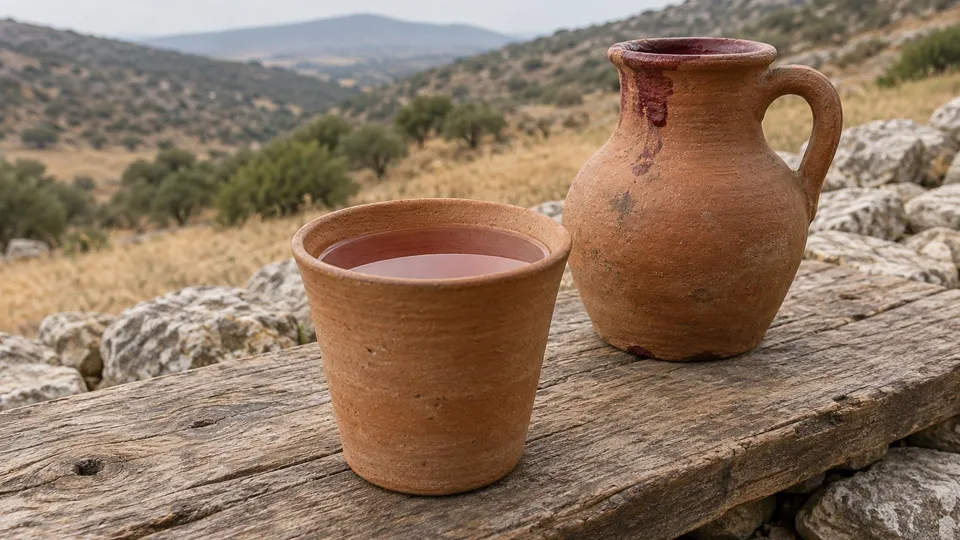 Always alcohol-freePosca, the Roman Soldier’s Vinegar Drink
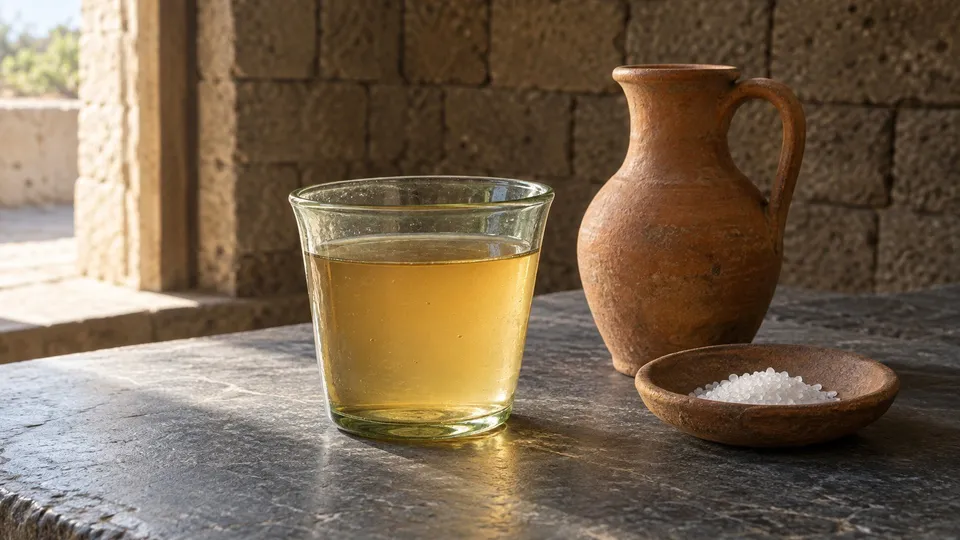 Always alcohol-freeOxymel, Pliny’s Honey and Vinegar Drink
Spirit, acid, and sugar
When Samuel Johnson came to the word in his Dictionary of 1755, he filed the drink under the same headword as the bush. The first sense is “A bush; a small tree,” and the second, after a run of quotations from Locke to Addison, is short: “[A cant word.] Spirit, acid, and sugar mixed.” Johnson’s “cant word” meant slang, and he gave the drink no origin of its own; his bracket traces only the bush, to the Saxon.
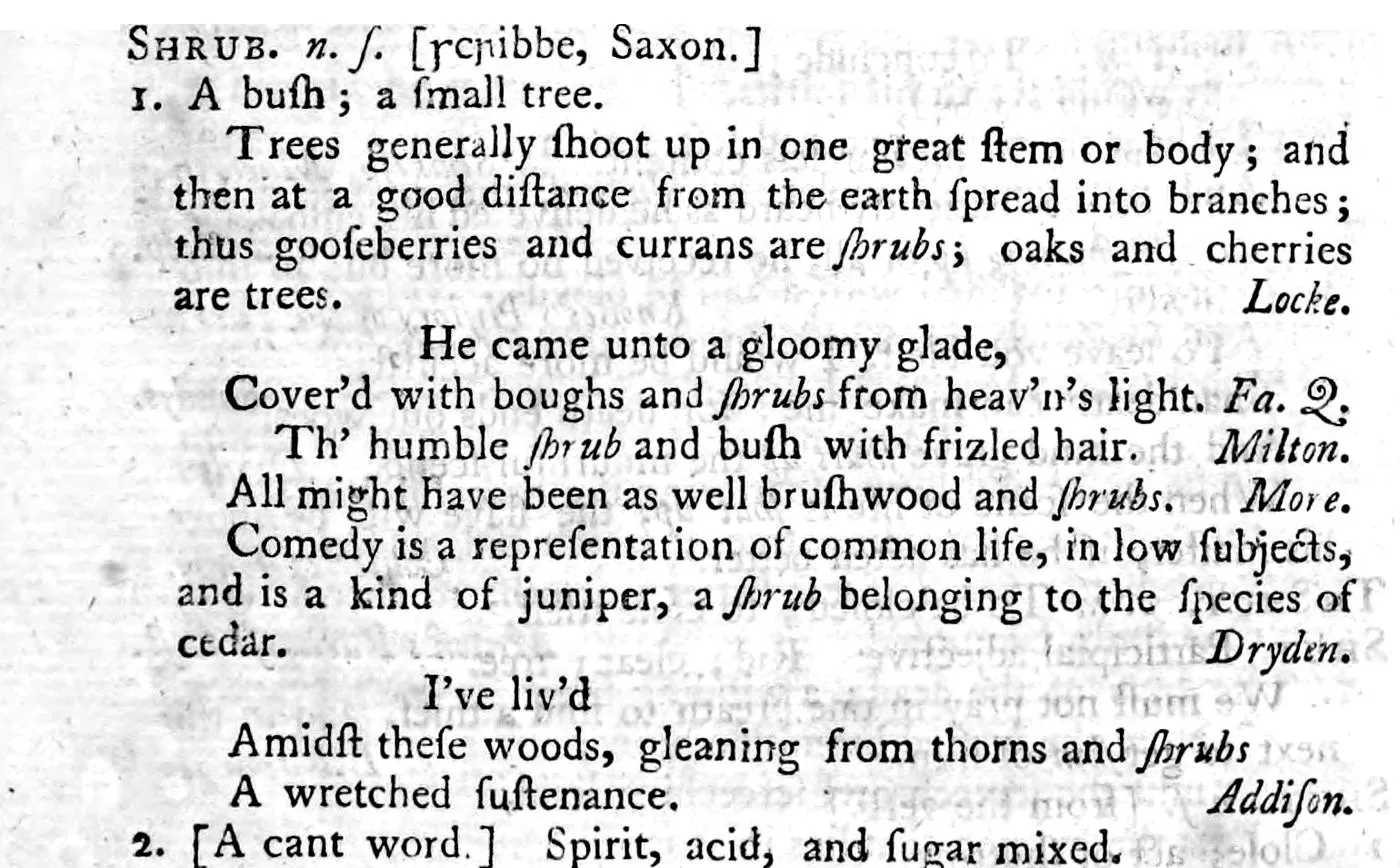 The SHRUB entry in Samuel Johnson’s A Dictionary of the English Language, vol. 2 (London, 1755).
The drink had nothing to do with the garden. Merriam-Webster traces this shrub to the Arabic sharāb, a drink, the same root that gave English syrup and, by way of Persian, sherbet, and dates its first known use in English to about 1706. The Victorian drinks writers James Mew and John Ashton had already made the point in Drinks of the World (1892): “Shrub is clearly the Arabic شرب or syrup.” Johnson’s definition still describes the English drink well.
A cordial and an essence of punch
By 1739 the English drink had a printed recipe. Eliza Smith’s The Compleat Housewife, in its ninth edition of that year, gives it under the plain title “To make Shrub.” Two quarts of brandy go into a large bottle with the juice of five lemons, the peel of two and half a nutmeg. After three days the bottle takes three pints of white wine and a pound and a half of sugar, and the whole is strained twice through flannel and bottled. Smith’s verdict: “it is a pretty wine, and a cordial.” At a quarter of her quantities it becomes our Brandy Shrub with Lemon and White Wine, and by our arithmetic it comes out at about 24% ABV, the strength of a liqueur.
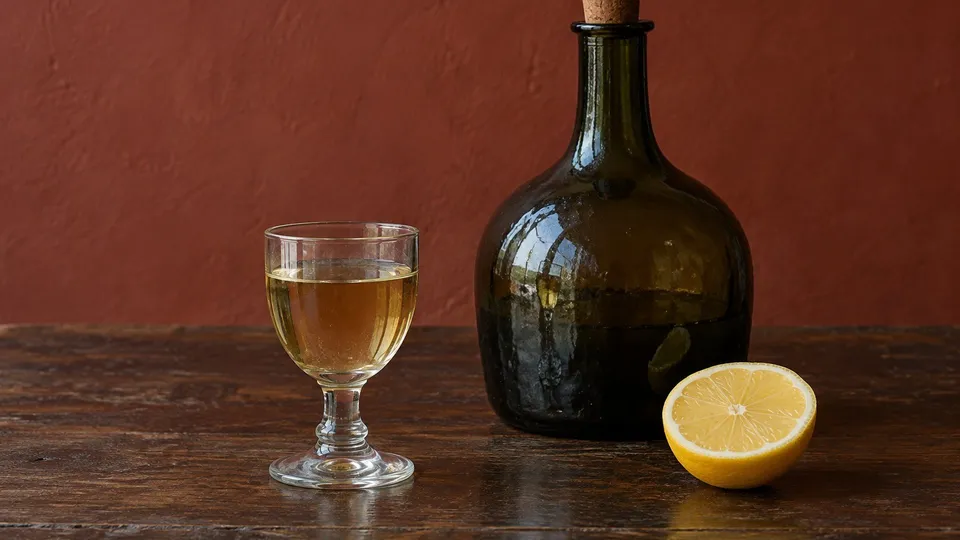 Make it todayBrandy Shrub with Lemon and White Wine
Punch was the obvious use for a bottle like that. In The Cook’s Oracle (1822) William Kitchiner gives a lemon syrup of which a tablespoonful in a pint of water makes “a very agreeable Sherbet,” and adds that “the addition of Rum and Brandy will convert this into PUNCH DIRECTLY.” The next recipe is titled “Shrub, or Essence of Punch,” and it is a single line: brandy or rum flavored with the same syrup gives “very good Extempore ‘Essence of Punch.’” Sherbet, punch and shrub sit on the same page, one step apart.
Shrub at the Crown
Charles Dickens shows Londoners drinking it. In “Miss Evans and the Eagle,” one of the Sketches by “Boz” of 1836, a party of young people walking up to the Eagle tavern stops at Pentonville, where one young man “would have the ladies go into the Crown, to taste some shrub.” After “a great blushing and giggling, and hiding of faces in elaborate pocket-handkerchiefs,” the ladies agree.
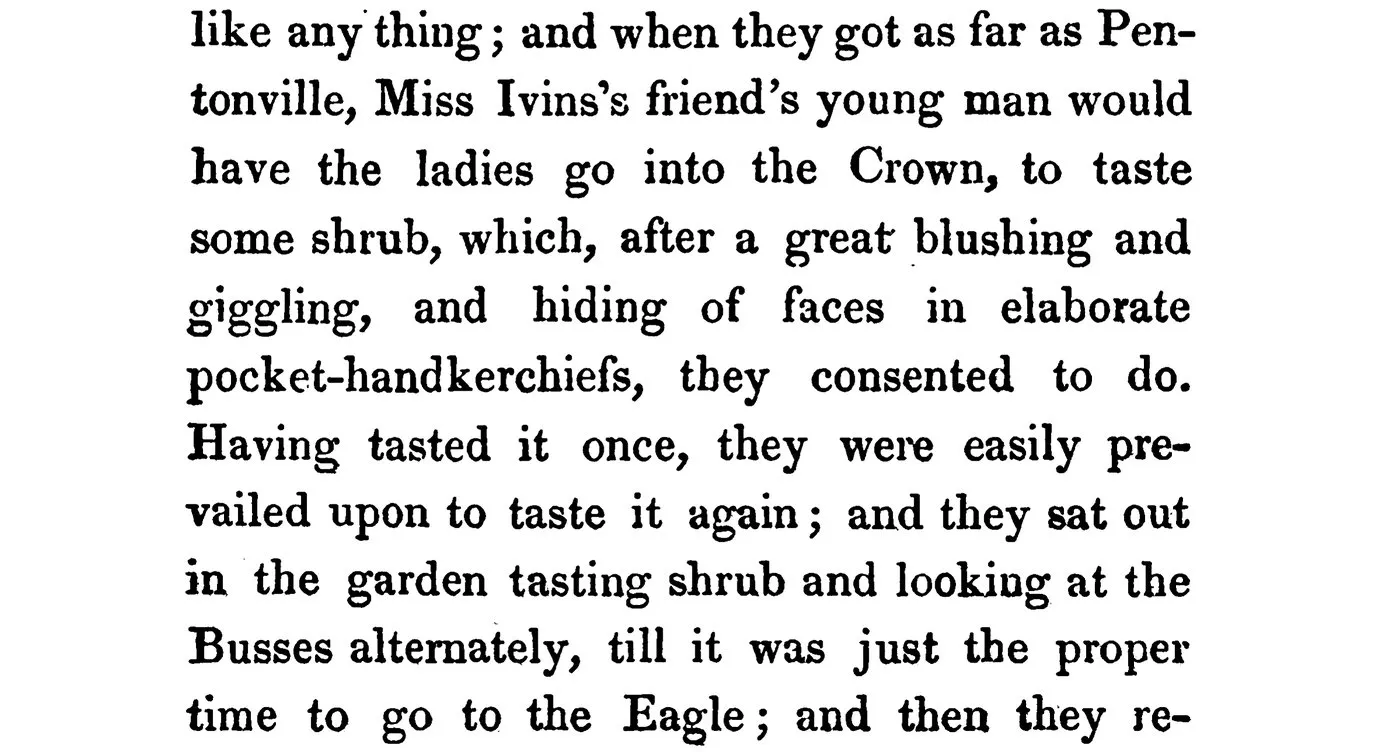 Charles Dickens, “Miss Evans and the Eagle,” p. 82 in Sketches by “Boz”, first series, vol. 1 (London: John Macrone, 1836).
“Having tasted it once, they were easily prevailed upon to taste it again; and they sat out in the garden tasting shrub and looking at the Busses alternately.” On the next page Miss J’mima Ivins finds the evening, “inspired by the novelty, or the shrub, or both,” to be “one of dazzlin excitement.”
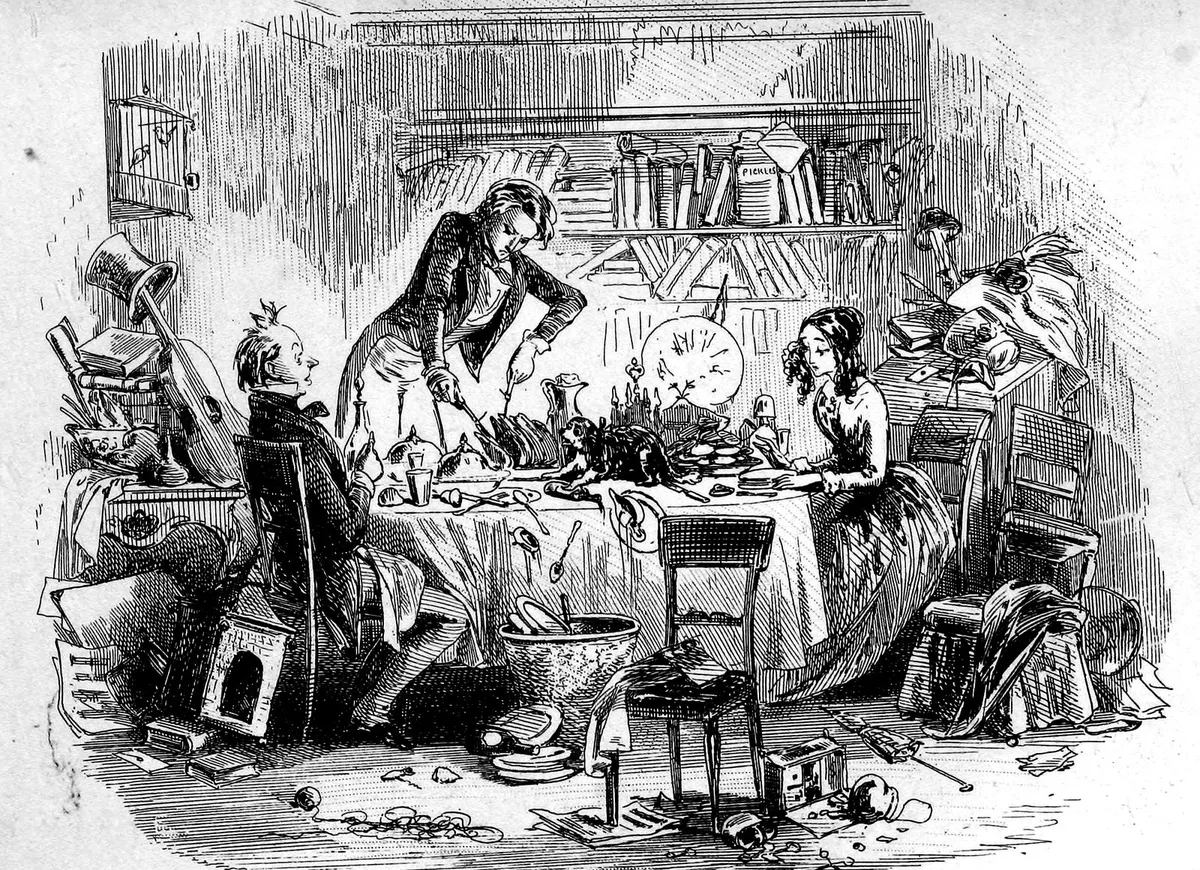
Fourteen years later shrub turns up on a bill. In David Copperfield (1850), David and Dora hire a servant “with a taste for cordials,” who runs up their account at the public house with items such as “quartern rum shrub (Mrs. C.),” a quarter pint of it, charged to Dora, “who was supposed, it appeared on explanation, to have imbibed the whole of these refreshments.” This is fiction, but the details are everyday ones: shrub sold by the glass in a pub garden, and rum shrub by the quartern over the counter.
Raspberry vinegar in Virginia
In America the name took a different road. Mary Randolph’s The Virginia Housewife, first published in 1824, shows the split in two neighboring recipes of its 1836 printing. Her “Cherry Shrub,” the one that keeps all summer, is cherry juice and sugar with a gill of brandy in each bottle. Two pages on comes “Raspberry Vinegar,” with no spirit at all: a quart of raspberries steeped for a day in a quart of strong vinegar, strained onto a second quart of berries and then a third, made “very sweet with pounded loaf sugar,” then bottled.
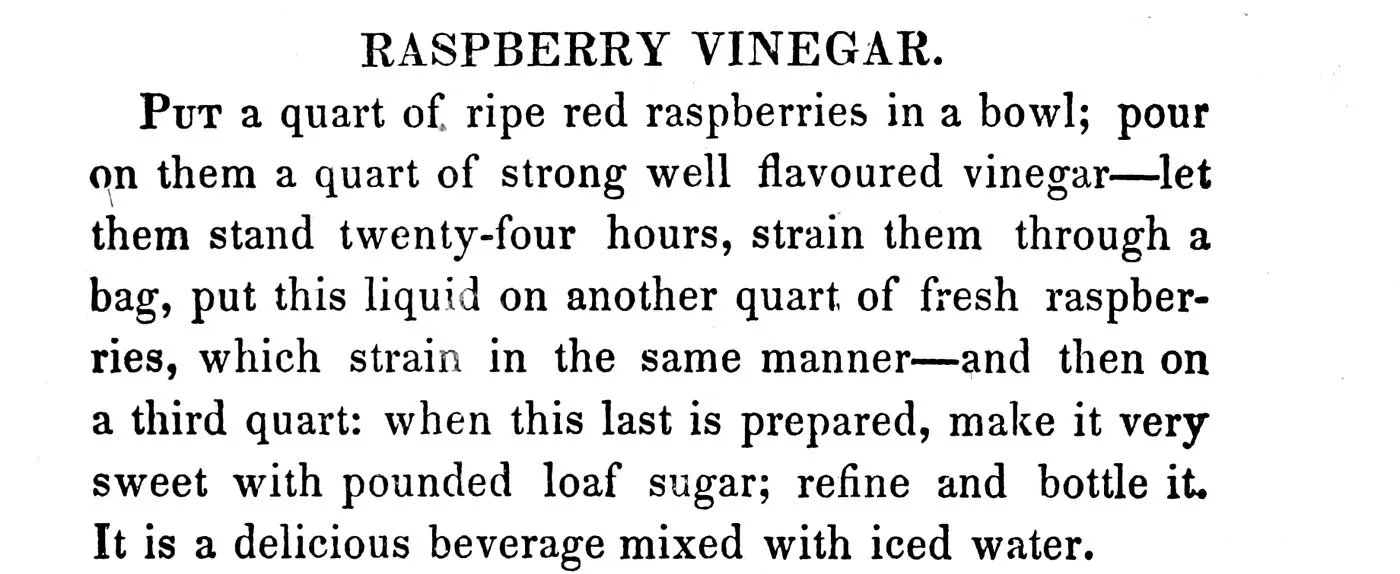 Mary Randolph, The Virginia Housewife (Baltimore: John Plaskitt, 1836 printing), p. 173.
“It is a delicious beverage mixed with iced water,” Randolph writes. Eliza Leslie’s Directions for Cookery (Philadelphia, 1837) kept the same two drinks apart. Her raspberry vinegar sits among the flavored vinegars, between chilli vinegar and mustard, and she calls it “a pleasant and cooling beverage in warm weather; also in fevers.” Her shrubs are in another chapter, “Domestic Liquors”: currant juice boiled with sugar, with “a jill of the best white brandy” to each quart, and “Raspberry shrub may be made in this manner.” In Leslie’s book, then, raspberry vinegar had no spirit in it and raspberry shrub did.
Three shrubs in one Kentucky book
Lettice Bryan’s The Kentucky Housewife (Cincinnati, 1839) let the word cover everything at once. Her Rum Shrub fills a cask: ten gallons of rum, five of water, raisin wine, honey, “concrete acid of lemons” and half a gallon of orange-flower water. Her Brandy Shrub is a gallon of brandy shaken up in a demijohn with water, lemon and orange juice, peel and three pounds of sugar.
A few pages earlier, in the same chapter, is her “Raspberry Shrub,” and there is no spirit in it. Ripe raspberries, “the English ones are best,” are broken up in a jar, covered with vinegar and left for several days, strained onto fresh berries for several days more, boiled up, strained, and sweetened with half a pound of loaf sugar to the quart. “Strawberry shrub may be made in the same manner, and either is very nice, mixed with iced water, for a summer drink.” It is the earliest use of “shrub” for the vinegar drink that we have found, though not necessarily the first in print. Bryan’s syrup carries about a quarter of the sugar of most raspberry vinegars, so it stays tart. It is our lead recipe, Raspberry Shrub Made with Vinegar, and like hers it contains no alcohol.
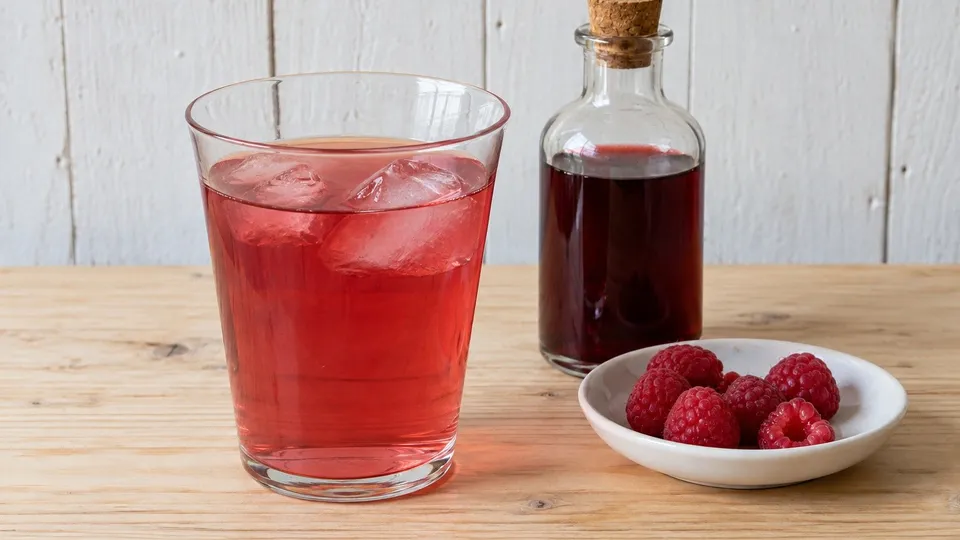 Always alcohol-freeRaspberry Shrub Made with Vinegar
The temperance shelf
Raspberry vinegar was already a soft drink. In the 1840s it found a place on the temperance shelf. Catharine Beecher’s Domestic Receipt-Book (1846) opens its chapter “Temperance Drinks” by sorting her readers: “The advocates of entire abstinence from intoxicating drinks seem to be divided into three classes.” Her own class took the pledge not to drink or offer to others intoxicating drinks “as a beverage,” but still cooked with wine and brandy, and her “Delicious Milk Lemonade” a few pages later calls for sherry. “The great abundance of delicious and healthful drinks that are within reach,” she writes, “leaves no excuse for resorting to such as are pernicious.”
Fruit vinegars were among them, and Beecher made them fizz. Bottled strawberry, raspberry or blackberry vinegar was used “in hot weather” like this: half a teaspoon or less of saleratus or baking soda dissolved in a tumbler, the tumbler two-thirds filled with water, and the fruit vinegar poured in last. For a crowd, the soda water went round in a pitcher and was poured onto each glass of vinegar only “as each person is all ready to drink, as delay spoils it.”
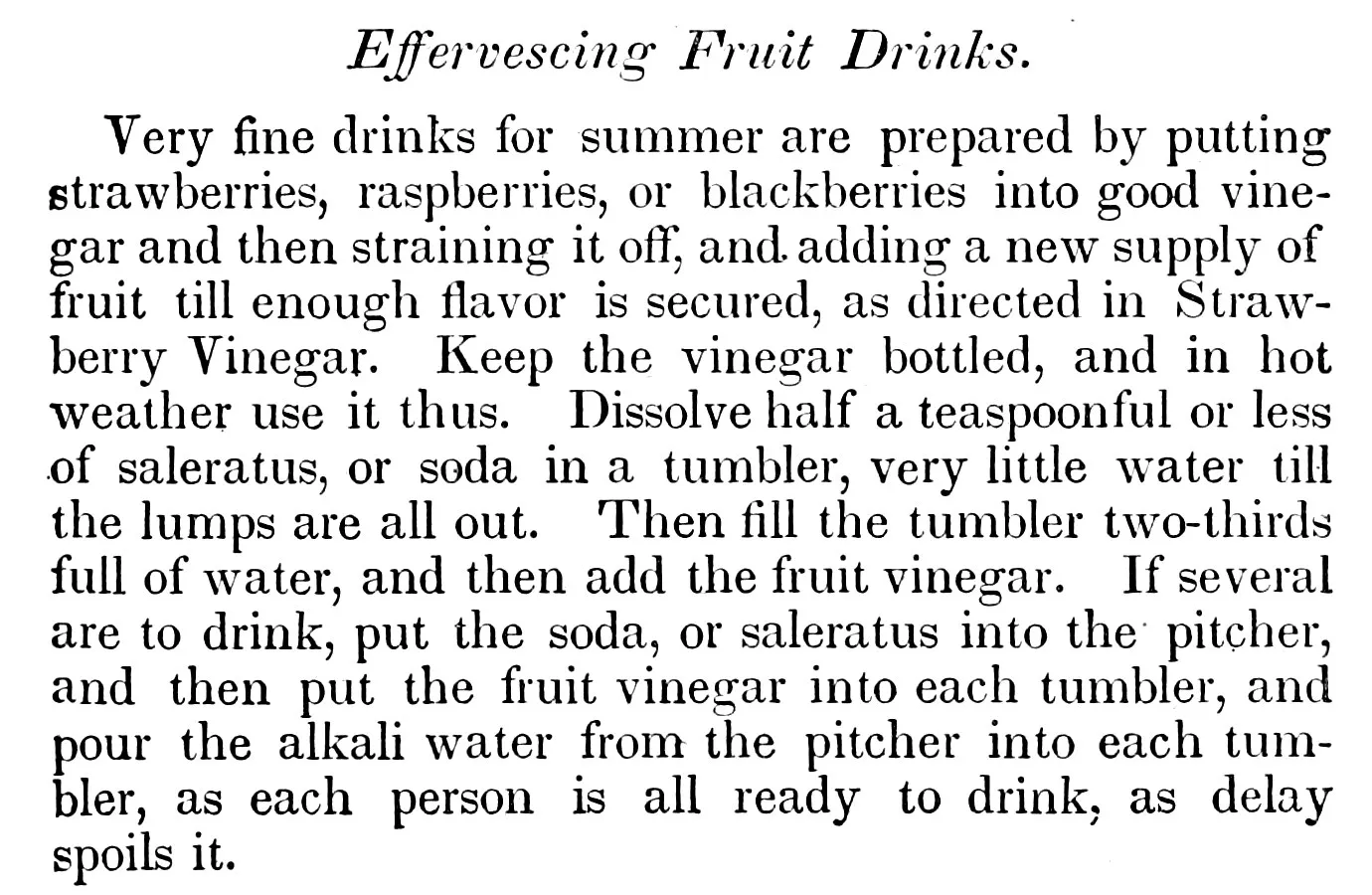 Catharine E. Beecher, Miss Beecher’s Domestic Receipt-Book (New York: Harper & Brothers, 1846), p. 185.
The soda reacts with the vinegar’s acid and the glass foams for a moment. It also uses up some of the sourness: by our arithmetic a quarter teaspoon of baking soda neutralizes more acid than two tablespoons of the sweet 1887 raspberry vinegar below hold, which leaves a flat, slightly salty glass if the cook is generous. Beecher’s “or less” was good advice.
Forty years on, the method was still in print. The Temperance Cook Book published in San Jose, California, in 1887 reprinted Beecher’s paragraph almost word for word and retitled it “Harvest Drinks.” Its own raspberry vinegar steeps berries for a week in “the purest and strongest vinegar,” then boils the liquid with a pound and a half of lump sugar to the pint, six times Bryan’s proportion. “Two tablespoonfuls of this vinegar, stirred into a tumbler of iced water, makes a delicious drink, or a little soda may be added.” The book never uses the word shrub. Its recipe is our Temperance Raspberry Vinegar and Iced Water. In Britain the same years had their own answers to the pub, from penny cocoa to coffee taverns.
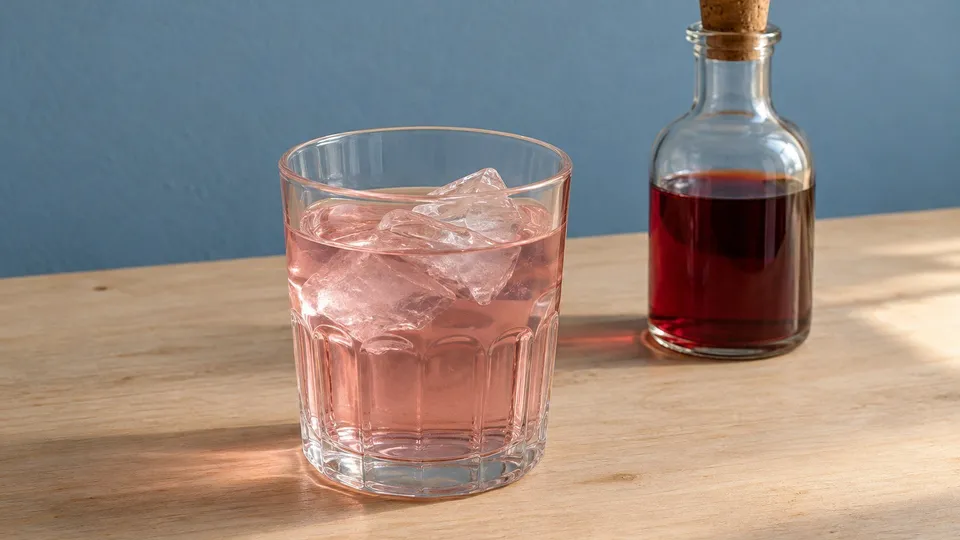 Always alcohol-freeTemperance Raspberry Vinegar and Iced Water
English households went the other way. Isabella Beeton’s Book of Household Management (1861) has no shrub, but its Raspberry Vinegar adds “1 wineglassful of brandy” to every pint, and she recommends it as “an excellent drink in cases of fevers and colds,” diluted with cold water “according to the taste or requirement of the patient.”
Keeping a vinegar shrub safe
For the vinegar shrubs, use apple cider vinegar of at least 5% acidity, which is what “good vinegar” most likely meant in an American kitchen of the 1830s, and heat it in stainless steel or enamel, never aluminum or copper. Both of our raspberry versions are boiled, but neither is a canning recipe. UC Cooperative Extension, which publishes a modern raspberry vinegar, says the product is not shelf stable: keep it in the fridge in sterilized bottles, where it holds its quality for up to eight months, and throw it away at any sign of mold, bubbling, cloudiness or sliminess. By our arithmetic Bryan’s syrup is about 3% acetic acid, milder than table vinegar but still meant for diluting, so always stir it into water before drinking. The brandy shrub keeps in the cupboard on its strength alone.
Both bottles behind the bar
By 1862 the American bar had taken in both shrubs. Jerry Thomas’s How to Mix Drinks gives a Cherry Shrub much like Randolph’s, a Brandy Shrub close to Smith’s of 1739, and a Raspberry Shrub of raspberry vinegar with brandy added. TuneMyRecipe (opens in a new tab) has all three of his bar shrubs. In Thomas’s hands, the raspberry shrub that Bryan made from nothing but fruit, vinegar and sugar had brandy in it again. To set both bottles side by side at home, start Bryan’s raspberry shrub and Smith’s brandy shrub on the same day; the raspberries take two three-day steeps and the brandy one, so within a week both are ready to pour.
Sources
- Eliza Smith, The Compleat Housewife, 9th ed. (London, 1739), p. 217.
- Samuel Johnson, A Dictionary of the English Language, vol. 2 (London: W. Strahan for J. and P. Knapton and others, 1755), “Shrub.”
- William Kitchiner, The Cook’s Oracle, new ed. (Edinburgh: A. Constable, 1822), p. 389, nos. 477 and 479.
- Mary Randolph, The Virginia Housewife: or, Methodical Cook (Baltimore: John Plaskitt, 1836 printing; first published 1824), pp. 171, 173.
- Eliza Leslie, Directions for Cookery (Philadelphia: E. L. Carey & A. Hart, 1837), pp. 180–181, 397–398.
- Lettice Bryan, The Kentucky Housewife (Cincinnati: Shepard & Stearns, 1839), pp. 391, 400–401.
- Charles Dickens, “Miss Evans and the Eagle,” in Sketches by “Boz”, first series, vol. 1 (London: John Macrone, 1836), pp. 82–83.
- Catharine E. Beecher, Miss Beecher’s Domestic Receipt-Book (New York: Harper & Brothers, 1846), pp. 183–185, 190.
- Charles Dickens, The Personal History of David Copperfield (London: Bradbury & Evans, 1850), ch. 44, p. 454, and the plate “Our Housekeeping” by Phiz (Hablot K. Browne).
- Isabella Beeton, The Book of Household Management (London: S. O. Beeton, 1861), p. 887, no. 1828.
- Jerry Thomas, How to Mix Drinks, or, The Bon-Vivant’s Companion (New York: Dick & Fitzgerald, 1862), nos. 154–158.
- Mrs. Mary G. Smith, Temperance Cook Book, 2nd ed. (San Jose, Cal.: Mercury Book and Job Printing Office, 1887), pp. 218–220.
- James Mew and John Ashton, Drinks of the World (London: Leadenhall Press, 1892), p. 181, note 1.
- Merriam-Webster, “shrub,” “syrup” and “sherbet,” merriam-webster.com, accessed October 21, 2026.
- UC Cooperative Extension, “Raspberry Vinegar” (2023), after the University of Georgia and the National Center for Home Food Preservation, Preserving Food: Flavored Vinegars.