Raspberry Shrub Made with Vinegar
Reader ratingsRaspberries steeped twice in cider vinegar, boiled and lightly sweetened, then stirred into iced water: Lettice Bryan’s alcohol-free raspberry shrub of 1839.
- Recipe makes
- About 800 ml syrup, enough for about 17 glasses
- Prep
- Cook
- Total
Includes six days of steeping, three for each batch of raspberries, and about an hour for the syrup to cool.
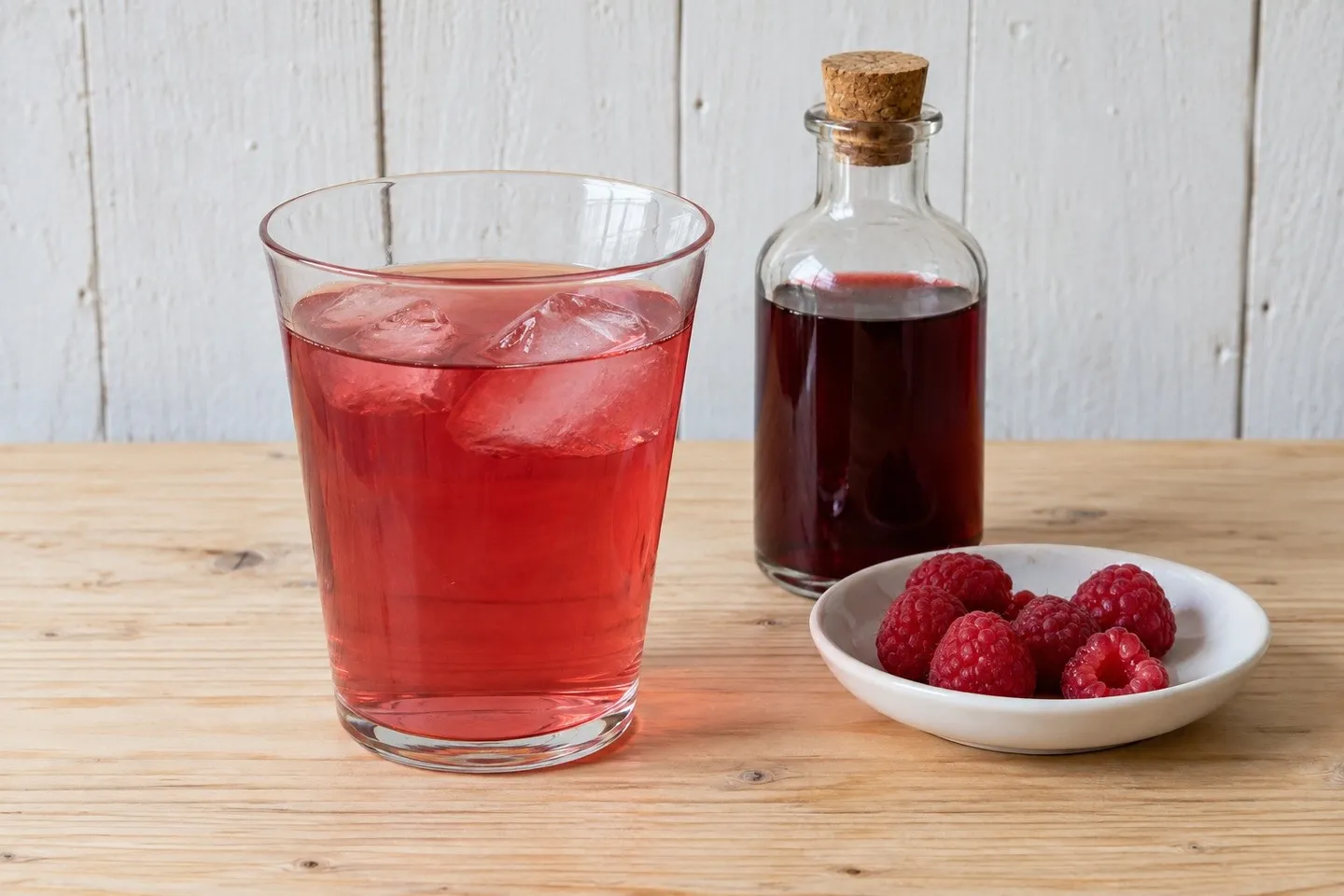
Raspberry shrub stirred into iced water in a thin tumbler, with the bottle of syrup and fresh raspberries.
The story behind the recipe
Raspberry shrub, in Kentucky in 1839, was raspberries steeped in vinegar, boiled, sweetened and bottled, then stirred into iced water on a hot day. Lettice Bryan’s The Kentucky Housewife gives it no spirit at all, and calls the result “very nice, mixed with iced water, for a summer drink.”
One word, three bottles
Bryan’s book is a good place to see how loose the word was. In the same chapter she prints a Rum Shrub made by the cask, with ten gallons of rum, honey, raisin wine and orange-flower water, and a Brandy Shrub mixed in a demijohn from a gallon of brandy and the juice and peel of lemons and oranges. Her raspberry shrub sits a few pages before them, and nothing in it is stronger than vinegar. No earlier vinegar drink called shrub has turned up in print. The English shrub it borrowed the name from was a bottle of brandy, citrus and sugar, and the whole tangle is in Shrub: One Name, Two Very Different Drinks.
She wanted good fruit: “fine ripe raspberries, (the English ones are best,)”, picked over but not washed. Her half pound of loaf sugar to the quart is a quarter of the sugar in Eliza Leslie’s raspberry vinegar of 1837, so this one stays sharp, more like a fruit vinegar than a cordial.
Read more about this recipe
Your own batch
Bryan gives no amount of fruit and no length for “several days,” so 450 g of berries for each steep and three days each are our choices, sized for a 1-liter jar. Her good vinegar was most likely cider vinegar; use one of at least 5% acidity. We rinse the berries, which she says not to do. She boils the second batch of berries in the vinegar and strains afterward; we strain first and boil only the liquid, which is easier to handle and keeps the syrup clear. And we keep the bottle in the fridge instead of sealing the cork with rosin. Diluted one to four, the glass is pink-red, clear and tart, with roughly half the sugar of a modern lemonade. For something sweeter, add more syrup or a spoonful of sugar to the glass. The much sweeter version of 1887 is Temperance Raspberry Vinegar and Iced Water, and for vinegar and water with no fruit at all, the Roman soldier’s posca is the plainest of the family.
Gather fine ripe raspberries, (the English ones are best,) pick them, but do not wash them, break them up, and put them in a jar. Pour in as much good vinegar as will cover them well, close the jar, and let them steep for several days. Then strain them through a cloth, pressing them, to obtain all the juice you can; pour it on a fresh supply of berries, let them set again for several days, then boil them up, strain the liquid through a cloth, and set it by to cool. Mix with it half a pound of loaf sugar to each quart of the liquid, and when it is completely dissolved, and the liquid cold, bottle it, securing the corks with melted rosin. Strawberry shrub may be made in the same manner, and either is very nice, mixed with iced water, for a summer drink.

Recipe makes: About 800 ml syrup, enough for about 17 glasses
Ingredients
For About 800 ml syrup, enough for about 17 glasses. Quantities are shown as written.
Quantities as written here, for About 800 ml syrup, enough for about 17 glasses.
First steep
- Fresh raspberries450 g
- Apple cider vinegar, 5% acidity500 ml
Second steep
- Fresh raspberries450 g
Syrup
- Sugar165 g
To serve
- Iced water per glass180 ml
- Ice cubes (optional)
Measurement notes
Ingredients as written here
- 450 g fresh raspberries
- 500 ml apple cider vinegar, 5% acidity
- 450 g fresh raspberries
- 165 g sugar
- 180 ml iced water per glass
- ice cubes (optional)
Equipment
 Glass jar with a lid, about 1 liter
 Wooden spoon
 Jelly bag or sieve lined with muslin
 Wide stainless steel or enameled saucepan
 Measuring jug
 Clean glass bottle or jar
 Tumbler
Instructions
Rinse the fresh raspberries for the first steep gently and drain them well. Put them in a clean glass jar and break them up lightly with a spoon.
Pour in the apple cider vinegar, which should cover the berries well. Close the jar and leave it in the fridge or a cool place for 3 days.
Strain the vinegar through a jelly bag or a sieve lined with muslin, pressing the berries to get out all the juice. Discard the pulp.
Rinse and drain the fresh raspberries for the second steep, put them in the clean jar, break them up and pour the strained vinegar over them. Close the jar and leave for another 3 days.
Strain again, pressing the berries, into a stainless steel or enameled saucepan. Bring the liquid to a full boil and let it boil for 1 minute.
Strain it once more through clean muslin into a measuring jug and leave it to cool. Measure the liquid and weigh out the sugar against it, at the rate in the scaling note; at the base size it comes close to the amount in the list.
Stir the sugar into the cooled liquid until it has completely dissolved, then pour the syrup into a sterilized bottle, close it and keep it in the fridge.
For each glass, stir about one part syrup into four parts iced water, adding ice cubes if you like. Taste and add more syrup for a stronger, sweeter glass.
Nutrition
55calories per serving
- Recipe makes
- About 800 ml syrup, enough for about 17 glasses
- Servings
- 17
Roughly estimated from USDA FoodData Central values for sugar, apple cider vinegar and raspberries, for one glass of 45 ml syrup in water, counting only part of the fruit, most of which is strained out.
Recipe notes
When adjusting quantities
Weigh the sugar against the strained liquid: 24 g of sugar for every 100 ml. Serve about 45 ml of syrup to 180 ml of iced water.
Notes
Quantities mentioned in these notes don’t change when you adjust the batch.
Never drink the syrup neat: always dilute it. By our arithmetic the syrup is about 3% acetic acid, milder than table vinegar, and about 0.6% in the glass.
The syrup is boiled, but this is not a canning recipe. UC Cooperative Extension, after the University of Georgia and the National Center for Home Food Preservation, says homemade raspberry vinegar is not shelf stable and belongs in the fridge in sterilized jars or bottles, made with vinegar of at least 5% acidity. Heat vinegar only in stainless steel or enamel, not aluminum, copper or cast iron.
Bryan’s quart is the US quart of 946 ml, so her half pound of sugar to the quart is 24 g for every 100 ml. Strawberries, she adds, work the same way.
Storage
Keep the syrup in a sterilized, closed bottle in the fridge and use it within about 3 months, our cautious limit, since no tested keeping time exists for a sweetened shrub. Freeze some to keep it longer; it stays soft. Throw it away if you see mold, bubbles, cloudiness or sliminess.
Scaling changes the ingredients only; glassware, ice and timings need their own judgment. To adapt this recipe further, try the recipe tool at TuneMyRecipe (opens in a new tab), our sister site.
Sources and attribution
Lettice Bryan, The Kentucky Housewife (Cincinnati: Shepard & Stearns, 1839), “Raspberry Shrub”, p. 391
See the original pages (scan at Internet Archive) (opens in a new tab)
Recipe details
- Drink
- Alcohol-free
- Drink family
- Shrubs, Syrups & Cordials
- Region
- American
- Era
- 19th century
- Difficulty
- Easy
- Occasion
- Dry January
- Season
- Summer