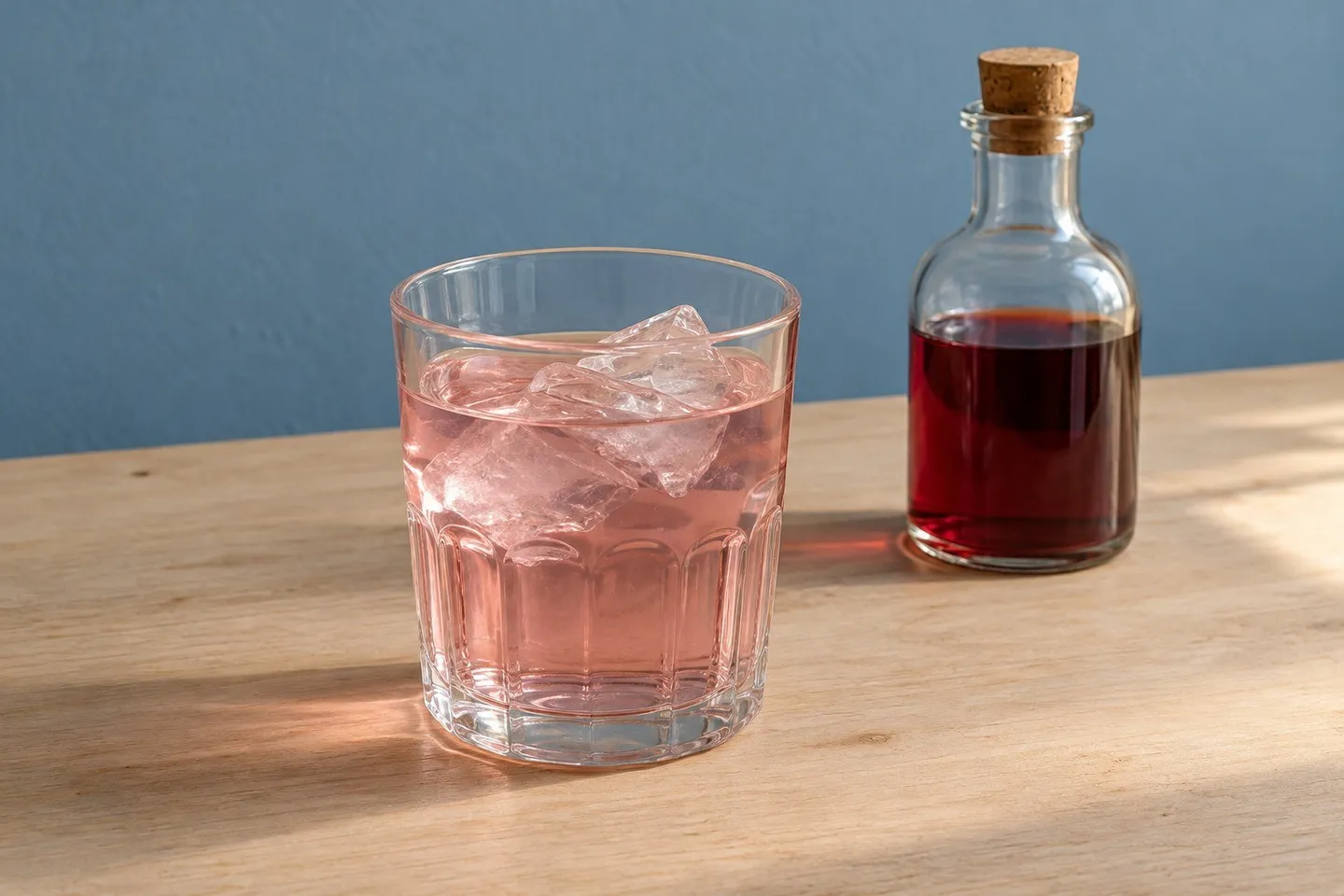
Temperance Raspberry Vinegar and Iced Water
Reader ratingsRaspberries steeped a week in cider vinegar and boiled with plenty of sugar, two tablespoons to a tumbler of iced water: the alcohol-free summer drink of an 1887 temperance cookbook.
- Recipe makes
- About 1.1 liters syrup, enough for about 36 glasses
- Prep
- Cook
- Total
Includes a week of steeping and about an hour for the syrup to cool.
Light rose-pink raspberry vinegar and iced water in a paneled tumbler, with a corked bottle of the dark ruby syrup.
The story behind the recipe
Two tablespoons of raspberry vinegar in a tumbler of iced water was a summer drink for teetotalers in 1887. The Temperance Cook Book printed in San Jose, California, made the syrup with a week’s steeping and a great deal of sugar, and promised a delicious glass.
A shrub without the name
Shrub is a word this book never prints. Its drinks chapter is made of vinegars, acids and syrups, and much of it is borrowed, almost word for word, from Catharine Beecher’s Domestic Receipt-Book of 1846, including her method for making fruit vinegar fizz with baking soda, which San Jose retitled “Harvest Drinks.” Its raspberry vinegar is a cousin of the Kentucky raspberry shrub of 1839, made sweet instead of sharp. Shrub: One Name, Two Very Different Drinks untangles the two drinks, the brandy cordial and the vinegar syrup.
A stone jar of ripe raspberries sat for a week under the purest, strongest vinegar to be had, and each pint of the strained liquid took a pound and a half of lump sugar. That is six times the sugar of the Kentucky recipe, and by our arithmetic it puts about as much sugar in the glass as a modern lemonade.
Read more about this recipe
In the tumbler
A 1-liter glass jar does the work of the stone jar, and 500 g of berries fills it. The vinegar is apple cider vinegar of at least 5% acidity. “A tumbler” is taken here as 240 ml, a US cup. The book’s last line, “or a little soda may be added,” means baking soda, which fizzes against the acid but flattens the taste and leaves it slightly salty, so a splash of soda water in place of some of the iced water is our modern alternative for bubbles. Diluted, the vinegar comes down to about 0.2% acid in the glass, a tenth of its strength in the bottle. The same sweet-and-sour idea is older than any temperance society: Pliny boiled honey with vinegar into oxymel, diluted the same way.
Recipe makes: About 1.1 liters syrup, enough for about 36 glasses
Ingredients
For About 1.1 liters syrup, enough for about 36 glasses. Quantities are shown as written.
Quantities as written here, for About 1.1 liters syrup, enough for about 36 glasses.
Syrup
- Fresh raspberries500 g
- Apple cider vinegar, 5% acidity450 ml
- Sugar860 g
To serve
- Iced water per glass240 ml
- Ice cubes (optional)
- Soda water, in place of some of the iced water (optional)
Measurement notes
Ingredients as written here
- 500 g fresh raspberries
- 450 ml apple cider vinegar, 5% acidity
- 860 g sugar
- 240 ml iced water per glass
- ice cubes (optional)
- soda water, in place of some of the iced water (optional)
Equipment
 Glass jar with a lid, about 1 liter
 Sieve
 Wooden spoon
 Wide stainless steel or enameled saucepan
 Measuring jug
 Clean glass bottle or jar
 Tumbler
Instructions
Rinse the fresh raspberries gently, drain them well and tip them into a clean glass jar.
Cover the berries with the apple cider vinegar. Put the lid on and set the jar in the fridge or a cool larder for a week.
Tip the berries and vinegar into a sieve over a measuring jug. Crush the fruit firmly with a wooden spoon so the juice runs through, then throw away the seeds and skins.
Weigh the sugar against the liquid in the jug, at the rate in the scaling note. Warm the two together in a stainless steel or enameled saucepan, stirring, and take the pan off the heat as soon as the sugar has melted and the first bubbles rise. Skim any foam.
Once cold, funnel the syrup into a sterilized bottle, stopper it and store it in the fridge.
To serve, put one part syrup in a tumbler and fill it with about eight parts iced water, adding ice cubes if you like. Swap some of the water for soda water to make it sparkle.
Nutrition
95calories per serving
- Recipe makes
- About 1.1 liters syrup, enough for about 36 glasses
- Servings
- 36
Roughly estimated from USDA FoodData Central values for sugar, apple cider vinegar and raspberries, for one glass of 30 ml syrup in iced water; nearly all of it is the sugar.
Recipe notes
When adjusting quantities
Weigh the sugar against the strained liquid: 144 g of sugar for every 100 ml. Serve 30 ml of syrup to 240 ml of iced water.
Notes
Quantities mentioned in these notes don’t change when you adjust the batch.
The syrup is for diluting only. By our arithmetic it holds about 2% acetic acid, which falls to about 0.2% once it is in the tumbler.
A short boil does not make it shelf stable. UC Cooperative Extension’s raspberry vinegar guidance (after the University of Georgia and the National Center for Home Food Preservation) keeps the product refrigerated, in sterilized bottles, and starts from vinegar of 5% acidity or more. Aluminum, copper and cast-iron pans react with vinegar; use steel or enamel.
The book’s pint is the US pint of 473 ml, so a pound and a half of sugar to the pint is 144 g for every 100 ml. For the baking-soda fizz as the book meant it, dissolve no more than a pinch in the water before stirring in the syrup, and drink it at once.
Storage
Keep the syrup in a sterilized, closed bottle in the fridge and use it within about 3 months, our cautious limit, since no tested keeping time exists for a sweetened fruit vinegar. Freeze some to keep it longer; it stays soft. Throw it away if you see mold, bubbles, cloudiness or sliminess.
Scaling changes the ingredients only; glassware, ice and timings need their own judgment. To adapt this recipe further, try the recipe tool at TuneMyRecipe (opens in a new tab), our sister site.
Sources and attribution
Mrs. Mary G. Smith, Temperance Cook Book, 2nd ed. (San Jose, Cal.: Mercury Book and Job Printing Office, 1887), “Raspberry Vinegar”, pp. 219–220
Recipe details
- Drink
- Alcohol-free
- Drink family
- Shrubs, Syrups & Cordials
- Region
- American
- Era
- 19th century
- Source decade
- 1880s
- Difficulty
- Easy
- Occasion
- Dry January
- Season
- Summer