Seawater, Pine Resin and Honey: How Roman Wine Tasted
Watered down, often sweetened, sometimes salted with seawater. What Pliny, Columella and the Roman table tell us about the taste of Roman wine.
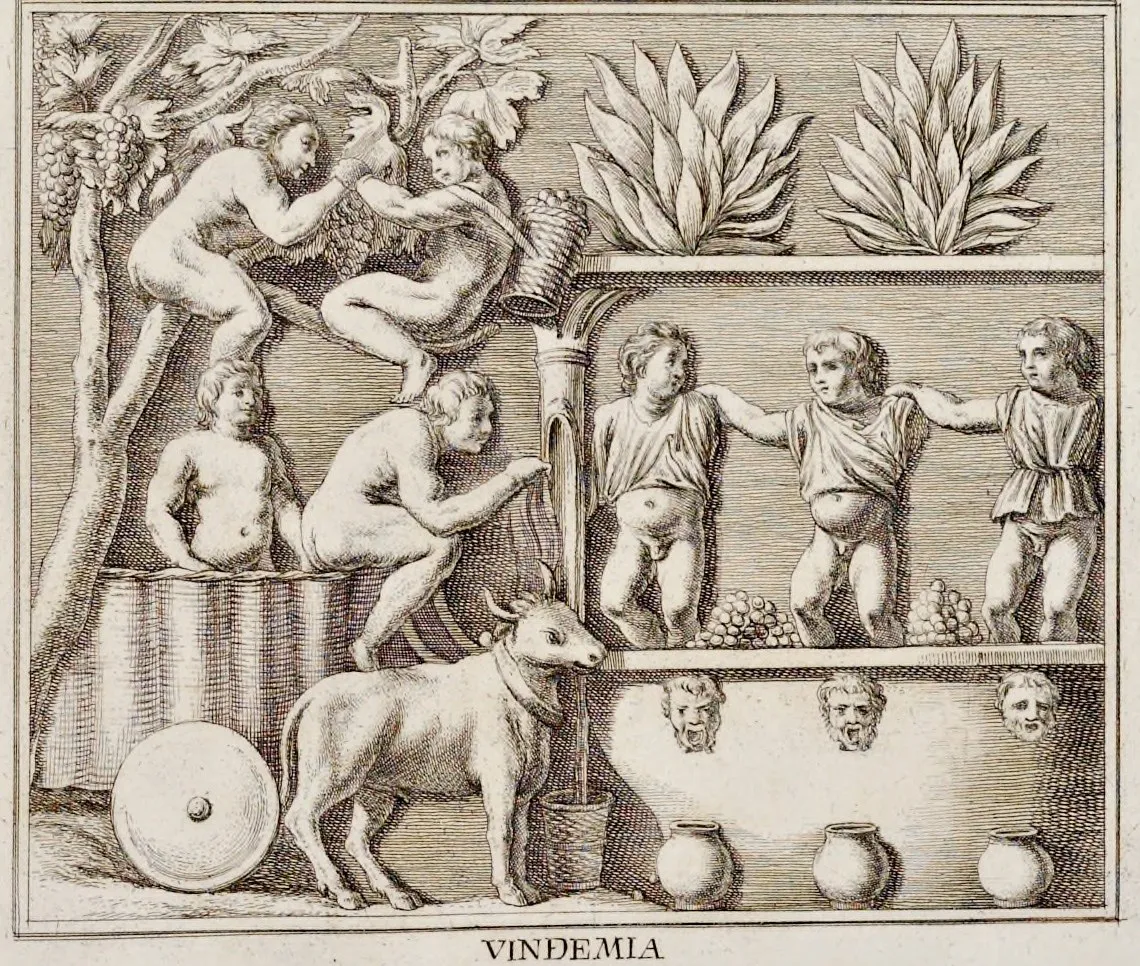
Roman wine was thinner than ours, and usually sweeter. A Roman cup of wine was almost always mixed with water, usually down to the strength of a modern beer or below, often sweetened with honey, and could carry a salty edge from seawater or a resinous note from the pitch that lined its storage jars. Drinking it the way we drink wine, without water, was something Romans associated with barbarians.
This story is part of our Ancient Roman Drinks guide.
Cut with water
Harold Whetstone Johnston, whose The Private Life of the Romans (1903) pulled the evidence together, puts it plainly: after water and milk, wine was the ordinary drink of Romans of every class, but “they always mixed it with water and used more water than wine.” Drinking it unmixed “was thought typical of barbarism.”
The proportions could be startling. Pliny the Elder, who catalogued dozens of wines in his Natural History, reports that Homer’s Maronean wine was mixed “in the proportion of twenty measures of water to one of wine,” and that Mucianus, three times consul, saw the custom in Thrace of mixing one sextarius of that wine with “no less than eighty sextarii” of water. Pliny tells the story to show how strong that wine was, and it says little about an ordinary Roman dinner.
What did all that water do to the strength? Nobody measured Roman wine, so take a modern table wine of 12% ABV as a stand-in and mix it the way Johnston describes, with more water than wine. One part wine to two of water comes to 4% ABV, a little under an ordinary beer at about 5%. One to three comes to 3%, closer to a light beer. Even a strong 15% wine mixed eighty to one, as in Thrace, would come to under 0.2%, well below the 0.5% limit for a beer sold as non-alcoholic in the United States.
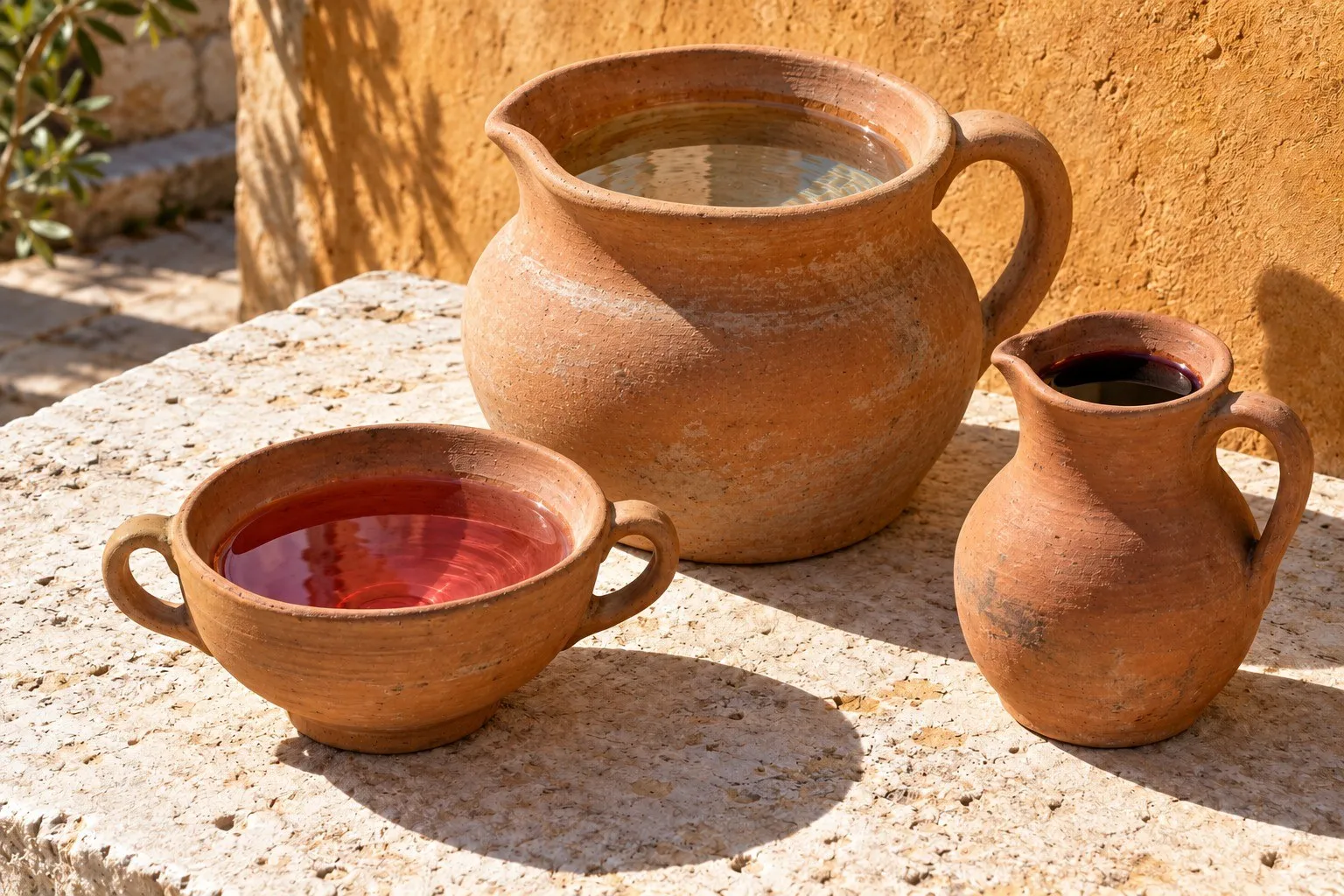 Wine cut with more water than wine, served in a two-handled cup.
At an ordinary dinner, Johnston says, each guest mixed his wine to his own taste. At the drinking party that followed, the comissatio, the mixing became a small ceremony. Johnston describes the guests throwing dice to choose a magister bibendi, the master of drinking, whose job appears to have included setting the proportion of water to wine for the evening. The wine was mixed in a large bowl, the crater, set on the table in view of everyone, and ladled into cups by servants.
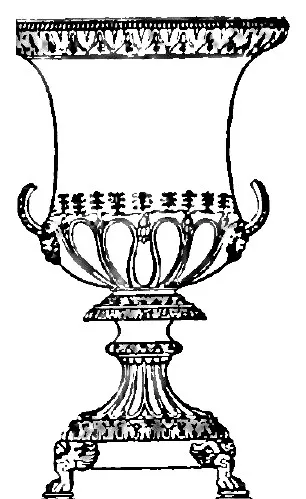 Mixing bowl, Figure 125 in Johnston, The Private Life of the Romans (1903).
One custom decided the size of a toast. Any guest could propose the health of anyone he liked, and the servants then ladled “as many cyathi (twelfths of a pint) as there were letters in the given name” into each cup, to be drained in one go. A short name was a mercy.
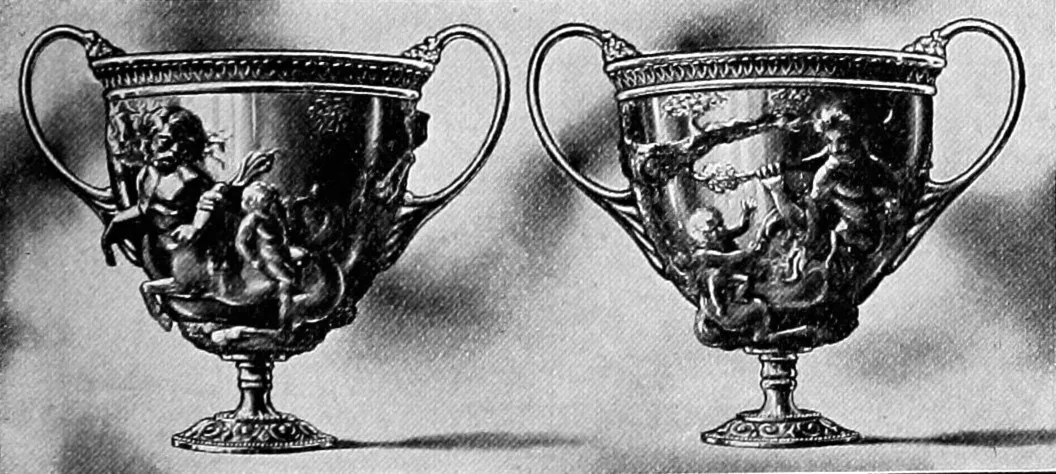 Drinking cups, Figure 126 in Johnston, The Private Life of the Romans (1903).
Salt, pitch and smoke
Some Roman wines tasted of the sea, on purpose. Pliny notes that the wine of Lesbos “has naturally a taste of sea-water,” and that the most esteemed wine of his day came from Clazomenae, “since they have learned to season it more sparingly with sea-water.” The people of Cos, he says, mixed seawater into their wine “in large quantities,” a habit they learned from a slave who used it to hide how much he had been stealing.
Then there was pitch. Johnston describes the great fermenting jars, the dolia, as “covered with pitch within and without,” and the farmer-writer Columella, whose manual on husbandry tells how to make and keep wine, gives three whole chapters to pitch. For Nemeturian pitch, from Liguria, seawater had to be drawn “out of the deep sea, at as great a distance from the shore as can be done conveniently,” boiled down by half, and used to wash the pitch until it took on “a bright-red shining colour.” Once the new wine had “twice left off fermenting,” two cyathi of pitch went into forty-eight sextarii of must. A modern taster’s nearest reference is probably Greek retsina, though that comparison is ours.
Age was helped along with heat. Johnston writes that a favorite store-room for good wine was “in the upper story of the house, where the wine was artificially aged by the heat rising from the furnace or even by the smoke escaping from the fire.”
Very old wine could stop being pleasant at all. Pliny describes the famous Opimian vintage, nearly two hundred years old in his time, as having “assumed the consistency of honey, with a rough taste,” so that it could not be drunk “in a pure state” and had to be mixed with water, “as long keeping renders them intolerably bitter.” A small amount was used to flavor other wines.
Honey in the cup
Sweetness was the other constant. The favorite mixed drink, according to Johnston, was mulsum, “made of four measures of wine and one of honey.” It was drunk with the appetizers, “wine being thought too heavy for an empty stomach,” and the first course of dinner was named the promulsis after it. Pliny adds that some wines, such as those of Apamea and Praetutia, were particularly suited to it. Wines were also blended for sweetness: the sweet wine of Mount Tmolus, Pliny says, was mixed into harsher wines “for the purpose of modifying their harsh flavour” and made them seem older than they were.
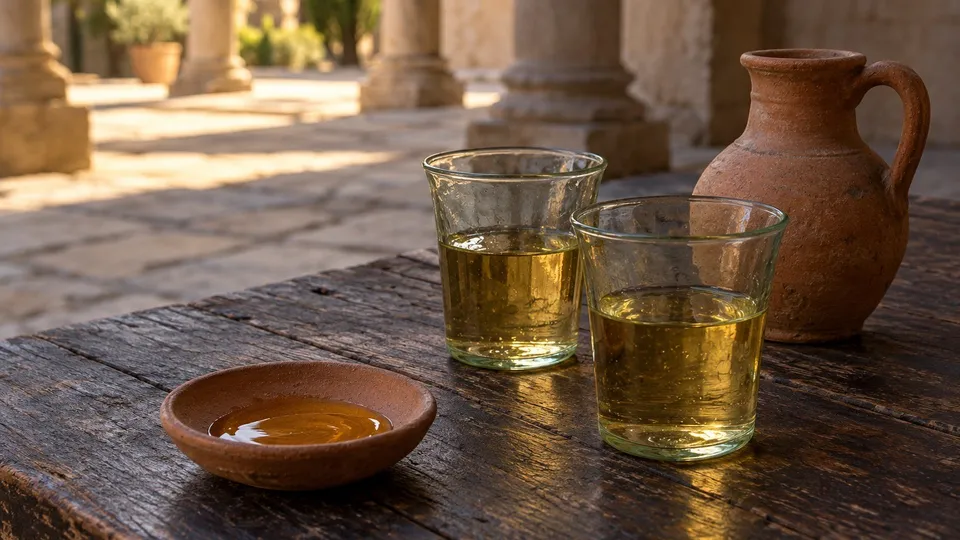
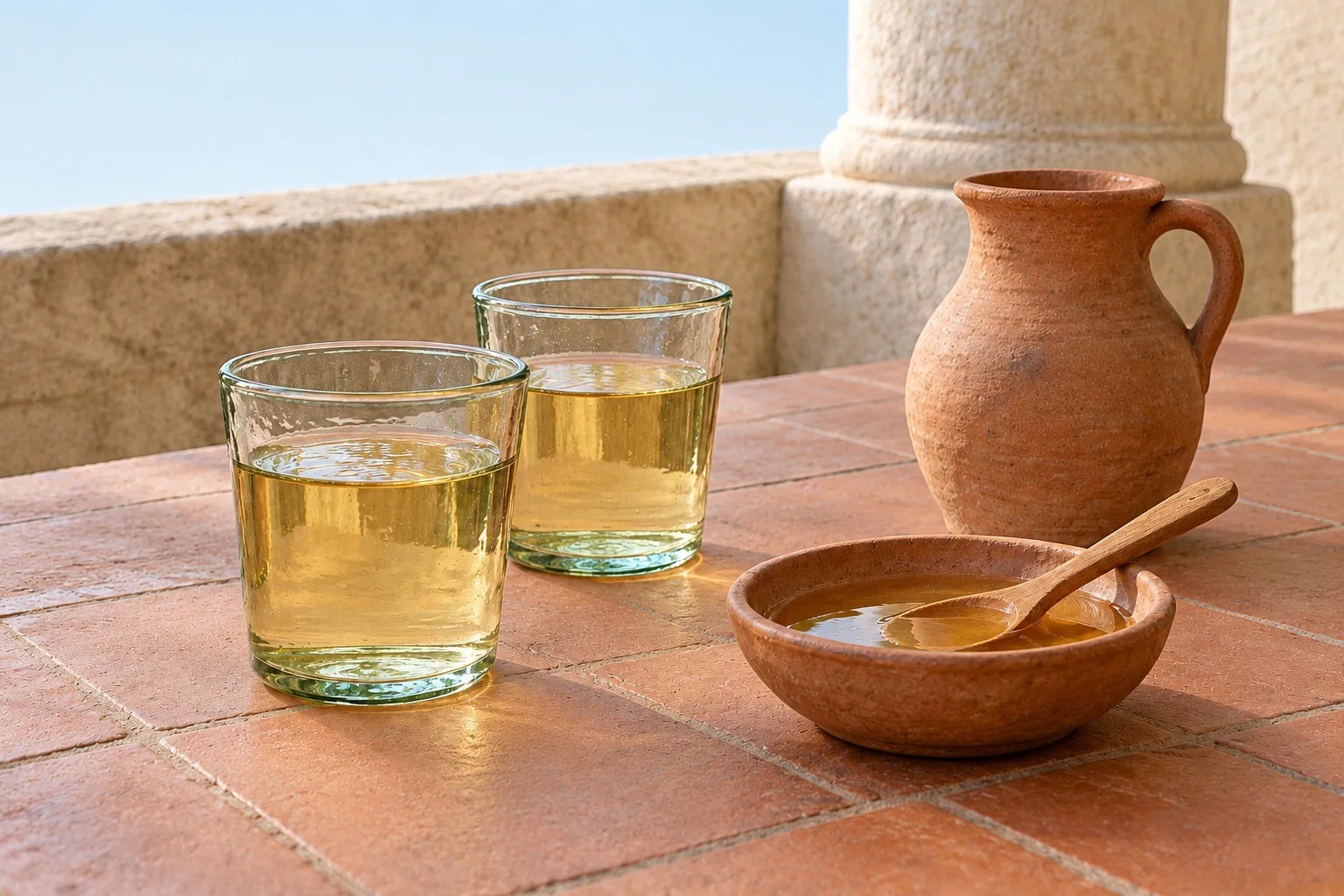 Mulsum in two plain glass cups, with a bowl of honey and an earthenware jug beside them.
Not everything was alcoholic. Fresh grape juice, mustum, “was often drunk unfermented, as ‘sweet’ cider is now,” Johnston writes, and could be kept sweet from one vintage to the next in a sealed, pitched jar sunk in cold water or wet sand. Pliny’s translators note that posca, vinegar mixed with water, was a soldiers’ drink, and Pliny himself records oxymeli, a boiled mixture of honey, old vinegar, sea salt and rain-water, though he found such drinks “somewhat forced.” His hydromeli sits on the boundary: honey and water left to mature until it “acquires the flavour of wine,” which is to say a mead. What Did Romans Drink Besides Wine? follows those drinks further, along with the water Romans drank beside their wine.
A cup of Roman wine
There is no bottle left to open, so the answer has to be built from the evidence. A typical Roman cup was a wine diluted well below modern strength, served from a shared bowl, and often softened with honey. Depending on where it came from and how it was kept, it might also taste of salt, of pine resin and smoke, or, if it was very old, of something thick and bitter that needed a lot of water to be drinkable.
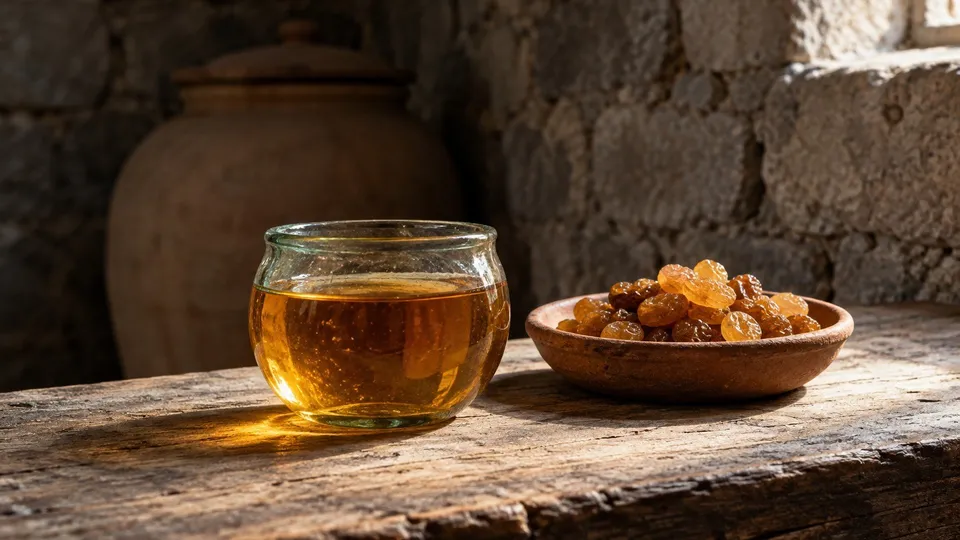
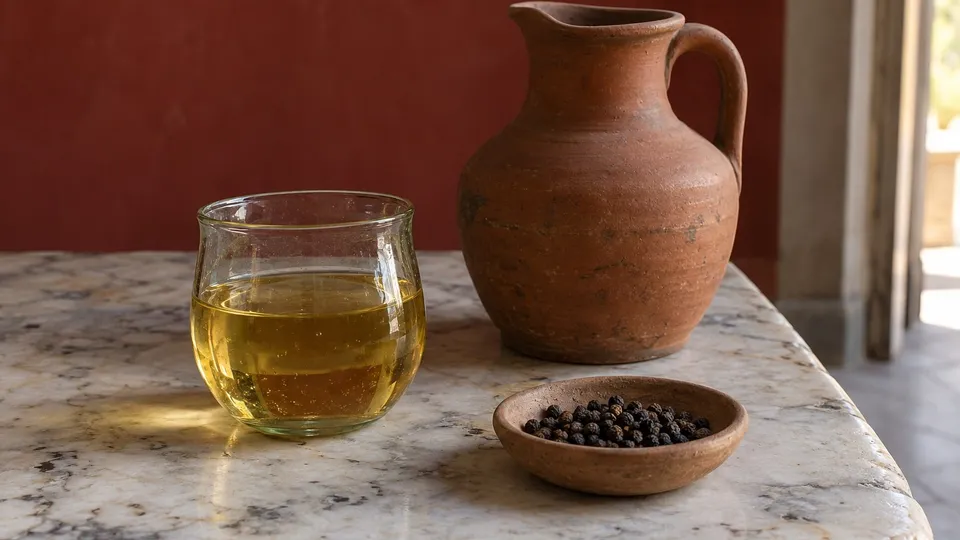
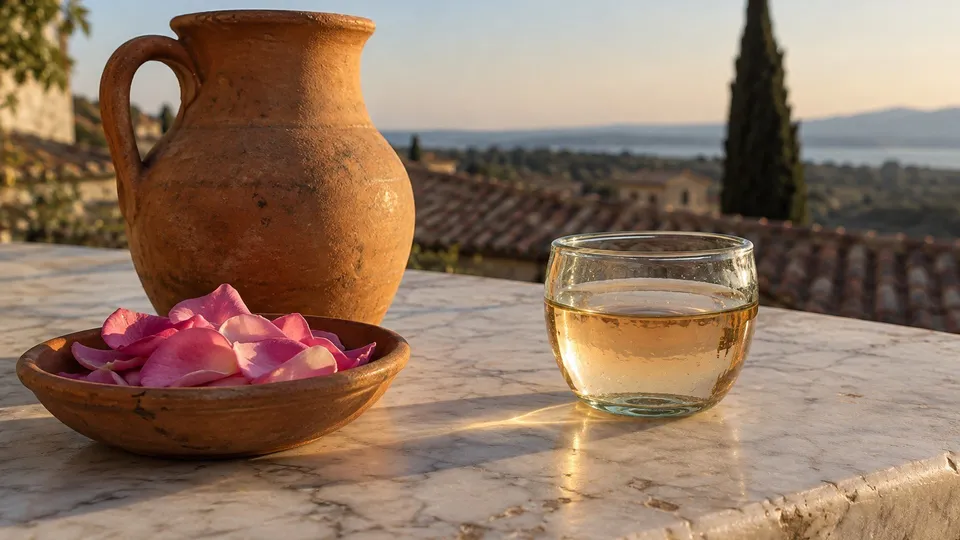
The sweet end of that range is passum, raisins soaked in white wine for five days. The seasoned wines take a day or more: conditum paradoxum steeps honeyed wine with pepper, saffron and mastic, rosatum takes three changes of rose petals, and absinthium is the bitter wormwood wine its translator called Roman vermouth. For the sharp, alcohol-free end, Pliny’s oxymel turns honey, vinegar and a pinch of salt into a syrup you dilute with water.
 Make it todayPassum, Roman Raisin Wine
 Make it todayConditum Paradoxum, Roman Spiced Honey Wine
 Make it todayRosatum, Roman Rose Wine
 Make it todayAbsinthium Romanum, Roman Wormwood Wine
 Always alcohol-freeOxymel, Pliny’s Honey and Vinegar Drink
To taste the honey that softened so many of those cups, start with mulsum: four measures of wine to one of honey, stirred together in five minutes, as Romans drank it with the first course.
 Make it todayMulsum, Roman Honeyed Wine
For what was on the plate, our sister site The Forgotten Menu has what was served at Trimalchio’s dinner (opens in a new tab).
Sources
- Pliny the Elder, The Natural History of Pliny, vol. 3, trans. John Bostock and H. T. Riley (London: Henry G. Bohn, 1855), Book XIV, pp. 236–237, 245–247, 261, 266.
- Columella, Of Husbandry, in Twelve Books (London: A. Millar, 1745), Book XII, ch. XXIV, p. 532.
- Harold Whetstone Johnston, The Private Life of the Romans (Chicago: Scott, Foresman and Company, 1903), pp. 198–199, 208, 212–214. Illustrations: Figures 125 and 126.
- Vetera monumenta quae in hortis Caelimontanis et in aedibus Matthaeiorum adservantur, vol. 3 (Rome, 1779), Tab. XLV, Fig. II, “Vindemia” (hero engraving; Getty Research Institute copy on archive.org).