Conditum Paradoxum, Roman Spiced Honey Wine
Reader ratingsThe first recipe in the Roman cookbook of Apicius: honey boiled with wine, then steeped with pepper, saffron, bay and mastic resin.
- Recipe makes
- About 950 ml
- Prep
- Cook
- Total
Includes an overnight rest for the honeyed wine, as Apicius directs, and 24 hours of steeping with the spices.
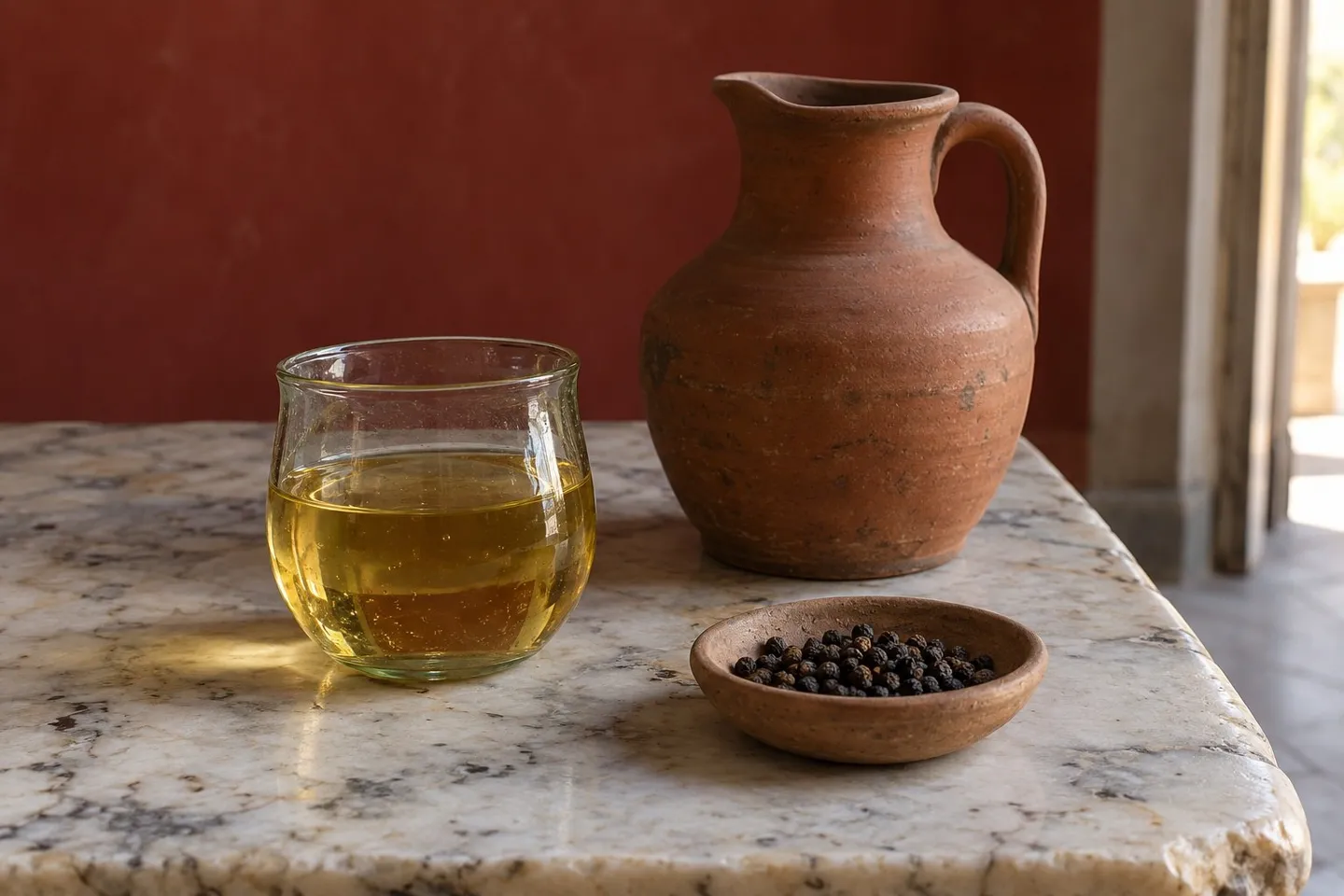
Conditum paradoxum in a low greenish glass beaker, with a terracotta jug and a dish of whole peppercorns on marble.
The story behind the recipe
The first recipe in the Roman cookbook that goes under the name of Apicius is a drink, conditum paradoxum: honey boiled with wine, then steeped with pepper, saffron, bay and mastic resin. The pepper is the surprise, four Roman ounces of it in a batch. His translator, Joseph Dommers Vehling, notes that pepper usually meant black or white peppercorns, though in dishes made with honey and sweets it could just as well mean allspice, or spice of any kind. This version takes it as pepper.
Why a cookbook starts with a drink
Vehling’s English version, published in 1936, calls it a fine spiced wine. He passes on a remark by Dr. Martin Lister, whose edition of Apicius came out in London in 1705: the book rightly begins here, because every Roman meal began with a mixed drink of this kind. The Latin conditum means something seasoned or preserved, and Vehling’s glossary traces the German Konditor, a confectioner, to the same word family.
Pliny the Elder knew the type. Among the artificial wines in his Natural History he describes wines made with aromatics and notes that, “with the addition of pepper and honey,” some people called them “confection wines” and others “peppered wines.” The next recipe in Apicius is a version for the road: peppered honey kept ready, with spiced wine mixed into it in the cup for travelers.
Read more about this recipe
Sweet, hot and resinous
Apicius’s proportions come to about one measure of honey for every three and a third of wine, so this is sweeter than mulsum: roughly two and a half times as much sugar as cola, at about 8 to 9% ABV. Honey gives the sweetness and pepper the heat; saffron turns it deep gold, and mastic adds a resinous note. Mastic is the dried resin of the lentisk tree. The most esteemed, Pliny says, was “the white mastich of Chios,” and it is still sold as small pale tears.
Apicius boils the honey and wine and skims it two or three times over, much as Columella skimmed boiling grape juice for defrutum, the syrup behind the alcohol-free defrutum cooler.
Two changes matter. A paper coffee filter does the work of Apicius’s charcoal, and the batch is cut to one bottle of wine, about a fifteenth of his. Apicius says nothing about water, but Romans usually watered their wine, so we suggest an equal amount of cold water in each glass.
Recipe makes: About 950 ml
Ingredients
For About 950 ml. Quantities are shown as written.
Quantities as written here, for About 950 ml.
Honeyed wine
- Honey225 ml
- Light dry white wine750 ml
Spices
- Date stone1
- Coarsely ground black pepper1 metric tbsp (15 ml per tbsp)
- Mastic0.25 g
- Dried bay leaf1
- Saffron threads0.2 g
To serve
- Cold water (optional)
Measurement notes
Ingredients as written here
- 225 ml honey
- 750 ml light dry white wine
- 1 date stone
- 1 tbsp coarsely ground black pepper
- 0.25 g mastic
- 1 dried bay leaf
- 0.2 g saffron threads
- cold water (optional)
Equipment
 Small dry frying pan
 Mortar and pestle
 Kitchen scale that weighs to 0.1 g
 Small saucepan
 Whisk
 Fine sieve and a paper coffee filter
 Jar or jug that holds 1 liter
 Glass bottle
Instructions
Toast the date stone in the small dry frying pan over medium heat for 3 to 4 minutes, turning it, until it smells toasty and has darkened. Crack it in the mortar, put the pieces in a cup with a spoonful of the light dry white wine, cover and set aside.
Put the honey and about a tenth of the wine in a small saucepan and warm over low heat, whisking all the time. As soon as it comes to the boil, pour in a splash of cold wine, take the pan off the heat and skim off the foam.
Return the pan to the heat and repeat twice more: back to the boil, a splash of cold wine, off the heat, skim.
Cover the pan and leave the honeyed wine at room temperature overnight. The next day, skim off any foam that has risen.
Crush the mastic to a powder in a mortar. Pour the honeyed wine into the jar and stir in the mastic, black pepper, bay leaf, saffron threads, the date stone with its wine, and the rest of the wine.
Cover and leave in the fridge for 24 hours.
Strain through a fine sieve, then through a paper coffee filter set in the sieve, and bottle.
Pour into small glasses and serve cool, with an equal amount of cold water in each if you like.
Nutrition
195calories per serving
- Recipe makes
- About 950 ml
- Servings
- 8
Estimated from the ingredients using USDA FoodData Central values for dry white wine and honey, for eight small glasses; the strained spices add almost nothing.
Recipe notes
When adjusting quantities
Keep about one measure of honey to three and a third of wine by volume, as in Apicius; the spices scale with the wine.
Notes
Quantities mentioned in these notes don’t change when you adjust the batch.
Apicius’s batch is 6 sextarii of honey, 2 sextarii of wine for the boiling and 18 of light wine to finish, with 4 ounces of pepper, 3 scruples of mastic, a drachm each of leaves and saffron, and 5 drachms of date stones. At about 546 ml to the sextarius and 27.4 g to the Roman ounce (Wikipedia, Ancient Roman units of measurement (opens in a new tab), accessed October 20, 2026), one bottle of wine is about a fifteenth of his batch, which gives the honey and spice amounts here. The mastic is a few small tears; the saffron a generous pinch.
We follow Vehling’s 1936 translation, which has date stones alone. The Latin text in the Teubner (1922) and Lister (1705) editions adds the dates themselves, softened in wine, to five roasted date stones: “dactylorum ossibus torridis quinque, isdemque dactylis vino mollitis.”
Vehling marks the leaves as nard or laurel; this version uses bay, which is laurel. Saffron, mastic and the pepper all come from his text; the pepper amount is his too, so expect real heat.
The overnight rest and the repeated boiling follow Apicius. He gives no steeping time, so the 24 hours in the fridge are ours, and so is the coffee filter.
Storage
Keep the strained wine in a closed bottle in the fridge.
Scaling changes the ingredients only; glassware, ice and timings need their own judgment. To adapt this recipe further, try the recipe tool at TuneMyRecipe (opens in a new tab), our sister site.
Sources and attribution
Apicius, Cookery and Dining in Imperial Rome, trans. Joseph Dommers Vehling (Chicago, 1936), Book I, recipe 1, Conditum paradoxum
Recipe details
- Drink family
- Wine, Beer & Mead
- Era
- Ancient Rome
- Difficulty
- Intermediate
- Occasion
- Dinner party