Rosatum, Roman Rose Wine
Reader ratingsWhite wine steeped with fresh rose petals three times over, a week at a time, then sweetened with honey: the rose wine of Apicius.
- Recipe makes
- About 750 ml
- Prep
- Total
Includes three weeks of steeping, with a fresh batch of petals each week.
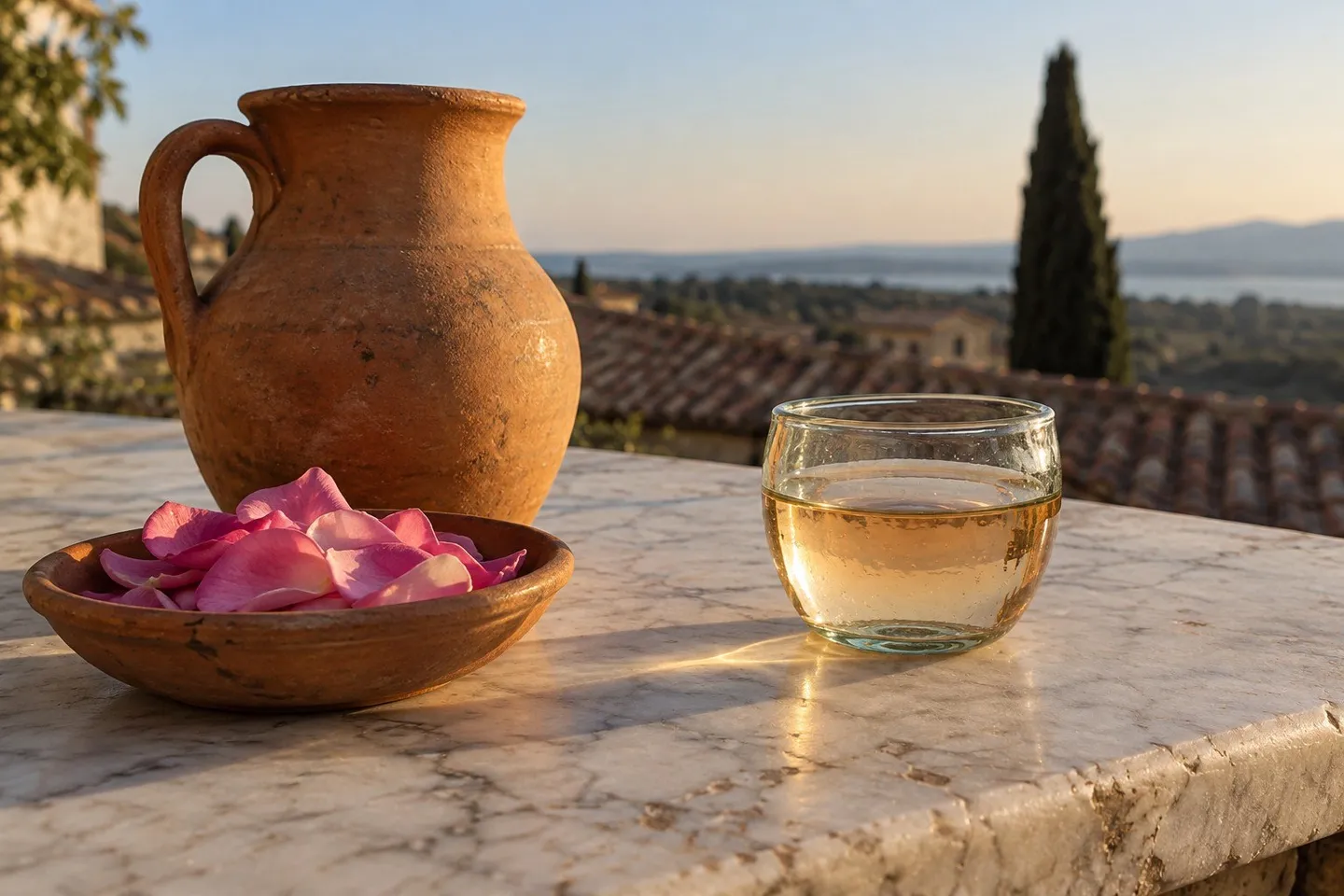
Rosatum in a small glass cup, with its jug and a dish of fresh rose petals.
The story behind the recipe
Apicius steeps rose petals in wine three times over, a week at a time, and sweetens the wine with honey just before it is poured: that is rosatum, Roman rose wine. Straight after it he gives a cheaper trick, rosatum sine rosa, rose wine with no roses in it at all: citrus leaves soaked in new wine, sweetened and passed off as the real thing. Joseph Dommers Vehling, who translated the book in 1936, files it under food fraud and does not let Apicius off lightly.
The party flower
Roses belonged to Roman drinking. In his 1903 handbook The Private Life of the Romans, Harold Whetstone Johnston has guests choosing their own garlands from various leaves and flowers, “but the rose was the most popular and came to be generally associated with the comissatio,” the drinking party after dinner.
Pliny the Elder describes a slower rose wine among his artificial wines: petals pounded in a linen cloth and sunk in fresh grape juice with a small weight, “forty drachms of leaves to twenty sextarii of must,” the vessel left shut for three months. Must left unfermented is an alcohol-free drink in its own right, mustum, Roman fresh grape juice, which Columella kept sweet by sinking a sealed jar in a cold pond for forty days. Apicius works with finished wine and fresh petals every week, and he is particular. The white base of each petal comes off, and only the best petals go in, none of them wet with dew.
Rose wine had a plainer use too. Vehling’s note on the recipe, citing the 1705 edition of Martin Lister, says it was used mainly as a laxative. That is a period claim, reported here, not a recommendation.
Read more about this recipe
Three weeks in the fridge
Apicius’s whole method is about the petals: three lots of fresh ones, each lifted out after a week. Use fragrant roses grown without pesticides, from a garden or sold for eating. Apicius gives no amount, so each change here follows Pliny’s proportion, about 10 g of petals to a bottle. The fridge is our addition, to keep the wine fresh for three weeks. A dry white lets you see whatever color the petals give. The honey goes in last, just before the wine is poured, as Apicius has it; his wormwood wine gets no honey at all.
Recipe makes: About 750 ml
Ingredients
For About 750 ml. Quantities are shown as written.
Quantities as written here, for About 750 ml.
Rose wine
- Dry white wine750 ml
- Fresh rose petals, unsprayed30 g
To serve
- Honey, or to taste30 ml
Measurement notes
Ingredients as written here
- 750 ml dry white wine
- 30 g fresh rose petals, unsprayed
- 30 ml honey, or to taste
Equipment
 Glass jar with a lid, about 1 liter
 Kitchen scissors
 Kitchen scale
 Small saucepan
 Muslin or cheesecloth and kitchen string
 Fine sieve
 Glass bottle
Instructions
Pull the fresh rose petals from the flowers, using only dry petals, and snip off the pale base of each one with scissors. Weigh out a third of them; you will need two more lots of the same weight, freshly picked, one a week later and one a week after that.
Tie the first lot of petals loosely in a square of muslin. Put the bag in the jar, pour in the dry white wine, press the bag under, close the jar and leave it in the fridge for 7 days.
Lift out the bag, let it drain without squeezing hard, and discard it. Tie the second lot of fresh petals in clean muslin, put it in the wine and return the jar to the fridge for another 7 days.
Repeat with the last lot of fresh petals for a third week.
Remove the bag and strain the wine through a fine sieve into a clean bottle.
Before serving, warm a splash of the rose wine with the honey in the small saucepan just until the honey melts, then stir it into the wine you are about to serve. If you are pouring only part of the bottle, use the honey in proportion, about a sixth of it for each small glass. Taste, add more honey if you like, then pour into small glasses.
Nutrition
125calories per serving
- Recipe makes
- About 750 ml
- Servings
- 6
Estimated from the ingredients using USDA FoodData Central values for dry white wine and honey, for six small glasses with 30 ml of honey in the bottle.
Recipe notes
When adjusting quantities
Use about 10 g of petals per 750 ml of wine for each of the three changes.
Notes
Quantities mentioned in these notes don’t change when you adjust the batch.
Pliny’s rose wine uses 40 drachms of petals to 20 sextarii of must in Bostock and Riley’s translation, about 136 g to 10.9 liters, or 12.5 g per liter, which is 9 to 10 g for one 750 ml bottle. The modern Latin text reads fifty, which would be about 15.6 g per liter; we keep to the translation. Each of Apicius’s three changes uses that amount here.
The 30 ml of honey is a starting point; Apicius leaves the amount to the drinker. Violet wine, he adds, is made the same way with fresh violets.
Storage
Keep the strained rose wine in a closed bottle in the fridge, and add the honey only when you serve it.
Scaling changes the ingredients only; glassware, ice and timings need their own judgment. To adapt this recipe further, try the recipe tool at TuneMyRecipe (opens in a new tab), our sister site.
Sources and attribution
Apicius, Cookery and Dining in Imperial Rome, trans. Joseph Dommers Vehling (Chicago, 1936), Book I, recipe 4, Rosatum
Recipe details
- Drink family
- Wine, Beer & Mead
- Era
- Ancient Rome
- Difficulty
- Easy
- Season
- Summer