Mulsum, Roman Honeyed Wine
Reader ratingsFour measures of wine to one of honey: the drink Romans poured with the first course of dinner, made in five minutes, then left to cool.
- Recipe makes
- About 750 ml, 6 small glasses
- Prep
- Total
Includes about 30 minutes for the honeyed wine to cool.
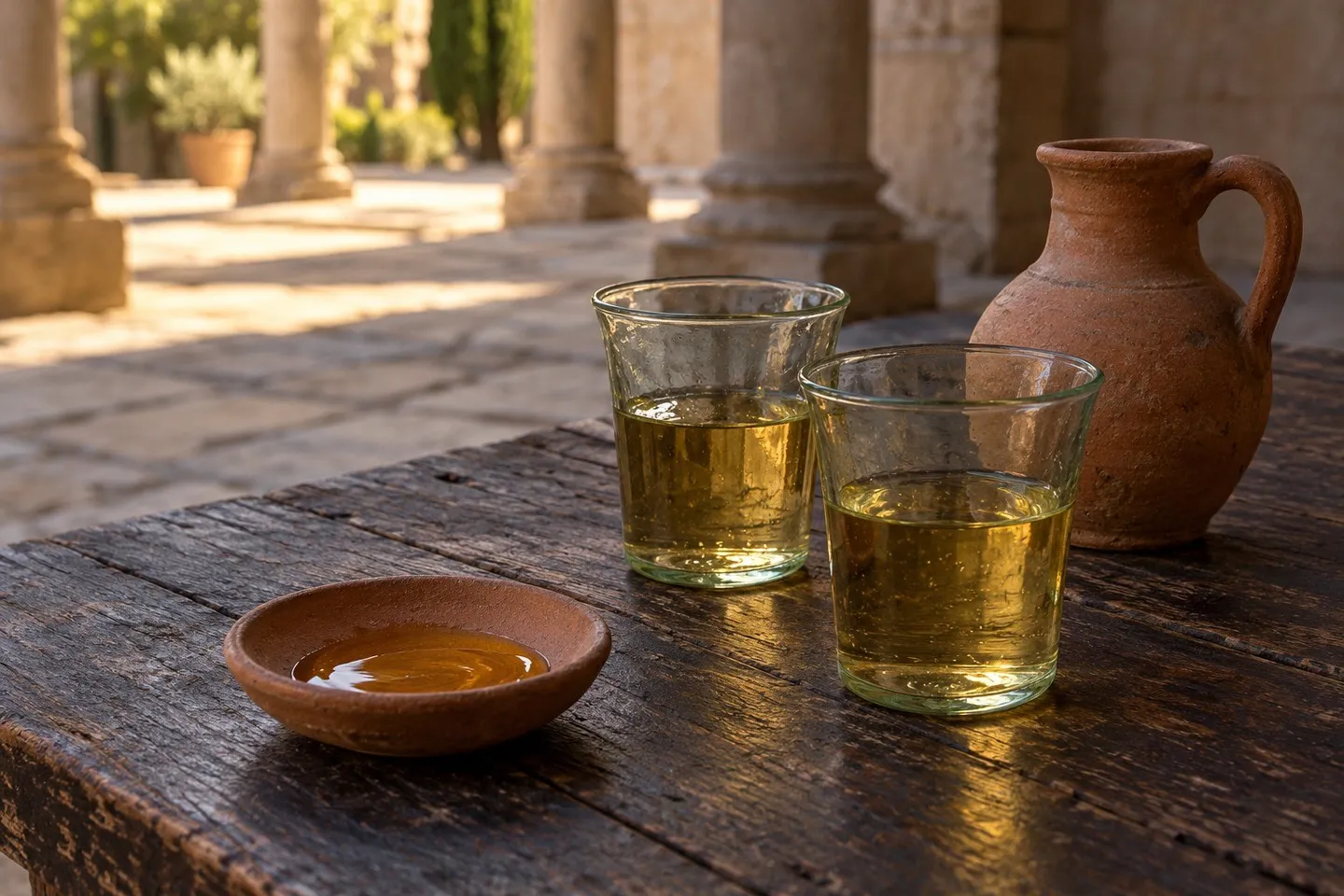
Mulsum in two small greenish glass beakers, with a clay dish of honey and a terracotta jug, in a stone courtyard.
The story behind the recipe
Mulsum is wine sweetened with honey, four measures to one, and Romans drank it at the start of a meal while the plain wine waited for the main course. Plain wine was kept for later, so mulsum went round with the appetizers, and the first course of a Roman dinner took its name from the drink: the promulsis.
When did Romans drink mulsum?
Harold Whetstone Johnston, summing up the Roman evidence in The Private Life of the Romans (1903), describes the appetizer course as shellfish, salted fish, raw onions and “almost invariably lettuce and eggs, all with piquant sauces.” With these, he writes, mulsum was drunk, “wine being thought too heavy for an empty stomach.” It turned up at breakfast too, on the rarer mornings when breakfast became a proper meal, drunk with eggs and milk.
The recipe itself is a single line in Johnston: “four measures of wine and one of honey.” Pliny the Elder adds that the wine mattered. The wine of Apamea, he reports, was said to be “remarkably well adapted for making mulsum,” like that of Praetutia in Italy, a quality only certain wines had, “the mixture of two sweet liquids being in general not attended with good results.” His translators add that mulsum came in two kinds: honey mixed into wine, and honey mixed into fresh grape juice.
Read more about this recipe
What did mulsum taste like?
Four to one is sweeter than it sounds. Honey is about 82 percent sugar, so this batch carries roughly 230 grams of sugar per liter, more than twice as much as cola. Made with a 12% ABV dry white, it comes out at about 10% ABV, a little below most modern wine. For an alcohol-free sweet drink, Romans turned to a syrup of boiled grape juice; the defrutum cooler stirs it into cold water, and Pliny’s 1855 translators reckoned that syrup, once cold, nearly as thick as honey.
Romans mixed their wine with water as a rule, usually more water than wine. Cutting mulsum half and half with cold water is our choice, a step in that direction, and it lands near 5% ABV, the strength of an ordinary beer, and about as sweet as cola. Choose a dry white with some body. A sweet wine would run into what we read as Pliny’s “two sweet liquids” problem. For a Roman wine that takes its sweetness from the grape instead of honey, passum soaks crushed raisins in white wine for five days. The wider story, from seawater to pine resin, is in Seawater, Pine Resin and Honey: How Roman Wine Tasted.
A favorite drink was mulsum, made of four measures of wine and one of honey.

Recipe makes: About 750 ml, 6 small glasses
Ingredients
For About 750 ml, 6 small glasses. Quantities are shown as written.
Quantities as written here, for About 750 ml, 6 small glasses.
- Dry white wine600 ml
- Honey150 ml
- Cold water, to serve (optional)
Measurement notes
Ingredients as written here
- 600 ml dry white wine
- 150 ml honey
- cold water, to serve (optional)
Equipment
 Small saucepan
 Jug or carafe
Instructions
Warm a quarter of the dry white wine with the honey in a small saucepan over low heat, stirring until the honey has dissolved. Do not let it boil.
Pour the honeyed wine into a jug and stir in the rest of the wine.
Leave to cool for about 30 minutes, then chill if you like.
Serve in small glasses, adding an equal amount of cold water to each if you want a lighter drink, closer to how Romans drank their wine.
Nutrition
190calories per serving
- Recipe makes
- About 750 ml, 6 small glasses
- Servings
- 6
Estimated from the ingredients using USDA FoodData Central values for dry white wine and honey; the optional water adds nothing.
Recipe notes
When adjusting quantities
Keep the four-to-one ratio of wine to honey by volume when you scale.
Notes
Quantities mentioned in these notes don’t change when you adjust the batch.
The 600 ml of wine and 150 ml of honey keep Johnston’s four-to-one ratio by volume. A light, floral honey gives the cleanest result; a dark honey such as chestnut adds a bitter edge.
Columella describes a slower honey-wine made with grape juice: ten pounds of honey stirred into an urn of fresh must, sealed in a stone bottle and opened after thirty-two days in the 1745 translation, twenty-two in the Latin (Of Husbandry, 1745, Book XII, ch. XLI, p. 543). This quick version mixes honey into finished wine instead.
Scaling changes the ingredients only; glassware, ice and timings need their own judgment. To adapt this recipe further, try the recipe tool at TuneMyRecipe (opens in a new tab), our sister site.
Sources and attribution
Harold Whetstone Johnston, The Private Life of the Romans (Chicago: Scott, Foresman and Company, 1903), p. 199
Recipe details
- Drink family
- Wine, Beer & Mead
- Era
- Ancient Rome
- Difficulty
- Easy
- Occasion
- Dinner party