Absinthium Romanum, Roman Wormwood Wine
Reader ratingsApicius’s Roman vermouth: mild white wine steeped for a day with wormwood, mastic, bay and saffron, unsweetened and bitter by design.
- Recipe makes
- About 730 ml
- Prep
- Total
Includes 24 hours of cold steeping.
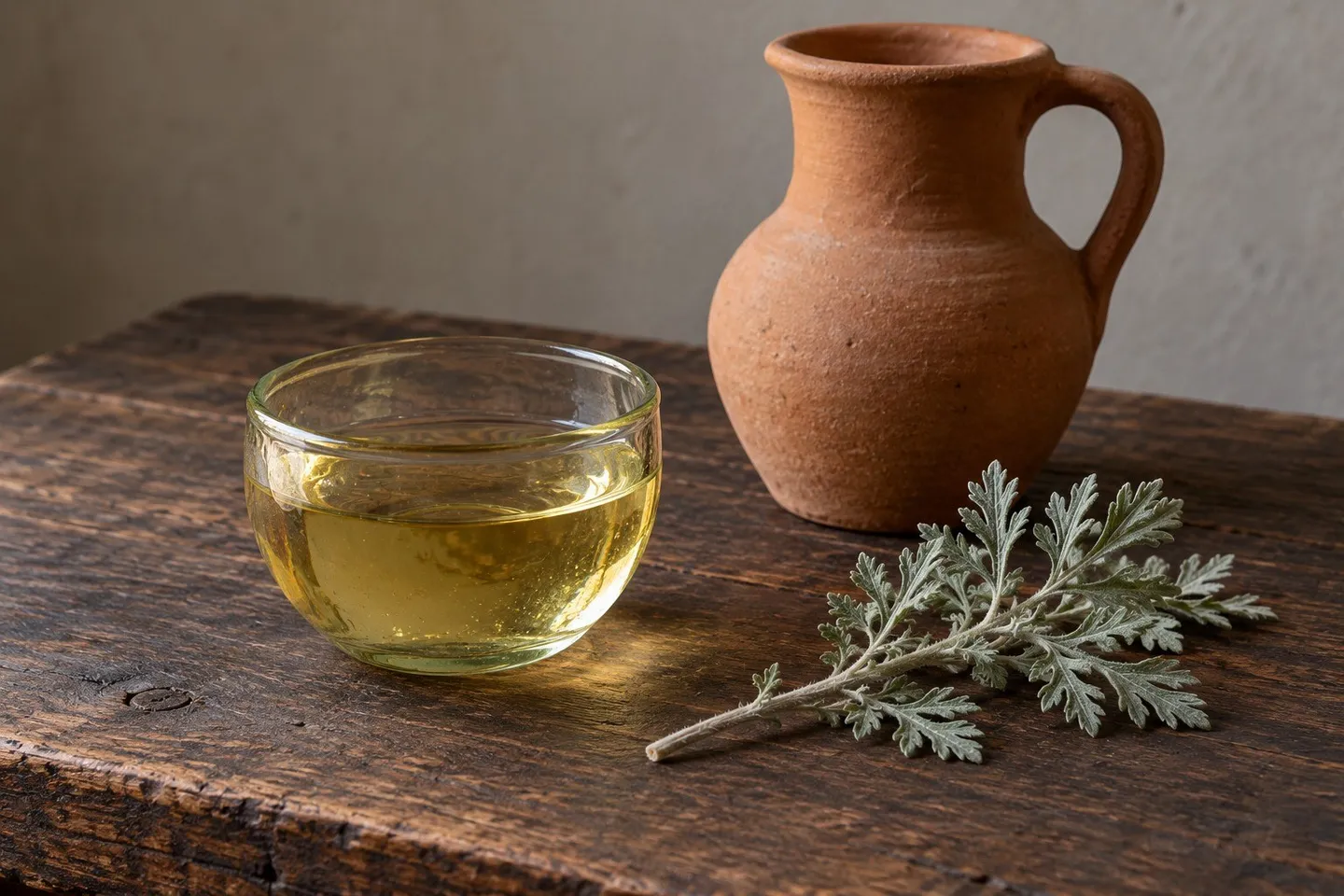
Absinthium in a low greenish glass cup, with a sprig of wormwood and a terracotta jug.
The story behind the recipe
Translating Apicius in 1936, Joseph Dommers Vehling gave Absinthium Romanum a familiar English name, Roman vermouth: wine steeped with wormwood, mastic, leaves and saffron, and left unsweetened. He had good grounds. Vermouth came into English from French, which took it from the German Wermut, wormwood, the bitter herb that once flavored it.
Pliny, Columella and the cook
Wormwood wine is one of the few drinks that Pliny the Elder, the farmer Columella and Apicius all describe. Pliny lists it among his artificial wines, “made of Pontic wormwood in the proportion of one pound to forty sextarii of must,” boiled down to a third, “or else of slips of wormwood put in wine.” Columella boils a pound of Pontic wormwood in four sextarii of must and stirs it, cold, into a whole urn of grape juice. Both men start from must, the juice straight from the press, which Romans also drank fresh, before it could ferment, as alcohol-free mustum.
Apicius, the cook, wants wormwood from Santonicum, which Vehling places in Saintonge in France, or failing that from Pontus on the Black Sea, steeped with mastic, saffron and leaves in whatever mild wine is to hand. He skips the charcoal he uses to clear his spiced wine, since the bitterness makes it unnecessary.
By 1855 Pliny’s English translators could point to where the herb had gone. A medicinal wine was “still prepared with wormwood,” they note, and from it came “apsinthe,” “a liqueur much esteemed in France.”
Read more about this recipe
How much wormwood
Wormwood is the one ingredient here that needs care. It contains thujone, which European rules cap at 35 mg per kilo in alcoholic drinks made from Artemisia, the wormwood genus. On the usual reading of his measures, Apicius’s proportion comes to roughly 2 g of dried wormwood for a bottle. This version uses 1 g, half that. Dried wormwood holds at most about 1.5% essential oil, only part of it thujone, according to the European Medicines Agency’s 2017 assessment of the herb, so 1 g carries under 15 mg. Even if all of it passed into the bottle, that is about 20 mg per kilo, under the European limit. Expect a dry, bitter, herbal wine, faintly gold from the saffron, without the sweetness of a modern vermouth: Apicius adds no honey. Skip it if you are pregnant or breastfeeding. Wormwood was one Roman seasoning for wine among many; Seawater, Pine Resin and Honey: How Roman Wine Tasted gathers the others.
Recipe makes: About 730 ml
Ingredients
For About 730 ml. Quantities are shown as written.
Quantities as written here, for About 730 ml.
- Mild dry white wine750 ml
- Dried wormwood1 g
- Mastic0.5 g
- Dried bay leaf1
- Saffron threads0.25 g
Measurement notes
Ingredients as written here
- 750 ml mild dry white wine
- 1 g dried wormwood
- 0.5 g mastic
- 1 dried bay leaf
- 0.25 g saffron threads
Equipment
 Glass jar with a lid, about 1 liter
 Mortar and pestle
 Fine sieve and a paper coffee filter
 Kitchen scale that weighs to 0.1 g
 Glass bottle
Instructions
Weigh the dried wormwood carefully and use no more than the list gives; a little goes a long way.
Crush the mastic to a powder in a mortar. Put the wormwood, mastic, bay leaf and saffron threads in the jar and pour in the mild dry white wine.
Close the jar, shake it and leave it in the fridge for 24 hours.
Pour it through a fine sieve to catch the herbs, then again through a paper coffee filter, and bottle it.
Taste a little first: it is meant to be bitter, and a splash of cold water softens it. Pour it cool, a small glass at a time.
Nutrition
100calories per serving
- Recipe makes
- About 730 ml
- Servings
- 6
Estimated from the ingredients using USDA FoodData Central values for dry white wine, for six small glasses; the herbs add nothing measurable.
Recipe notes
When adjusting quantities
Keep the wormwood at no more than 1 g per 750 ml of wine when you scale.
Notes
Quantities mentioned in these notes don’t change when you adjust the batch.
Buy dried wormwood sold for culinary or tea use, either common wormwood (Artemisia absinthium) or Roman wormwood (Artemisia pontica), the “Pontic” wormwood of Pliny and Columella. Never use wormwood oil or extract. Don’t make it for anyone under drinking age or with liver disease.
In Vehling’s translation Apicius uses a Theban ounce of wormwood, 6 scruples of mastic and 3 each of leaves, costmary and saffron for 18 measures of wine. The 1922 Latin edition of Giarratano and Vollmer swaps two amounts, 3 scruples of mastic and 6 of costus, and adds terebinth resin; we follow Vehling. The Theban ounce is of uncertain weight; taking it as a Roman ounce of 27.4 g and the measures as sextarii of about 546 ml (Wikipedia, Ancient Roman units of measurement (opens in a new tab), accessed October 20, 2026), one bottle is about a thirteenth of his batch: about 2 g of wormwood, halved here, and his mastic and saffron as given. His recipe also lists costmary, but Vehling’s notes show the early editions disagree on that word, so it is left out.
Apicius gives no steeping time; this version settles on 24 hours in the fridge. Vehling’s bracket names the leaves as nard; bay, which he offers as the alternative in Apicius’s spiced wine, stands in here.
Storage
Keep the strained wine in a closed bottle in the fridge.
Scaling changes the ingredients only; glassware, ice and timings need their own judgment. To adapt this recipe further, try the recipe tool at TuneMyRecipe (opens in a new tab), our sister site.
Sources and attribution
Apicius, Cookery and Dining in Imperial Rome, trans. Joseph Dommers Vehling (Chicago, 1936), Book I, recipe 3, Absinthium Romanum
Recipe details
- Drink family
- Wine, Beer & Mead
- Era
- Ancient Rome
- Difficulty
- Easy