Passum, Roman Raisin Wine
Reader ratingsCrushed raisins soaked in wine for five days and pressed: Columella’s raisin wine, made with shop raisins and a bottle of white.
- Recipe makes
- About 400 ml
- Prep
- Total
Includes five days of steeping in the fridge.
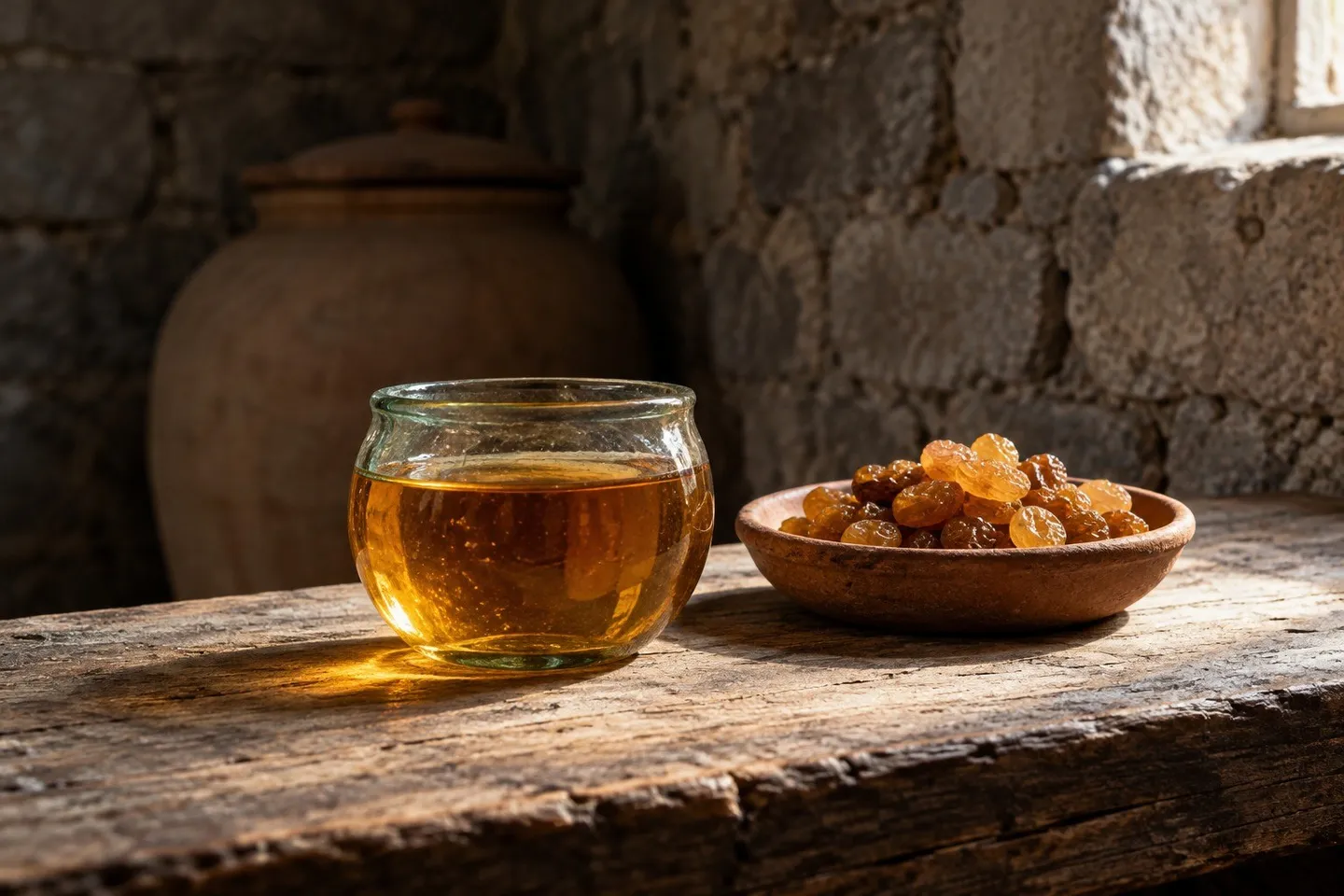
Passum in a small glass cup, with a dish of muscat raisins.
The story behind the recipe
In Polybius’s day, the Greek writer Athenaeus reports, Roman women were forbidden wine and drank passum instead. The loophole was a generous one, since passum was made with wine: grapes dried in the sun until they shrivel, then soaked in wine and pressed. It was a sweet wine to drink, from the sweet end of Roman wine, and a staple sweetener of the Roman kitchen.
From the drying racks
The Roman farm writers took it seriously. Columella gives the method of an earlier authority, Mago, “as I myself also have made it”: ripe early grapes spread on reed racks in the sun and covered at night, “lest they be wet with the dew,” then soaked in the best must and pressed on the sixth day. For the Apian grape, a variety Pliny the Elder says was named for the bees that loved it, Columella has the raisins trodden in layers and sprinkled with old wine until it can “swim above them,” then left for five days and pressed.
Pliny describes the same careful method, steeping the raisins “in wine of good quality until they swell,” and of two named kinds, psythium and melampsythium, he says they have “the peculiar flavour of the grape, and not that of wine.” Crete’s raisin wine was held the best. In the kitchen it was everywhere: raisin wine turns up dozens of times in the Roman cookbook of Apicius, mostly to sweeten sauces.
Read more about this recipe
With raisins from the shop
Shop raisins have already done the drying, so this version starts at the Apian method: crushed raisins, covered with wine, left five days, pressed. Muscat raisins come closest, since Pliny’s translators thought the Apian grape was probably a muscatel; golden raisins work too. Columella’s “old wine” can’t be bought, so a dry white stands in, and the jar goes in the fridge to keep everything fresh. If Pliny’s psythium is a guide, it should taste sweet and more of the grape than of wine, at about 10% ABV, a little below the wine you start with. Romans who had to keep off wine for their health were given an alcohol-free stand-in, adynamon, the “wine without strength” boiled from grape must.
If you would make raisin-wine of the Apian grape, gather the Apian grape sound and intire; purge them of such grains as are rotten and spoiled, and put them apart by themselves; afterwards hang them up on poles, and order it so, that the poles may be always in the Sun. After the berries are shrivelled enough, pull them off, and throw them into a tub without the stalks, and tread them well with your feet. When you have made one floor or story of them, sprinkle old wine upon it; afterwards tread down another upon it, and also sprinkle wine on it. In the same manner tread a third story, and continue to pour wine upon them, so that it may swim above them, and let them alone for five days; afterwards tread them with your feet, and press the grapes in a new wicker-basket.

Recipe makes: About 400 ml
Ingredients
For About 400 ml. Quantities are shown as written.
Quantities as written here, for About 400 ml.
- Muscat or golden raisins250 g
- Dry white wine500 ml
Measurement notes
Ingredients as written here
- 250 g muscat or golden raisins
- 500 ml dry white wine
Equipment
 Kitchen scale
 Food processor or potato masher
 Glass jar or bowl with a lid, about 1 liter
 Sieve lined with muslin or cheesecloth
 Glass bottle
Instructions
Pick over the muscat or golden raisins, pulling off any stalks and throwing out any that look moldy or spoiled.
Pulse the raisins in a food processor for a few seconds at a time until they are broken up but not a paste, or crush them in a bowl with a potato masher.
Put a third of the crushed raisins in the jar and pour over a little of the dry white wine. Add the next third and a little more wine, then the last third, and pour in the rest of the wine. Press the raisins down so the wine covers them.
Close the jar and leave it in the fridge for 5 days without stirring.
Press the raisins down hard once more, then tip everything into the muslin-lined sieve set over a bowl. Gather up the cloth, twist it closed and squeeze out as much wine as you can.
Bottle it and keep it in the fridge; small glasses suit it.
Nutrition
130calories per serving
- Recipe makes
- About 400 ml
- Servings
- 5
Roughly estimated from USDA FoodData Central values for raisins and dry white wine, for five small glasses, assuming about half the raisins’ sugar ends up in the wine.
Recipe notes
When adjusting quantities
Use enough wine to cover the crushed raisins, about 2 ml for every gram of raisins.
Notes
Quantities mentioned in these notes don’t change when you adjust the batch.
The yield depends on how hard you squeeze; the raisins keep some of the wine.
Pliny makes a second, cheaper raisin wine by adding an equal amount of well-water to the pressed pulp, and Columella mentions an Apian raisin wine made with boiled rain-water in place of wine, which he says comes out “even sweeter” than the others. This recipe makes only the first, wine-based kind.
The Original is from the scan of the 1745 translation, with the old long s printed as s.
Storage
Keep the pressed raisin wine in a closed bottle in the fridge.
Scaling changes the ingredients only; glassware, ice and timings need their own judgment. To adapt this recipe further, try the recipe tool at TuneMyRecipe (opens in a new tab), our sister site.
Sources and attribution
Columella, Of Husbandry, in Twelve Books (London: A. Millar, 1745), Book XII, ch. XXXIX, p. 542
Recipe details
- Drink family
- Wine, Beer & Mead
- Era
- Ancient Rome
- Difficulty
- Easy