What Did People Drink Before Coffee and Tea?
Before coffee and tea reached England in the 1650s, the first drink of the day was ale or beer, and wine in great houses: the morning draught.
Before coffee and tea reached England in the 1650s, the first drink of the day was ale or beer, and in great houses wine as well. It came with bread, salt fish or boiled meat at a breakfast table, or on its own as a “morning draught” taken in an alehouse or tavern on the way to work. Coffee arrived in London around 1652, sold from the start as a morning drink, and tea followed a few years later.
This story is part of our What Did People Drink in the 1600s? 17th-Century Drinks and Recipes guide.
This is a question about the time of day, not about water. Whether people avoided water is the subject of Did Medieval People Really Drink Beer Instead of Water?; here we look at what went into the cup at breakfast.
A quart of beer and a quart of wine
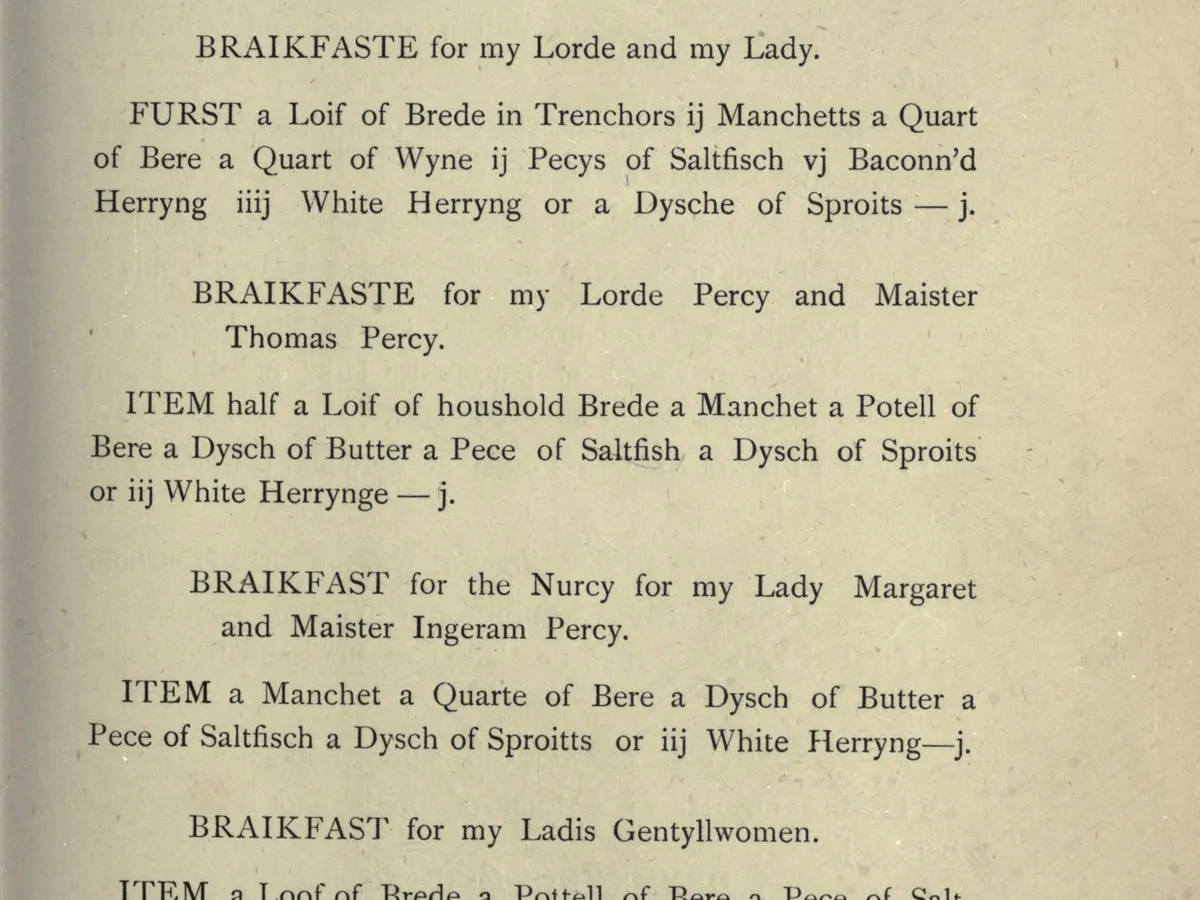
The best record of an early Tudor breakfast is the household book of Henry Algernon Percy, the fifth Earl of Northumberland, whose regulations were begun in 1512. It lists what each person in the house was allowed, meal by meal. In Lent the earl and countess began the day with “a Loif of Brede in Trenchors ij Manchetts a Quart of Bere a Quart of Wyne ij Pecys of Saltfisch vj Baconn’d Herryng iiij White Herryng or a Dysche of Sproits.”
A quart was two pints, so the couple shared a little over a liter of beer and the same of wine with their salt fish. Their two elder sons got “a Potell of Bere,” half a gallon, between them. The nursery, for Lady Margaret and Master Ingeram Percy, got “a Manchet a Quarte of Bere a Dysch of Butter.” Lent breakfasts were served only on Sundays, Tuesdays, Thursdays and Saturdays, “Except my Lordis Childeryn which shall have Braikfasts every day in the weik in Lent.”
On flesh days, from Candlemas 1511, the menu changed and the drink stayed the same: the earl and countess had “j Quart of Bere a Quart of Wyne Half a Chyne of Mutton or ells a Chyne of Beif boilid.” Further down the list, household officers got “a Gallon of Bere,” about four and a half liters.
The Percy clerks wrote “Bere,” not ale, and beer meant the hopped drink, the change told in When Did English Beer Get Its Hops?
Breakfast out of fashion
Sixty years later William Harrison thought breakfast was on its way out. In his Description of England (1577) he wrote that “of old we had breakefasts in the forenoone, beuerages, or nuntions after dinner, and thereto reare suppers generallie when it was time to go to rest.” Now, he said, “these od repasts, thanked be God, are verie well left,” and almost everyone “contenteth himselfe with dinner & supper onelie,” apart from “here and there some yoong hungrie stomach that cannot fast till dinner time.”
What they drank at those two meals was beer. “Our drinke,” Harrison wrote, “is made of barleie, water, and hops, sodden and mingled togither, by the industrie of our bruers.” In the 1587 edition he added his own household’s brewing: his wife and her maids brewed once a month, and “for my twentie shillings I haue ten score gallons of beere or more.” Twenty shillings in 1587 is roughly £290 today, by UK consumer prices (Bank of England), so about £1.45 a gallon for beer “meet for poore men as I am, to liue withall.”
The morning draught
A sit-down breakfast may have gone out of fashion, but a drink first thing did not. Samuel Pepys, then a young clerk in London, took his “morning draft” all through 1660, the first year of his diary. On January 16 he “went into an alehouse and drank my morning draft with Matthew Andrews and two or three more of his friends, coachmen.” On September 22, “at Mr. Standing’s in Salsbury Court we drank our morning draft and had a pickled herring.” On November 19 he took a friend “to the Sun, and I did give him a morning draft of Muscadine,” which Wheatley glosses as “a rich sort of wine.”
The morning draught was a social drink, bought for friends and colleagues on the way to work, most often ale or beer and sometimes wine. Henry Wheatley, who edited the diary in 1893, put it in one line of his notes: “It was not usual at this time to sit down to breakfast, but instead a morning draught was taken at a tavern.” That is Wheatley’s summary, two centuries on, not Pepys’s own words, but it fits every entry quoted here.
Coffee and tea arrive
Coffee was first sold to the public in London around 1652 by Pasqua Rosee, at the sign of his own head in St Michael’s Alley, Cornhill. His handbill, which carries no date, told buyers to take “about half a pint of it to be drunk, fasting an hour before, and not Eating an hour after, and to be taken as hot as possibly can be endured.” It was good, he said, “about 3 or 4 a Clock afternoon, as well as in the morning,” but not after supper, “unless you intend to be watchful, for it will hinder sleep for 3 or 4 hours.”
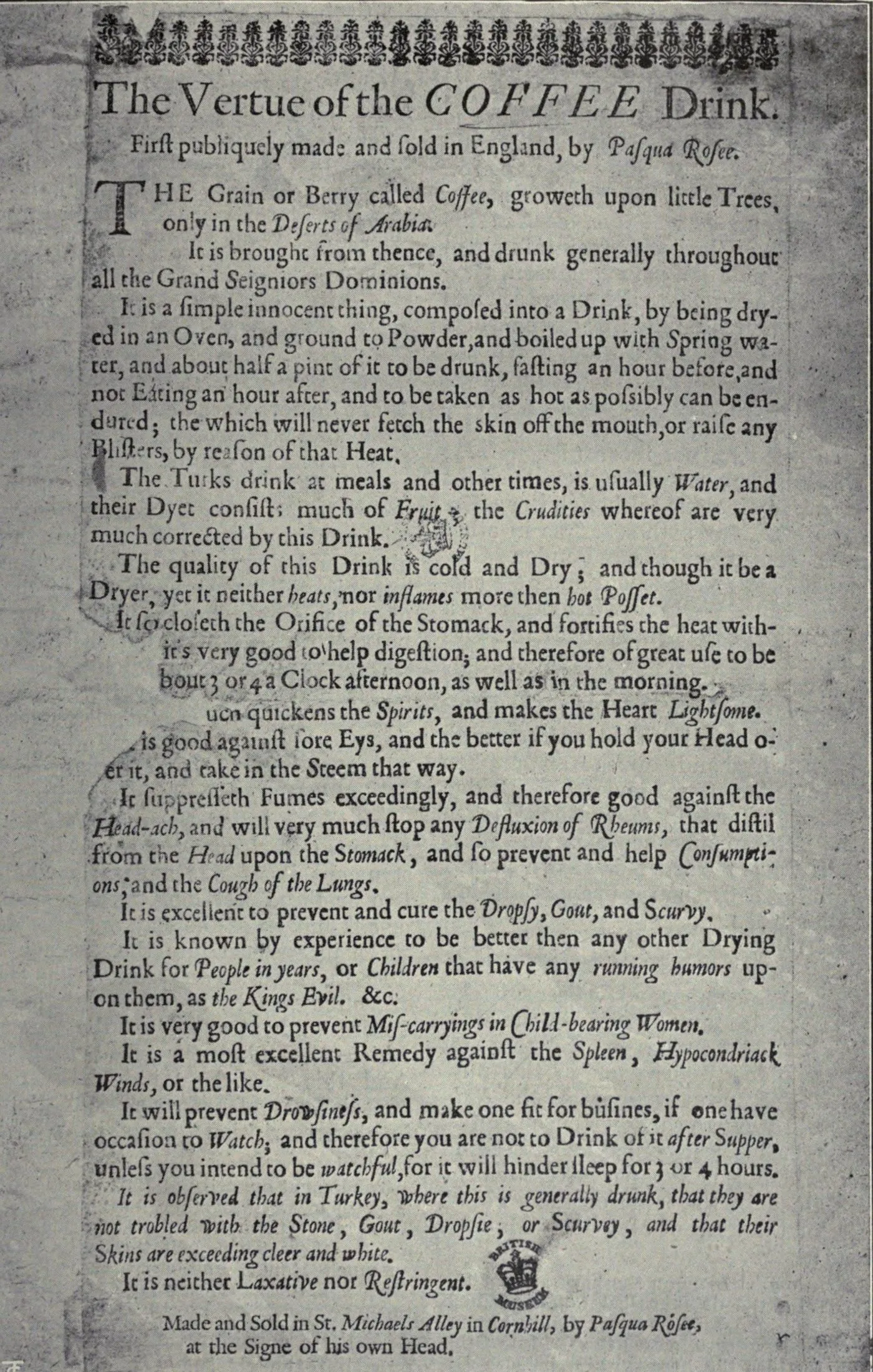 Pasqua Rosee’s handbill, The Vertue of the Coffee Drink, undated, about 1652, as reproduced from the British Museum copy in W. H. Ukers, All About Coffee (1922), p. 55.
Rosee measured his new drink against an old one: it “neither heats, nor inflames more then hot Posset,” the hot milk curdled with ale or wine that we make as posset ale.
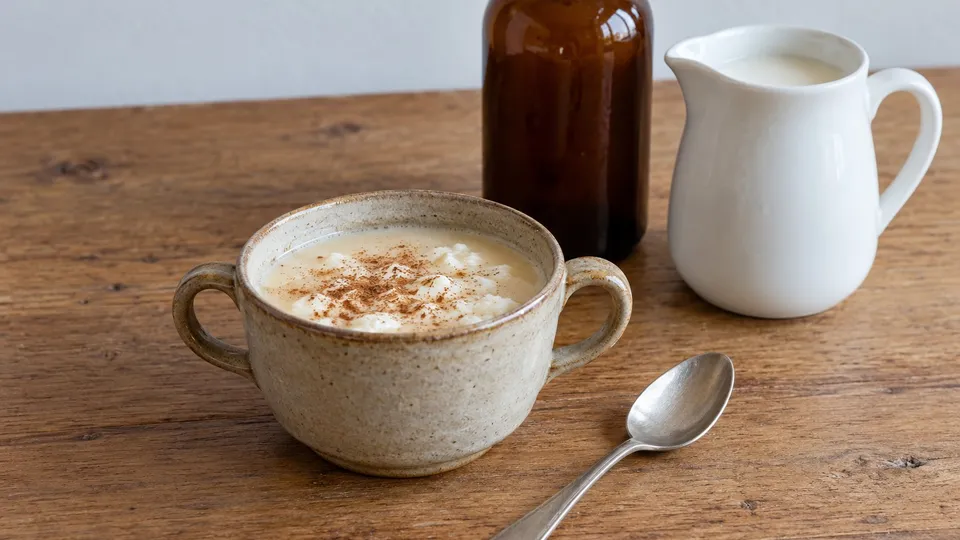 Make it todayPosset Ale, Hot Milk Curdled with Ale
Tea was advertised in September 1658 as “That excellent and by all Physicians, approved, China drink,” sold at the Sultaness Head coffee house by the Royal Exchange (as Wheatley printed the advertisement in 1893). Pepys had his first cup two years later, on September 25, 1660: “I did send for a cup of tee (a China drink) of which I never had drank before.” He went on taking his morning draft that autumn all the same. How the new drinks were brewed and sold is in How Were Coffee, Tea and Chocolate Made in 1685?
Beer at breakfast outlasted the first coffee houses by a long way. When Benjamin Franklin worked at a London printing house in 1725, his press-mate “drank every day a pint before breakfast, a pint at breakfast with his bread and cheese, a pint between breakfast and dinner,” and three more before the day was out. Some of the men later “left their muddling breakfast of beer, and bread, and cheese” for “a large porringer of hot water-gruel, sprinkled with pepper, crumb’d with bread, and a bit of butter in it, for the price of a pint of beer, viz., three half-pence,” about £1.10 today by the same Bank of England measure. Our water gruel is the plain, older form of that bowl.
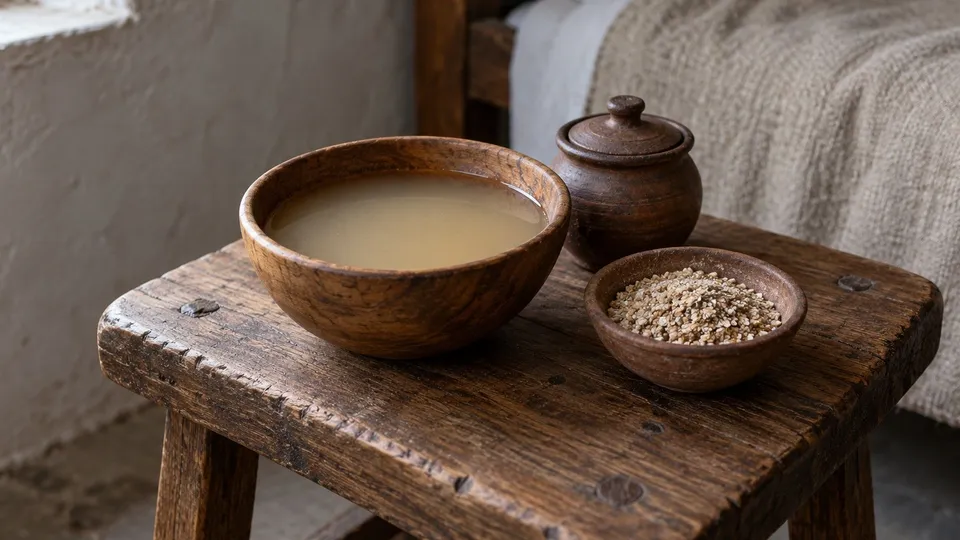 Always alcohol-freeWater Gruel, a Medieval Oat Drink for the Sick
A warm cup, fasting
The recipe books of the time give one more morning drink, and it is not ale. Sir Kenelm Digby’s Closet, printed in 1669, ends its long recipe for “Mr. Pierce’s Excellent white Metheglin,” a spiced mead, with two ways to drink it in the morning. As a remedy “in colds and coughs and consumptions,” heat it, “Then dissolve the yolk of an Egge or two in a Pint of it, and some fresh Butter, and drink it warm in the morning fasting.” Or, plain from the barrel, “a large draught … with a toste early in the morning (eating the toste) when they intend to dine late.”
The first is framed as medicine, and the second is a morning draught in all but name: one drink and a piece of toast to last until a late dinner. We make the warm cup with store-bought mead in Warm Mead with Egg and Butter, Digby’s 1669 Morning Draught, heated as gently as the medieval ale caudle it resembles. For a cup with no alcohol, Digby’s honey water, boiled with ginger and stopped before the yeast goes in, is our spiced honey water.
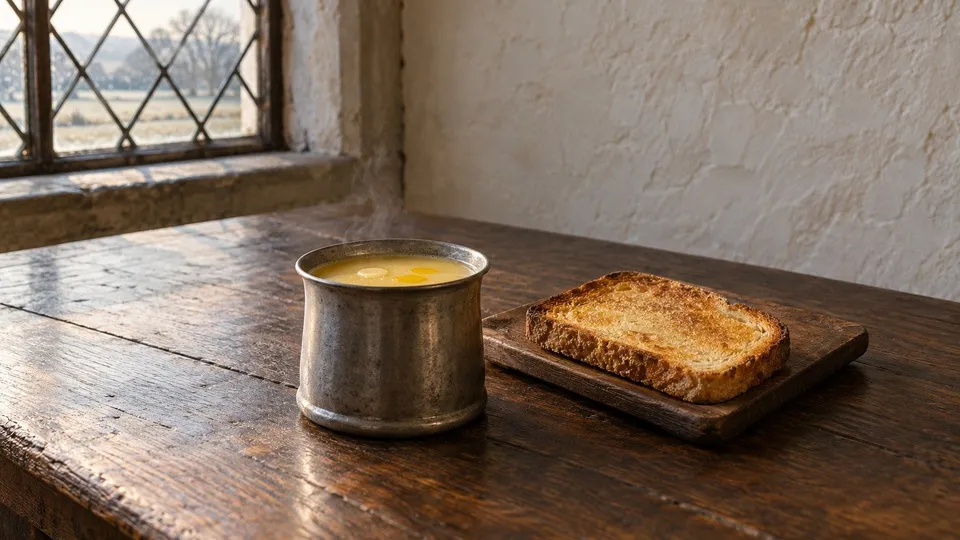 Make it todayWarm Mead with Egg and Butter, Digby’s 1669 Morning Draught
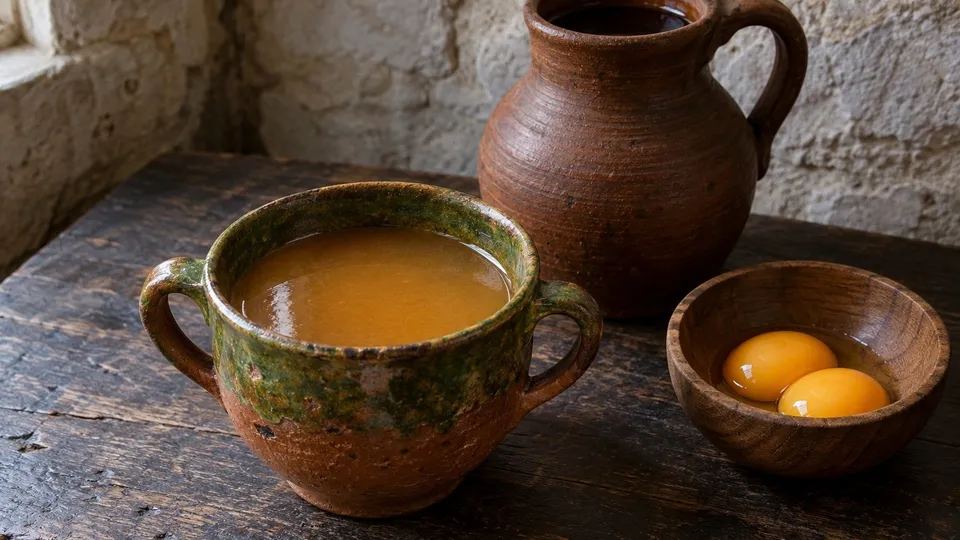 Make it todayAle Caudle, Warm Ale Thickened with Egg Yolks
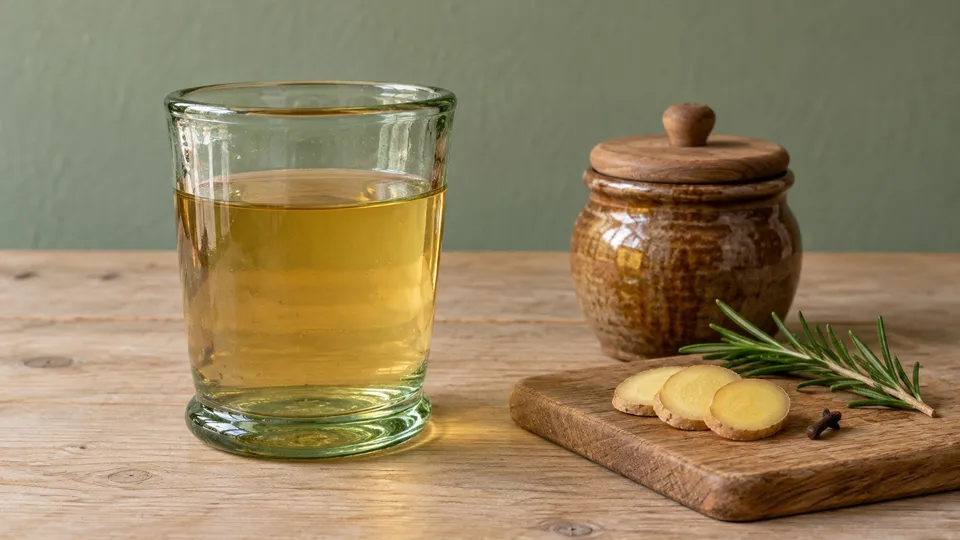 Alcohol-free versionSpiced Honey Water from Digby’s 1669 Mead
Sources
- The Regulations and Establishment of the Household of Henry Algernon Percy, the Fifth Earl of Northumberland, at His Castles of Wresill and Lekinfield in Yorkshire, Begun Anno Domini MDXII, new ed. (London: A. Brown & Sons, 1905), pp. 73, 75–76.
- William Harrison, Description of England in Shakspere’s Youth, ed. Frederick J. Furnivall, Part I (London: New Shakspere Society, N. Trübner, 1877), pp. 150, 155, 158–159, 162.
- Samuel Pepys, The Diary of Samuel Pepys, ed. Henry B. Wheatley, vol. 1 (London: George Bell & Sons, 1893), pp. 8, 20, 246, 249–250, 287.
- Pasqua Rosee, The Vertue of the Coffee Drink (London, undated, about 1652), as reproduced in William H. Ukers, All About Coffee (New York: The Tea and Coffee Trade Journal Co., 1922), pp. 53, 55.
- Benjamin Franklin, Autobiography, ed. John Bigelow (Philadelphia: J. B. Lippincott & Co., 1868), pp. 146–148.
- Sir Kenelm Digby, The Closet of the Eminently Learned Sir Kenelme Digbie Kt. Opened (London: E. C. for H. Brome, 1669), pp. 50–54.