- Wine
- History
Take, Drink: A Cup of Wine in an Egyptian Tomb
Barley beer and wine. In one Theban tomb a woman hands a sculptor his cup with a toast, and the spiced cordial in it is only an Egyptologist’s perhaps.
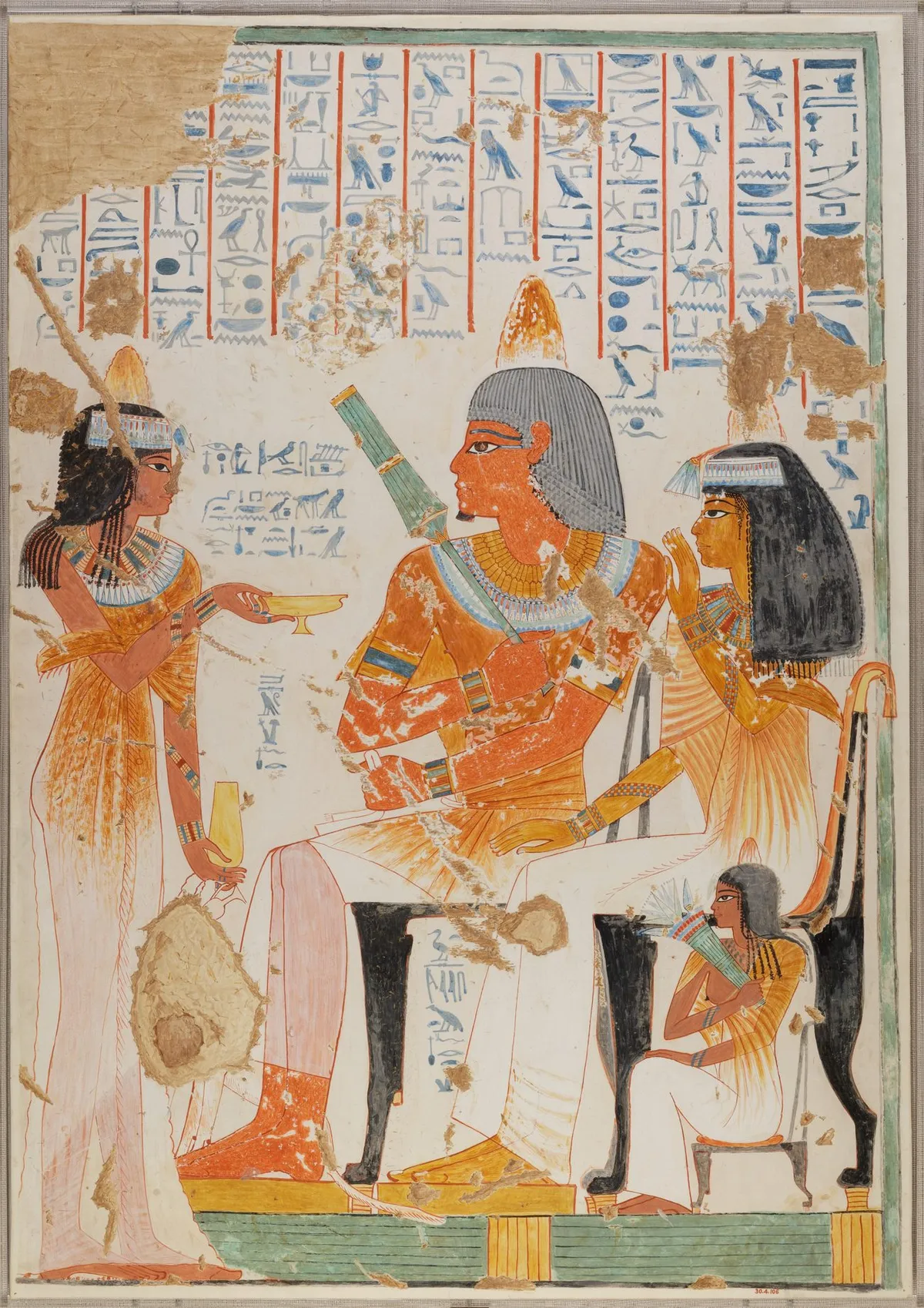
Ancient Egyptians drank barley beer and wine, and one of the clearest pictures of wine being served is painted on a tomb wall at Thebes. In the tomb of two sculptors, Nebamun and Ipuky, from the fourteenth century BC, a woman hands Nebamun his cup with a toast that the Egyptologist Norman de Garis Davies translated in 1925: “Take, drink, and pass a pleasant day within thy lasting abode.” The wall shows who poured and who drank, and it says the drink was wine. What else went into the cup it doesn’t say, and the spiced cordial sometimes credited to this scene is Davies’s guess, introduced with the word “perhaps.”
The beer side of Egypt reached Europe through Greek and Roman writers, Pliny’s “drink made from barley” among them, and that story is told in Cleopatra’s Bitter and a Babylonian Sauce. This one stays with the wine, one tomb and the one book that described it.
A pleasant day within thy lasting abode
The tomb is known today as TT181, number 181 among the private tombs of Thebes, on the west bank of the Nile opposite modern Luxor. The Metropolitan Museum of Art dates its paintings to Dynasty 18, in the reigns of Amenhotep III and Akhenaten, about 1386 to 1330 BC. Davies recorded it for the Met and published it in 1925 as The Tomb of Two Sculptors at Thebes, with his translations of the painted words.
Nebamun was a sculptor of rank. The inscription Davies translates calls him “superintendent of the sculptors of the lord of the two Egypts.” On the south wall he sits enthroned “presiding over the hour of carousal,” Davies writes, his wig “heavy with ointment,” with his mother behind him and his hound, named “Good Guardian,” at his feet. The woman before him is Henetnofret, in Davies’s reading his wife, though the Met’s catalogue is more careful and calls her his wife or his sister. Davies explains why she stands and his mother sits: she is “relegated to second place in his household during her elder’s lifetime.”
Then the cup. Henetnofret “has a pleasant word for her husband as she serves him with the wine,” and the painted words are hers: “Take, drink, and pass a pleasant day within thy lasting abode, (ministered to) by the hand of thy wife, Henetnofret.”
The lasting abode is the tomb itself. Another line says Nebamun is “sitting down to make merry during a pleasant day within his house of the West,” the West being where the sun set and the dead lived. The wishes go on, addressed through the goddess Hathor: “May she give thee leave to come up to earth and to the open forecourt of the tomb; so that thou mayest see the sun when he rises, and listen to the sound of the lowing kine.” Davies liked that touch. The lowing of cattle as music to the dead was, he thought, “a very human touch.”
The pleasures of the past
So is this a party or a funeral? Davies spent two pages on the question before he described the cup, and his answer is careful.
He sorted the feasts in Theban tombs into three kinds, and said so with a “perhaps.” One was “the regular meal of the dead,” the offerings a priest consecrates to the dead couple, which most people could only be given “pictorially or by written spell.” The second “reflects an actual presentation of food and a real assembly of living relations on the occasion of the New Year, or some other anniversary,” with the food offered to the dead “in the company of friends and to music and laughter.” The third kind, the kind on Nebamun’s wall, “commemorates primarily the pleasures of the past. No priest needs to intervene here.” In it “the daughters of the house come forward with the cup, the garland, the ointment.”
Then he warned his readers off his own system. “The distinction between these occasions of feasting was, however, not observed strictly by the decorators. The actions and words proper to the one crept often into the other.” A cup of wine at a remembered party was being handed over in a tomb, and the painters didn’t try to keep the two apart.
The same wall makes the point by itself. Below the banquet is a smaller scene for Ipuky, the second sculptor of the tomb’s name, whom Davies spells Apuki and reads as Henetnofret’s first husband. There she sits with him to receive gifts, and this feast is, Davies writes, “distinctly sepulchral”: a formal offering table, food “ritually consecrated,” and Apuki “a recipient, rather than an honored host.” Davies took the contrast to mean that when the wall was designed Apuki was dead and Nebamun still alive. Upstairs a host is given his wine; downstairs the dead are given their offerings.
Pour wine into their cups
The cup to Nebamun is the center of a larger company. His relatives sit in rows before him, men and women apart, and Davies notes that their names “are broken away or are omitted, whether from sloth or because this pretty family array scarcely corresponded to fact.” He allowed that the family on the wall might be an ideal one.
The serving goes on down the rows. “The ladies sit on cushioned chairs and are waited on by girls who place unguents on their heads, or pour wine into their cups.” Among the chairs is a detail Davies thought the prettiest on the wall, “the little yellow cat, with lolling red tongue and inordinately long tail.”
He also noticed something under the chairs. “A little bowl is set beneath the chairs for each row of men and women. It is to be feared that this is a resource in case any one should over-drink himself.” That is his reading of a bowl, supported by a footnote to scenes in other tombs, and the painting gives no use for it. His next sentence turns the guess into a sweeping judgment on Egyptians old and new, and we leave it on the page where he wrote it.
Perhaps a dash of some spicy cordial
The line most often borrowed from Davies is a clause about the wine. Henetnofret serves Nebamun “with the wine, to which she has perhaps added a dash of some spicy cordial from her little carafe.”
A small vessel in her other hand is what prompted it. The “perhaps” is his, and it matters. The toast says “take, drink”; it names no pepper, no honey, no herb and no measure, and a painted jug can’t tell us what was in it. So there is no recipe for Nebamun’s wine, and any page that offers one has made it up.
Real mixing instructions for a spiced wine come from much later and a long way off. The Roman cookbook known as Apicius, compiled more than a thousand years after this tomb was painted, tells the cook to keep ground pepper in skimmed honey for a traveler’s wine, ready to mix into the cup on the road, and to steep rose petals in wine three times over, a week at a time, then sweeten it with honey. Those are actions, written down for someone to follow. The tomb shows only a woman, a cup and a little carafe.
A copy made in 1916
The color picture at the top of this page, like most pictures of this scene, is not the wall itself. It is a facsimile in tempera on paper, painted in 1916 by the artist Nina de Garis Davies. The museum holds it as Nebamun Receiving Wine, number 30.4.106. The 1925 book also reproduces her color version of the serving group as its frontispiece and prints a line drawing of the whole south wall, banquet and offering scene together.
The copies are records of one ancient painting, so they add detail but not more parties. Where the wall has lost its names, the copies have lost them too.
A cup to make today
Nobody can pour Nebamun’s wine, so for a spiced cup with written instructions, make the Romans’. The Conditum Paradoxum is honey boiled with wine and steeped with pepper and spice, the recipe that comes just before the traveler’s peppered honey in Apicius. That traveler’s mix is the Peppered Honey Wine, ground pepper in skimmed honey stirred into white wine in the cup. The Rosatum is the rose wine steeped three times and sweetened at the end. Both are Roman, and neither is Egyptian.
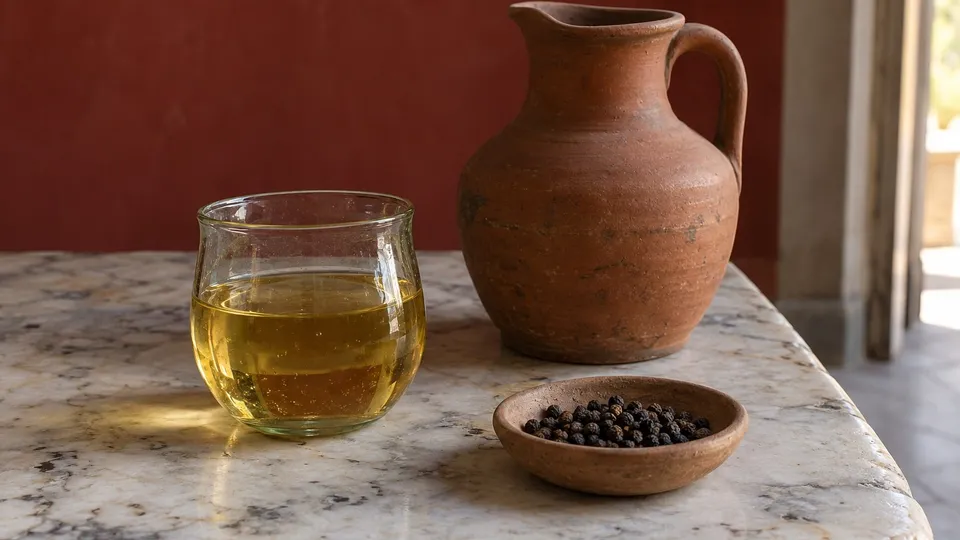 Make it todayConditum Paradoxum, Roman Spiced Honey Wine
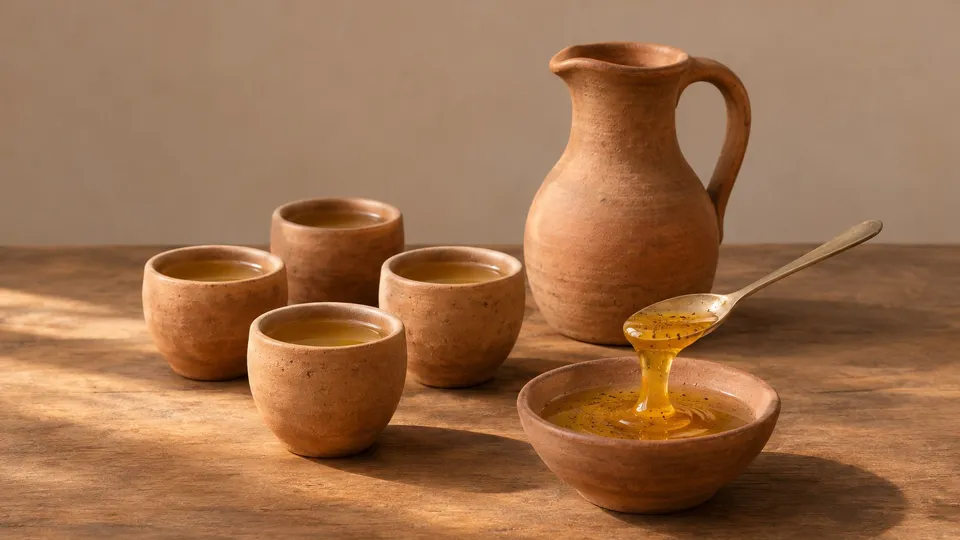 Make it todayPeppered Honey Wine, the Roman Traveler’s Mix
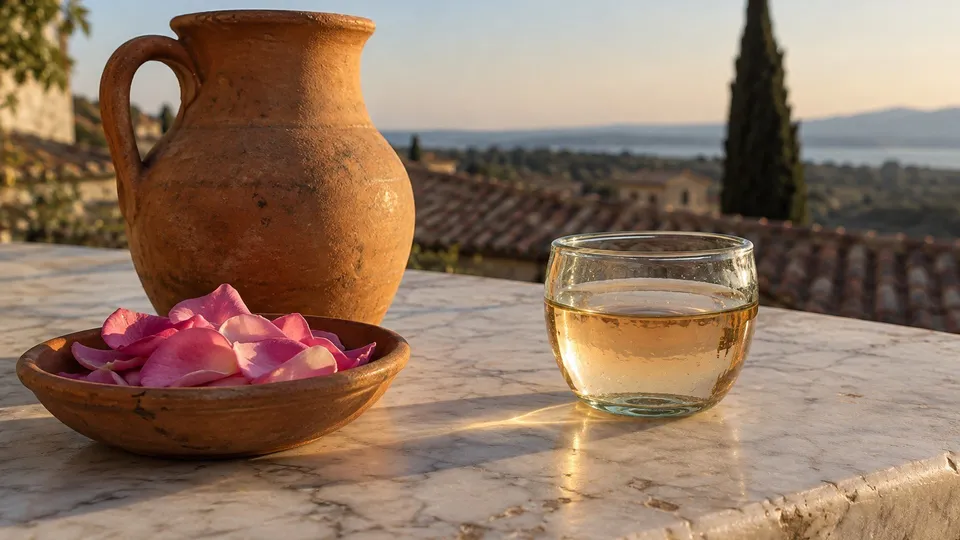 Make it todayRosatum, Roman Rose Wine
Without the wine, the same peppered honey goes into white grape juice in the Alcohol-Free Peppered Honey Grape Juice, and the Defrutum Cooler stirs Roman grape syrup into cold water, a sweet dark grape drink with no alcohol in it. And for the barley side of the Nile, the Sweet Wort is the unfermented malt liquid that every beer starts from. For more on what the Romans did to their wine, read What Did Roman Wine Taste Like?
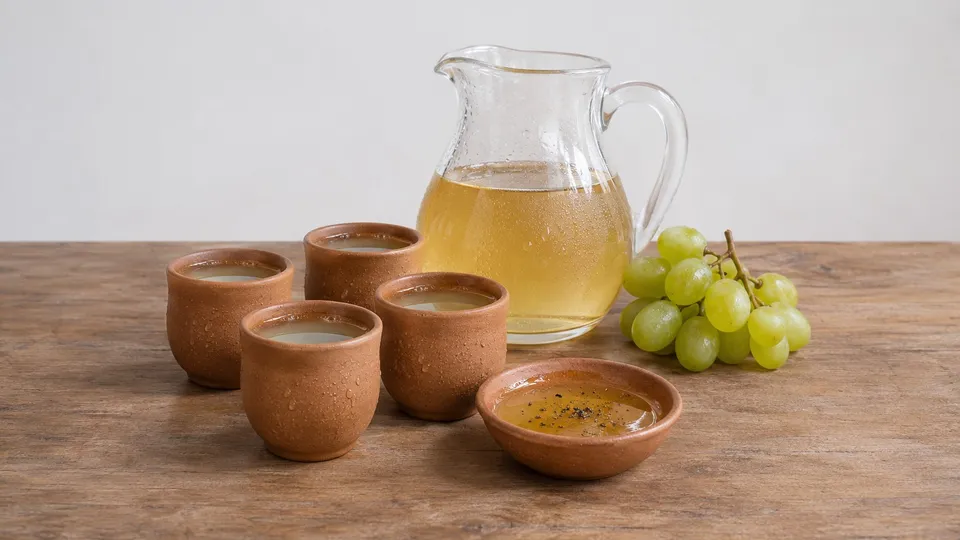 Alcohol-free versionAlcohol-Free Peppered Honey Grape Juice, after Apicius
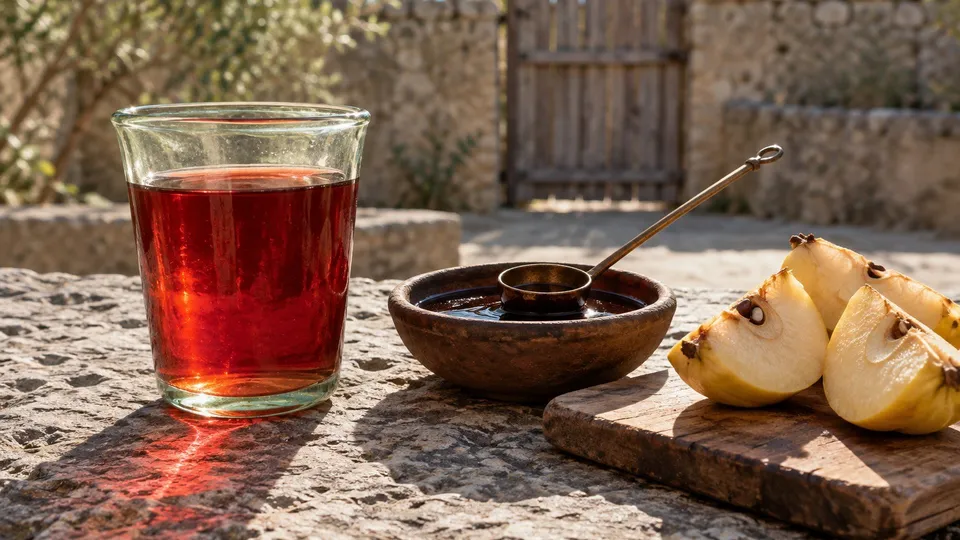 Always alcohol-freeDefrutum Cooler, Roman Grape Syrup and Water
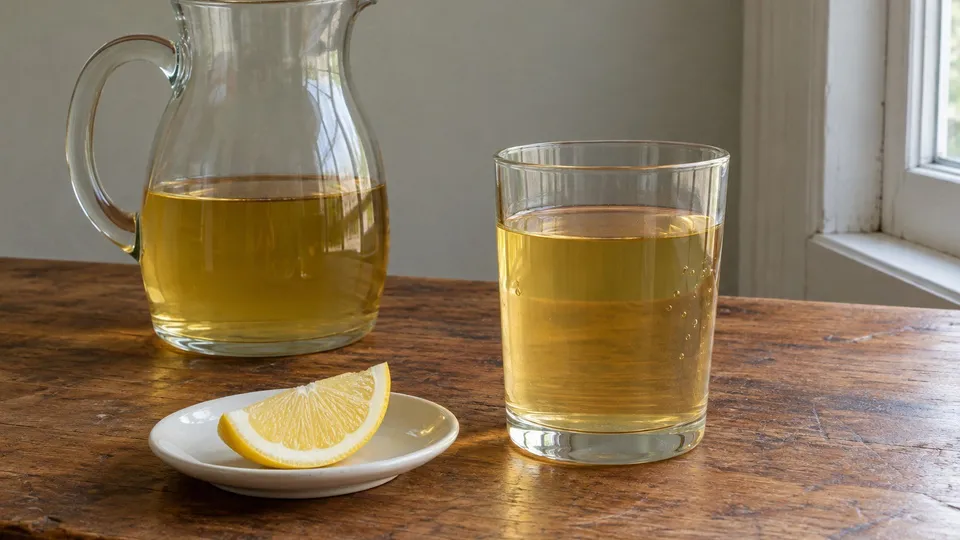 Alcohol-free versionSweet Wort, the Malt Drink Before the Beer
Sources
- Norman de Garis Davies, The Tomb of Two Sculptors at Thebes, Robb de Peyster Tytus Memorial Series IV (New York: Metropolitan Museum of Art, 1925), pp. 52–56, frontispiece (plate I) and plate V. Getty Research Institute copy, Internet Archive.
- The Metropolitan Museum of Art, Nebamun Receiving Wine, facsimile by Nina de Garis Davies, 1916, tempera on paper, Rogers Fund, 1930, accession 30.4.106, online collection record.
- Apicii librorum X qui dicuntur De re coquinaria quae extant, ed. C. Giarratano and Fr. Vollmer (Leipzig: Teubner, 1922), Book I, pp. 6–7.