Peppered Honey Wine, the Roman Traveler’s Mix
Reader ratingsGround pepper kept in skimmed honey, ready to stir into a cup of wine on the road: the traveler’s conditum from the Roman cookbook of Apicius, made as a small batch for four.
- Recipe makes
- About 540 ml, 4 small cups
- Prep
- Cook
- Total
Includes about 20 minutes for the peppered honey to cool before the wine goes in.
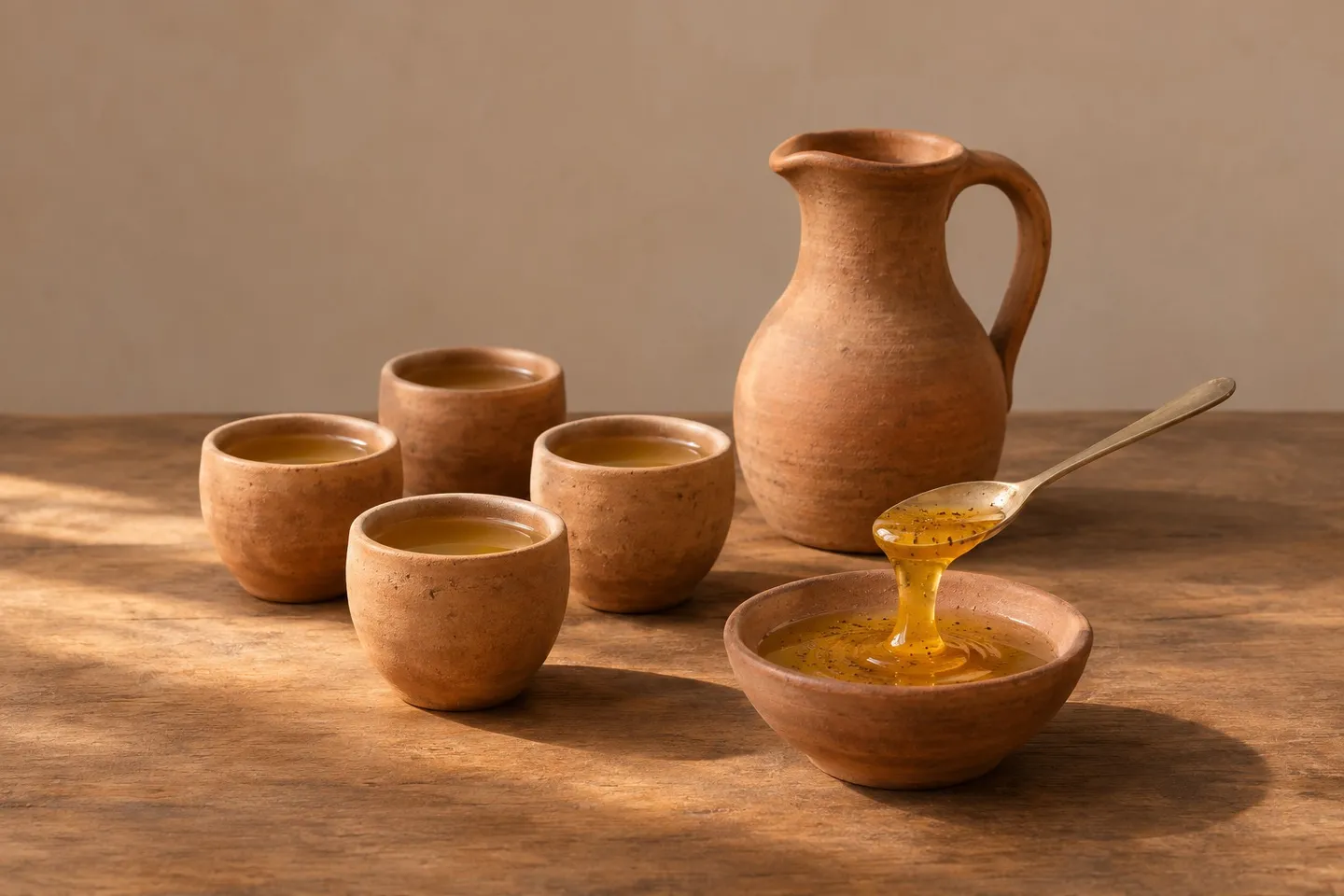
Peppered honey wine in four earthenware cups, with a jug of white wine and a bowl of peppered honey.
The story behind the recipe
The Roman traveler’s spiced wine was not carried as wine. It was carried as peppered honey. The cookbook that goes under the name of Apicius tells the cook to put ground pepper in skimmed honey in a small vessel, “in place of conditum,” so that on the road, whenever a drink was wanted, the honey could be brought out and mixed with wine in the cup.
Spiced wine, the short way
The recipe sits second in the book, straight after the grand Conditum Paradoxum, with its boiled honey, saffron, bay, mastic and eighteen measures of wine. The traveler’s version keeps only two of those things, honey and pepper, and leaves the wine until the moment of drinking. Its Latin name, conditum melizomum viatorium, makes it a traveler’s honeyed conditum, and the text calls it perpetuum, lasting, which is the Roman cook’s word, not a modern promise. It even anticipates the trouble with honey in a jar: if the vessel is larger, put some wine in with the peppered honey so that it pours more easily.
The Egyptian story that sent us back to this recipe is about a much older cup. The tomb painting described in What Did Ancient Egyptians Drink? shows a woman who may have added “a dash of some spicy cordial,” in one Egyptologist’s guess, but no Egyptian text gives a mixing instruction. Apicius does, more than a thousand years later and far away, so this is a Roman comparison, not Nebamun’s wine.
Read more about this recipe
Making it today
Apicius gives no amounts, so all of ours are choices. We warm the honey with a spoonful of water and skim it, as his “skimmed honey” asks, then stir in a mild eighth of a teaspoon of pepper, enough to notice, and cool it. Each cup takes a quarter of the peppered honey and 125 ml of dry white wine, stirred together just before drinking. With wine at 12%, the cup comes to about 11% alcohol by our arithmetic, and the honey adds only about 4 grams of sugar per 100 ml, so it is lightly sweet. For a cup without wine, the Alcohol-Free Peppered Honey Grape Juice uses the same honey with white grape juice.
Apicius, Book I, recipe 2, from the edition of Giarratano and Vollmer (Leipzig, 1922), p. 6. The word in angle brackets was supplied by the editors.
CONDITVM MELIZOMVM VIATORIVM. Conditum melizomum perpetuum, quod subministratur per viam peregrinanti: piper tritum cum melle despumato in cupellam mittis conditi loco, et ad momentum quantum sit bibendum, tantum aut mellis proferas aut vini misceas. sed si ⟨maius⟩ vas erit, nonnihil vini melizomo mittas, adiciendum propter mellis exitum solutiorem.
In our translation:
A lasting honeyed conditum, supplied to a traveler on the road: put ground pepper with skimmed honey into a small vessel in place of conditum, and at the moment, as much as is to be drunk, so much honey bring out, or mix in wine. But if the vessel is larger, put some wine into the honey mixture, to be added so that the honey flows out more freely.

Recipe makes: About 540 ml, 4 small cups
Ingredients
My drinksFor About 540 ml, 4 small cups. Quantities are shown as written.
Quantities as written here, for About 540 ml, 4 small cups.
- Honey30 g
- Water15 ml
- Finely ground black pepper1/8 metric tsp (5 ml per tsp)
- Dry white wine500 ml
Measurement notes
Ingredients as written here
- 30 g honey
- 15 ml water
- 1/8 tsp finely ground black pepper
- 500 ml dry white wine
Equipment
 Small saucepan
 Spoon
 Small jar or bowl
 4 small cups
Instructions
Put the honey and the water in the small saucepan and warm them gently, stirring, until the honey is runny.
Bring it just to a gentle simmer for about a minute and skim off any foam with the spoon.
Take it off the heat, stir in the finely ground black pepper and pour it into the small jar. Leave it to cool, about 20 minutes.
Divide the peppered honey between the cups. Pour a little of the dry white wine into each and stir to loosen the honey, then fill each cup with the rest of its quarter of the wine and stir again.
Serve it at once, stirring once more, since the pepper settles.
Nutrition
125calories per serving
- Recipe makes
- About 540 ml, 4 small cups
- Servings
- 4
Roughly estimated from USDA FoodData Central values for dry white wine and honey, for one 135 ml cup.
Recipe notes
When adjusting quantities
Apicius gives no amounts. Keep about 7 g of honey and a small pinch of pepper to each 125 ml of wine, and add pepper to taste.
Notes
Quantities mentioned in these notes don’t change when you adjust the batch.
Changes from the source: every amount, the spoonful of water, the minute’s simmer and the cooling are ours, since Apicius gives none. Making it in four cups at once is ours too; his mixture was a store for the road, cup by cup.
Make the peppered honey fresh for each batch. Apicius calls his mixture lasting, but we haven’t established a safe keeping time for it, so keep it covered in the fridge and use it within a day or two, our cautious advice.
For more pepper, add it a pinch at a time to the cooled honey. Romans usually watered their wine, so a splash of cold water in each cup is in keeping, as told in What Did Roman Wine Taste Like?
Scaling changes the ingredients only; glassware, ice and timings need their own judgment. To adapt this recipe further, try the recipe tool at TuneMyRecipe (opens in a new tab), our sister site.
Sources and attribution
Apicius, De re coquinaria, Book I, recipe 2, “Conditum melizomum viatorium,” in Apicii librorum X qui dicuntur De re coquinaria quae extant, ed. C. Giarratano and F. Vollmer (Leipzig: B. G. Teubner, 1922), p. 6; our translation
Recipe details
- Drink family
- Wine, Beer & Mead
- Era
- Ancient Rome
- Difficulty
- Easy