Cleopatra’s Bitter and a Babylonian Sauce: Ancient Beer in Victorian Drink Books
Victorian and Edwardian drink books got the ancients charmingly wrong: a Babylonian sauce listed as a drink, and Cleopatra pulling a pint of bitter.
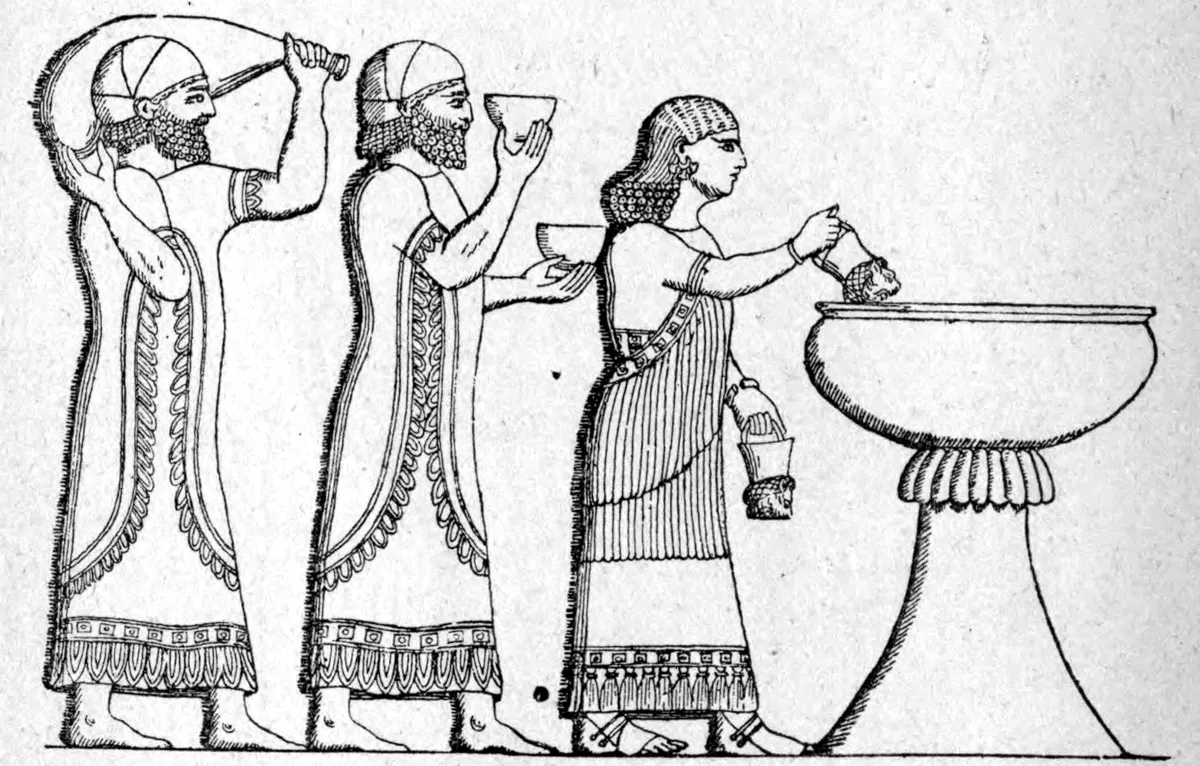
Victorian and Edwardian drink writers liked to start with the ancients, and they got them charmingly wrong. In 1892 Drinks of the World listed a Babylonian “mixed drink” called Cuttach, which the Talmud describes as a sauce of whey, salt and moldy bread. In 1903 The Flowing Bowl pinned a Scythian habit on the Babylonians and pictured Cleopatra drawing Mark Antony a pint of bitter. A drink of their own day comes a few pages later in Spencer’s book, and it is much easier to believe: an ale cup of mild ale, sherry and brandy, poured over hot toast.
A mixed drink used in Babylon
James Mew and John Ashton’s Drinks of the World came out in London in 1892. On page 20, among the drinks of the ancient world, they found one with a reputation. “According to the Abodah Zarah, a treatise on false worship, there was a mixed drink used in Babylon called Cuttach, which possessed marvellous properties.”
The properties were all bad. “It obstructs the heart, blinds the eyes, and emaciates the body. It obstructs the heart, because it contains whey of milk; it blinds the eyes, because it contains a peculiar salt which has this property; and it emaciates the body, because of the putrefied bread which is mixed with it.” They added more: “If poured upon stones, it breaks them; and of it is a proverb, ‘That it is better to eat a stinking fish than take Cuttach!’” And they noted, almost in passing, that “The same treatise also mentions Median beer and Edomite vinegar.”
The drawing at the top of this page is on the same page of their book. It shows cups being filled from a great bowl at an Assyrian feast, and Mew and Ashton describe it as the filling of wine cups, not beer.
Kuthach at Passover
The same description turns up in the Talmud’s tract on Passover, in a list of foods that count as leaven and must not be in a Jewish house during the festival. Michael Rodkinson’s English translation of 1896 gives the Mishnah’s list: “Babylonian Kuthach, Median beer (made of wheat or barley), Edomite vinegar (made by the fermentation of barley and wine), Egyptian zeethum,” and more.
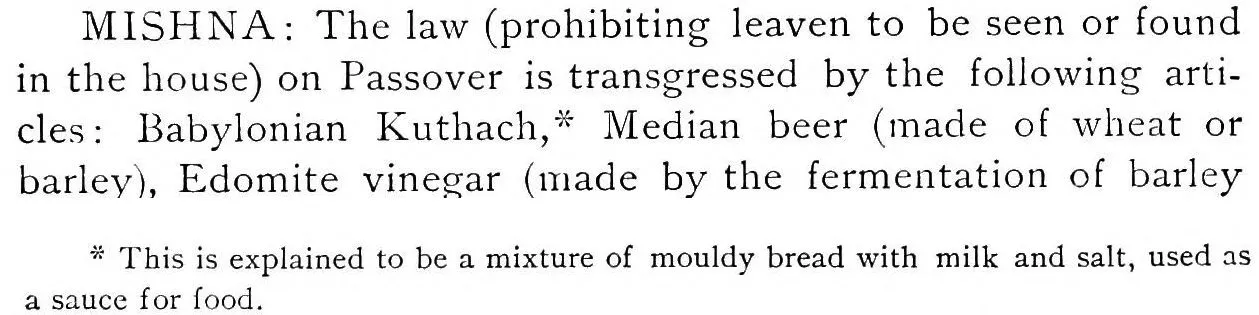 Tract Pesachim, translated by Michael L. Rodkinson (New York, 1896), p. 68, with its footnote to Kuthach.
The discussion that follows is the one Mew and Ashton were quoting. “It depresses the heart, blinds the eyes, and makes the body lean. It depresses the heart on account of the whey contained therein, it blinds the eyes on account of the salt, and makes the body lean on account of the mould (on the bread).” Rodkinson’s footnote says what it was: “This is explained to be a mixture of mouldy bread with milk and salt, used as a sauce for food.”
So the Babylonian mixed drink was a dip. It was banned at Passover because of the bread in it, and the beer in the same list was Median. The stone-breaking and the stinking fish aren’t in Rodkinson’s version, which is abridged, so Mew and Ashton were working from a fuller text, and the tract they name may be a slip or may be right; we can’t say which. Either way, “Babylonian” here means the Babylonia of the rabbis, whose Talmud dates from about AD 200 to 500, more than two thousand years after the Sumerian brewery accounts.
A glass of bitter with a head on it
Edward Spencer, who sometimes wrote as “Nathaniel Gubbins,” published The Flowing Bowl in 1903, a treatise “on drinks of all kinds and of all periods.” In its chapter “Drinks Ancient and Modern,” on page 23, he reached Babylon.
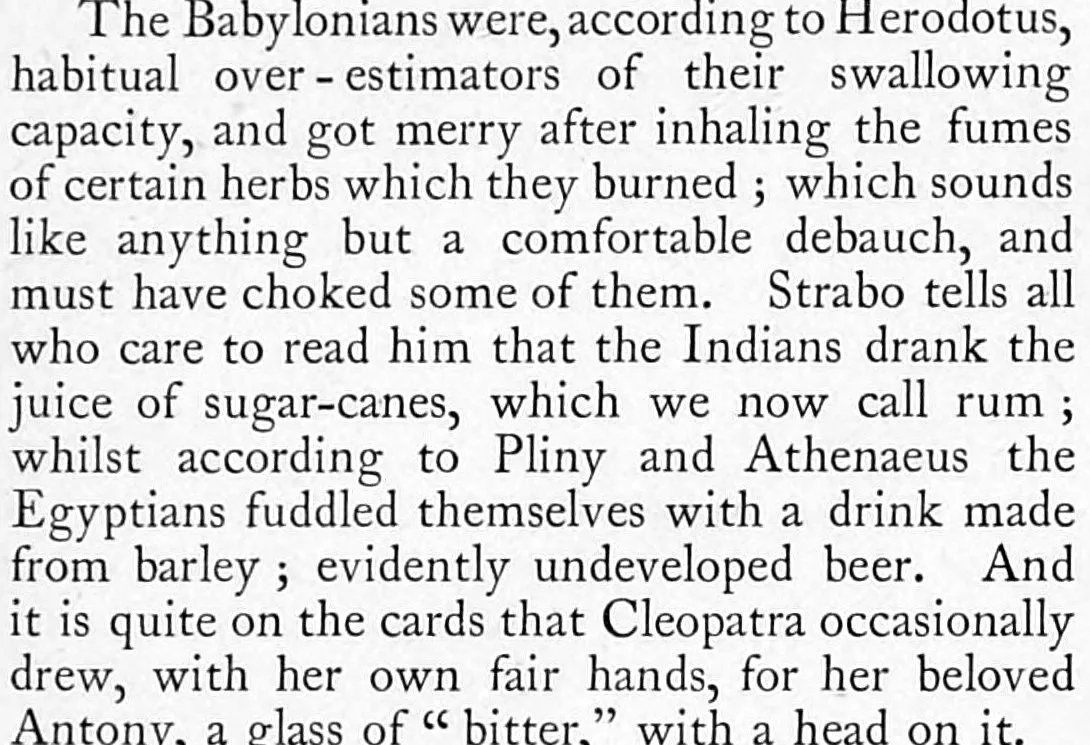 Edward Spencer, The Flowing Bowl (London, 1903), p. 23.
“The Babylonians were, according to Herodotus, habitual over-estimators of their swallowing capacity, and got merry after inhaling the fumes of certain herbs which they burned; which sounds like anything but a comfortable debauch, and must have choked some of them.”
Herodotus does tell something like it, but of another people. In Book I he describes the islanders of the river Araxes, beyond the Caspian, who had found a tree with an odd fruit. In George Rawlinson’s translation of 1862: “When they are met together in companies they throw some of it upon the fire round which they are sitting, and presently, by the mere smell of the fumes which it gives out in burning, they grow drunk, as the Greeks do with wine.” Spencer moved the party to Babylon and turned the fruit into herbs.
A few lines on, he got to Egypt: “according to Pliny and Athenaeus the Egyptians fuddled themselves with a drink made from barley; evidently undeveloped beer. And it is quite on the cards that Cleopatra occasionally drew, with her own fair hands, for her beloved Antony, a glass of ‘bitter,’ with a head on it.” Egypt did have its barley drink, as Pliny says. The rest is Spencer’s joke, an English pub pull set in Alexandria, and he meant it as one.
Beer, or rather sweet wort
The scholars of the day were more careful, and their caution shows in the footnotes. When John Bostock and H. T. Riley translated Pliny’s Natural History for Bohn’s library in 1855, they reached his passage on “intoxicating drinks, made from corn steeped in water.” The passage itself is quoted in What Did Romans Drink Besides Wine?; here it is the notes that matter.
The first one hedges: “He alludes to beer, or rather sweet wort, for hops were not used till the latter part, probably, of the middle ages.” To these translators, beer meant hopped beer, so an unhopped grain drink was only a sort of beer. The second note cites an older Greek author against the idea that it was weak: “Diodorus Siculus says that the Egyptian beer was nearly equal to wine in strength.”
So by 1855 the two sides of the modern argument were already on one page: was ancient beer a mild, sweetish grain drink, or something nearly as strong as wine? No translator of the time could settle it, and the sources the Victorians had, Greek and Latin writers describing other people’s drinks, couldn’t either. Sweet wort, at least, can be drunk today with no guesswork: it is the unfermented malt liquid that every beer starts from, on our pages as Sweet Wort, the Malt Drink Before the Beer, with no alcohol in it.
 Alcohol-free versionSweet Wort, the Malt Drink Before the Beer
A cup of their own day
Spencer’s book comes back to beer in its chapter “Glorious Beer,” and there he gives “a few modern recipes for tasty beer-compounds.” The first is an Ale Cup (Cold). It is nothing like his Babylonians. “Squeeze the juice of a lemon into a round of hot toast; lay on it a thin piece of the rind, a tablespoonful of powdered sugar, a little grated nutmeg or powdered all-spice, and a sprig of balm. Pour over these one wine-glass of brandy, two of sherry, and three pints of mild ale. Do not allow the balm to remain in many minutes.” The same book’s claret cups and lemon squash are the summer side of the same table, told in What Did People Drink in an Edwardian Country House?
Make Spencer’s Ale Cup, because it is a drink of his own day, not one he imagined for the ancients: a jug of cold mild ale with sherry and brandy over hot toast, ready in ten minutes, at about 6% alcohol. For guests who don’t drink, the Alcohol-Free Ale Cup keeps the toast, the lemon and the balm, with a 0.0% ale and white grape juice.
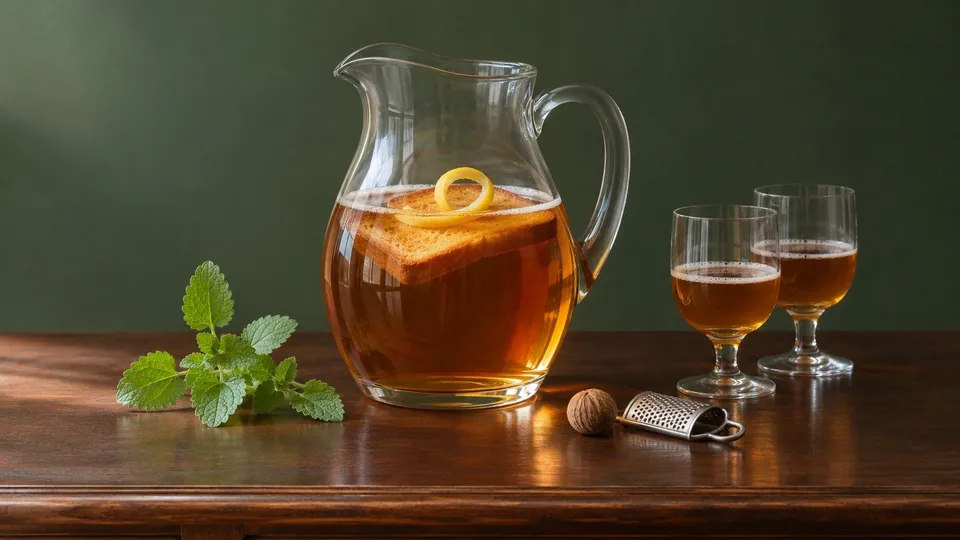 Make it todayAle Cup, Cold Ale with Sherry and Brandy over Toast
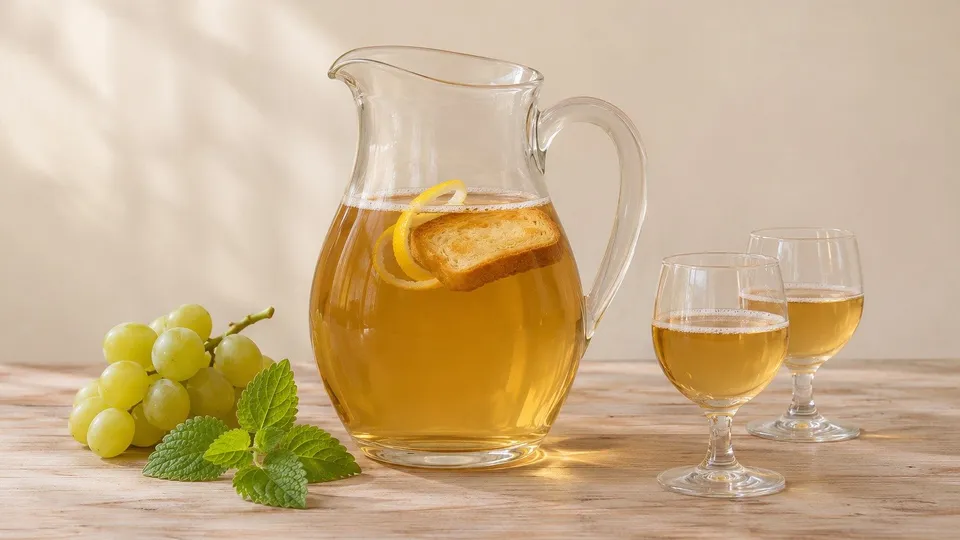 Alcohol-free versionAlcohol-Free Ale Cup, with White Grape Juice over Toast
Sources
- James Mew and John Ashton, Drinks of the World (London: Leadenhall Press, 1892), p. 20, text and drawing. Internet Archive.
- Michael L. Rodkinson, trans., New Edition of the Babylonian Talmud, vol. 5, Tract Pesachim (Passover) (New York: New Talmud Publishing Co., 1896), ch. III, p. 68. Cornell University Library copy, Internet Archive.
- Edward Spencer, The Flowing Bowl: A Treatise on Drinks of All Kinds and of All Periods (London: Grant Richards, 1903), pp. 23 and 55. Wellcome Collection copy, Internet Archive.
- George Rawlinson, trans., The History of Herodotus, vol. 1 (London: John Murray, 1862), Book I, ch. 202, p. 275. Internet Archive.
- The Natural History of Pliny, vol. 3, trans. John Bostock and H. T. Riley (London: Henry G. Bohn, 1855), Book XIV, ch. 29, p. 274, notes. Internet Archive.