How Was Eggnog First Made?
Beaten yolks, milk, sugar, rum or brandy and nutmeg, mixed cold in a bowl: the first printed eggnogs (1837, 1839) and how Jerry Thomas made it one shaken glass.
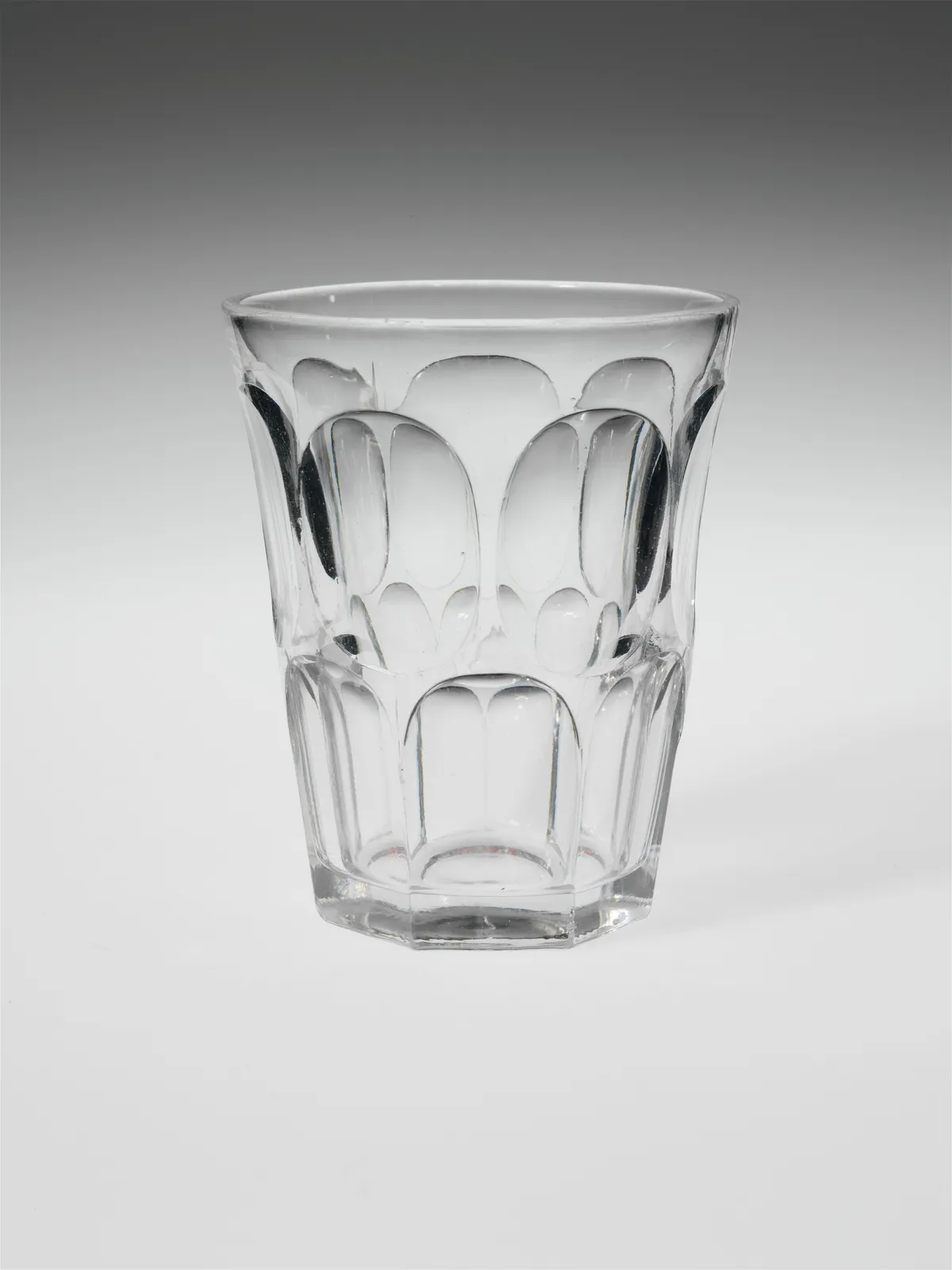
The first eggnogs were cold drinks mixed in a bowl. Egg yolks were beaten and stirred into milk or thin cream with sugar, rum or brandy went in next, then a grated nutmeg, and the whites, beaten separately, were folded through at the end. Among the earliest printed recipes are two American ones, from 1837 and 1839, and they agree almost measure for measure. In 1862 the bartender Jerry Thomas cut the bowl down to a single glass shaken with ice. Britain’s egg drinks were close relatives but ran hot: ale or wine heated nearly to the boil, poured onto beaten eggs and tossed between two jugs until it frothed.
This story is part of our Christmas Drinks From History guide.
Over the next quarter century the mixture hardly changed. The scale did: a china bowl for a household in the 1830s, a tumbler for one customer at the bar by the 1860s.
A word older than the recipe
The name is half a century older than the recipes. The lexicographer Fred Shapiro found “egg nog” in a New Jersey newspaper of 1788, in a report of a young man who had eaten thirty raw eggs and drunk a glass of egg nog. We know the item from the word historians who report Shapiro’s find, Ben Zimmer and Wordorigins.org, and it names the drink without saying what was in it. “Nog” had been an English word for a strong ale brewed in East Anglia, recorded in 1693. How it came to name an American drink of milk and eggs is not known, and the popular explanation that eggnog is short for “egg and grog” has nothing behind it.
Two cookbooks and one bowl
Eliza Leslie’s Directions for Cookery, published in Philadelphia in 1837, gives the drink a short paragraph in its chapter on domestic liquors.
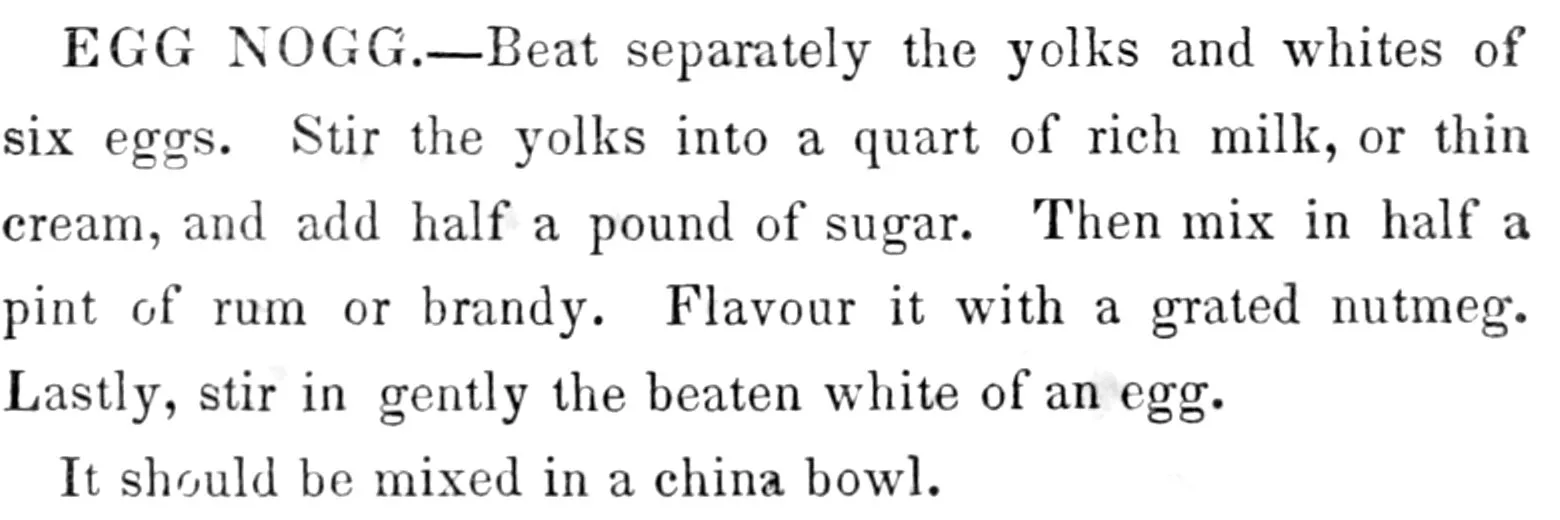 Eliza Leslie, Directions for Cookery (Philadelphia: Carey & Hart, 1837), p. 407.
Six eggs, a quart of milk or cream, half a pound of sugar and half a pint of spirit made a large, sweet bowl. Made with today’s 40 percent rum or brandy, it would come out at about 6 or 7 percent alcohol, the strength of a strong beer. Leslie separates all six eggs and then stirs in “the beaten white of an egg,” one, as printed, leaving the other five whites unaccounted for. Her last line is about the vessel: “It should be mixed in a china bowl.”
Two years later, Lettice Bryan’s The Kentucky Housewife (Cincinnati, 1839) printed the same drink with all the whites beaten “to a stiff froth” and stirred in at the end, a choice between half a pint of rum or three gills of brandy, and a reason for the order of work.
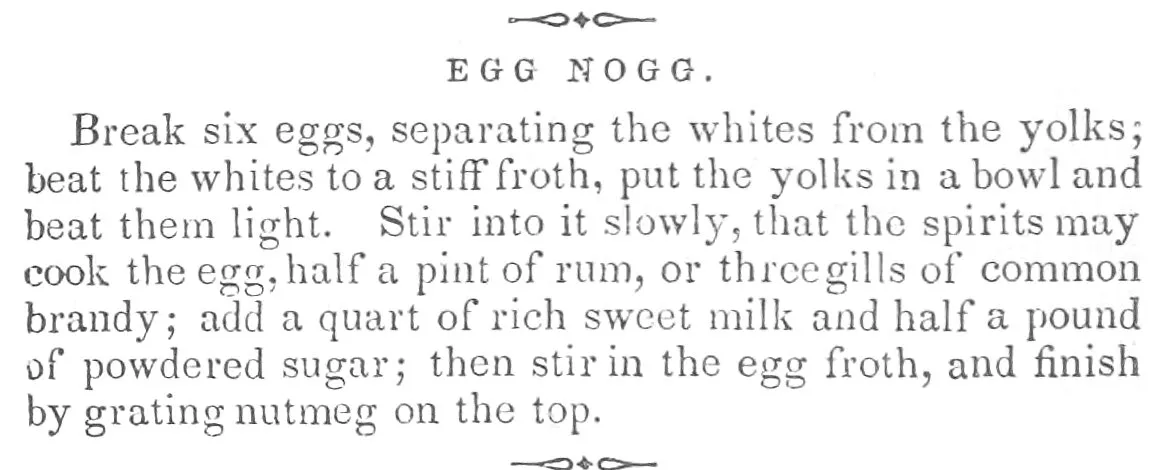 Lettice Bryan, The Kentucky Housewife (Cincinnati: Shepard & Stearns, 1839), p. 408.
The spirit goes into the beaten yolks slowly, “that the spirits may cook the egg.” Bryan believed the rum did the work of the fire. The US Food and Drug Administration, as quoted by Food Safety News, says the opposite: “you can’t count on the alcohol in the drink to kill all of the bacteria.” Raw egg in a homemade eggnog today should be pasteurized (in the US) or carry the British Lion mark (in the UK), or the egg and milk should be heated together to 160 °F (71 °C) first.
Neither Leslie nor Bryan heats anything, and neither mentions Christmas. Bryan’s page has a hint of how ordinary milk drinks were in her kitchen: “Apple and quince punch are nothing more than baked apples or quinces put into common milk punch.”
One glass and a tin shaker
Jerry Thomas’s How to Mix Drinks, or, The Bon-Vivant’s Companion (New York, 1862) opens its eggnog pages with a claim for the drink’s nationality.
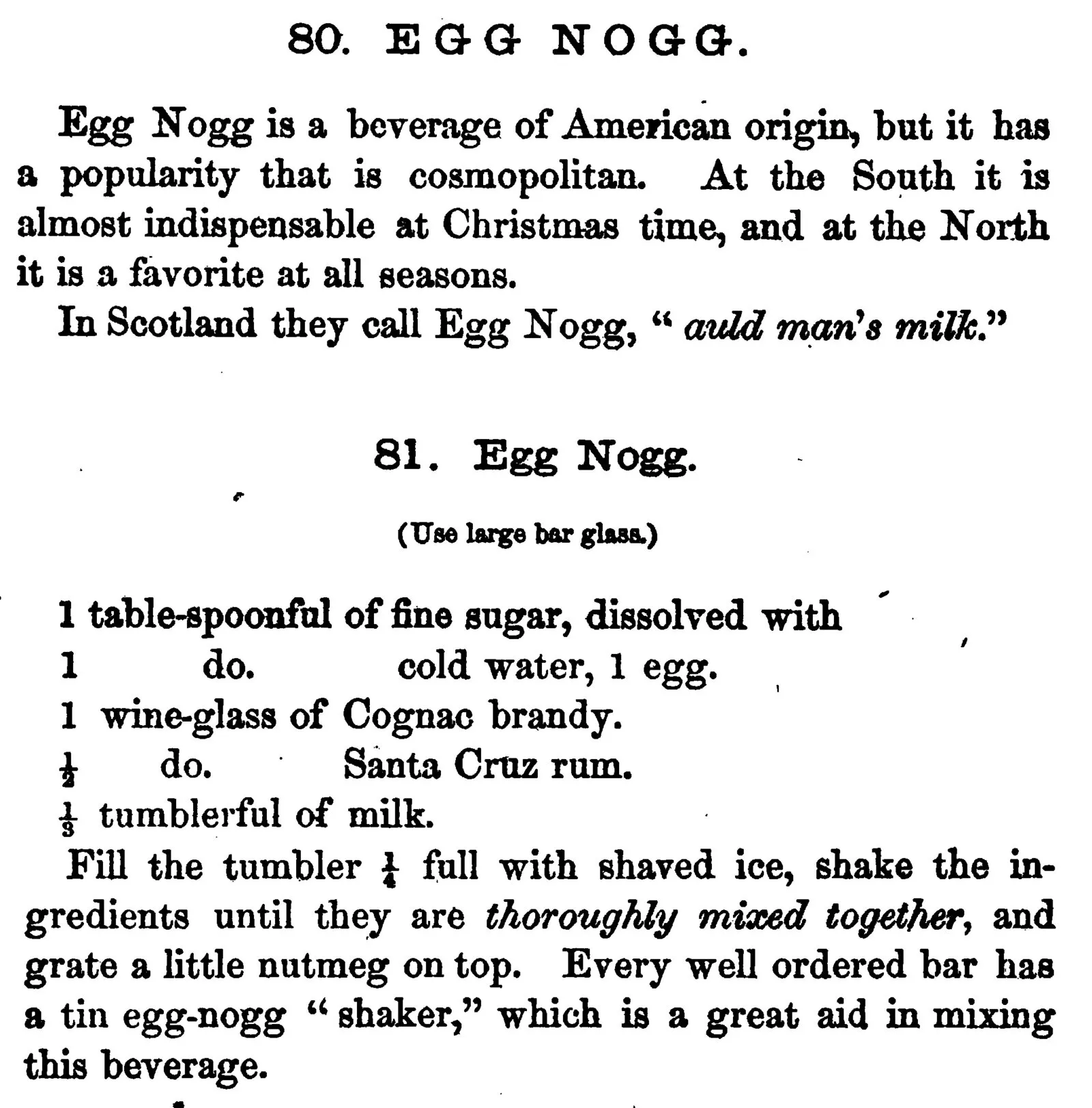 Jerry Thomas, How to Mix Drinks, or, The Bon-Vivant’s Companion (New York: Dick & Fitzgerald, 1862), p. 40.
“Egg Nogg is a beverage of American origin,” he writes, and in the South “it is almost indispensable at Christmas time, and at the North it is a favorite at all seasons.” He adds that in Scotland they call it “auld man’s milk.”
His Egg Nogg, No. 81, is made one at a time in a large bar glass: a tablespoon of sugar dissolved in a tablespoon of cold water, one egg, a wine-glass of Cognac, half a wine-glass of Santa Cruz rum from St. Croix, and a third of a tumbler of milk, shaken with shaved ice and dusted with nutmeg. In the single glass nobody beats the whites separately. “Every well ordered bar has a tin egg-nogg ‘shaker,’” Thomas notes, and the shaker does that job. TuneMyRecipe has a guide to what shaking does to a mixed drink (opens in a new tab), with Thomas’s own cocktails as examples.
Set his recipe beside his Milk Punch, No. 22 in the same book, and the two match in sugar, brandy and rum; the eggnog adds the egg and takes less milk. That makes the bar version much stronger than the old bowl, about 12 percent alcohol by our arithmetic. Our Egg Nogg follows No. 81 as printed.
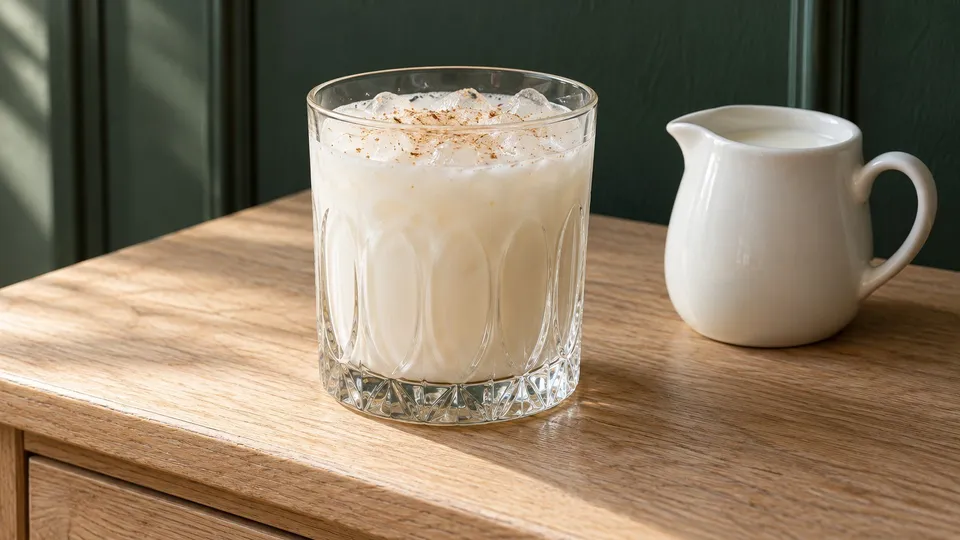 Make it todayMilk Punch, Brandy and Rum Shaken with Milk
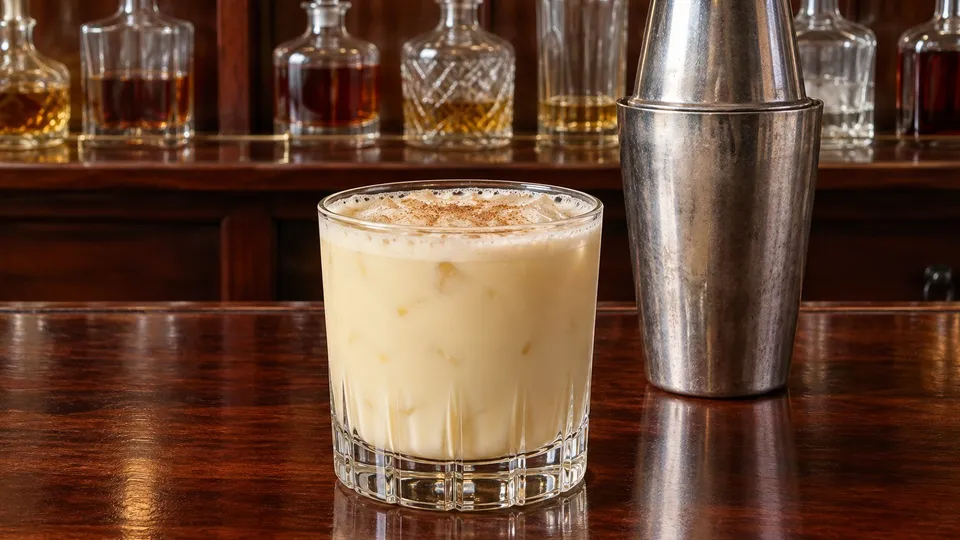 Make it todayEgg Nogg, the 1862 Bar Eggnog
Thomas kept the bowl for parties, and there the whites are still beaten on their own. His eggnog “for a party of forty” takes a dozen eggs, two quarts of brandy, a pint of rum, two gallons of milk and a pound and a half of sugar, with the whites floated on top to “ornament with colored sugars.” It is cooled in a tub of ice. His Baltimore Egg Nogg, made with sixteen yolks and two wine-glasses of Madeira, ends: “There is no heat used.” He also claims that it “is digestible, and will not cause headache,” and makes “a nourishing diet for consumptives.” Those are Thomas’s claims, made in 1862.
Hot cousins across the Atlantic
The British egg drinks of the same years started with hot liquor, poured onto eggs beaten in a jug. William Kitchiner’s The Cook’s Oracle (1822 edition) prints a flip “in the words of the Publican who gave us the Receipt.” Ale heated nearly to the boil went into one pitcher, three or four eggs beaten with moist sugar, nutmeg or ginger and a measure of rum or brandy into another, and the two were turned from pitcher to pitcher “till it is as smooth as Cream.” The publican called that quart One Yard of Flannel. Forty years on, Thomas printed an Egg Flip of hot ale and eggs that, “from its fleecy appearance, is sometimes designated ‘a yard of flannel.’”
Oxford Night Caps (4th edition, 1847) makes its egg flip with wine. Its Rum Booze, “sometimes denominated Egg Flip,” boils a bottle of white wine with cinnamon and lemon-rubbed sugar, takes the edge off it with a glass of cold wine, and pours it gradually onto eight beaten yolks, then passes it between two vessels “until a fine white froth is obtained.” The book warns that wine poured boiling onto the eggs will curdle them. Its Beer Flip uses strong home-brewed beer instead, and “is generally given to servants at Christmas.” Of Rumfustian, made with beer, white wine and gin, it says that “none but hard drinkers will venture to regale themselves with it a second time.”
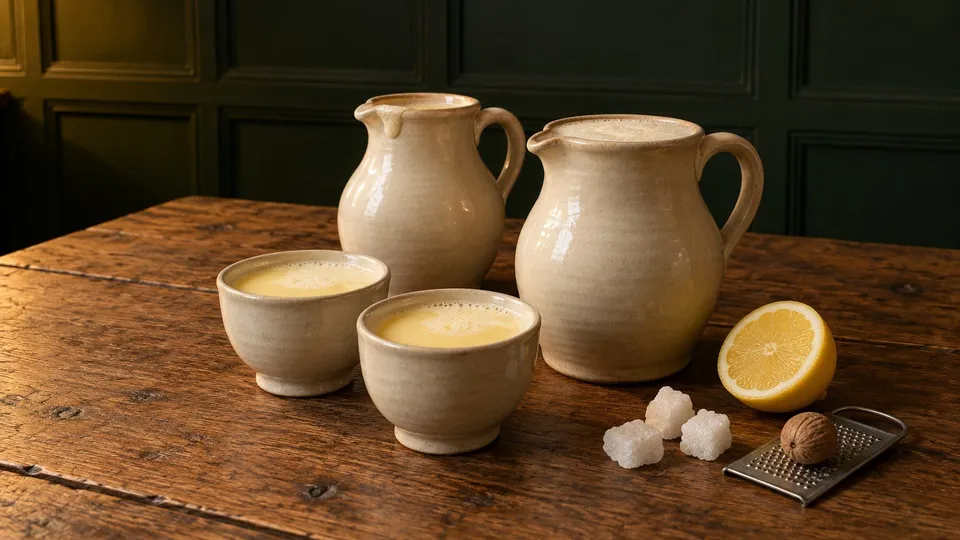 Make it todayRum Booze, Oxford’s 1847 Egg Posset of Hot White Wine
The same book traces this whole family to an older drink, saying they “have an affinity to, and possibly derived their origin from” a seventeenth-century rhyming recipe for sack posset, hot cream and eggs poured onto sweet wine, as in Sir Kenelm Digby’s Sack Posset of 1669. Posset itself goes back further, as hot milk curdled with ale in Posset Ale, and Ale Caudle thickens hot ale with yolks.
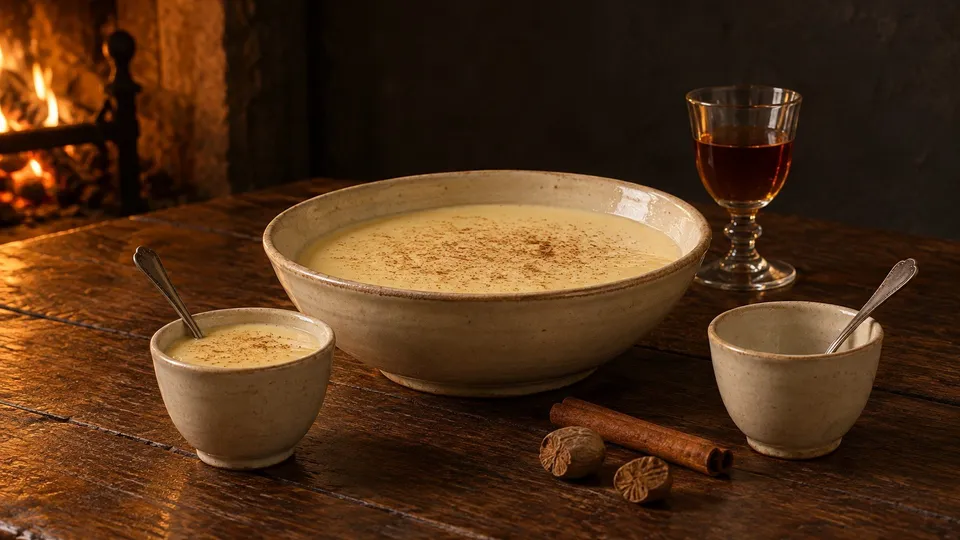 Make it todaySack Posset, Sir Kenelm Digby’s Cream and Sack from 1669
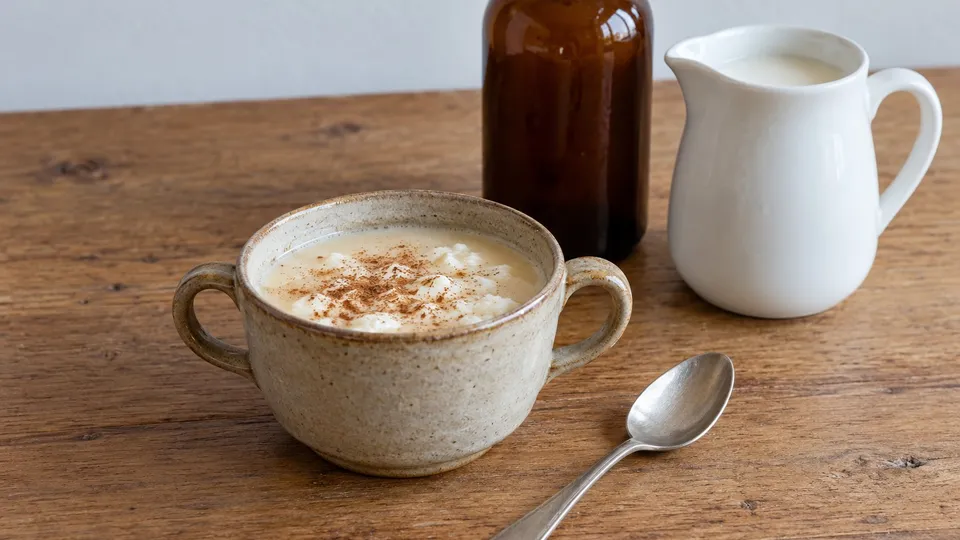 Make it todayPosset Ale, Hot Milk Curdled with Ale
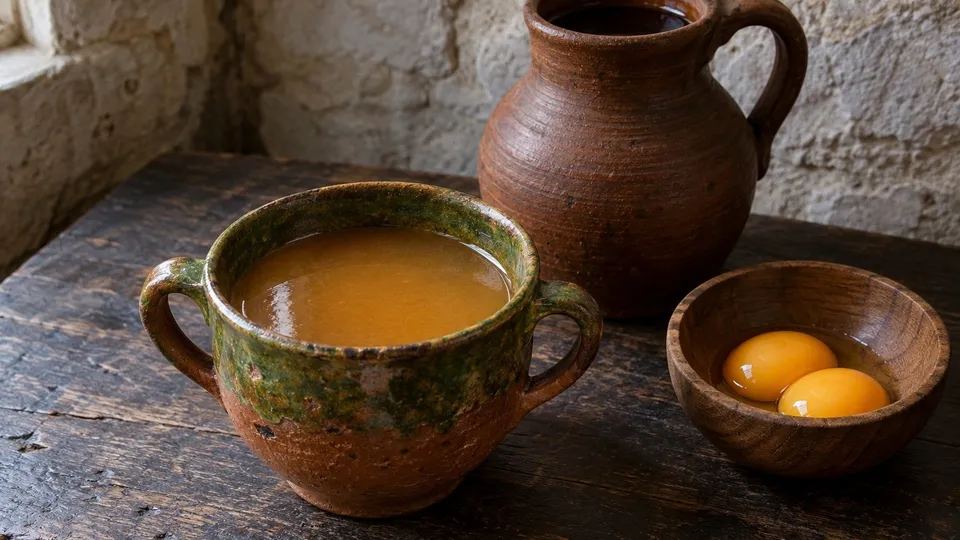 Make it todayAle Caudle, Warm Ale Thickened with Egg Yolks
The split between hot British flips and cold American nogs held only roughly. Leslie’s and Bryan’s eggnog pages both also print a Mulled Cider, boiling cider poured onto six beaten eggs and frothed. Leslie pours hers “backwards and forwards from one pitcher to another, till it has a fine froth on it,” which is a flip in all but name, and Thomas has a Hot Egg Nogg made with boiling water instead of ice. His best-known hot egg drink was the Tom and Jerry, a spoonful of spiced egg batter in a mug with brandy and boiling water; the alcohol-free Tom and Jerry stirs the same batter into hot milk.
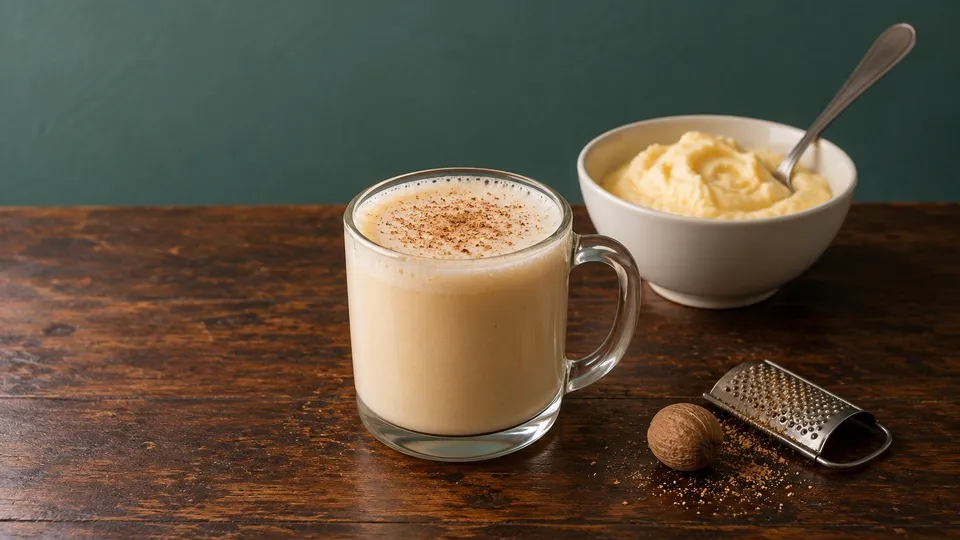 Make it todayTom and Jerry, the 1862 Egg-Batter Hot Drink
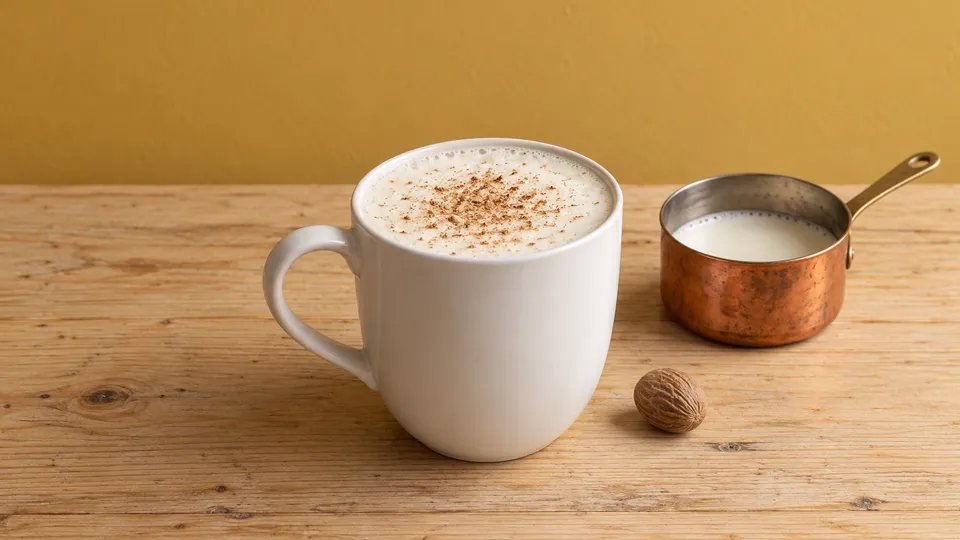 Alcohol-free versionAlcohol-Free Tom and Jerry, the Batter in Hot Milk
Washington and the West Point riot
Every December a recipe for George Washington’s eggnog, with brandy, rye whiskey, rum and sherry, makes the rounds. It is a legend. Mary Thompson, a historian at Mount Vernon, told the Virginian-Pilot in 2020: “We have no references to the use of eggnog at Mount Vernon.” According to the same report, the recipe appears in neither George’s nor Martha’s papers.
The Eggnog Riot at West Point is better documented, through the court-martial records that James Agnew used for his 1979 book on it and that later accounts follow. Superintendent Sylvanus Thayer had banned alcohol at the Military Academy, and on the night of December 24, 1826, cadets smuggled whiskey into the North Barracks to make Christmas eggnog. The party ended in a riot. About twenty cadets were court-martialed in the weeks that followed. Jefferson Davis, then a cadet, was confined to his quarters and was not among those tried.
Cooked by the fire
The same cookbooks also printed egg-and-milk drinks with no spirit at all. Further on in the same book, Bryan has an Egg Gruel: two beaten eggs stirred into a pint of sweet milk, heated over a few coals until scalding hot but not boiling, then sweetened and seasoned with lemon juice or nutmeg. Here the heat cooks the egg, as food-safety advice asks of a homemade eggnog today. Our Egg Gruel follows her recipe, with a thermometer.
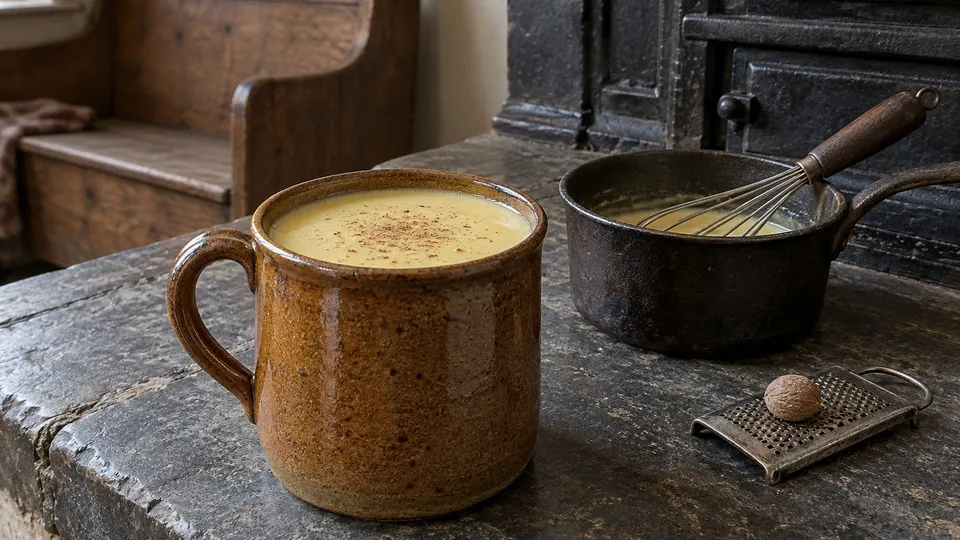 Always alcohol-freeEgg Gruel, Hot Milk and Beaten Eggs
An American edition of Maria Rundell’s A New System of Domestic Cookery (Philadelphia, 1807) gives an uncooked version among its dishes for the sick: a fresh egg beaten into a quarter of a pint of warm new milk with capillaire, rosewater and nutmeg, “to be taken the first and last thing, by those who are weak, and have a cough.” By the 1890s the soda fountain was shaking eggs with lemon syrup and hot water, in drinks like Hot Egg Lemonade, as What Did Soda Fountains Sell in Winter? explains.
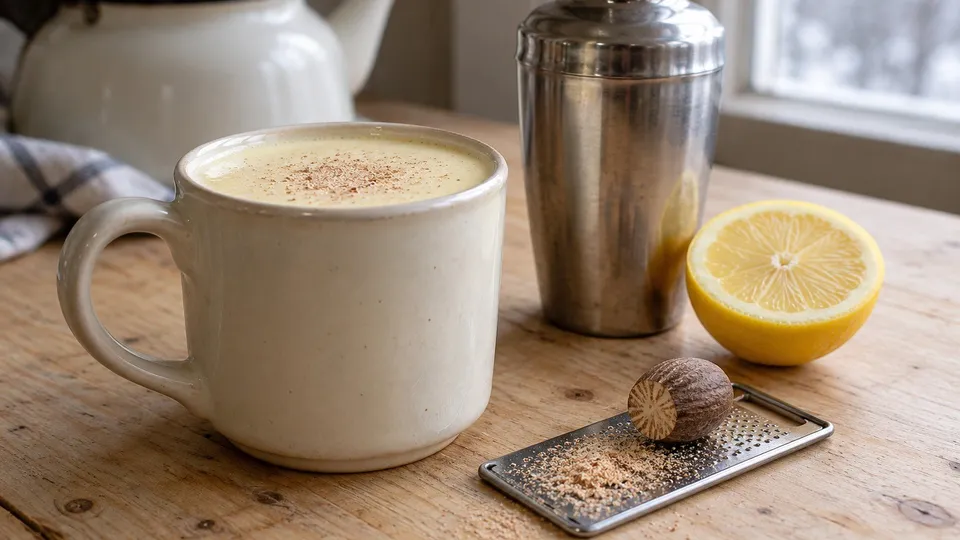 Always alcohol-freeHot Egg Lemonade from the Soda Fountain
The cold bowl of the 1830s and Thomas’s shaken glass both left their eggs raw. The American recipe of the period that meets today’s advice for eggnog is Bryan’s plainest one, two eggs and a pint of milk stirred over a few coals until scalding. Our Egg Gruel adds one modern tool to her method, a thermometer: stir until the milk steams and reaches 160°F (71°C), short of a boil, and two mugs are ready in fifteen minutes.
Sources
- Eliza Leslie, Directions for Cookery, being a System of the Art, in its Various Branches (Philadelphia: Carey & Hart, 1837), p. 407.
- Lettice Bryan, The Kentucky Housewife (Cincinnati: Shepard & Stearns, 1839), pp. 408, 419.
- Jerry Thomas, How to Mix Drinks, or, The Bon-Vivant’s Companion (New York: Dick & Fitzgerald, 1862), pp. 19, 40–41, 61.
- William Kitchiner, The Cook’s Oracle (Edinburgh: A. Constable, 1822), pp. 384–385.
- Oxford Night Caps, 4th ed. (Oxford: Henry Slatter, 1847), pp. 28–30.
- [Maria Eliza Rundell], A New System of Domestic Cookery (Philadelphia: Benjamin C. Buzby, 1807), p. 131.
- Ben Zimmer, “The Origins of ‘Eggnog,’ Holiday Grog,” Word Routes, Vocabulary.com, 2009; and “egg nog,” Wordorigins.org.
- “The real story of George Washington’s boozy eggnog,” History News Network, December 19, 2020, from the Virginian-Pilot.
- James B. Agnew, Eggnog Riot: The Christmas Mutiny at West Point (San Rafael: Presidio Press, 1979); Christopher Klein, “When Eggnog Sparked a Riot at West Point,” History.com.
- US Food and Drug Administration, “What You Need to Know About Egg Safety,” fda.gov; FDA advice on eggnog as quoted in Food Safety News, December 2018.
- Food Standards Scotland and Food Standards Agency, review of advice on eating raw or lightly cooked shell eggs (2016).