Rum Booze, Oxford’s 1847 Egg Posset of Hot White Wine
Reader ratingsWhite wine boiled with cinnamon and lemon-rubbed sugar, poured onto beaten egg yolks with nutmeg and tossed between two jugs to a froth: the Rum Booze of Oxford Night Caps, 1847, which has no rum in it.
- Recipe makes
- About 500 ml, 4 small cups
- Prep
- Cook
- Total
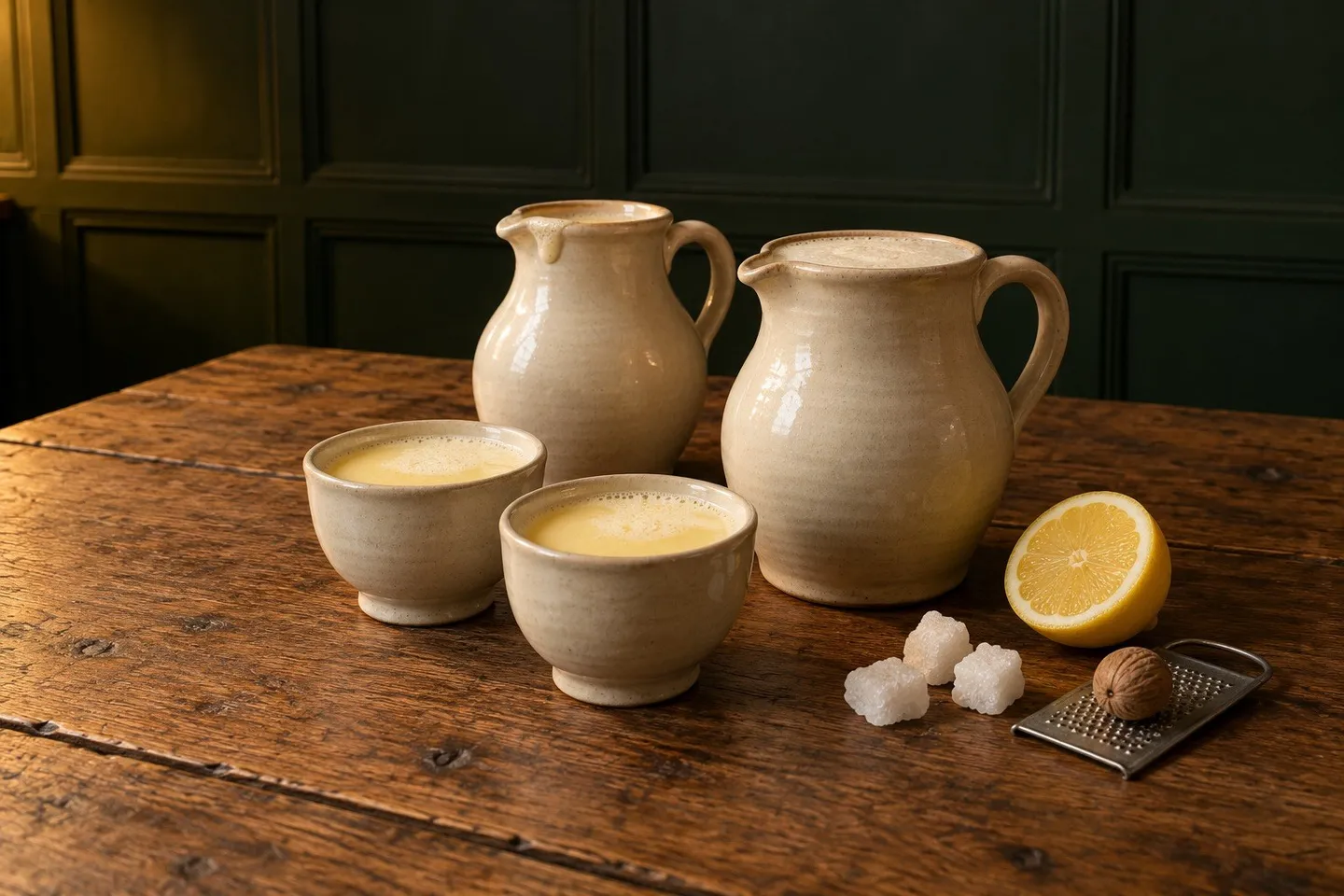
Rum Booze frothed between two jugs and poured into small cups, with the lemon, lump sugar and nutmeg that go into it.
The story behind the recipe
Rum Booze has no rum in it. Oxford Night Caps, a little book of the hot drinks served in Oxford colleges, gave it in 1847 as a bottle of white wine boiled with cinnamon and sugar rubbed on lemon peel, then poured slowly onto eight beaten egg yolks with nutmeg and tossed from one vessel to another “until a fine white froth is obtained.” A footnote adds that “it is sometimes denominated Egg Flip.” Its other name, Egg Posset, ties it to the sack posset of the 1600s, which the book prints a few pages earlier as a seventeenth-century rhyme.
The rum was optional
Rum appears only in the last lines: “Half a pint of rum is sometimes added, but it is then very intoxicating.” The book allows port in place of the white wine too, though port “is not considered so palatable.” Our recipe leaves out the rum and keeps the white wine.
The same page gives the drink’s working rule. The boiling wine is taken off the fire and checked with a glass of cold wine before it meets the eggs, because “if the wine is poured boiling hot among the eggs, the mixture will become curdled.” Made with a quart of strong home-brewed beer instead of wine, the same mixture becomes the book’s Beer Flip, which it says was given to servants at Christmas and on the Church’s other high feasts. Our Sack Posset shows the older dish behind both, and the cold American bowl that grew up alongside them is in How Was Eggnog First Made?
Read more about this recipe
Making it today
The thermometer is our addition: the hot wine should bring the yolks to 71 °C (160 °F), the temperature the FDA gives for cooked egg dishes, and a minute over low heat finishes the job if it falls short. The froth is light and pale, with lemon and nutmeg over the wine. For a hot egg cup without any wine, make Egg Gruel.
Rum Booze, or Egg Posset. The yolks of eight eggs well beaten up, with some refined sugar pulverised, and a grated nutmeg; extract the juice from the rind of a lemon by rubbing loaf sugar on it; put the sugar, a piece of cinnamon, and bottle of white wine, into a clean saucepan; when the wine boils take it off the fire; pour one glass of cold white wine into it, put it into a spouted jug, and pour it gradually among the yolks of eggs, &c. keeping them well stirred with a spoon as the wine is poured in; if not sweet enough, add a small quantity of loaf sugar; then pour the mixture as swift as possible from one vessel to the other until a fine white froth is obtained. Half a pint of rum is sometimes added, but it is then very intoxicating. Port wine is sometimes substituted for white, but is not considered so palatable. This liquor should be drank when quite hot. If the wine is poured boiling hot among the eggs, the mixture will become curdled.
(Footnote: It is sometimes denominated Egg Flip.)

Recipe makes: About 500 ml, 4 small cups
Ingredients
For About 500 ml, 4 small cups. Quantities are shown as written.
Quantities as written here, for About 500 ml, 4 small cups.
- Lemon1
- Sugar cubes4
- Large egg yolks4
- Caster sugar, plus more to taste40 g
- Freshly grated nutmeg1 metric tsp (5 ml per tsp)
- Small piece of cinnamon stick1
- Dry white wine375 ml
- Dry white wine, chilled30 ml
Measurement notes
Ingredients as written here
- 1 lemon
- 4 sugar cubes
- 4 large egg yolks
- 40 g caster sugar, plus more to taste
- 1 tsp freshly grated nutmeg
- 1 small piece of cinnamon stick
- 375 ml dry white wine
- 30 ml dry white wine, chilled
Equipment
 Small saucepan
 Two heatproof bowls or jugs
 Whisk
 Instant-read thermometer
 Grater
 Small heatproof cups
Instructions
Rub the sugar cubes hard over the rind of the lemon, turning them, until they are yellow and oily on every side.
In a heatproof jug, whisk the large egg yolks with the caster sugar and the freshly grated nutmeg until pale and thick.
Put the lemon sugar cubes, the cinnamon stick and the larger measure of dry white wine in a small saucepan and bring to the boil, stirring until the sugar dissolves.
Take the pan off the heat, lift out the cinnamon and stir in the small measure of chilled wine.
Pour the hot wine slowly onto the yolks, whisking all the time.
Check the temperature. If it is below 71 °C (160 °F), pour it back into the saucepan and stir over low heat until it reaches 71 to 75 °C (160 to 167 °F). Do not let it boil.
Taste, and stir in a little more sugar if it is not sweet enough.
Pour the mixture quickly from one warmed heatproof jug into the other, from as high as you safely can, 8 to 10 times, until it is covered with a pale froth.
Pour into small heatproof cups and drink at once, while it is hot.
Nutrition
190calories per serving
- Recipe makes
- About 500 ml, 4 small cups
- Servings
- 4
Roughly estimated from USDA FoodData Central values for dry white wine, raw egg yolk and granulated sugar, for one small cup.
Recipe notes
When adjusting quantities
This is half the book’s bottle of wine and eight yolks. For the full Oxford quantity, double everything.
Notes
Quantities mentioned in these notes don’t change when you adjust the batch.
Changes from the source: this is half the book’s quantity, with a 375 ml half bottle for its bottle of wine, 30 ml for its glass of cold wine and four yolks for its eight. The book gives no weight for the sugar; 40 g beaten with the yolks and four lumps rubbed on the lemon is ours, and it says to add more if the drink is not sweet enough. It grates a whole nutmeg into the full quantity; we use a teaspoon, which is a little less. The thermometer, and warming the mixture again if it falls short of 71 °C, are ours. If you prefer not to cook the yolks, use pasteurized egg yolks. We leave out the optional rum.
Strength: 405 ml of 12% wine holds about 49 ml of alcohol. Bringing it to the boil drives off some of that, so roughly 40 ml stays in about 500 ml of drink, about 8%, or about one UK unit in each small cup.
From the same Oxford book, we make the bishop without its port as the Alcohol-Free Bishop: hot grape juice with a roasted, clove-studded lemon.
Storage
Drink it hot as soon as it is made; the book says it should be drunk quite hot, and the froth soon falls.
Scaling changes the ingredients only; glassware, ice and timings need their own judgment. To adapt this recipe further, try the recipe tool at TuneMyRecipe (opens in a new tab), our sister site.
Sources and attribution
[Richard Cook, attrib.], Oxford Night Caps, 4th ed. (Oxford: Henry Slatter, 1847), “Rum Booze, or Egg Posset”, pp. 28–29
See the original pages (scan at Internet Archive) (opens in a new tab)
Recipe details
- Drink family
- Hot Drinks
- Region
- British
- Era
- 19th century
- Difficulty
- Intermediate
- Occasion
- Christmas
- Season
- Winter