Egg Gruel, Hot Milk and Beaten Eggs
Reader ratingsTwo beaten eggs stirred into a pint of milk and heated until scalding but never boiling, then sweetened and finished with nutmeg or lemon: Lettice Bryan’s egg drink of 1839.
- Recipe makes
- About 2 1/3 cups, 2 mugs
- Prep
- Cook
- Total
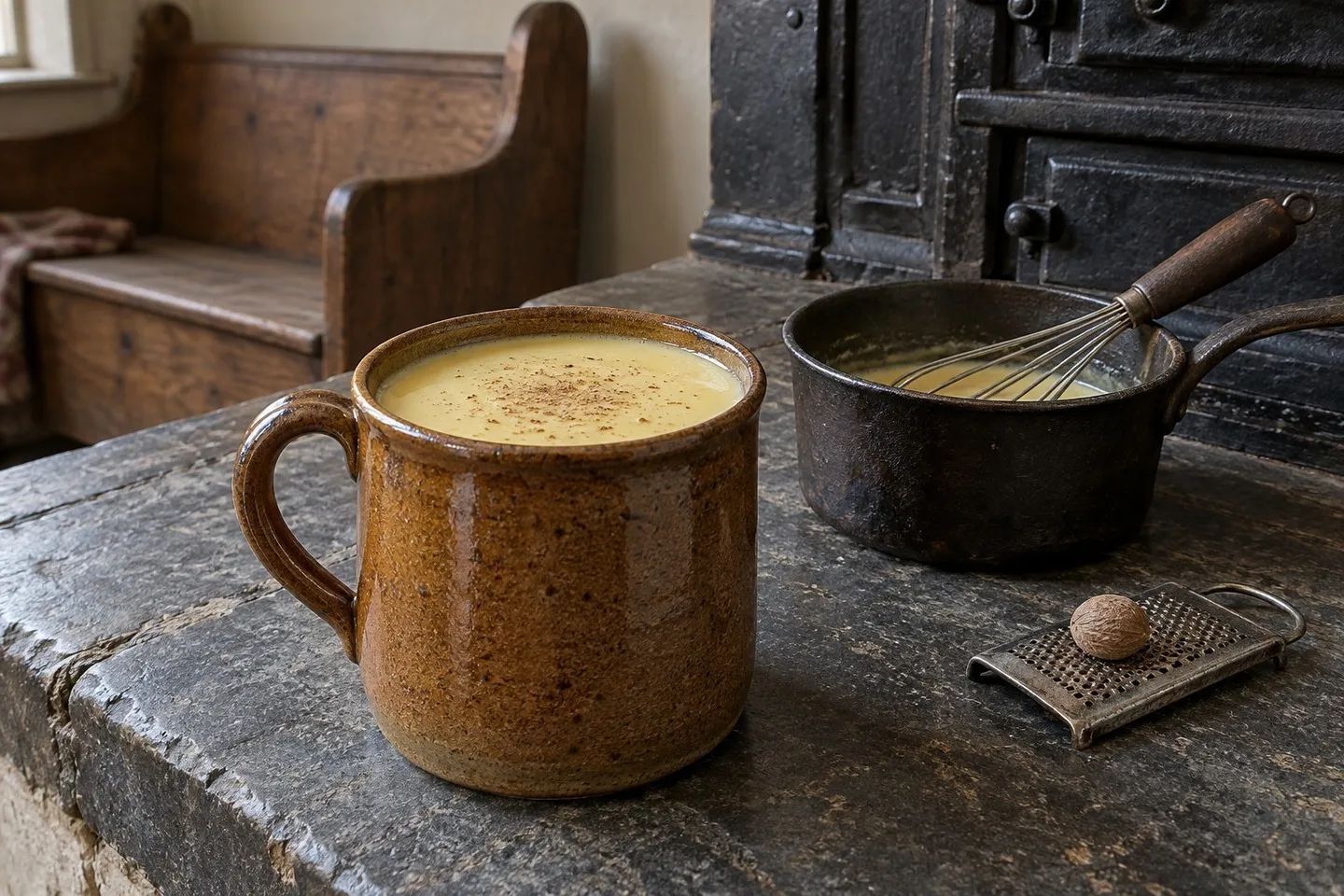
Egg gruel in a brown stoneware mug, finished with grated nutmeg.
The story behind the recipe
Egg Gruel is a hot, cooked drink of egg and milk with no spirit in it: two beaten eggs stirred into a pint of milk, heated over the coals until scalding hot, then sweetened and seasoned with lemon or nutmeg. Lettice Bryan printed it on page 419 of The Kentucky Housewife in 1839.
The rum that cooked the egg
Bryan’s Egg Nogg, on page 408, is a cold bowl: six eggs, a quart of rich milk, half a pound of sugar and half a pint of rum, with the spirit stirred into the yolks slowly, “that the spirits may cook the egg.” The gruel does without the rum and lets the fire do that work instead, with fewer eggs to the pint and no beaten whites.
Her only warning is about texture. Keep stirring, she says, and take it as far as scalding but no further, or it “will curdle and be like a boiled custard.” Her sugar was loaf sugar, cut from a hard cone, and the choice of lemon juice or nutmeg was left to whoever drank it.
Gruel usually meant something thinner and plainer, grain boiled in water, like the medieval Water Gruel. Bryan’s has no grain at all.
Read more about this recipe
Scalding, by thermometer
Bryan’s “scalding hot” means steaming hot and short of a simmer, around 175 to 180 °F (80 to 82 °C). That is above the 160 °F (71 °C) that US food-safety advice sets for cooking an egg-and-milk base, and it is also close to the point where the eggs set, which is why she says to stir constantly and never let it boil. A thermometer lets you stop sooner, at 160 to 167 °F (71 to 75 °C): hot enough to be safe, with room to spare before it curdles.
The sugar amount is ours, since Bryan gives none. If you choose lemon, add it off the heat and a little at a time, because acid can curdle hot milk. The drink is pale yellow, smooth and a little thicker than plain milk, with no alcohol.
Half a century later the soda fountain shook its eggs with lemon syrup and hot water, in Hot Egg Lemonade. Bryan’s cold eggnog bowl, with the rum that was meant to cook its eggs, is in How Was Eggnog First Made?
Beat two eggs light, and stir them into a pint of sweet milk; set it over a few coals, and stir it constantly till it gets scalding hot, but do not let it boil, or it will curdle and be like a boiled custard. Season it with loaf sugar and lemon juice, or nutmeg, whichever is preferred.

Recipe makes: About 2 1/3 cups, 2 mugs
Ingredients
For About 2 1/3 cups, 2 mugs. Quantities are shown as written.
Quantities as written here, for About 2 1/3 cups, 2 mugs.
- Large eggs2
- Whole milk2 cups
- Sugar1 1/2 tbsp
- Grated nutmeg, to finish
- Lemon juice (optional, in place of the nutmeg)2 tsp
Measurement notes
Ingredients as written here
- 2 large eggs
- 2 cups whole milk
- 1 1/2 tbsp sugar
- grated nutmeg, to finish
- 2 tsp lemon juice (optional, in place of the nutmeg)
Equipment
 Small heavy saucepan
 Whisk
 Instant-read thermometer
 Nutmeg grater
 2 mugs
Instructions
Whisk the large eggs in a small heavy saucepan until frothy and pale.
Whisk in the cold whole milk a little at a time, then the sugar.
Set the pan over low heat and stir constantly, scraping the bottom, until the milk steams and reaches 160 to 167°F (71 to 75°C) on the thermometer, about 8 minutes. Do not let it boil.
Take the pan off the heat and pour into 2 warmed mugs.
Grate a little nutmeg over each mug, or stir in the lemon juice a little at a time instead, tasting as you go.
Nutrition
260calories per serving
- Recipe makes
- About 2 1/3 cups, 2 mugs
- Servings
- 2
Estimated from USDA FoodData Central values for whole milk, whole raw egg and granulated sugar, per mug.
Recipe notes
When adjusting quantities
Keep two eggs to each 2 cups of milk when you scale, and heat no more than a double batch at a time so it warms evenly.
Notes
Quantities mentioned in these notes don’t change when you adjust the batch.
Bryan’s “pint of sweet milk” is a US pint, 2 cups; “sweet” meant fresh milk, not soured. Her eggs were beaten “light,” which here means whisked until frothy.
If the gruel starts to look grainy, take it off the heat at once and whisk hard; small curds can be strained out through a fine sieve.
Drink it as soon as it is made.
Scaling changes the ingredients only; glassware, ice and timings need their own judgment. To adapt this recipe further, try the recipe tool at TuneMyRecipe (opens in a new tab), our sister site.
Sources and attribution
Lettice Bryan, The Kentucky Housewife (Cincinnati: Shepard & Stearns, 1839), p. 419
See the original pages (scan at Internet Archive) (opens in a new tab)
Recipe details
- Drink
- Alcohol-free
- Drink family
- Hot Drinks
- Region
- American
- Era
- 19th century
- Base
- Milk & whey
- Difficulty
- Easy
- Season
- Winter