Bishop à la Prusse, Roasted Bitter Oranges in Claret (1862)
Reader ratingsFour bitter oranges roasted pale brown, left overnight under sugar and claret, then pressed out and served warm with the rest of the bottle: Jerry Thomas’s Bishop of 1862.
- Recipe makes
- About 1.1 liters, 9 small glasses
- Prep
- Cook
- Total
Includes about 40 minutes to roast the oranges and an overnight steep of about 12 hours under sugar and wine before the bishop is finished and served.
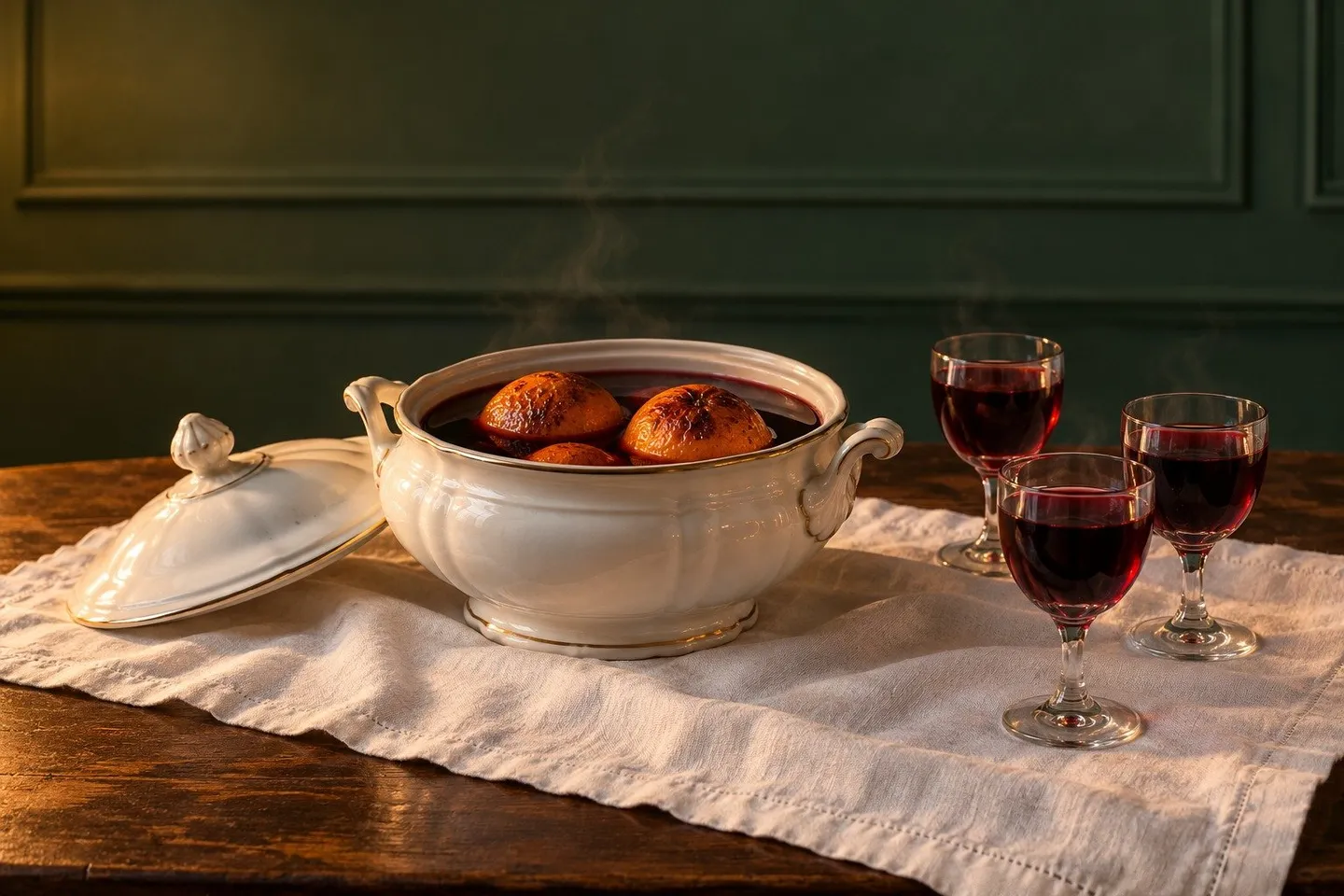
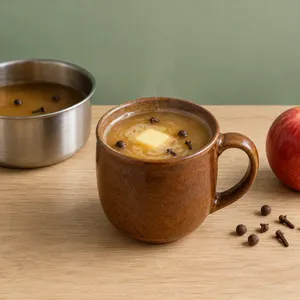
Bishop à la Prusse: roasted oranges in warm claret in a china tureen, with three small glasses.
The story behind the recipe
Bishop à la Prusse is warm claret made with roasted bitter oranges and no spice at all. Jerry Thomas printed it in New York in 1862, as No. 178 in How to Mix Drinks: four bitter oranges are roasted “till they are of a pale-brown color,” laid in a tureen under half a pound of sugar and three glasses of claret, and left covered until the next day. Then the oranges are pressed out, the rest of the bottle is heated and added, and the bishop goes round warm in glasses.
Two bishops on one page
Thomas calls it “a favorite beverage, made with claret or port,” and puts the better-known bishop straight after it. His No. 179 is the clove-studded orange roasted before the fire and quartered into a quart of hot port, simmered for half an hour, close to the roasted, clove-stuck lemon of the Oxford bishop of 1847. The Prussian version swaps port for claret and spice for time. Thomas adds that bishop is “sometimes made with the above materials, substituting lemons instead of oranges, but this is not often done when claret is used.” For the spice, he points the reader to the trade recipes at the back of the book, a bishop essence of nutmeg, pepper, cardamom and mace.
Read more about this recipe
Making it today
Seville oranges, the bitter marmalade kind, are in season in winter. Out of season, three navel oranges with the zest and juice of a lemon come closer than sweet oranges alone; that swap is ours. Thomas’s “three glasses” of claret are taken as 180 ml. He boils the rest of the bottle; we only heat it until it steams, which keeps most of the alcohol. The arithmetic: a 750 ml bottle at 13% holds about 97 ml of alcohol, in about 1.1 liters of finished bishop with the orange juice and dissolved sugar, so about 9% ABV. Half a pound of sugar to a bottle is about 200 g a liter, so it is sweet. Thomas gives no tasting note.
The spiced version and its part in A Christmas Carol are in What Was Smoking Bishop?, and for a glass without wine there is the alcohol-free bishop of grape juice and a roasted lemon.
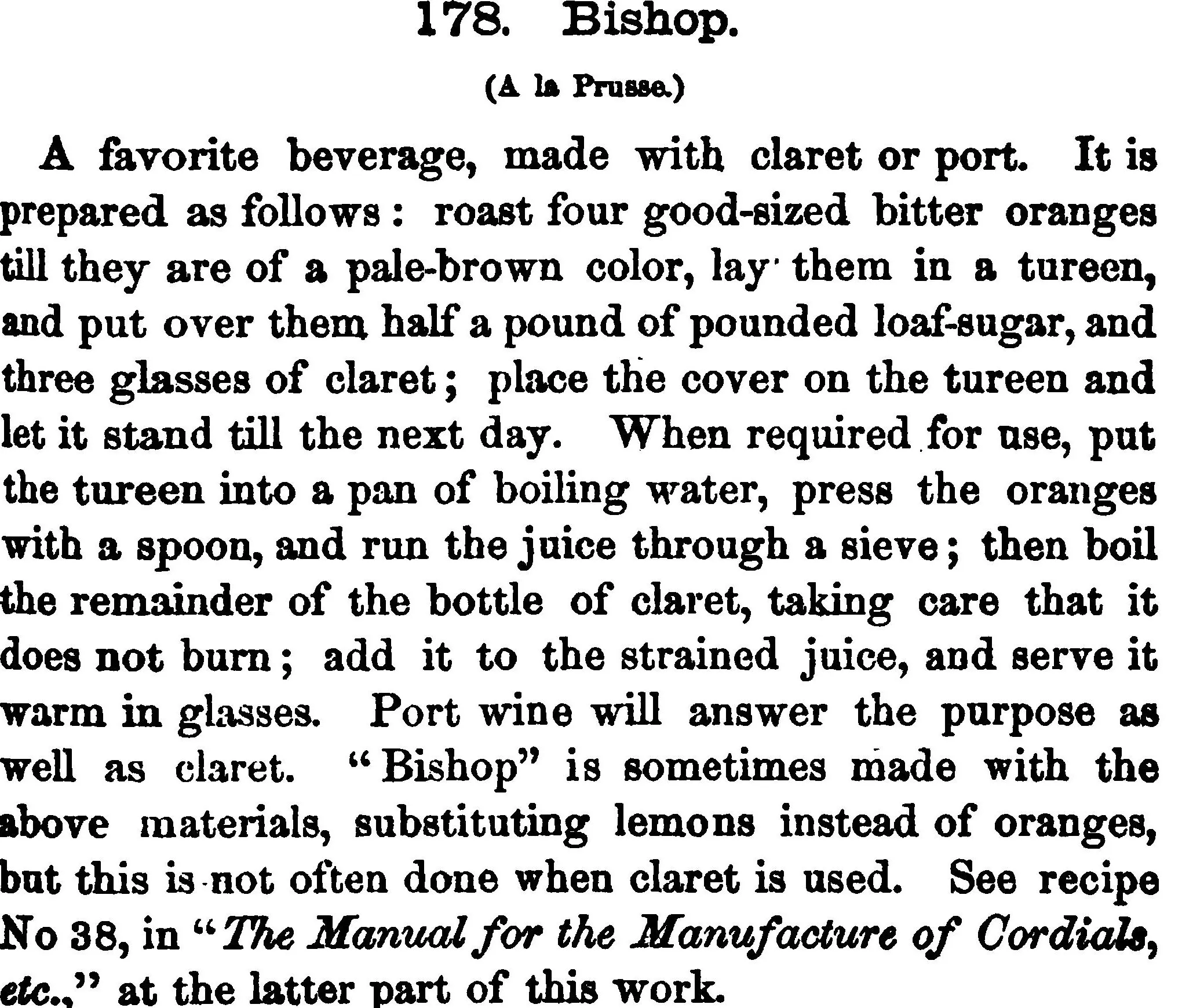
178. Bishop.
(À la Prusse.)
A favorite beverage, made with claret or port. It is prepared as follows: roast four good-sized bitter oranges till they are of a pale-brown color, lay them in a tureen, and put over them half a pound of pounded loaf-sugar, and three glasses of claret; place the cover on the tureen and let it stand till the next day. When required for use, put the tureen into a pan of boiling water, press the oranges with a spoon, and run the juice through a sieve; then boil the remainder of the bottle of claret, taking care that it does not burn; add it to the strained juice, and serve it warm in glasses. Port wine will answer the purpose as well as claret. “Bishop” is sometimes made with the above materials, substituting lemons instead of oranges, but this is not often done when claret is used. See recipe No 38, in “The Manual for the Manufacture of Cordials, etc.,” at the latter part of this work.

Recipe makes: About 1.1 liters, 9 small glasses
Ingredients
For About 1.1 liters, 9 small glasses. Quantities are shown as written.
Quantities as written here, for About 1.1 liters, 9 small glasses.
- Seville (bitter) oranges4
- Sugar225 g
- Claret (red Bordeaux)750 ml
Measurement notes
Ingredients as written here
- 4 Seville (bitter) oranges
- 225 g sugar
- 750 ml claret (red Bordeaux)
Equipment
 Small baking dish
 Heatproof bowl set over a pan of simmering water
 Spoon
 Sieve
 Medium saucepan
Instructions
Heat the oven to 200°C. Put the whole Seville (bitter) oranges in a small baking dish and roast for 30 to 40 minutes, turning once, until the skins are pale brown in patches.
Put the hot oranges in a heatproof bowl, add the sugar and pour over about a quarter of the claret (red Bordeaux). Cover and leave overnight at cool room temperature.
The next day, set the bowl over a pan of simmering water for about 10 minutes to warm through. Press the oranges hard with a spoon to break them and squeeze out their juice, then strain everything through a sieve, pressing on the pulp.
Heat the rest of the claret in a medium saucepan until it steams, without letting it boil. Stir it into the strained juice and serve warm in small glasses.
Nutrition
170calories per serving
- Recipe makes
- About 1.1 liters, 9 small glasses
- Servings
- 9
Estimated from USDA FoodData Central values for red table wine, granulated sugar and orange juice, for one of nine 120 ml glasses, ignoring any alcohol lost to heat.
Recipe notes
When adjusting quantities
The recipe is built on one bottle of claret and four oranges. Scale by the bottle.
Notes
Quantities mentioned in these notes don’t change when you adjust the batch.
Thomas boils the second part of the wine. We heat it short of boiling, so the bishop keeps most of its alcohol; boiled hard, it will come out weaker.
His “three glasses” of claret are read as 180 ml, and his half pound of pounded loaf sugar as 225 g of granulated sugar.
Port, Thomas says, works as well as claret. With a ruby port the bishop is stronger and sweeter; cut the sugar by about half.
The navel orange and lemon swap for Seville oranges is ours, for when bitter oranges are out of season.
Scaling changes the ingredients only; glassware, ice and timings need their own judgment. To adapt this recipe further, try the recipe tool at TuneMyRecipe (opens in a new tab), our sister site.
Sources and attribution
Jerry Thomas, How to Mix Drinks, or, The Bon-Vivant’s Companion (New York: Dick & Fitzgerald, 1862), No. 178, “Bishop (à la Prusse)”, p. 71
Recipe details
- Drink family
- Hot Drinks
- Region
- American
- Era
- 19th century
- Source decade
- 1860s
- Difficulty
- Easy
- Occasion
- Christmas
- Season
- Winter