Bishop, Hot Spiced Port with a Roasted Lemon
Reader ratingsHot port with a roasted clove-studded lemon, boiled-down spices, fresh lemon and nutmeg: the Oxford bishop of 1847 and the smoking bishop of A Christmas Carol.
- Recipe makes
- About 900 ml, 6 small glasses
- Prep
- Cook
- Total
Includes 30 to 40 minutes for roasting the lemon; the spice water reduces at the same time.
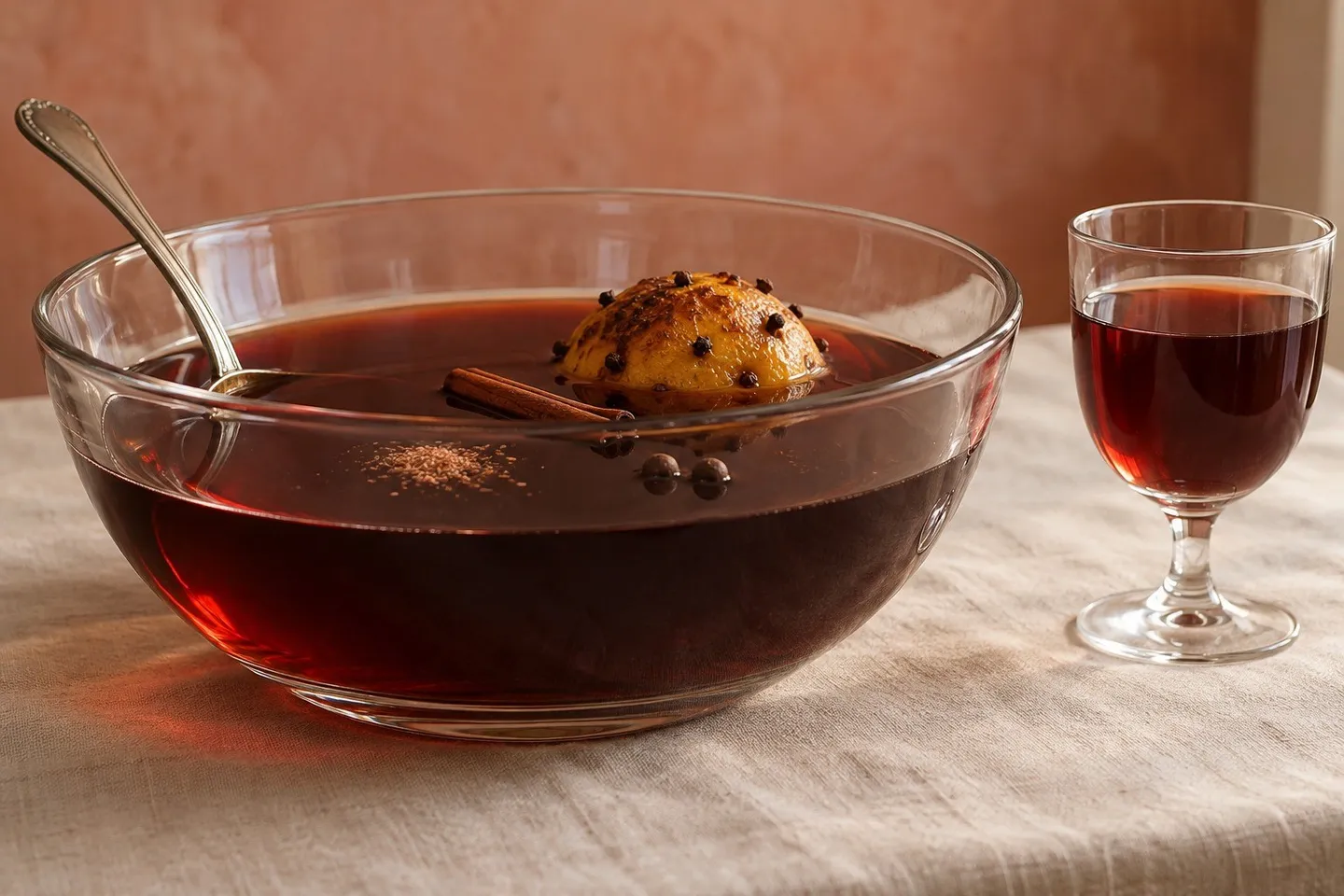
Hot spiced port in a glass bowl with its roasted, clove-studded lemon, a serving spoon and a small stemmed glass.
The story behind the recipe
Bishop is a bottle of ruby port heated with a roasted, clove-studded lemon and a little pan of boiled-down spices, then poured over sugar that has been rubbed hard against fresh lemon peel. It is the drink behind Scrooge’s “Christmas bowl of smoking bishop,” and this version keeps the Oxford method of 1847, with one change: the port is warmed, never boiled or set alight.
Sugar that tastes of lemon
The cleverest step in the 1847 recipe comes last. Before the hot wine goes into the bowl, the cook rubs “a few knobs of sugar” over the rind of a fresh lemon. The rough lumps scrape at the peel and pick up its oil, so the sugar carries the scent of the fruit into the drink without any of the white pith. Modern sugar cubes are rough enough to do the same job.
How much is up to you. The book gives no number and tells the cook to “sweeten it to your taste.” Ruby port brings plenty of sugar of its own, which is why our starting amount is a modest one. Swift’s verse, which Johnson quotes, calls it “sweet,” and that is about all the period record says of the taste.
Read more about this recipe
Which port, and which fruit
Buy an everyday bottle of ruby port. A vintage port would be wasted in a pan with cloves and mace. Port is a fortified wine, and most bottles are labeled at about 19 to 20% ABV, so even after the spice water goes in, the bowl lands around 15 to 16%. Serve it in small glasses: it is stronger than table wine.
Oxford used a lemon, and with it the bowl stays sharp as well as rich. Swift’s orange, roasted the same way, makes a softer, sweeter bowl; use one in place of the lemon or alongside it. For a bowl with no alcohol at all, see Alcohol-Free Bishop. What Was Smoking Bishop, the Drink in A Christmas Carol? traces how bishop got its name and where Swift’s oranges come in.
Make several incisions, in the rind of a lemon, stick cloves in the incisions, and roast the lemon by a slow fire. Put small but equal quantities of cinnamon, cloves, mace and all-spice, into a saucepan, with half a pint of water; let it boil until it is reduced one half. Boil one bottle of port wine; burn a portion of the spirit out of it, by applying a lighted paper to the saucepan. Put the roasted lemon and spice into the wine; stir it up well, and let it stand near the fire ten minutes. Rub a few knobs of sugar on the rind of a lemon, put the sugar into a bowl or jug, with the juice of half a lemon, (not roasted,) pour the wine into it, grate some nutmeg into it, sweeten it to your taste, and serve it up with the lemon and spice floating in it.

Recipe makes: About 900 ml, 6 small glasses
Ingredients
For About 900 ml, 6 small glasses. Quantities are shown as written.
Quantities as written here, for About 900 ml, 6 small glasses.
Roasted lemon
- Lemon1
- Cloves12
Spice water
- Cinnamon stick, about 7 cm1
- Cloves6
- Blades mace2
- Allspice berries6
- Water285 ml
Bishop
- Ruby port750 ml
- Sugar cubes, plus more to taste4–6
- Unwaxed lemon, for the sugar and juice1
- Whole nutmeg, for grating
Measurement notes
Ingredients as written here
- 1 lemon
- 12 whole cloves
- 1 cinnamon stick, about 7 cm
- 6 whole cloves
- 2 blades mace
- 6 allspice berries
- 285 ml water
- 750 ml ruby port
- 4 to 6 sugar cubes, plus more to taste
- 1 unwaxed lemon, for the sugar and juice
- whole nutmeg, for grating
Equipment
 Small baking dish
 Small saucepan
- Medium saucepan
 Heatproof bowl or jug, warmed, to serve
 Ladle and small heatproof glasses or cups
Instructions
Heat the oven to 200°C. Cut 12 short, shallow slits in the rind of the lemon for roasting and push a whole clove into each one. Roast the lemon in a small baking dish for 30 to 40 minutes, until the skin is browned in patches and the fruit gives when pressed.
While the lemon roasts, put the cinnamon stick, whole cloves, mace, allspice berries and water in a small saucepan. Simmer gently until reduced by half, which takes 20 to 25 minutes.
Pour the ruby port into a medium saucepan and warm it over low heat until it steams, about 70°C. Do not let it boil.
Add the roasted lemon and the spice water, with its spices, to the port. Stir, and keep it hot over the lowest heat for 10 minutes, still without boiling.
Meanwhile, rub the sugar cubes hard over the rind of the unwaxed lemon until they turn pale yellow and smell of lemon; if using granulated sugar, grate in a little of the zest instead. Put the sugar in a warmed heatproof bowl or jug and squeeze in the juice of half the lemon (of half of each lemon, if you have scaled up).
Pour the hot port, with the roasted lemon and spices, into the bowl and stir until the sugar dissolves. Grate a little nutmeg over the top, taste, and add more sugar if you like.
Serve at once, ladling it into small heatproof glasses or cups, with the lemon and spices left floating in the bowl.
Nutrition
220calories per serving
- Recipe makes
- About 900 ml, 6 small glasses
- Servings
- 6
Roughly estimated from USDA FoodData Central values for sweet dessert wine, granulated sugar and lemon juice, ignoring any alcohol lost to heat.
Recipe notes
When adjusting quantities
One bottle of port is the 1847 batch. For two bottles, double every ingredient, including the roasted lemon.
Notes
Quantities mentioned in these notes don’t change when you adjust the batch.
The 1847 recipe boils the port and burns off part of its spirit with a lighted paper. We leave out the flaming: a pan of hot port gives off alcohol vapor that can catch light, so keep it away from open flames, never pour from the bottle near a gas burner, and heat it only until it steams. Hot sweetened wine clings and scalds, so warm a glass or china bowl with hot water first, use heatproof glasses or cups, and keep it out of reach of children.
The book’s half pint is the British Imperial half pint of about 284 ml, rounded to 285 ml, and its bottle is taken as a standard 750 ml. It gives no count of cloves or weight of spices, only “small but equal quantities,” and no measure for “a few knobs of sugar,” so those amounts are our choice. A blade of mace is a dried piece of the lacy red coat around the nutmeg seed; if you can’t find it, use 1/4 tsp ground mace.
Four to six sugar cubes is about 2 tbsp of sugar, if you would rather measure granulated.
Scaling changes the ingredients only; glassware, ice and timings need their own judgment. To adapt this recipe further, try the recipe tool at TuneMyRecipe (opens in a new tab), our sister site.
Sources and attribution
[Richard Cook, attrib.], Oxford Night Caps, being a Collection of Receipts for Making Various Beverages Used in the University, 4th ed., enlarged (Oxford: Henry Slatter, 1847), “Bishop, or Spiced Wine”, pp. 1–3
See the original pages (scan at Internet Archive) (opens in a new tab)
Recipe details
- Drink family
- Hot Drinks
- Region
- British
- Era
- 19th century
- Difficulty
- Easy
- Occasion
- Christmas
- Season
- Winter