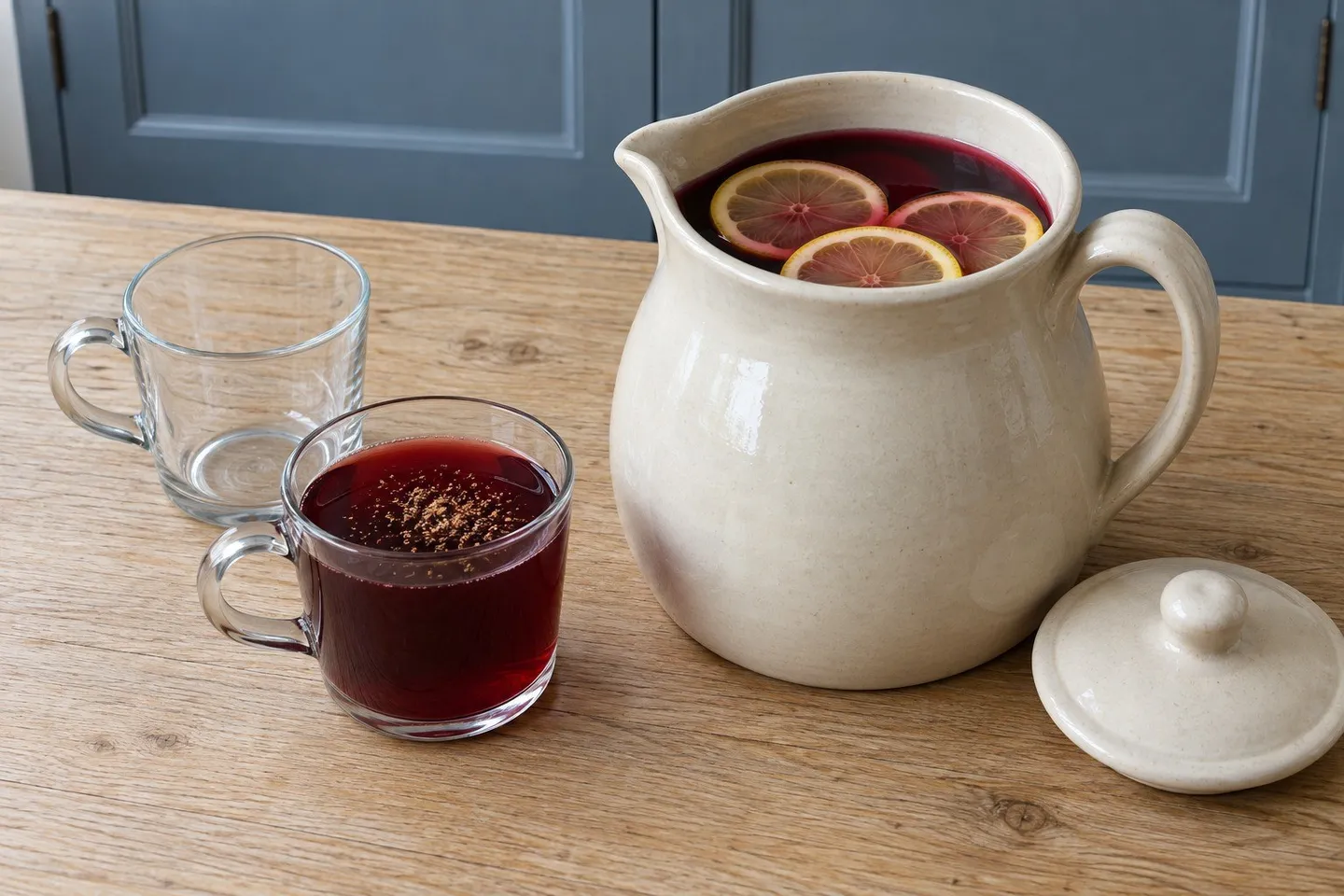
Alcohol-Free Negus, Hot Grape and Blackcurrant with Lemon
Reader ratingsHot red grape and blackcurrant juice poured into a covered jug of lemon sugar, sliced lemons and a little spice, then grated over with nutmeg: negus by the 1847 Oxford method, without the port.
- Recipe makes
- About 1.5 liters, 8 small cups
- Prep
- Cook
- Total
Includes 15 minutes for the lemons and spices to steep in the covered jug.
Alcohol-free negus in a cream earthenware jug with lemon slices, and two handled glass cups.
The story behind the recipe
This negus is new: in every period source we found, from 1745 on, the name meant wine and hot water. It keeps the rest of the 1847 Oxford method, the lemon sugar, the sliced lemons and the covered jug of spiced boiling water, and pours in hot red grape and blackcurrant juice where the bottle of port went. The jug with the port is our Port Wine Negus, from the same two pages.
Lemon sugar and a covered jug
Oxford Night Caps (1847) starts its negus before any wine is near: “Extract the juice from the peeling of one lemon, by rubbing loaf sugar on it.” Two more lemons go in sliced, with “small quantities of cinnamon, mace, cloves, and all-spice.” A quart of boiling water is poured over, and the cook is told to “cover the jug close, let it stand a quarter of an hour,” before the hot wine and half a grated nutmeg go in.
Nothing is boiled down and nothing is roasted, and that is the difference from its Oxford neighbor. The alcohol-free bishop roasts a clove-studded lemon and reduces its spices in a pan; this jug is mostly hot water, fresh lemon and fruit, with the spice kept to the book’s “small quantities.” It was the drink of the ballroom, carried round on trays with lemonade. Negus, the Warm Wine of Georgian Balls starts from its first printed mention in 1745 and weighs the colonel it is said to be named after.
Read more about this recipe
Why blackcurrant
Red grape juice gives the dark color of port but little of its sharpness, so a third of the juice here is blackcurrant, which is far more acidic and nearly black. The pair also keeps this jug distinct from the bishop, which uses grape juice alone. Juice carries less flavor than a fortified wine, so the Oxford quart of water comes down to 750 ml, one part juice to one of water. That change is ours, not the book’s.
The sugar is a starting point. Oxford says only “sweeten it to your taste.” Unsweetened blackcurrant juice is very sharp, which is why this jug takes more sugar than a sweet port would need, rubbed into the lemon zest so it carries the oil of the peel. Taste after the juice goes in and add more a spoonful at a time.
Recipe makes: About 1.5 liters, 8 small cups
Ingredients
For About 1.5 liters, 8 small cups. Quantities are shown as written.
Quantities as written here, for About 1.5 liters, 8 small cups.
- Unwaxed lemon, for the zest1
- Sugar, plus more to taste3 metric tbsp (15 ml per tbsp)
- Lemons, thinly sliced2
- Cinnamon stick, about 3 cm1
- Blade mace1
- Cloves2
- Allspice berries2
- Boiling water750 ml
- Unsweetened red grape juice500 ml
- Unsweetened blackcurrant juice250 ml
- Freshly grated nutmeg, plus a little to finish1/2 metric tsp (5 ml per tsp)
Measurement notes
Ingredients as written here
- 1 unwaxed lemon, for the zest
- 3 tbsp sugar, plus more to taste
- 2 lemons, thinly sliced
- 1 cinnamon stick, about 3 cm
- 1 blade mace
- 2 whole cloves
- 2 allspice berries
- 750 ml boiling water
- 500 ml unsweetened red grape juice
- 250 ml unsweetened blackcurrant juice
- 1/2 tsp freshly grated nutmeg, plus a little to finish
Equipment
 Fine grater
 Large heatproof jug with a lid or a plate to cover it
 Saucepan
 Kettle
 Small heatproof cups
Instructions
Finely grate the zest of the unwaxed lemon into a large heatproof jug. Add the sugar and rub the two together with your fingertips or the back of a spoon until the sugar is damp, pale yellow and smells strongly of lemon.
Add the sliced lemons, picking out the pips, with the cinnamon stick, mace, whole cloves and allspice berries.
Pour the boiling water into the jug, stir once, cover it closely with a lid or a plate and leave it to stand for 15 minutes.
Meanwhile, warm the unsweetened red grape juice and unsweetened blackcurrant juice together in a saucepan over medium heat until steaming. Do not let them boil.
Pour the hot juice into the jug, grate in the nutmeg and stir well. Taste, and add more sugar if you like.
Lift out the spices if you prefer, leaving the lemon slices in the jug, and serve hot in small cups with a little more nutmeg grated over each.
Nutrition
80calories per serving
- Recipe makes
- About 1.5 liters, 8 small cups
- Servings
- 8
Roughly estimated from USDA FoodData Central values for unsweetened grape juice and granulated sugar, with raw black currants standing in for the blackcurrant juice (USDA lists no juice); the lemons, spices and water add almost nothing.
Recipe notes
When adjusting quantities
750 ml of juice stands in for the bottle of port in the 1847 recipe. Keep the juice and water in equal amounts when you scale.
Notes
Quantities mentioned in these notes don’t change when you adjust the batch.
This negus has no alcohol in it: unfermented fruit juice, water, fruit and spices. Use juices labeled 100% juice with no added sugar. Blackcurrant cordial or squash is a sweetened concentrate and will make the jug far too sweet; if you can only find that, leave out the sugar and taste as you go. A dealcoholized red wine or port is not a substitute, since such drinks can still carry up to 0.5% alcohol.
Hot sweet juice scalds and clings, so warm the jug with hot water before you start, serve in heatproof cups with handles, and let children’s cups cool a little first. Nutmeg is used here in a kitchen amount; the nutmeg poisonings reviewed by the Illinois Poison Center (Ehrenpreis and colleagues, Journal of Medical Toxicology, 2014) involved amounts many times larger than any recipe calls for.
The 1847 quart is the British Imperial quart of about 1,136 ml. The book gives no weight for its spices or sugar, so those amounts are our choice. A blade of mace is a dried piece of the lacy red coat around the nutmeg seed; a pinch of ground mace will do instead.
For a fizzy version in the manner of Jerry Thomas’s 1862 soda negus, warm 250 ml of the mixed juices with 3 sugar cubes, 3 cloves and a pinch of nutmeg without boiling, pour into a jug and top with 300 ml chilled soda water.
Scaling changes the ingredients only; glassware, ice and timings need their own judgment. To adapt this recipe further, try the recipe tool at TuneMyRecipe (opens in a new tab), our sister site.
Sources and attribution
A modern alcohol-free adaptation of “White Wine Negus” and “Port Wine Negus” in [Richard Cook, attrib.], Oxford Night Caps, 4th ed., enlarged (Oxford: Henry Slatter, 1847), pp. 6–7
See the original pages (scan at Internet Archive) (opens in a new tab)
Recipe details
- Drink
- Alcohol-free
- Drink family
- Hot Drinks
- Region
- British
- Era
- 19th century
- Difficulty
- Easy
- Occasion
- Christmas
- Season
- Winter