What Was Smoking Bishop, the Drink in A Christmas Carol?
Scrooge’s smoking bishop was hot spiced port with a roasted clove-studded lemon. The Oxford recipe of 1847, Swift’s oranges and the alcohol-free version.
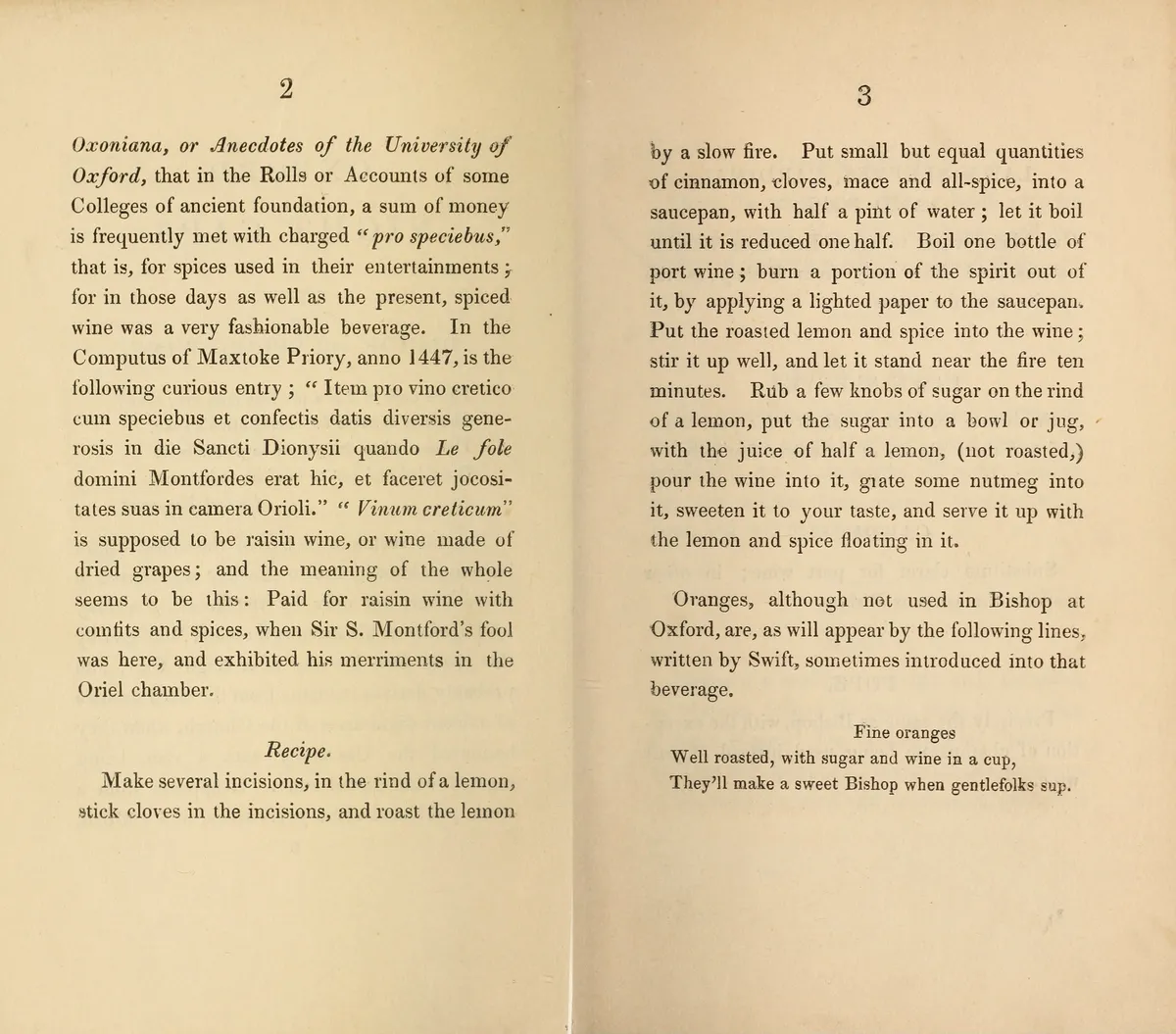
Smoking bishop was hot spiced port, poured over a lemon stuck with cloves and roasted by the fire, and served steaming from a bowl. Oxford Night Caps, a little book of university drinks, printed it that way in 1847, four years after Scrooge promised Bob Cratchit “a Christmas bowl of smoking bishop.” Dickens gives no recipe, and “smoking” meant hot enough to steam.
This story is part of our Christmas Drinks From History guide.
Where the old writers part company is the fruit. Oxford roasted a lemon and said outright that oranges were not used there, yet Samuel Johnson’s Dictionary of 1755 had already quoted Jonathan Swift’s verse for an orange-seller, in which roasted oranges, sugar and wine “make a sweet bishop.” By 1869 Cups and Their Customs had muddled the two. As for Scrooge’s own bowl, John Leech drew it for the first edition, still steaming.
The bowl Scrooge promised
The line comes on the morning after the ghosts. Bob arrives late, braces for a scolding, and gets a raise instead:
I’ll raise your salary, and endeavour to assist your struggling family, and we will discuss your affairs this very afternoon, over a Christmas bowl of smoking bishop, Bob!
The drink comes up only this once, and Dickens never says what went into the bowl. Away from Scrooge’s bowl, what London’s poorest drank at Christmas, from workhouse stout to halfpenny elder wine in the street, is in A Pint of Stout on Christmas Day.
Leech, who illustrated the first edition, drew the scene. Scrooge, in a dressing gown, ladles from a wide bowl into a glass for Bob, who sits holding a stemmed glass of his own. A kettle steams on the hob, two wine bottles and a candle stand on the table, and holly and mistletoe hang above. The steam rising off the bowl is the “smoking.”
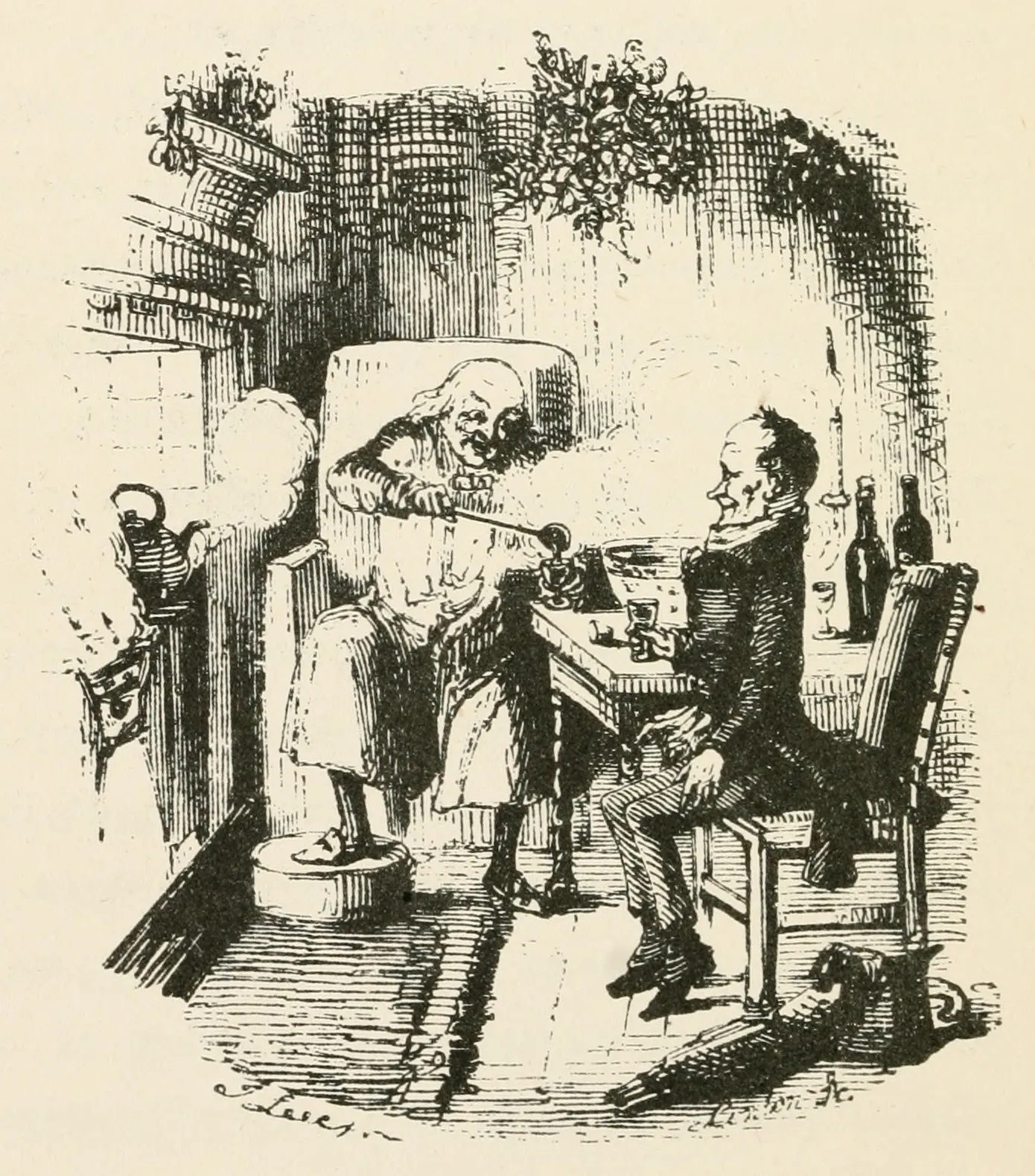 Scrooge pours Bob Cratchit a glass of smoking bishop. Wood engraving after John Leech for the first edition of A Christmas Carol (1843), from the 1920 Atlantic Monthly Press facsimile of that edition.
What Oxford put in it
The best witness to the recipe is Oxford Night Caps, being a Collection of Receipts for Making Various Beverages Used in the University, published in Oxford by Henry Slatter. Its fourth edition, of 1847, opens with “BISHOP, OR SPICED WINE,” under an epigraph credited to an “Ancient Fragment”:
Three cups of this a prudent man may take; The first of these for constitution’s sake, The second to the girl he loves the best, The third and last to lull him to his rest.
The book calls it “one of the oldest winter beverages known,” preferred “not only by the youthful votary of Bacchus at his evening’s revelry, but also by the grave Don by way of a Night Cap.”
The recipe is short. A lemon gets “several incisions” in its rind, a clove in each, and is roasted “by a slow fire.” Small but equal amounts of cinnamon, cloves, mace and allspice are boiled in half a pint of water until it is reduced by half. A bottle of port is boiled too, and part of its spirit is burned off “by applying a lighted paper to the saucepan.” The roasted lemon and the spices go into the hot wine, which stands near the fire for ten minutes. Then it is poured onto sugar rubbed on the rind of a fresh lemon, with the juice of half a lemon, “not roasted,” and a grating of nutmeg, sweetened to taste and served “with the lemon and spice floating in it.” Our Bishop recipe keeps the method, with modern amounts and no flaming.
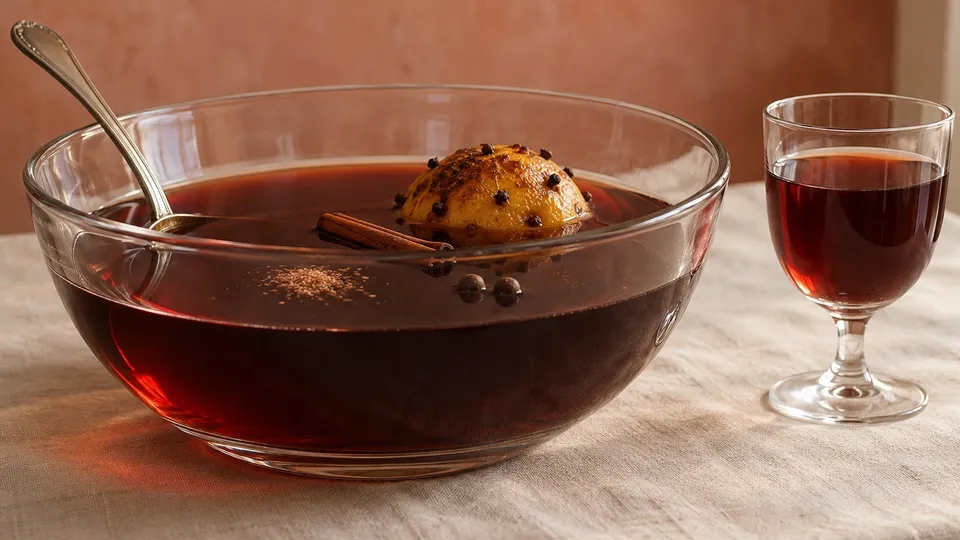 Make it todayBishop, Hot Spiced Port with a Roasted Lemon
Why “bishop”? The book offers a guess and labels it as one. The name “probably derives,” it says, from “ancient dignitaries of the Church, when they honoured the University with a visit, being regaled with spiced wine.” For proof that spiced wine was an old treat, it points to college accounts charging “pro speciebus,” for spices, and to a Latin entry in the accounts of Maxtoke Priory for 1447, which it translates as paying for raisin wine “with comfits and spices, when Sir S. Montford’s fool was here, and exhibited his merriments in the Oriel chamber.” A popular modern explanation, that the drink’s color matched a bishop’s robes, has no period source behind it that we have found.
Oxford liked the churchly joke enough to extend it. Cardinal, made with claret, and Pope, made with champagne, “owe their origin to some Brasenose Bacchanalians, and differ only from Bishop as the species from the genus.”
Lemons at Oxford, oranges for Swift
The surprise is printed right under the recipe:
Oranges, although not used in Bishop at Oxford, are, as will appear by the following lines, written by Swift, sometimes introduced into that beverage.
The lines come from Swift’s verses for the fruit-women who cried their wares in the street. In full, as W. E. Browning’s 1910 edition of Swift’s poems prints it, the orange-seller’s verse runs:
Come buy my fine oranges, sauce for your veal, And charming, when squeezed in a pot of brown ale; Well roasted, with sugar and wine in a cup, They’ll make a sweet bishop when gentlefolks sup.
In Johnson’s Dictionary the second entry for “bishop” is “a cant word for a mixture of wine, oranges, and sugar,” and Swift’s roasted-orange lines are its example. Cant here means slang. So the word was in print with oranges in it nearly a century before Scrooge, while the Oxford book, the only full recipe of the period in our sources, insists on lemons.
Later writers blurred the line. Cups and Their Customs calls bishop “one of the oldest of winter beverages, and an especial favourite, both in ancient and modern times, in our Universities,” notes that it is known on the Continent as Bischof, quotes Swift’s oranges, and then says that “this recipe is given verbatim in ‘Oxford Night-caps.’” The Oxford book quotes Swift, but its own recipe is the lemon one.
Many modern recipes go further and call for Seville oranges, the bitter marmalade kind, as the true Dickensian bishop. That idea comes from cookbooks, not from Dickens, who names no fruit at all.
Other bowls by the fire
Bishop belonged to a family of hot winter bowls, and Cups and Their Customs prints several. Its Wassail Bowl puts a pound of raw sugar into warm beer with nutmeg and ginger, adds “four glasses of sherry and two quarts more of beer, with three slices of lemon,” and serves it “with three slices of toasted bread floating in it.” Its Lamb’s Wool is a quart of strong hot ale with the pulp of six roasted apples, stirred “assiduously”; our Lambswool is made from that recipe.
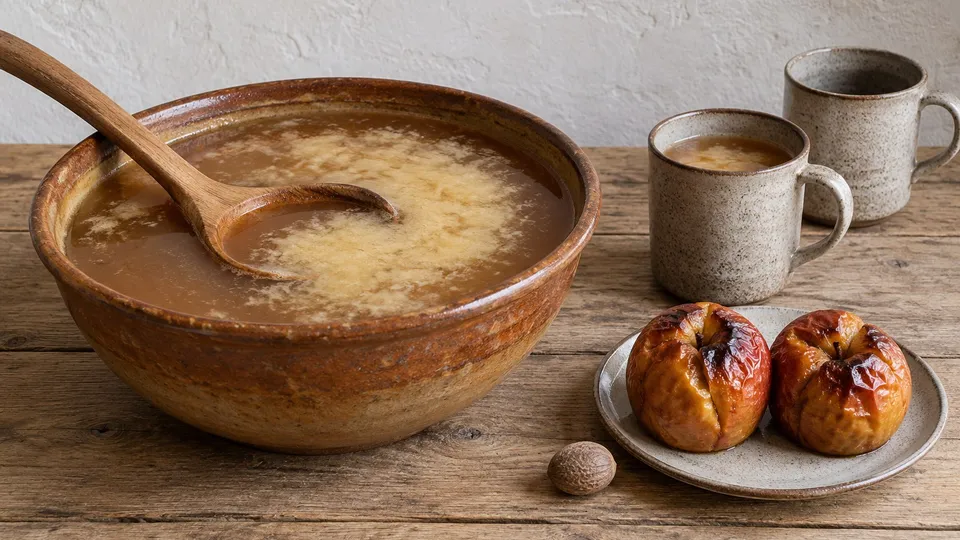 Make it todayLambswool, Hot Spiced Ale with Roasted Apples
Each bowl started at the fire: fruit roasted in front of it, a pan of wine or ale warmed beside it, and something floating on top, whether toast, apple pulp or a lemon dark with cloves. Bishop is the wine drinker’s version.
Bishop without the port
Two pages later, Dickens closes the book by saying that Scrooge “had no further intercourse with Spirits, but lived upon the Total Abstinence Principle, ever afterwards.” The Spirits are the ghosts, and “total abstinence” was the teetotal movement’s own phrase of the 1830s, borrowed for a pun. Scrooge has just invited his clerk to a bowl of hot port. Children at a Victorian Christmas were more likely to be given lemonade or a well-watered negus, and what Victorian children drank at Christmas is a story of its own.
The joke points somewhere useful all the same. Take the port away and every other step of the Oxford method still applies: the roasted clove lemon, the reduced spice water, the sugar rubbed on fresh peel and the nutmeg. Hot red grape juice brings the dark color and the sweetness without the alcohol. We have found no period recipe for an alcohol-free bishop, so ours is a modern adaptation of the 1847 method, and it says so: Alcohol-Free Bishop, Spiced Grape Juice with a Roasted Lemon.
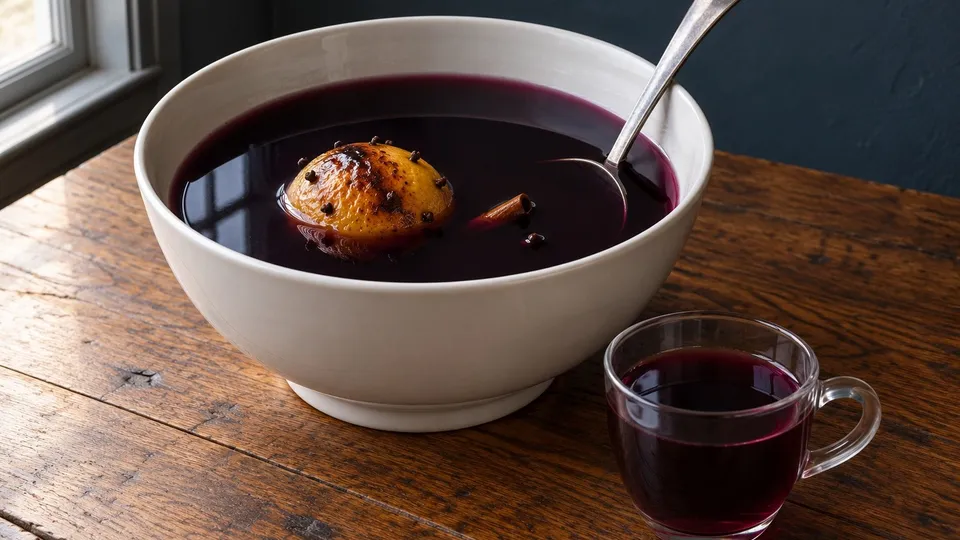 Alcohol-free versionAlcohol-Free Bishop, Spiced Grape Juice with a Roasted Lemon
What Scrooge would have poured
Dickens leaves the bowl empty, so the answer comes from the people who made the drink. In Oxford it was port, boiled and partly burned off, spiced with cinnamon, cloves, mace and allspice, sharpened with fresh lemon and sweetened to taste, with a roasted lemon full of cloves floating in it. Elsewhere, by Swift’s and Johnson’s account, the fruit could be a roasted orange, and in New York in 1862 Jerry Thomas left four roasted bitter oranges overnight under sugar and claret for his Bishop à la Prusse. Either way it was hot, sweet and served from a bowl by the fire.
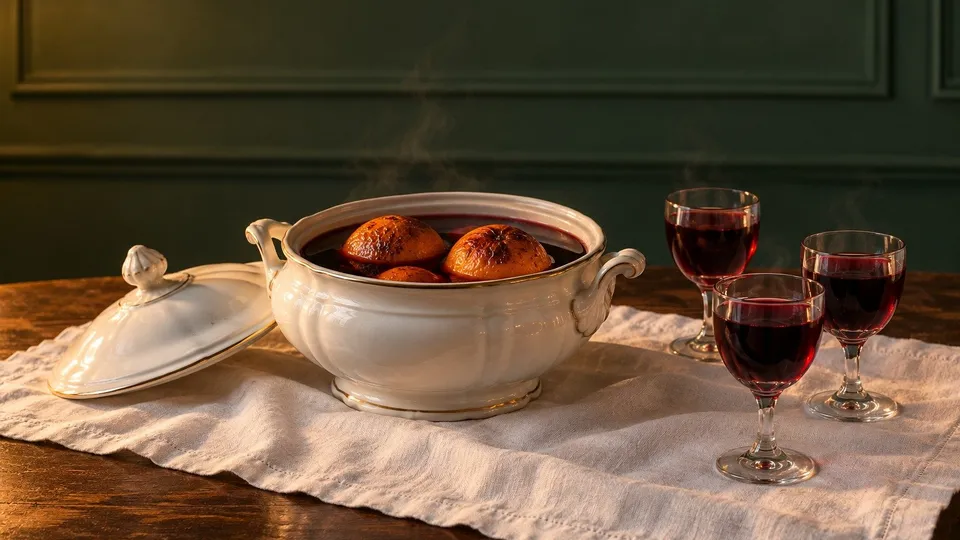 Make it todayBishop à la Prusse, Roasted Bitter Oranges in Claret (1862)
It was also stronger than it looks. A bottle of port in a little under a liter of finished drink comes to roughly 15 or 16% alcohol if none is lost to the heat, more than a glass of table wine. Boiling and flaming would have taken some of that away, though no one measured how much. It may also explain the advice at the head of the recipe: three cups for a prudent man, and the third to send him to bed. Anyone stopping at none can make the alcohol-free bishop, which roasts the same clove-studded lemon and boils down the same spices before hot red grape juice goes in where the port went.
For what was on the plate, our sister site The Forgotten Menu has the Cratchits’ Christmas dinner of 1843 (opens in a new tab).
Sources
- Charles Dickens, A Christmas Carol. In Prose. Being a Ghost Story of Christmas, ill. John Leech (London: Chapman & Hall, 1843), pp. 163–166. McGill University Library copy and University of Toronto copy, archive.org; Leech engraving from the photographic facsimile (Boston: Atlantic Monthly Press, 1920).
- [Richard Cook, attrib.], Oxford Night Caps, being a Collection of Receipts for Making Various Beverages Used in the University, 4th ed., enlarged (Oxford: Henry Slatter, 1847), pp. 1–4. Library of Congress copy, archive.org.
- [Henry Porter and George Edwin Roberts], Cups and Their Customs, 2nd ed. (London: John Van Voorst, 1869), pp. 41, 43.
- Samuel Johnson, A Dictionary of the English Language, vol. 1 (London: Knapton et al., 1755), “Bishop.”
- Jonathan Swift, “Oranges,” in Verses Made for Fruit-Women, in The Poems of Jonathan Swift, ed. W. E. Browning, vol. 1 (London: G. Bell, 1910).