Apples, Ale and Nuts: The Old Drinks of Halloween
Roasted apples bruised into ale or milk in Ireland, nuts and ale on Nutcrack Night, a dram with sowens in Scotland, sweet cider at a 1903 American party.
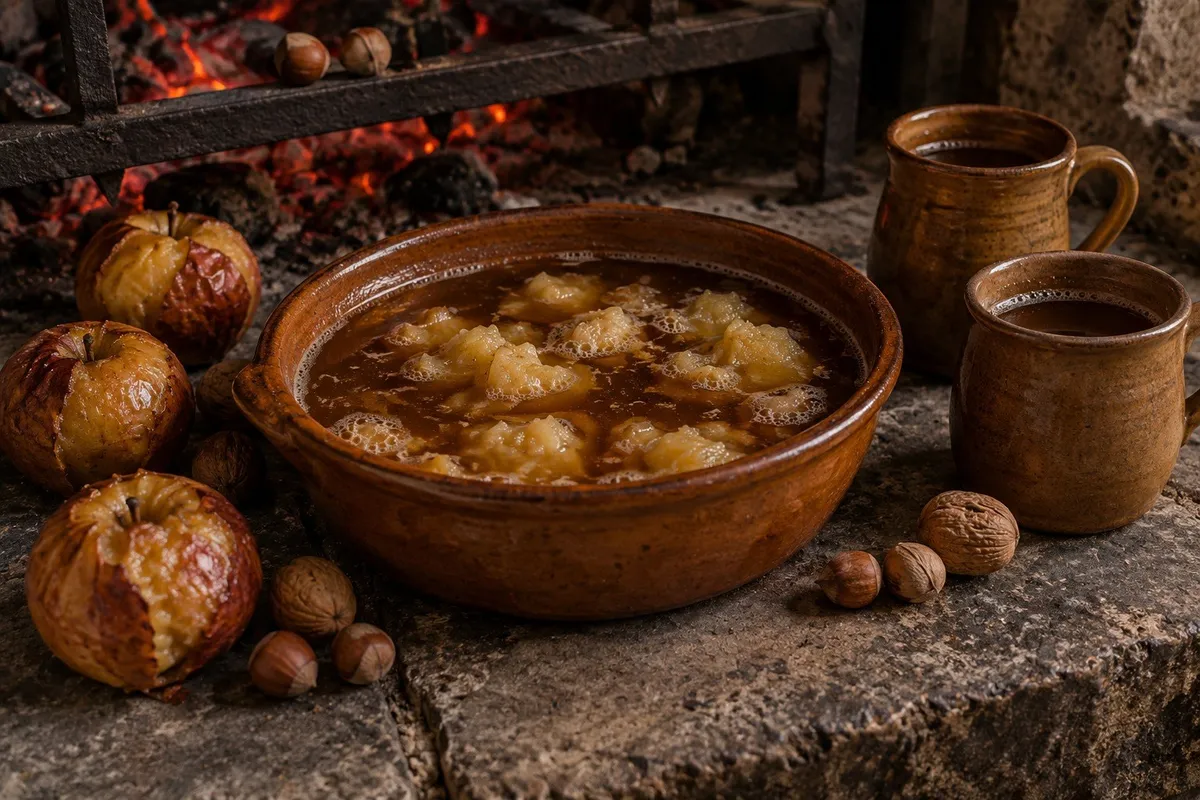
The old drink of Halloween was apples in something warm. In Ireland in the 1780s the night’s bowl was lambswool: roasted apples bruised into ale, or into milk, or in grander houses into white wine. In the north of England the evening went by the name Nutcrack Night, and its table was nuts, apples and ale. In Scotland, Robert Burns ended his poem “Halloween” with buttered sowens and a glass of spirits. By 1903 an American book of party plans had moved the apples into a pitcher of sweet cider with lemon, and, in another of its party plans, served lemonade.
Two of those drinks have no alcohol in them, and both come straight from the period books, so the night’s own drinks include something for children and drivers.
Lambswool on Holy Eve
The best witness is a letter in the Gentleman’s Magazine for May 1784, dated March 15 and signed only “D. A. B.” The writer was answering earlier correspondents who had puzzled over the name lambswool, and had met the drink in Ireland:
I have often met with it in Ireland, where it is a constant ingredient at a merry-making on Holy-eve, or the evening before All Saints day; and it is made there by bruising roasted apples and mixing them with ale, or sometimes with milk.
Holy Eve is the eve of All Saints, October 31. The letter goes on to say that “when the superior ranks of people were not too refined for these periodical meetings of jollity, white-wine was frequently substituted for ale,” so the gentry had once joined in, with white wine. Nuts and apples came with it “as a necessary part of the entertainment,” and the young people burned nuts in pairs “on the bar of the grate, or among the warm embers,” each pair named for a couple, and judged “the constancy or strength of their passions” by how the nuts burned.
The ale version had been an English winter drink for a long time already. Clunch the smith calls for a crab apple to be roasted “for lamb’s-wool” in George Peele’s The Old Wives’ Tale, printed in 1595, and the Victorian drinks book Cups and Their Customs (1869) gives the version our Lambswool follows: a quart of strong hot ale, the pulp of six roasted apples, nutmeg, ginger and raw sugar, stirred “assiduously” and served hot. The milk version is the Irish letter’s own, and it is the one to make for anyone not drinking: Lambswool with Milk.
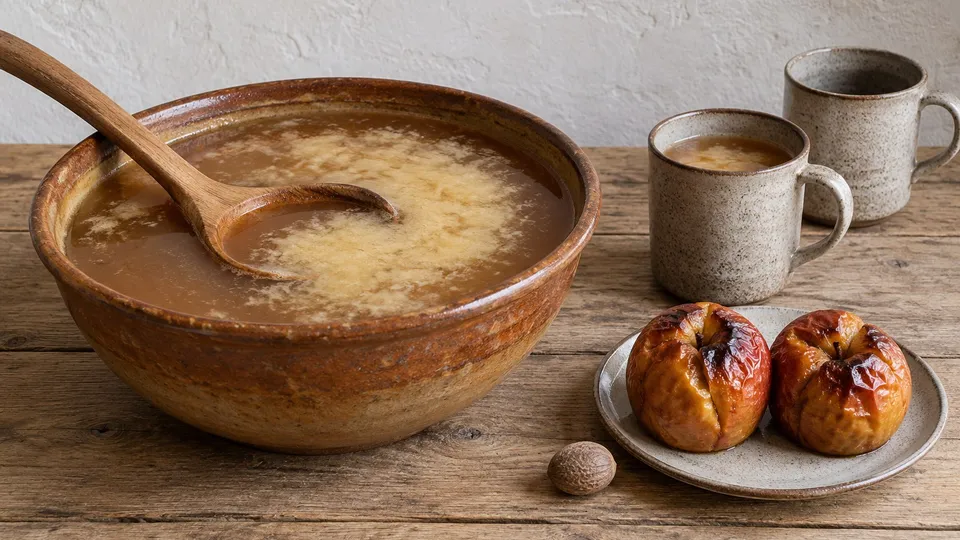 Make it todayLambswool, Hot Spiced Ale with Roasted Apples
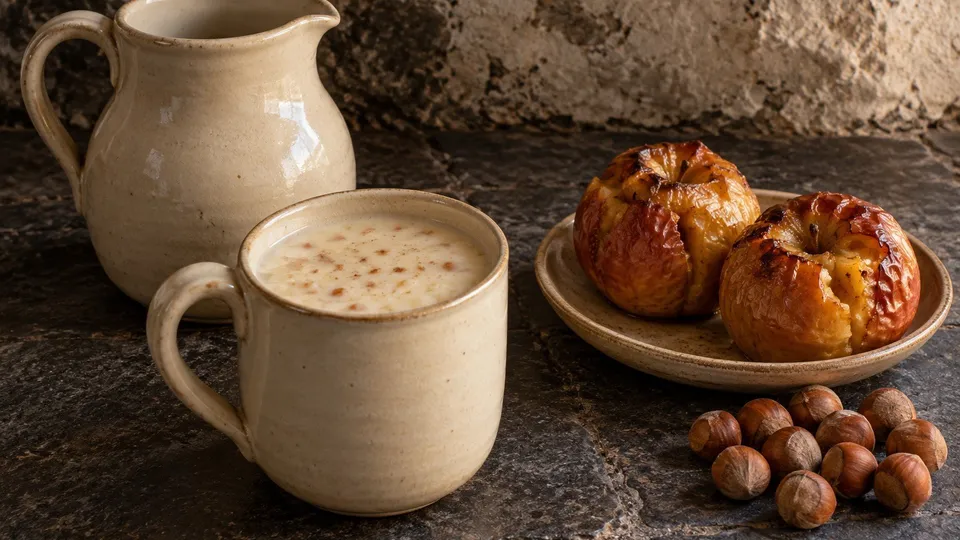 Always alcohol-freeLambswool with Milk, Roasted Apples Beaten into Hot Milk
A name with a legend
Why a drink of apples and ale should be named after a sheep’s fleece has bothered writers since the 18th century. The answer most often repeated is a legend. Charles Vallancey, an antiquary writing about Irish customs, claimed that the first day of November was “dedicated to the angel presiding over fruits” and named “La Mas Ubhal, that is, the day of the apple fruit,” and that “the English have corrupted the name to LAMBS-WOOL.” John Brand printed it in his Observations on Popular Antiquities, as revised by Henry Ellis in 1813, and the 1903 American party book repeated it, adding that the angel was “obviously a reminiscence of Pomona.”
Lamb’s-wool was in print in England by 1595, nearly two centuries before Vallancey, and his derivation is best kept with the legends. Another guess, that the soft, pale apple floating on the ale looks like wool, is just as unproven. The Christmas wassail bowl held much the same mixture and sometimes went by the same name; how the wassail bowl went from a greeting to a Christmas custom is told in Wassail, from a Greeting to a Christmas Bowl.
Nutcrack Night
In northern England the night took its name from what was eaten. Brand’s chapter heading in 1813 reads “Allhallow Even: vulgarly Halle E’en, as also, in the North, Nutcrack Night,” and he explains it plainly: “Nuts and apples chiefly compose the entertainment, and from the custom of flinging the former into the fire, or cracking them with their teeth, it has doubtless had its vulgar name of Nutcrack Night.”
The drink that went with them shows up in a footnote. Brand quotes a pamphlet about a conjurer named Harvey, printed in Dublin and reprinted in London in 1728, in which a letter dated October 31 records that “the servants having demanded Apples, Ale, and Nuts,” the writer took the chance to look back over his own Halloweens. It is the earliest mention of apples, ale and nuts for the night that we found, though it reaches us through Brand; we have not seen the pamphlet itself.
Sowens and a dram in Scotland
Scotland ate its Halloween supper with a spoon. The last stanza of Burns’s “Halloween,” in the Edinburgh edition of his poems of 1787, sends the company home after a night of fortune-telling games:
Till butter’d So’ns, wi’ fragrant lunt, Set a’ their gabs a-steerin; Syne, wi’ a social glass o’ strunt, They parted aff careerin Fu’ blythe that night.
Sowens was a porridge made from the soured husks of oats, and Burns’s own footnote says that “Sowens, with butter instead of milk to them, is always the Halloween Supper.” The “lunt” is the steam rising off it. “Strunt,” his glossary explains, is “spiritous liquor of any kind.” So the Scottish night ended with something hot to eat and a dram to see the guests out, and Sir Frederick Eden, writing in 1797 and quoted by Brand, added that the same buttered sowens served as the Christmas and New Year breakfast in many parts of Scotland.
Sweet cider at an American party
In the United States the night turned into a party with invitations and games. Stanley Schell’s Hallowe’en Festivities, published in New York in 1903 as a number of Werner’s Readings, is a book of plans for them: invitations written in white ink on black cards, fortune cakes with a ring baked inside, walnuts emptied and filled with riddles, and apples everywhere.
Its drink recipe, in the plan for “A Hallowe’en Supper,” is the Cider-Flip: two quarts of sweet cider in a tall pitcher with a few slices of lemon, the juice of three lemons turned in just before serving, straws and thin glasses. Schell adds that it can be made hot on a cold night, and that the cider “must be fresh and very sweet.” In 1903 American usage, sweet cider meant freshly pressed apple juice that had not started to ferment, so the Cider-Flip is an alcohol-free drink, and despite its name it has no egg in it, unlike the flips in the bar books of its day. In other plans in the book, coffee comes round with the riddle walnuts, and lemonade is handed out between games.
The hot version of the same idea, sweet cider simmered with nutmeg and cloves from a 1919 temperance drinks book, is our Mulled Sweet Cider.
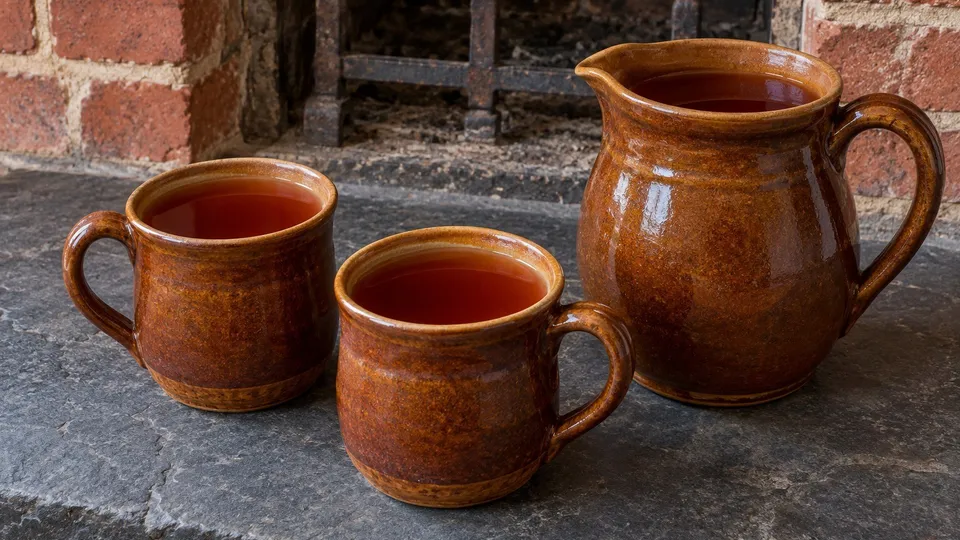 Always alcohol-freeMulled Sweet Cider with Nutmeg and Cloves
Two drinks for tonight
The two alcohol-free drinks of the night sit at either end of this history. The Irish one is roasted apples bruised into hot milk, warm and thick, and the letter of 1784 gives no amounts, so ours borrows the Victorian lambswool’s proportion of apple to liquid. The American one is cold sweet cider sharpened with lemon, a pitcher that waits on the table while the games go on.
Schell’s Cider-Flip asks only for a jug of fresh apple cider and three or four lemons, so it is the one to set out while the children are still in costume; the roasted apples for the milk lambswool can go in the oven when the doorbell starts ringing.
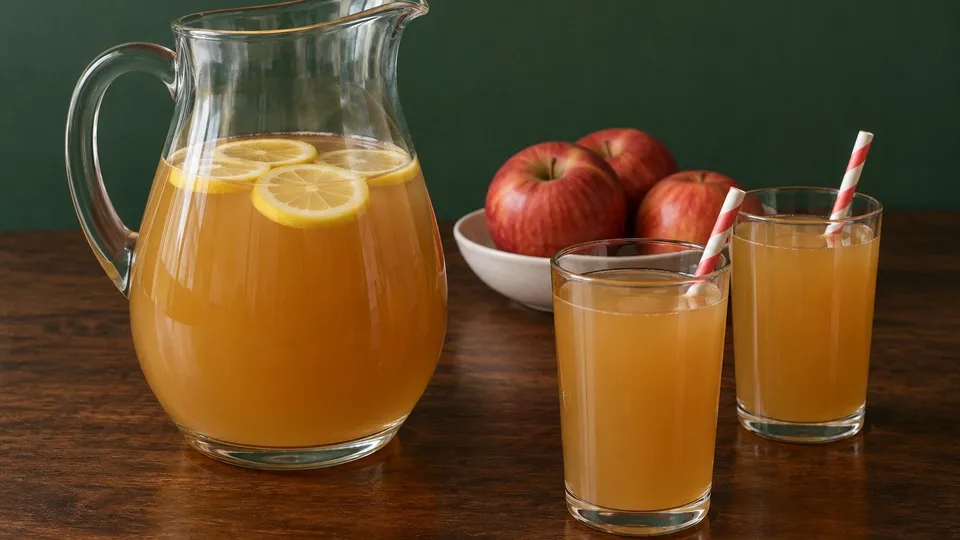 Always alcohol-freeCider-Flip, Sweet Cider and Lemon for a 1903 Halloween Party
Sources
- D. A. B., letter to Mr. Urban dated March 15, 1784, The Gentleman’s Magazine, vol. 54 (May 1784), p. 343.
- John Brand, Observations on Popular Antiquities, ed. Henry Ellis, vol. 1 (London: Rivington, 1813), “Allhallow Even”, pp. 300–312, including the Harvey pamphlet of 1728 (p. 300, note), Eden on Burns (p. 306) and Vallancey’s etymology (p. 312).
- Robert Burns, “Halloween”, in Poems, Chiefly in the Scottish Dialect (Edinburgh: William Creech, 1787), p. 173, with the author’s note and glossary.
- Cups and Their Customs, 2nd ed. (London: John Van Voorst, 1869), “Lamb’s Wool”, p. 41.
- Stanley Schell, Hallowe’en Festivities, Werner’s Readings No. 31 (New York: Edgar S. Werner, 1903), pp. 14, 46, 58–60 and 77–78.