Spruce Beer, from Captain Cook to Jane Austen
Molasses, water and spruce essence worked with yeast: the small beer Captain Cook brewed in New Zealand, a New York druggist sold and Jane Austen’s family made.
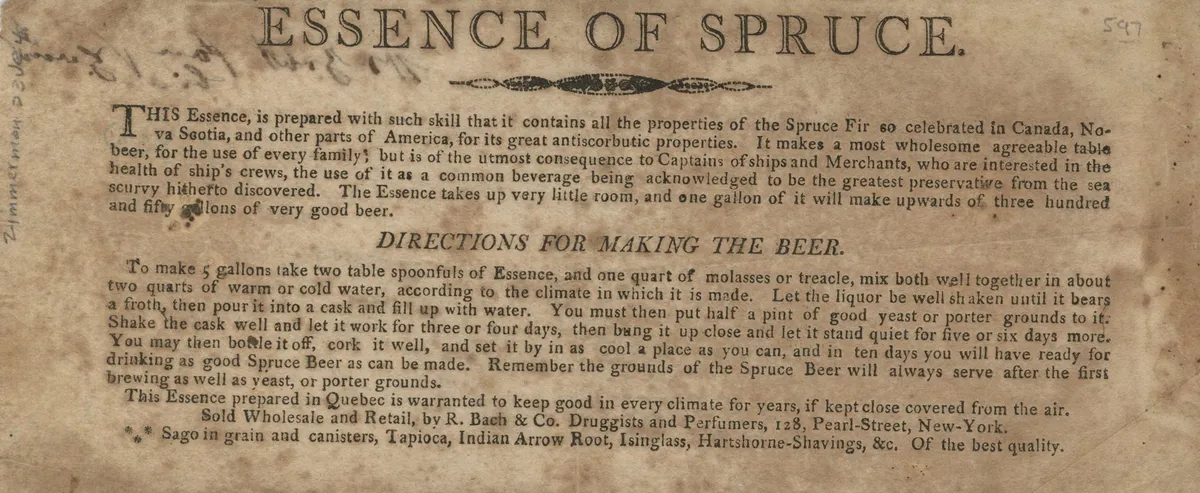
Spruce beer was a light home-brewed beer of molasses or sugar and water, flavored with spruce and worked with yeast for a few days before it was bottled. The spruce came either as a strong brew of young branches, boiled for hours, or as a ready-made “essence of spruce” sold by druggists. It was a cheap table beer in North America and Britain, and it went to sea, where sailors and the people selling to them believed it kept off scurvy.
This story is part of our Old-Fashioned Sodas guide.
It was never quite alcohol-free. Most of the recipes below would have made a small beer of roughly 2 percent alcohol, about half the strength of an ordinary modern beer.
Essence of spruce
R. Bach & Co., “Druggists and Perfumers, 128, Pearl-Street,” advertised their essence of spruce on a handbill printed in New York around 1804. The essence, the sheet says, “contains all the properties of the Spruce Fir so celebrated in Canada, Nova Scotia, and other parts of America, for its great antiscorbutic properties.” It “makes a most wholesome agreeable table beer, for the use of every family; but is of the utmost consequence to Captains of ships and Merchants, who are interested in the health of ship’s crews.” The essence was “prepared in Quebec” and “warranted to keep good in every climate for years.”
That is an advertisement, and its medical claim, that spruce beer was “the greatest preservative from the sea scurvy hitherto discovered,” is the seller’s. What the sheet does give straight is a method. Two tablespoons of essence and a quart of molasses or treacle go into a little water, worked “until it bears a froth.” That goes into a cask of five gallons, which is filled with water and started with half a pint of yeast “or porter grounds,” the sediment of a porter brew. The cask works for three or four days, is stopped up for five or six more, and then the beer is bottled and kept cool. “In ten days you will have ready for drinking as good Spruce Beer as can be made.”
The selling point was the size. One gallon of essence, the bill says, “will make upwards of three hundred and fifty gallons of very good beer,” which by its own directions is a modest claim: two tablespoons to five gallons comes to about six hundred and forty.
Too astringent
Thirty years earlier, spruce beer had been brewed at the far side of the world. In March 1773 James Cook brought the Resolution into Dusky Bay, a deep inlet in the south of New Zealand. The trees on shore were new to the ship’s company, but the naturalist George Forster saw “the resemblance it bore to the trees of the fir tribe, and a kind of resinous taste,” and the crew set about brewing.
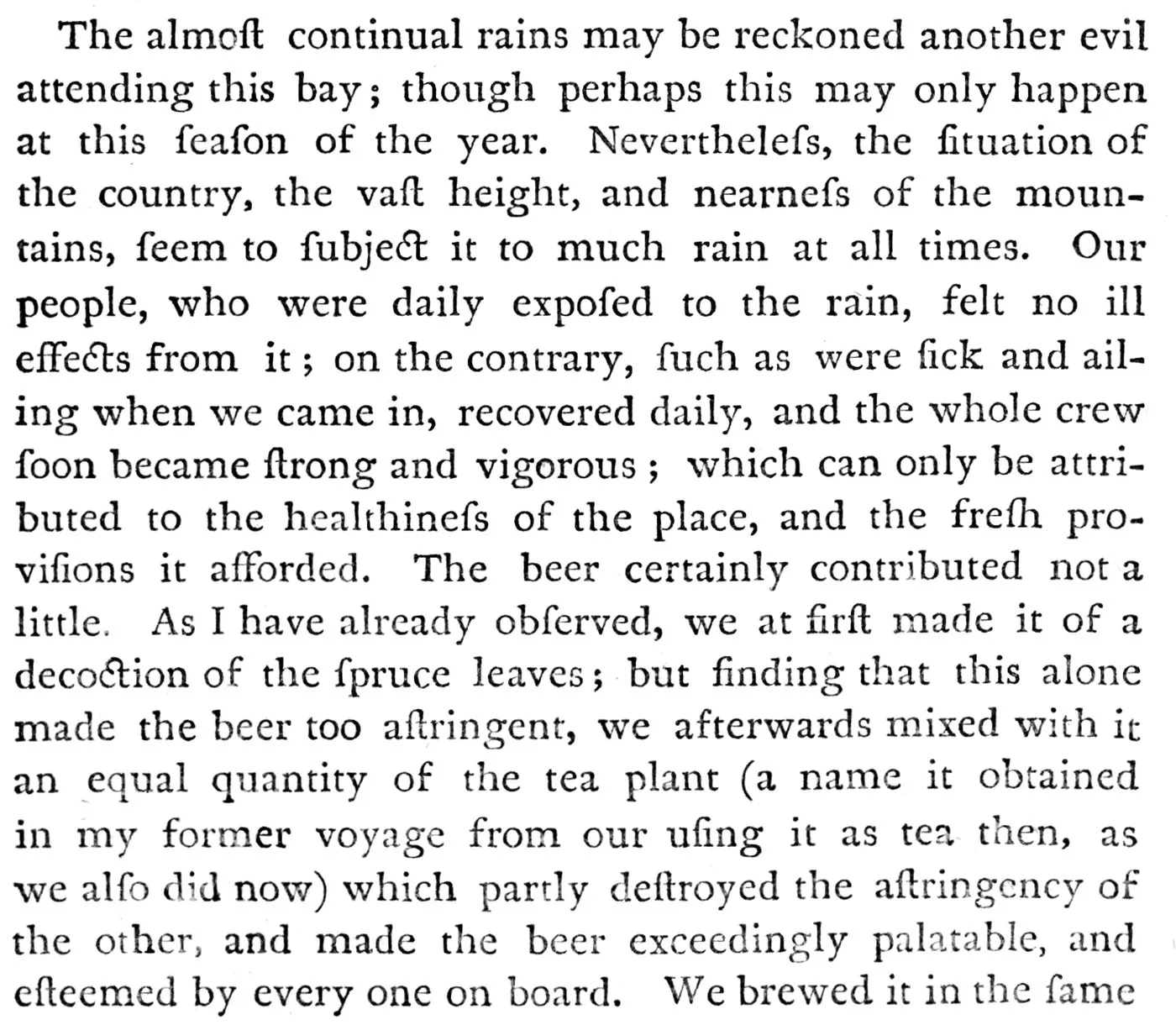 James Cook, A Voyage towards the South Pole, and round the World, vol. I (London: Strahan and Cadell, 1777), p. 99.
Cook gives his method on the next page. Small branches of the “spruce” and the shrub he called the tea plant were boiled “three or four hours, or until the bark will strip with ease,” then molasses went in, “ten gallons of which is sufficient to make a ton or two hundred and forty gallons of beer.” Cold water followed, then, “when the whole is milk-warm,” a little yeast or “grounds of beer,” and “in a few days the beer will be fit to drink.”
He is careful about what it did. The crew’s recovery he puts down first to “the healthiness of the place, and the fresh provisions it afforded”; “the beer certainly contributed not a little.” Forster’s account adds the taste and a warning. It was “pleasant, and something bitter,” and “the only fault we could observe in it was, that being taken on an empty stomach, it frequently caused a nausea or sickness.”
The spruce beer is brewed
In Britain spruce beer was a household drink, made at home in a cask. In October 1808 Jane Austen, writing from Southampton, told her sister Cassandra that their friend Martha Lloyd was coming that day: “yesterday brought us notice of it, and the spruce beer is brewed in consequence.” In a letter to Cassandra that December the subject came up again, by way of a quotation from Mrs. Piozzi about a master who “has his great casks to mind.” “It is you, however, in this instance, that have the little children,” Austen told her sister, “and I that have the great cask, for we are brewing spruce beer again.” The year on both comes from their Victorian editor, Lord Brabourne.
Eight years later she put it in a novel. In Emma (1816), Harriet Smith confesses that she has kept a worn-out pencil stub because Mr. Elton once used it. He had wanted to write down something “about spruce beer,” since “Mr. Knightley had been telling him something about brewing spruce beer,” and when his pencil ran out of lead, Emma lent him another.
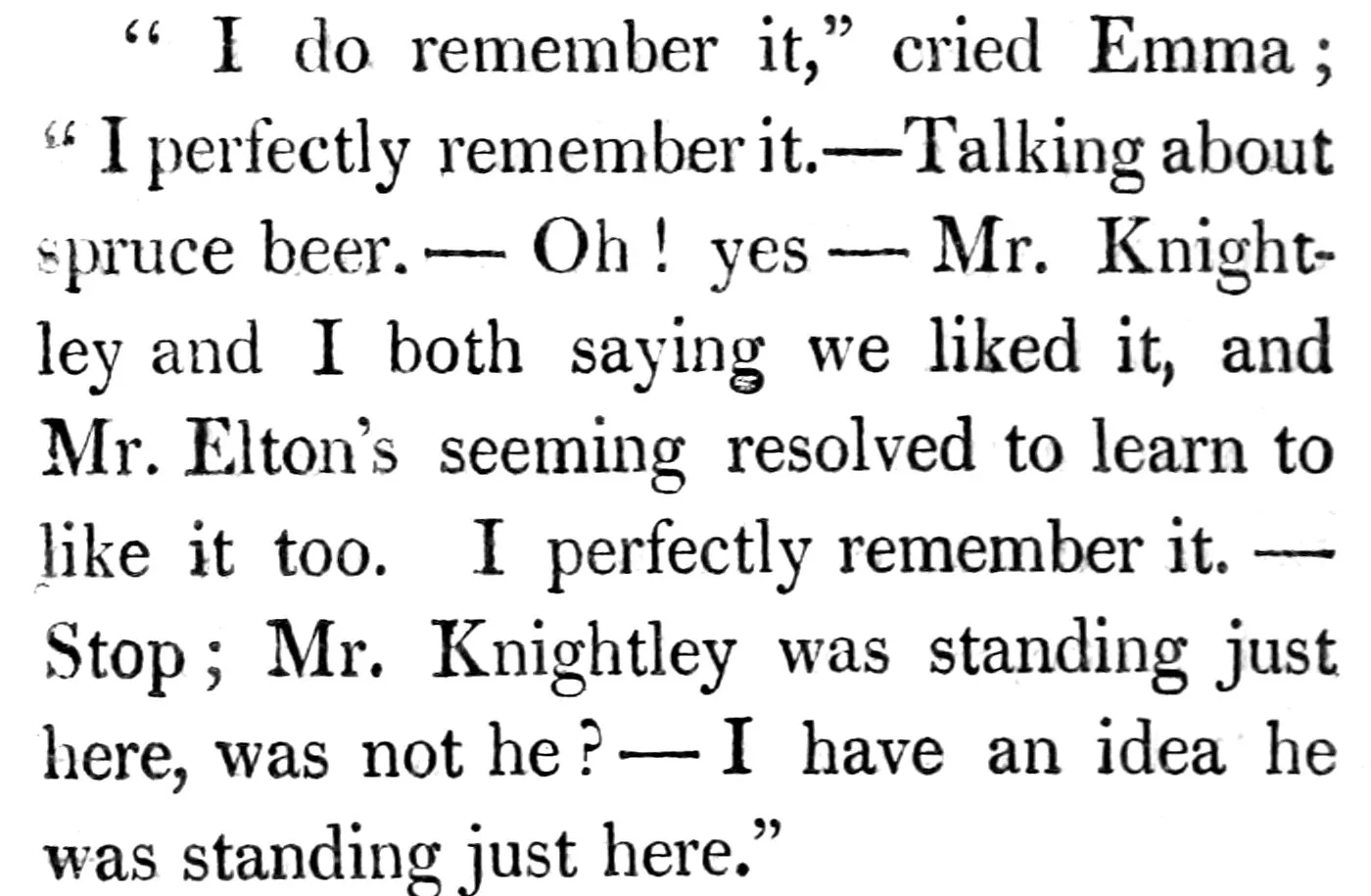 Jane Austen, Emma, vol. III (London: John Murray, 1816), p. 54.
The joke is Mr. Elton’s: the vicar will learn to like anything Emma likes. For the joke to work, spruce beer has to be an ordinary thing that a country gentleman brews and talks about, which is what Austen’s own letters show it was.
Black spruce, or larch
By 1869 spruce beer was still in the drinks books. William Terrington’s Cooling Cups and Dainty Drinks gives three on one page, among the ginger beers. The plainest takes “Sugar, 1lb.; essence of spruce, 1 oz.; boiling water, 1 gallon,” with “a tablespoonful of German yeast” when lukewarm, and is bottled “like ginger beer.” Another starts with hops, allspice and bruised ginger, given an hour in six gallons of water before the molasses and spruce go in.
Terrington’s essences are less settled. One recipe boils “the young tops of the black spruce-fir (Abies nigra)” and concentrates the liquid. The next names “Pinus larix,” the larch, which is not a spruce at all. He prints both and does not choose between them.
None of these was a temperance drink in the modern sense. Yeast that makes gas makes alcohol, and the molasses in Bach’s or Cook’s proportions, fermented out, comes to about 2 to 2.5 percent by our arithmetic. Terrington’s sugar recipe could run stronger if left to finish, though bottling it early, like ginger beer, kept it lower. Victorian bottled “non-alcoholic” beers had the same small secret. In America, spruce beer sat beside switchel on an 1805 list of harvest drinks.
Three weeks from jug to glass
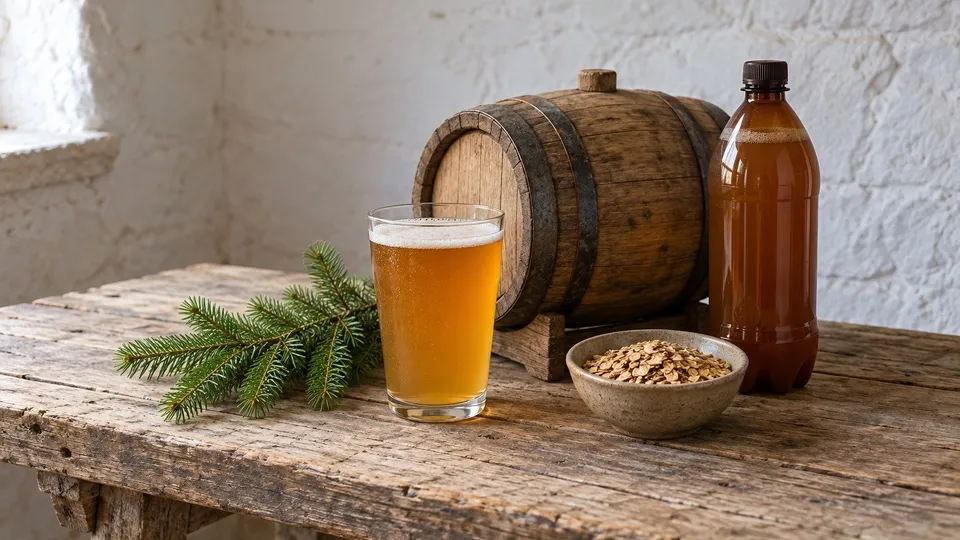
Bach’s handbill asks for patience. Three or four days working, five or six days resting, ten days in the bottle: about three weeks from mixing to the first glass. Our spruce beer from an 1804 New York handbill keeps his molasses and his water at one gallon, with a bought food-grade spruce essence in place of the Quebec one and dried ale yeast for his porter grounds. It follows his timetable with one addition: the bottles stand 1 to 3 days at room temperature until firm, then spend his ten days in the fridge. They are plastic soda bottles, because a beer bottled while it is still working keeps making gas. For the older Canadian way, fresh spruce boiled with roasted oats and toast before the molasses goes in, as a Paris book printed it in 1755, make the Canadian spruce beer of 1755; What Did People Drink in New France? tells where it was drunk.
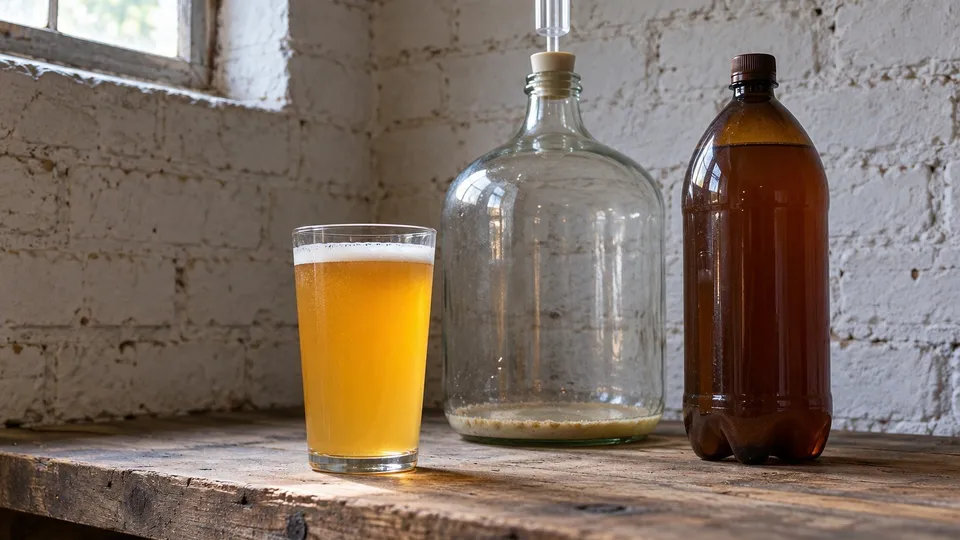 Make it todaySpruce Beer from an 1804 New York Handbill
 Make it todayCanadian Spruce Beer from a French Book of 1755
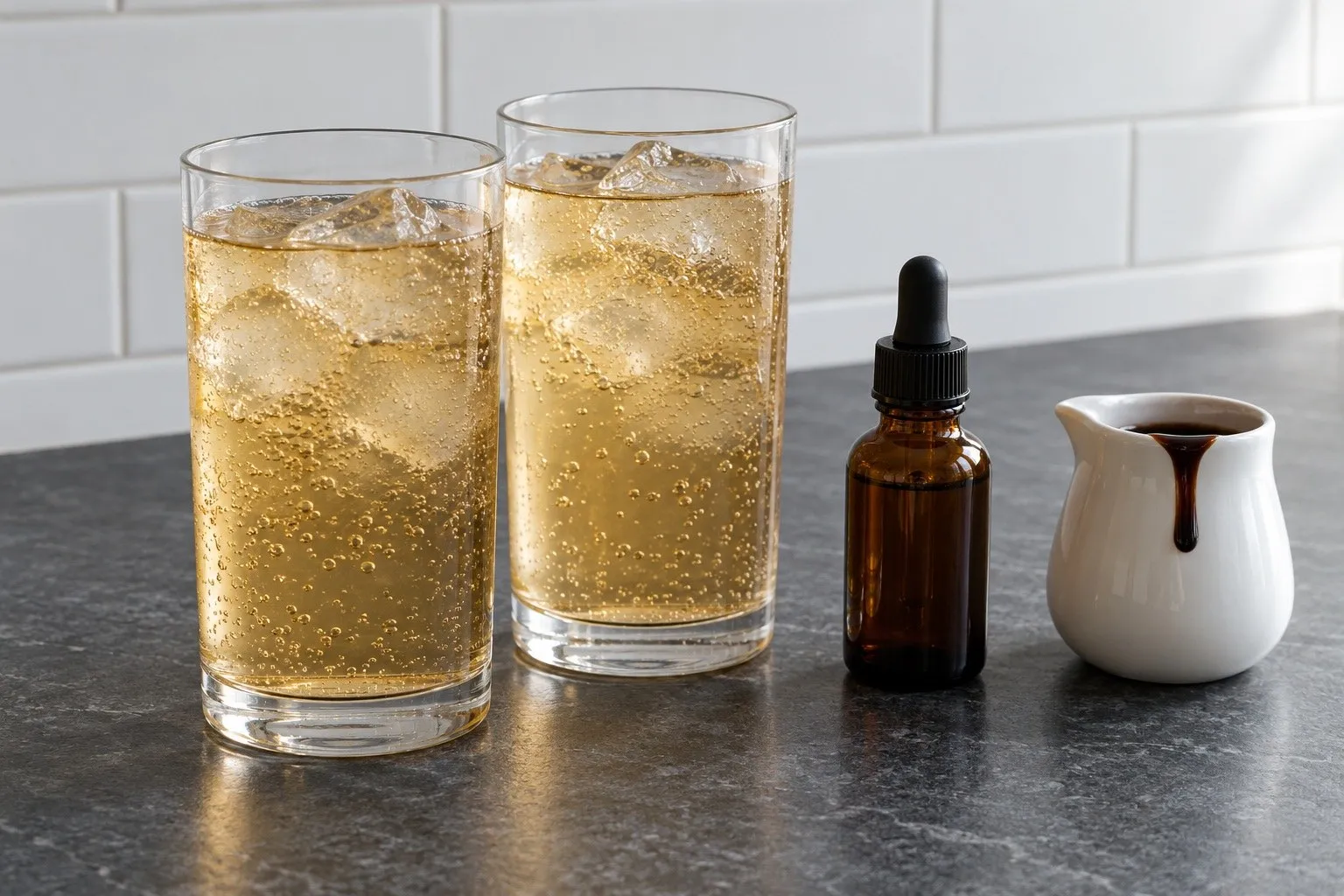 Spruce soda over ice in two tall glasses, with the dropper bottle of spruce essence and a small jug of molasses.
If three weeks is too long to wait, the spruce soda with molasses takes the same flavors, essence, sugar and a spoonful of molasses, and puts the fizz in from a bottle of soda water, with no yeast and no alcohol. It is ready in the time it takes to fill a glass with ice.
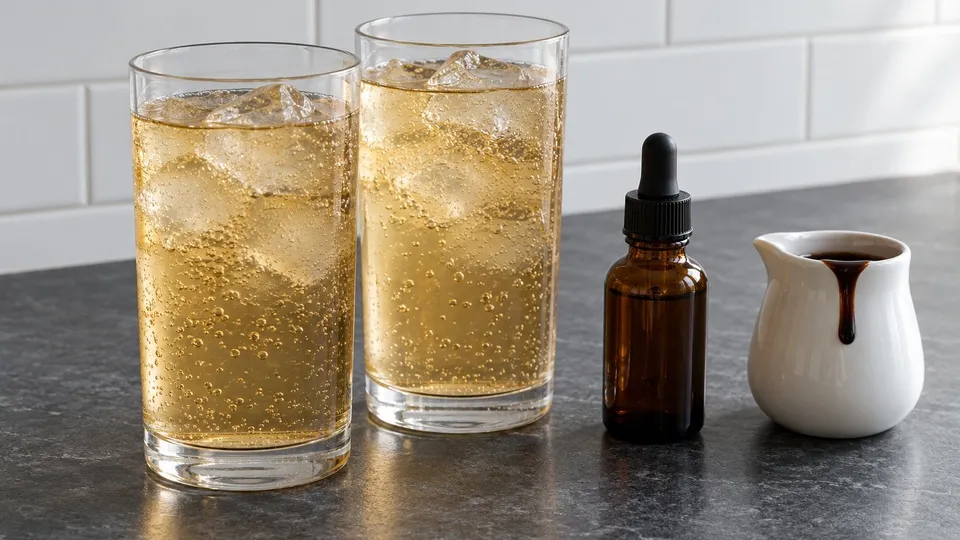 Alcohol-free versionSpruce Soda with Molasses
Sources
- R. Bach & Co., Essence of Spruce, handbill (New York, about 1804), National Library of Medicine, Bethesda, UID 2542002R.
- James Cook, A Voyage towards the South Pole, and round the World, vol. I (London: Strahan and Cadell, 1777), pp. 99–100.
- George Forster, A Voyage round the World, in His Britannic Majesty’s Sloop, Resolution, vol. I (London, 1777), pp. 129–130.
- Letters of Jane Austen, ed. Edward, Lord Brabourne, vol. II (London: Bentley, 1884), pp. 12–13 and 39.
- Jane Austen, Emma, vol. III (London: John Murray, 1816), pp. 53–54.
- William Terrington, Cooling Cups and Dainty Drinks (London: Routledge, 1869), pp. 105 and 155.