Spruce Beer from an 1804 New York Handbill
Reader ratingsMolasses, water and essence of spruce, worked with yeast for three or four days, rested, then bottled for ten: a New York druggist’s spruce beer of about 1804, at one gallon.
- Recipe makes
- About 3.5 liters, 10 bottles of 330 ml
- Prep
- Total
About three weeks in all: 3 to 4 days working, 5 to 6 days resting and about 10 days in the bottle, as the handbill directs. Hands-on time is about half an hour.
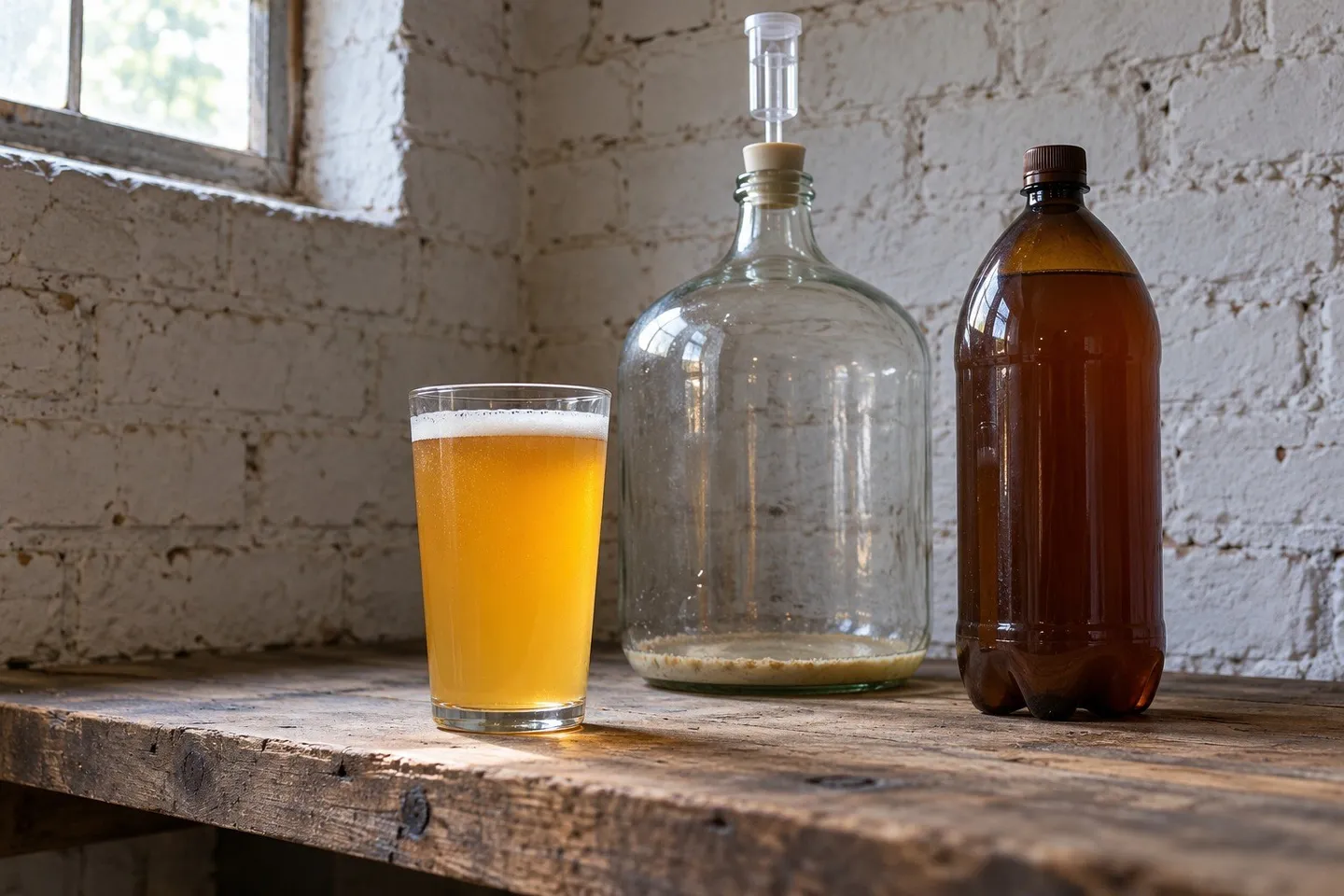
Spruce beer in a glass, with the emptied fermenting jug and a capped bottle on a cellar shelf.
The story behind the recipe
Molasses, water and a spoonful of spruce essence make this small beer, brewed the way a New York druggist told his customers to make it around 1804. It works with yeast for a few days, rests, and then conditions in the bottle, and it comes out a light, gently sparkling beer of roughly 2.5 percent alcohol.
Directions on a handbill
The recipe is printed on a handbill of R. Bach & Co., “Druggists and Perfumers, 128, Pearl-Street, New-York,” now in the National Library of Medicine. The sheet was an advertisement for its “Essence of Spruce,” prepared in Quebec, and the brewing directions sat under the sales pitch so that a buyer could use the bottle at home. Bach’s quantities are for five gallons: two tablespoons of essence, a quart of molasses or treacle, water, and half a pint of “good yeast or porter grounds.”
Bach sold to ship captains as well as households: thirty years earlier, spruce beer had gone to sea with Captain Cook.
Read more about this recipe
A gallon, and plastic bottles
Our batch is a fifth of Bach’s, one US gallon, taking his gallons and quarts as American ones, as a New York druggist’s would most likely have been. His essence is long gone, so use a food-grade spruce essence sold for brewing, at its maker’s dose, rather than anything cut from a tree at home. A quarter teaspoon of dried ale yeast stands in for his yeast or porter grounds. Bach stopped his cask “close” after the first few days; we keep the airlock on, because a sealed glass jug of working beer can build up dangerous pressure. For the bottle stage we add a little more molasses and use plastic soda bottles, the safe choice for anything still fermenting, filled to the shoulder.
For a spruce drink with no yeast and no wait, there is the spruce soda with molasses.
DIRECTIONS FOR MAKING THE BEER.
To make 5 gallons take two table spoonfuls of Essence, and one quart of molasses or treacle, mix both well together in about two quarts of warm or cold water, according to the climate in which it is made. Let the liquor be well shaken until it bears a froth, then pour it into a cask and fill up with water. You must then put half a pint of good yeast or porter grounds to it. Shake the cask well and let it work for three or four days, then bung it up close and let it stand quiet for five or six days more. You may then bottle it off, cork it well, and set it by in as cool a place as you can, and in ten days you will have ready for drinking as good Spruce Beer as can be made. Remember the grounds of the Spruce Beer will always serve after the first brewing as well as yeast, or porter grounds.
This Essence prepared in Quebec is warranted to keep good in every climate for years, if kept close covered from the air.

Recipe makes: About 3.5 liters, 10 bottles of 330 ml
Ingredients
For About 3.5 liters, 10 bottles of 330 ml. Quantities are shown as written.
Quantities as written here, for About 3.5 liters, 10 bottles of 330 ml.
- Light molasses190 ml
- Food-grade spruce essence, the maker’s dose for 3.8 l
- Water3.6 l
- Dried ale yeast1 g
- Light molasses, for bottling2 metric tbsp (15 ml per tbsp)
Measurement notes
Ingredients as written here
- 190 ml light molasses
- Food-grade spruce essence, the maker’s dose for 3.8 l
- 3.6 l water
- 1 g dried ale yeast
- 2 tbsp light molasses, for bottling
Equipment
 Glass jug, 4 liters, with a bung and airlock
 Funnel
 Brewing sanitizer
 Small saucepan
 Plastic soda bottles, enough for 3.5 liters
Instructions
Clean and sanitize the jug, bung, airlock and funnel, following the sanitizer maker’s directions.
Warm about a tenth of the water to lukewarm, about 35 °C. Pour it into the jug through the funnel with the light molasses and the food-grade spruce essence.
Close the jug with the bung (without the airlock) and shake it hard until the liquid is well mixed and bears a froth.
Pour in the rest of the water, cool, leaving a hand’s width of space at the top of the jug. The mixture should feel only just cool to the touch, about 20 °C.
Sprinkle in the dried ale yeast, close the jug and shake it again for a minute.
Fit the airlock and leave the jug somewhere at 18 to 22 °C for 3 to 4 days, until the bubbling slows.
Leave it standing quietly, with the airlock still on, for 5 to 6 days more, so the yeast settles.
Sanitize the bottles. Warm the light molasses for bottling with a splash of the beer in a small saucepan until it is runny, then stir it gently back into the jug.
Pour the beer through the funnel into the plastic bottles, leaving the sediment in the jug. Fill each only to the shoulder and screw the caps on tight.
Keep the bottles at room temperature and squeeze one each day. When it feels firm, after 1 to 3 days, move them all to the fridge.
Leave them in the fridge for about 10 days, as the handbill directs. Open each bottle slowly over the sink, and pour gently to leave the yeast in the bottom.
Nutrition
80calories per serving
- Recipe makes
- About 3.5 liters, 10 bottles of 330 ml
- Servings
- 10
Estimated from USDA FoodData Central values for molasses, assuming about three-quarters of its sugar ferments to alcohol, counted at 7 kcal per gram, for one 330 ml bottle.
Recipe notes
When adjusting quantities
The handbill’s own batch is five times this one: two tablespoons of essence and a quart of molasses to five gallons. Follow the essence maker’s dose for the volume you brew.
Notes
Quantities mentioned in these notes don’t change when you adjust the batch.
Bach’s quantities divided by five, in US measure, are about 6 ml of essence and 190 ml of molasses to 3.8 liters, a gallon. A gram of dried ale yeast is about a quarter teaspoon. Modern essences differ in strength from his, which is why the maker’s dose comes first.
Strength is an estimate. Molasses is roughly half fermentable sugar, so at Bach’s proportions the beer can reach about 2.5 percent alcohol by volume once fully worked, a little more with the bottling molasses. It is not alcohol-free, and not for children or anyone avoiding alcohol.
Never bottle it in glass, never fill the bottles to the top and never leave full bottles somewhere warm: the yeast keeps making gas. If a bottle is rock-hard, chill it well and open it slowly.
Use light (or “fancy”) molasses, not blackstrap, which is bitter. Bach also allows treacle.
Storage
Keep the bottles in the fridge once they are firm. They are ready after about 10 days there; drink them within 2 weeks after that. The beer contains live yeast and goes on making gas while it is warm.
Scaling changes the ingredients only; glassware, ice and timings need their own judgment. To adapt this recipe further, try the recipe tool at TuneMyRecipe (opens in a new tab), our sister site.
Sources and attribution
R. Bach & Co., Essence of Spruce, handbill (New York, about 1804), National Library of Medicine
Recipe details
- Drink
- DrinkLow-alcohol
- Drink family
- Wine, Beer & Mead
- Region
- American
- Era
- 19th century
- Base
- Beer & ale
- Difficulty
- Intermediate
- Season
- Summer