Canadian Spruce Beer from a French Book of 1755
Reader ratingsSpruce branches boiled until the bark slips, roasted oats and toast, molasses and beer yeast: spruce beer as Canada made it, printed in Paris in 1755, at one gallon.
- Recipe makes
- About 3.5 liters, 10 bottles of 330 ml
- Prep
- Cook
- Total
About five days in all: an hour and a half of brewing, a day or two in the jug and 1 to 3 days in the bottle before it goes in the fridge. Hands-on time is about an hour.
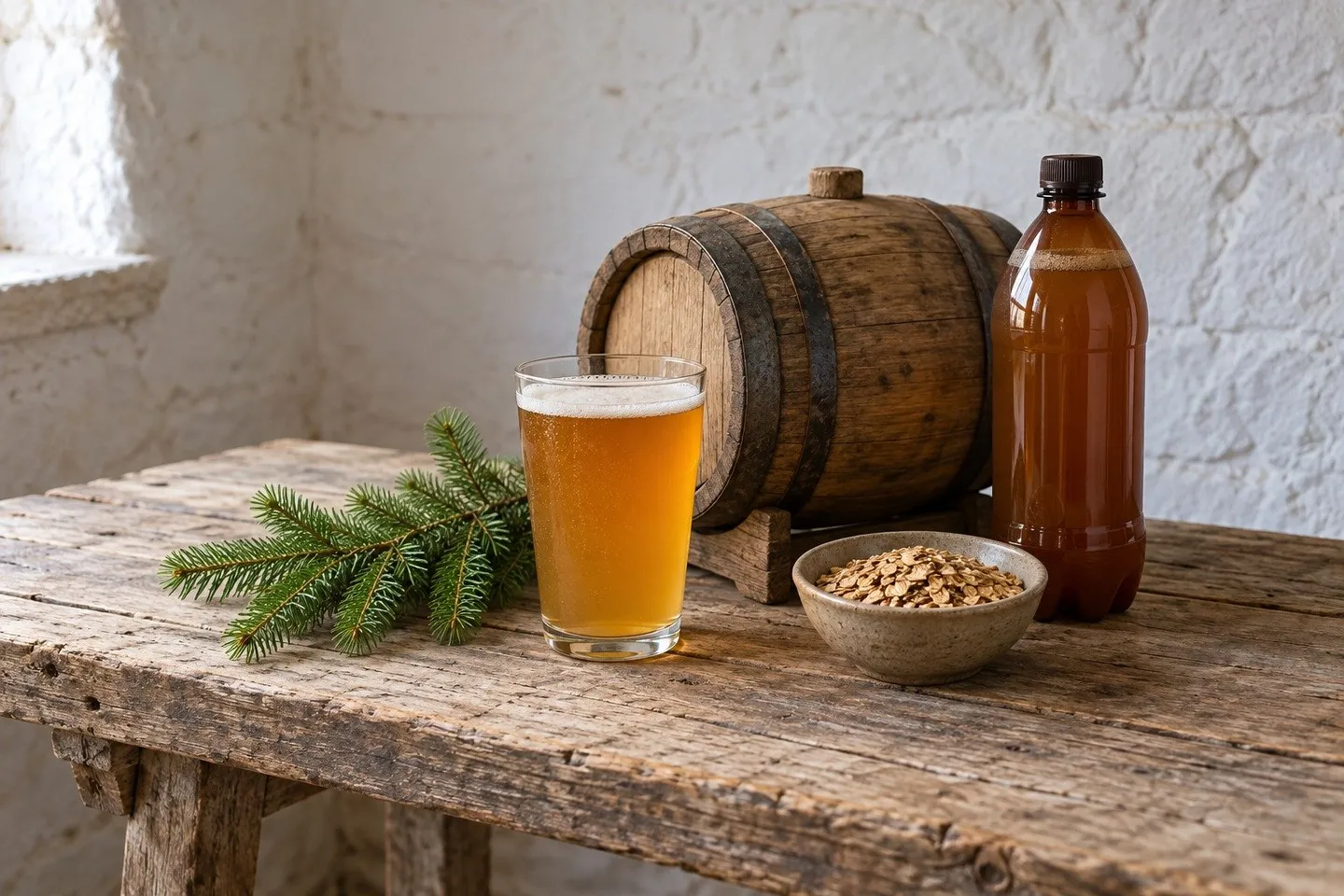
Spruce beer in a glass beside a small cask, fresh spruce, toasted oats and a capped bottle.
The story behind the recipe
Spruce beer in French Canada was brewed from the tree itself: spruce branches boiled until the bark slipped off, roasted oats and toasted ship’s biscuit or bread, molasses and beer yeast, worked in a cask that had held red wine. The French botanist Henri-Louis Duhamel du Monceau printed the Canadian method in Paris in 1755, so that France could brew it “in the years when wine is too dear.” Bunged after a day, he wrote, it stays “piquante comme le cidre,” sparkling like cider.
Not pleasant the first time
Duhamel was honest about it. In Canada, he wrote, the white spruce makes “a very healthy drink, which does not seem pleasant the first time one drinks it, but becomes so once one has used it for some time.” Once used to it, “one drinks it with great pleasure, above all in summer.” He thought juniper could stand in for the Canadian spruce in France. When the Swedish traveler Pehr Kalm visited Quebec in 1749, spruce beer was “much in use”; in Montreal it was drunk in summer, though “not general.” Both reports are in What Did People Drink in New France?
Read more about this recipe
A gallon, and plastic bottles
Our batch is about a sixtieth of Duhamel’s barrique, one US gallon. Duhamel boils a faggot of broken branches; we use 50 grams of fresh spruce tips or young twigs, our amount. The oats and bread are scaled from his bushel and his 12 to 15 pounds; his six pints of molasses, divided by sixty, come to about 95 ml. His “pint of beer yeast” becomes a gram of dried ale yeast. We strain the beer rather than leave the grain in the cask, and instead of bunging a cask after 24 hours we bottle it young in plastic soda bottles, the safe choice for anything still fermenting, and chill it as soon as the bottles are firm. The book says nothing more about taste than Duhamel’s first sip. It comes out at roughly 1% ABV. For the 1804 American way with spruce essence, try Spruce Beer from an 1804 New York Handbill; with no alcohol at all, Spruce Soda with Molasses.
Pour faire une barrique d’Epinette il faut avoir une chaudiere qui tienne au moins un quart de plus. On l’emplit d’eau, & dès que cette eau commence à être chaude, l’on y jette un fagot de branches d’Epinette rompues par morceaux: ce fagot doit avoir environ 21 pouces de circonférence auprès du lien. On entretient l’eau bouillante jusqu’à ce que la peau de l’Epicia se détache facilement de toute la longueur des branches. Pendant cette cuisson on fait rôtir à plusieurs reprises, dans une grande poële de fer, un boisseau d’avoine; on fait encore griller une quinzaine de galettes de biscuit de mer, ou à leur défaut 12 ou 15 livres de pain coupé par tranches; & quand toutes ces matieres sont bien rôties, on les jette dans la chaudiere, & elles y restent jusqu’à ce que l’Epinette soit bien cuite. Alors on retire de la chaudiere toutes les branches d’Epinette, & l’on éteint le feu. L’avoine & le pain se précipitent au fond; il faut ensuite retirer avec une écumoire les feuilles d’Epicia qui flottent sur l’eau. Enfin l’on délaye dans cette liqueur six pintes de mélasse, ou gros sirop de sucre, ou à son défaut 12 à 15 livres de sucre brut. On entonne sur le champ cette liqueur dans une barrique fraîche qui ait contenu du vin rouge; & lorsque l’on veut qu’elle soit plus colorée, on y laisse la lie & cinq à six pintes de ce vin. Quand cette liqueur n’est plus que tiede, on délaye dedans une chopine de levure de biere que l’on brasse bien fort, afin de l’incorporer avec la liqueur; ensuite l’on acheve d’emplir la barrique jusqu’au bondon que l’on laisse ouvert. Cette liqueur fermente & jette dehors beaucoup de saletés: à mesure qu’elle se vuide, l’on a soin de la remplir avec une partie de la même liqueur que l’on conserve à part dans quelque vaisseau de bois. Si l’on ferme le bondon au bout de 24 heures, l’Epinette reste piquante comme le cidre; mais si on veut la boire plus douce, il ne faut la bondonner que quand elle a passé sa fermentation, & avoir soin de la remplir deux fois par jour.
Our translation, in short: For a barrique of spruce beer, take a copper holding at least a quarter more. Fill it with water, and as soon as it is hot throw in a faggot of spruce branches, broken in pieces, about 21 inches round at the tie. Keep it boiling until the bark comes away easily along the whole length of the branches. Meanwhile roast a bushel of oats in batches in a large iron pan, and toast about fifteen ship’s biscuits, or failing them 12 or 15 pounds of sliced bread; when well roasted, put them in the copper until the spruce is well cooked. Then take out all the branches and put out the fire. The oats and bread sink; skim off the spruce needles floating on top. Stir in six pints of molasses, or coarse sugar syrup, or failing that 12 to 15 pounds of raw sugar. Funnel it at once into a fresh cask that has held red wine; for more color, leave in the lees and five or six pints of the wine. When it is only lukewarm, stir in a pint of beer yeast, fill the cask to the bung and leave it open. It ferments and throws out a great deal of dirt; top it up from a reserve kept aside. If the bung is closed after 24 hours, the spruce beer stays sparkling like cider; to drink it sweeter, bung it only when it has finished fermenting, and top it up twice a day.

Recipe makes: About 3.5 liters, 10 bottles of 330 ml
Ingredients
For About 3.5 liters, 10 bottles of 330 ml. Quantities are shown as written.
Quantities as written here, for About 3.5 liters, 10 bottles of 330 ml.
- Water4.5 l
- Fresh spruce tips50 g
- Rolled oats100 g
- White bread3 slices
- Light molasses95 ml
- Dried ale yeast1 g
Measurement notes
Ingredients as written here
- 4.5 l water
- 50 g fresh spruce tips
- 100 g rolled oats
- 3 slices white bread
- 95 ml light molasses
- 1 g dried ale yeast
Equipment
 Large pot, at least 6 liters
 Dry frying pan
 Fine sieve
 Glass jug, 4 liters, with a bung and airlock
 Funnel
 Brewing sanitizer
 Thermometer
 Plastic soda bottles, enough for 3.5 liters
Instructions
Make sure what you pick is spruce: short, single needles growing all around the twig, each on a little woody peg. Never use yew, which has flat needles in two rows and red berries and is poisonous. Rinse the fresh spruce tips.
Bring the water to a boil in the large pot, add the spruce and keep it at a steady simmer for about an hour, until the bark comes away easily from any woody twigs.
Meanwhile, toast the rolled oats in the dry frying pan over medium heat, stirring, until they are deep golden and smell nutty, about 8 minutes. Toast the white bread until it is well browned.
Add the oats and the toast to the pot and simmer for 15 minutes more.
Turn off the heat, lift out the spruce, and let the oats and bread settle for 10 minutes. Skim off any floating needles.
Stir in the light molasses until it dissolves.
Clean and sanitize the jug, bung, airlock, funnel and sieve, following the sanitizer maker’s directions. Pour the liquid through the sieve and funnel into the jug, leaving the oats and bread behind, and fill to a hand’s width below the neck.
Let it cool to about 20°C, then sprinkle in the dried ale yeast, close the jug with the bung and shake it for a minute.
Fit the airlock and leave the jug at 18 to 22°C for 1 to 2 days, until it is bubbling steadily.
Sanitize the bottles and fill them through the funnel while the beer is still working, leaving the sediment in the jug. Fill each only to the shoulder and screw the caps on tight.
Keep the bottles at room temperature and squeeze one each day. When it feels firm, after 1 to 3 days, move them all to the fridge. Open each bottle slowly over the sink.
Nutrition
50calories per serving
- Recipe makes
- About 3.5 liters, 10 bottles of 330 ml
- Servings
- 10
Estimated from USDA FoodData Central values for molasses, rolled oats and white bread, assuming most of the molasses sugar ferments and little of the oat and bread starch dissolves, for one 330 ml bottle.
Recipe notes
When adjusting quantities
Duhamel’s own batch is a barrique, about 60 times this one: a faggot of spruce, a bushel of oats, 12 to 15 pounds of bread or fifteen ship’s biscuits, six pints of molasses and a pint of beer yeast.
Notes
Quantities mentioned in these notes don’t change when you adjust the batch.
Pick spring tips or young twigs from a tree you are sure of, away from roads and anywhere that may have been sprayed. If you can’t, use a food-grade spruce essence at the maker’s dose for 3.8 liters instead, as in the 1804 handbill recipe.
Duhamel’s barrique is taken as about 228 liters, his pint as the Paris pinte of about 0.93 liters and his bushel as the Paris boisseau of about 13 liters; about 95 ml of molasses, 100 g of oats and 100 g of bread, three slices, are a sixtieth of his amounts, rounded.
Strength is an estimate. Duhamel’s beer is light: at his proportions it can reach only about 1 percent alcohol by volume once fully worked. It is not alcohol-free, and not for children or anyone avoiding alcohol.
Never bottle it in glass, never fill the bottles to the top and never leave full bottles somewhere warm: the yeast keeps making gas. If a bottle is rock-hard, chill it well and open it slowly.
For Duhamel’s darker “colored” version, he left red-wine lees and a little red wine in the cask; a splash of red wine in the jug does the same.
Storage
Keep the bottles in the fridge once they are firm and drink them within 2 weeks. The beer contains live yeast and goes on making gas while it is warm.
Scaling changes the ingredients only; glassware, ice and timings need their own judgment. To adapt this recipe further, try the recipe tool at TuneMyRecipe (opens in a new tab), our sister site.
Sources and attribution
Henri-Louis Duhamel du Monceau, Traité des arbres et arbustes, vol. 1 (Paris, 1755), article “Abies”, pp. 17–18; translation ours
See the original pages (scan at Internet Archive) (opens in a new tab)
Recipe details
- Drink
- DrinkLow-alcohol
- Drink family
- Wine, Beer & Mead
- Region
- French
- Era
- 18th century
- Difficulty
- Advanced
- Season
- Summer