A Pint of Stout on Christmas Day: What the Victorian Poor Drank
A pint of beer or stout with the workhouse Christmas dinner, hot elder wine in the street, tea for the teetotal: what the Victorian poor drank at Christmas.
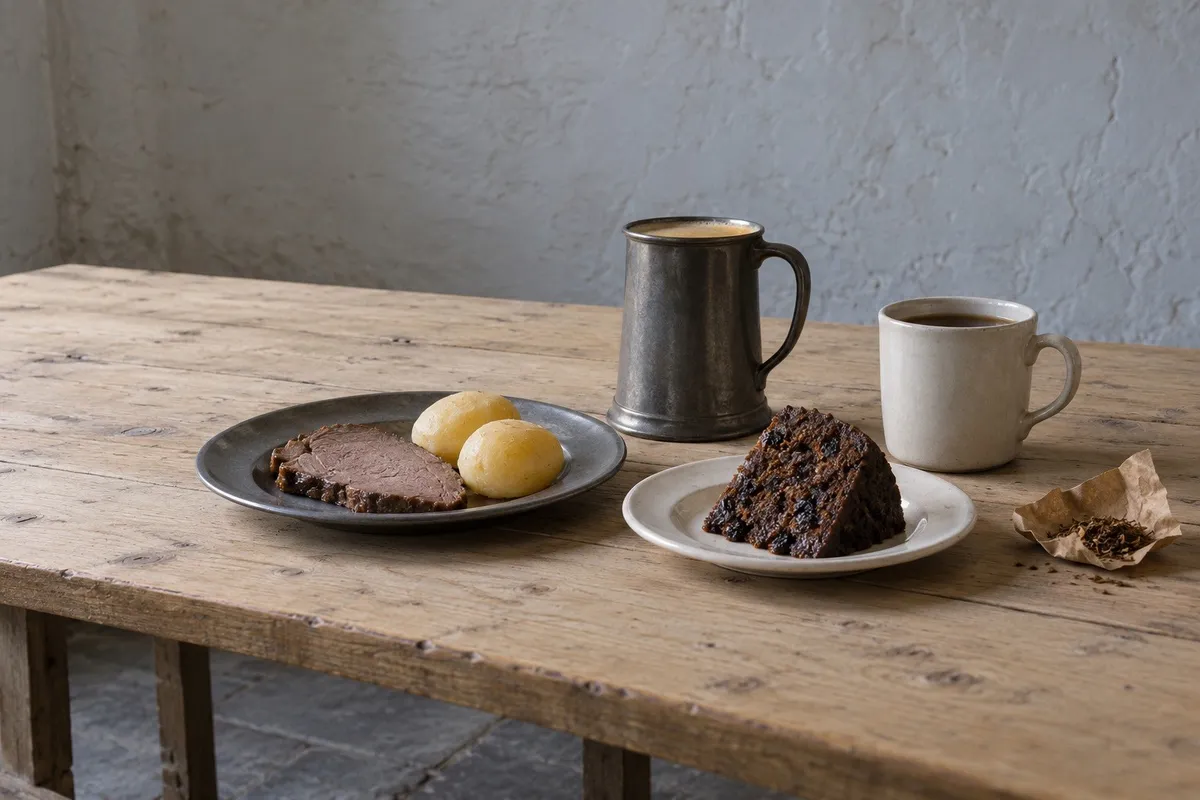
For the poorest people in Victorian England, the ones living in the workhouse, Christmas brought a single drink: a pint of beer or stout with the Christmas dinner. It was the one day of the year, sickness apart, when alcohol came inside the walls, and every November the local Guardians argued over whether to allow even that. Outside the walls, the poor bought hot elder wine in the street by the halfpenny glass, about 25p today by UK consumer prices (Bank of England), and the temperance movement offered them tea.
Dinner at St Pancras
On Christmas Day 1871 the war correspondent Archibald Forbes went to St Pancras workhouse in north London and wrote up what he saw, publishing it the next year as “Workhouse Christmas Depravity.” The cook gave him the menu for each grown-up: “6 oz. of roast beef free from bone,” eight ounces of potatoes, “and one pound of the plum-pudding,” besides “a pint of stout, with tobacco and snuff to follow, and fruit and sweets for the women and children.” The fruit and sweets, the cook explained, were “leastways for such of the women as don’t use tobacco.”
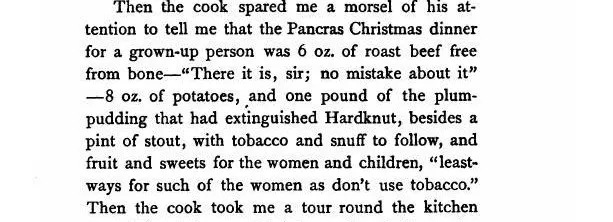 The St Pancras Christmas dinner of 1871, p. 267 in Archibald Forbes, Soldiering and Scribbling (London: H. S. King, 1872).
The stout mattered more to the inmates than anything else on the table. An old woman of eighty-eight told Forbes that once “the Christmas dinners had been served cold, and without beer,” and she was still indignant about it. “Beer was evidently with her the question of the day,” he wrote, and when the master assured her the allowance was a pint of stout, she “blessed everybody all round.” Not every ward got the full measure. In the male lunatic ward a man stood up to report, as a matter of duty, that they had had only half a pint, and Forbes found that the smaller allowance was “by the doctor’s orders.”
Forbes was writing a sketch, with a comic companion along for the visit, so his scenes are shaped for the reader. The menu and the pint of stout come from the cook and the master, and they are the parts of the piece that can be relied on.
The November argument
The pint was never safe. Writing in 1910, the country parson Richard Lawson Gales described a fight that came round every year in early November. The Boards of Guardians met to decide whether inmates should have “the annual allowance of a pint of beer with their dinner on Christmas Day,” and a teetotal Guardian would arrive with a petition against it. A Birmingham campaigner, W. C. Amery, published surveys of which workhouses gave beer and which did not; his map, Gales reported, showed the counties round London heavily shaded for beer, while the Scottish and Irish workhouses were “practically all ‘non-alcoholic.’”
So practice varied from one union to the next, and St Pancras with its stout, tobacco and snuff was not the rule everywhere. Gales had no patience with the campaign. One objection he heard was that some inmates might swap a slice of pudding for a teetotaler’s beer and so drink two. That could not happen, he answered, because each inmate was “asked beforehand” whether they would take the beer or prefer “some substitute for it.” The non-drinker’s pint was replaced, not left on the plate. None of these sources says what the substitute was, whether tea, coffee or lemonade, and we would rather not guess. Just before Christmas 1915 the House of Commons heard about a man fined in Bristol for buying his wife a drink, under wartime orders that made it an offense in much of Britain to buy anyone else one; that story is No Rounds Allowed: The Wartime Treating Orders of 1915.
Outside the walls
The poor who were not in the workhouse had more choice and less money. In London the street-sellers of hot elder wine worked through the winter, selling a small glass with a piece of toast for a halfpenny or a penny, about 25p or 50p today, as Henry Mayhew recorded; that trade, the publicans’ Christmas goose clubs and Dickens’s punch are in Victorian Christmas Drinks, from Punch to Elder Wine. Elder wine was fermented, so it was not the teetotal option it was sometimes sold as.
The teetotal option was tea. The Band of Hope, the temperance movement’s societies for the young, kept the day with tea: early in 1864 its paper reported a ladies’ Band of Hope at Bishop Auckland holding its annual festival on Christmas Day itself, with tea first and a public meeting after. By the late 1870s the movement had gone further and opened coffee taverns, pub-like rooms with urns on the counter, where tea, coffee and cocoa cost a penny or a halfpenny a cup, about 43p or 21p today. Their story is told in Coffee Taverns, the Victorian Answer to the Pub.
The coffee tavern’s coffee was made in pails, a pound to thirteen pints of boiling water, and sold sweet and milky at a penny, about 43p, for half a pint. Our Coffee-Tavern Coffee at a Penny a Cup scales that down to a home pot. Its tea was the dearer drink, never sold for less than a penny.
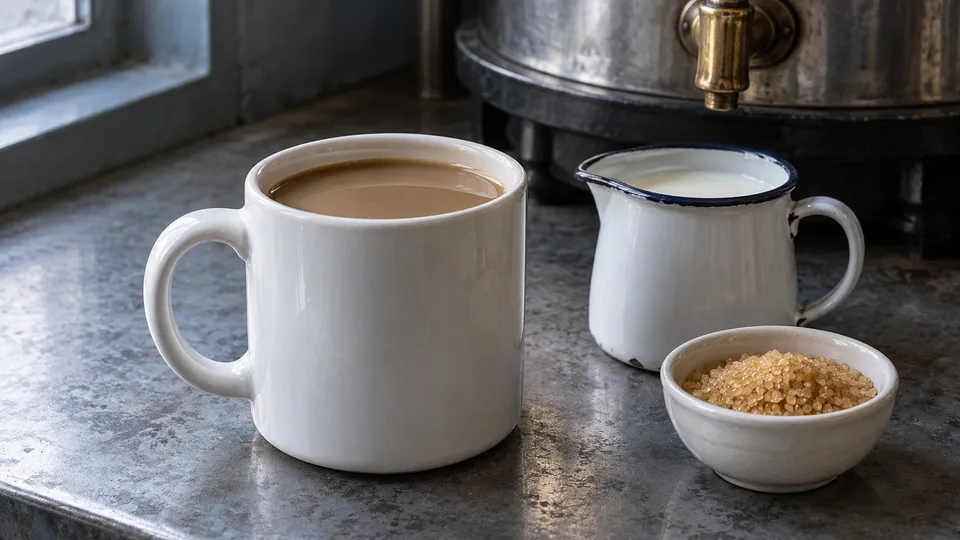 Always alcohol-freeCoffee-Tavern Coffee at a Penny a Cup
Make the Coffee-Tavern Tea for the pot to set beside the Christmas pudding: the 1878 manual let the leaf stand a full ten minutes and sweetened it in the pot, so it comes out dark, brisk and sweet, the penny cup the temperance movement set against the pub.
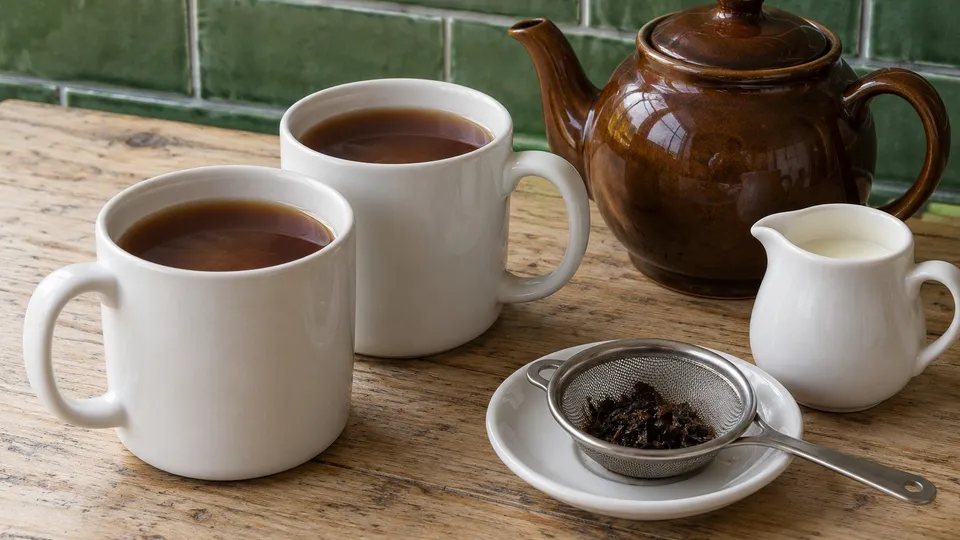 Always alcohol-freeCoffee-Tavern Tea, Steeped Ten Minutes
For what was on the plate, our sister site The Forgotten Menu has the Cratchits’ Christmas dinner of 1843 (opens in a new tab).
Sources
- Archibald Forbes, “Workhouse Christmas Depravity, 1871,” in Soldiering and Scribbling (London: H. S. King, 1872), pp. 267, 269–270.
- Richard Lawson Gales, “Christmas Beer in Workhouses,” in Studies in Arcady and Other Essays from a Country Parsonage, first series (London: Herbert & Daniel, 1910), pp. 433–436.
- Henry Mayhew, London Labour and the London Poor, vol. 1 (London: Griffin, Bohn, 1861; text first published 1851), pp. 189–191.
- The Band of Hope Record, 1864, p. 44.
- Coffee Publichouse Association, The Coffee Publichouse: How to Establish and Manage It (London: Coffee Publichouse Association, 1878).