What Did Romans Drink Before Christ?
Rationed farm wine, a winter mix stretched with water and sea water, after-wine from pressed grape skins: what Cato and Varro say Romans drank before Christ.
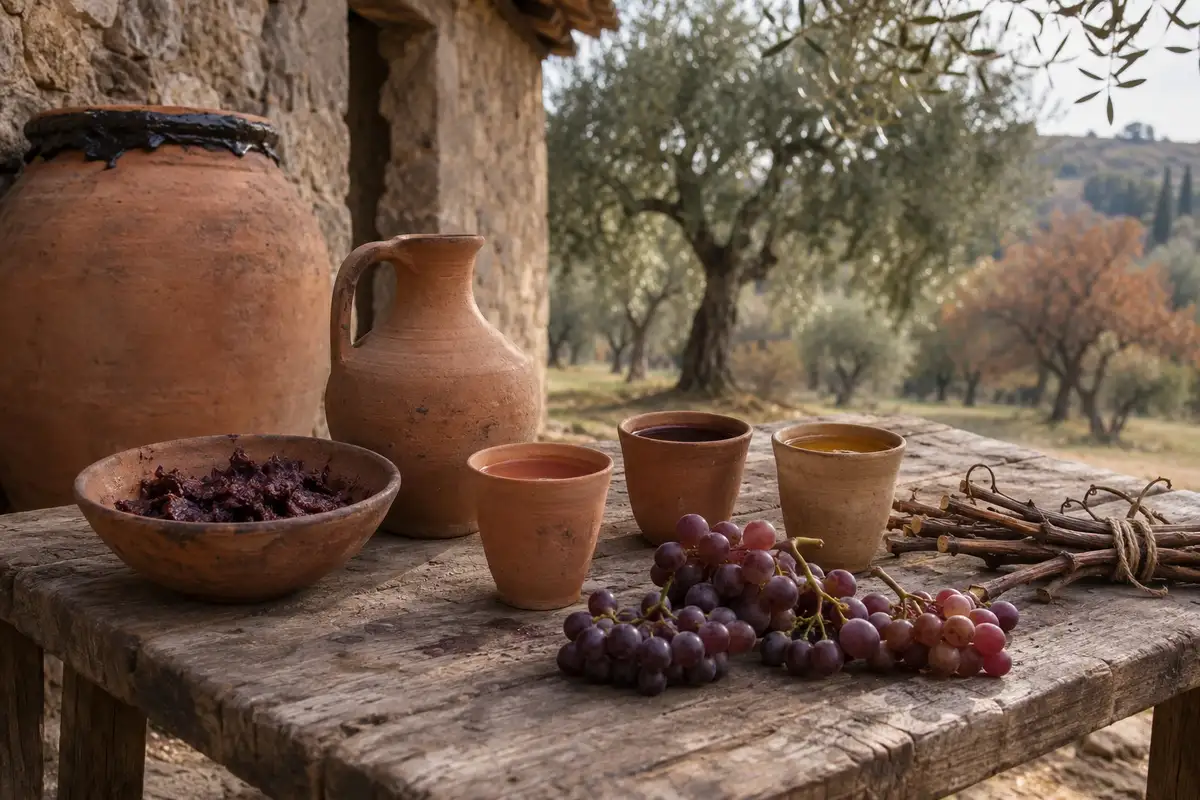
Before Christ, Romans drank the wine of their own vines, but the people who worked those vines were mostly given thinner drinks: a measured ration of wine, a winter mix of fresh grape juice stretched with vinegar, water and sea water, and an “after-wine” made by soaking the pressed grape skins in water. The fullest witnesses are two farmers who wrote it down. Marcus Porcius Cato set out his rules for a farm in the middle of the second century BC, and Marcus Terentius Varro published his books on farming in 37 BC.
This story is part of our Ancient Roman Drinks guide.
Both men wrote for owners of estates worked by enslaved laborers, and most of what they say about drink is about what those workers should get. Their recipes have none of the spice and rose petals of the later cookbook that goes under the name of Apicius. They are about stretching the vintage until the next one.
Cato’s farm and its wine
Cato (234–149 BC) was a soldier, consul and censor who made frugality his public creed. His book on farming, De Agri Cultura, is a working manual of short commands: what to plant, what to buy, how many hands to keep, what to give them. Fairfax Harrison, who put Cato and Varro into English in Roman Farm Management (1918) under the name “A Virginia Farmer,” notes that Cato’s book “was the first on the subject in Latin; indeed, it was one of the very first books written in that vernacular at all.”
Cato fixed the drink as he fixed the bread. “The sum of the wine allowed for each hand per annum is eight quadrantals, or Amphora,” he wrote, “but add in the proportion as they do work. Ten quadrantals per annum is not too much to allow them to drink.” A quadrantal held about 26 liters, so eight came to about 210 liters a year, a little over half a liter a day, and ten to about 0.7 liter. Romans normally cut their wine with water before drinking it, which is the subject of Seawater, Pine Resin and Honey: How Roman Wine Tasted.
A winter wine for the household
Cato also gives the recipe for a drink to last the workers through the winter. His heading, in the Latin printed in the bilingual Les agronomes latins edited by Nisard (Paris, 1844), is Vinum familiae per hiemem qui utatur, wine for the household to use through the winter. The familia of a Roman farm meant its slaves, and Nisard’s French translation calls it plainly vin des gens, the people’s wine.
Into a large jar went 10 quadrantals of must, the fresh juice of the grapes, 2 of sharp vinegar, 2 of sapa, must boiled down to a syrup, and 50 of fresh water. It was stirred with a stick three times a day for five days, then given 64 sextarii of sea water drawn some time before, covered and sealed for ten days. “This wine will last you until the solstice,” Cato promises, in our translation. “Whatever is left after the solstice will be the sharpest and finest vinegar.”
Count the measures and the grape juice comes to about one part in six and a half of the whole. Cato calls it wine, and the must may have fermented a little in those fifteen days, but by the numbers it was mostly water with a sweet and sour grape taste and a trace of salt, a drink built to stretch a little juice over a whole winter. We make it without the fermenting as Cato’s Winter Wine for the Farm Hands, Made Alcohol-Free.
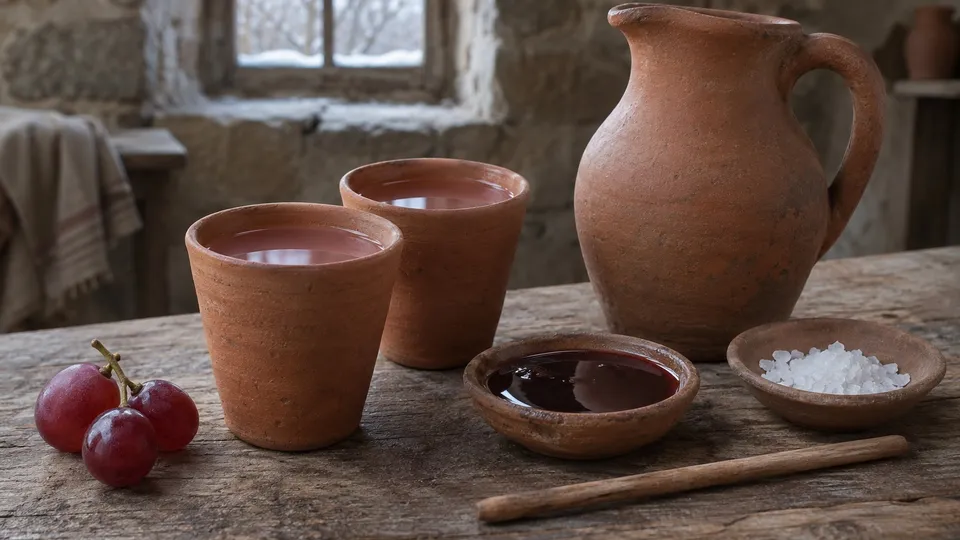 Always alcohol-freeCato’s Winter Wine for the Farm Hands, Made Alcohol-Free
After-wine from the skins
Nothing in the vintage was wasted. Once the grapes had been trodden and pressed, Cato had the skins packed into pitched jars as winter feed for the oxen. “From the same, if you like, wash out a little at a time,” he adds. “That will be lora for the household to drink.” His word is lora. Nisard, translating in 1844, turned it into French as “une piquette pour vos esclaves,” a piquette for your slaves.
A century later Varro explains how it was made and where the name came from. In Harrison’s English, the skins left after the last pressing are “thrown into jars, to which water is added, thus preparing a drink which is called after-wine or grape juice, and is given to the hands in the winter instead of wine.” His Latin gives the reason for the word: it is called lora, he says, because the grape skins have been washed, lota. The drink was named for the washing.
Water soaked through pressed skins picks up the sugar and color left in them and, left in a jar, begins to ferment on its own, so lora would have been a pale, thin, lightly alcoholic drink, far weaker than wine. We make it that way, with fresh red grapes, in Lora, the Roman After-Wine of Grape Skins.
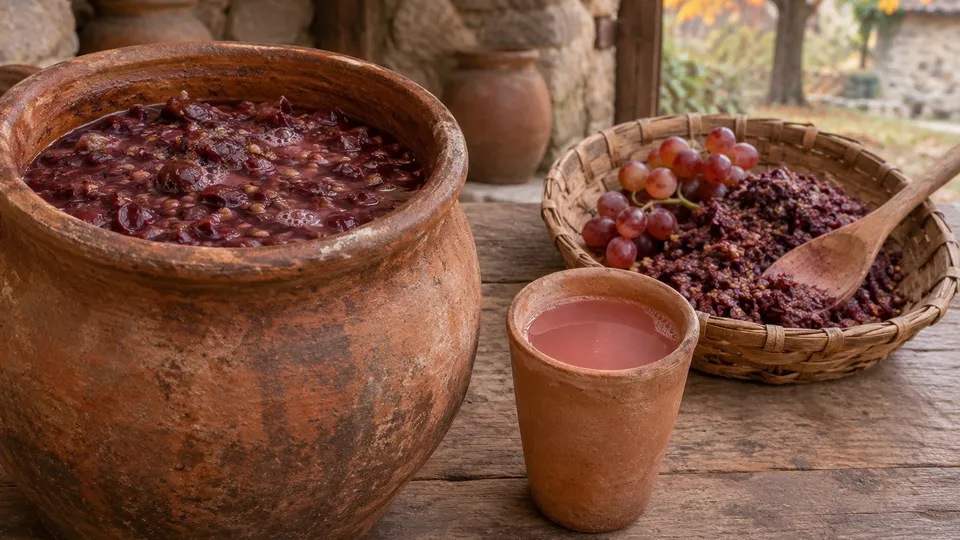 Make it todayLora, the Roman After-Wine of Grape Skins
Water and vinegar for a consul
Cato asked no more of himself than of his hands, or so he said. Plutarch, the Greek biographer who wrote his life more than two centuries later, records the habits Cato claimed. In the translation called Dryden’s, revised by Arthur Hugh Clough, “When he was with the army, he used to drink only water; unless, perhaps, when extremely thirsty, he might mingle it with a little vinegar; or if he found his strength fail him, take a little wine.”
At home Cato said the same. “He himself says,” Plutarch writes, “that, when he was general and consul, he drank the same wine which his workmen did.” Plutarch is reporting Cato’s own boasts, and Cato’s reputation was built on them, but the drinks are real enough. Water with a little vinegar in it was the drink Romans called posca, and we make it as Posca, the Roman Soldier’s Vinegar Drink.
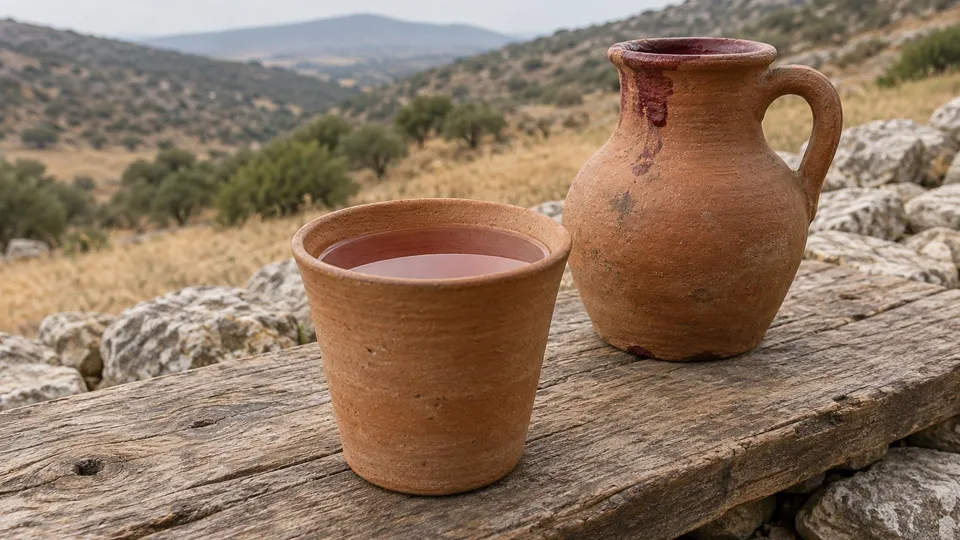 Always alcohol-freePosca, the Roman Soldier’s Vinegar Drink
Honeyed wine for the guests
Varro’s own book is a set of dialogues, and in the third, on the smaller animals of the farm, the talk turns to bees. One of the speakers is Appius Claudius Pulcher, consul in 54 BC and the brother-in-law of the general Lucullus. Another speaker teases him that “in your youth you never drank mead in your own house, such was your practice of frugality.” The Latin is mulsum, wine sweetened with honey, which Harrison renders as mead.
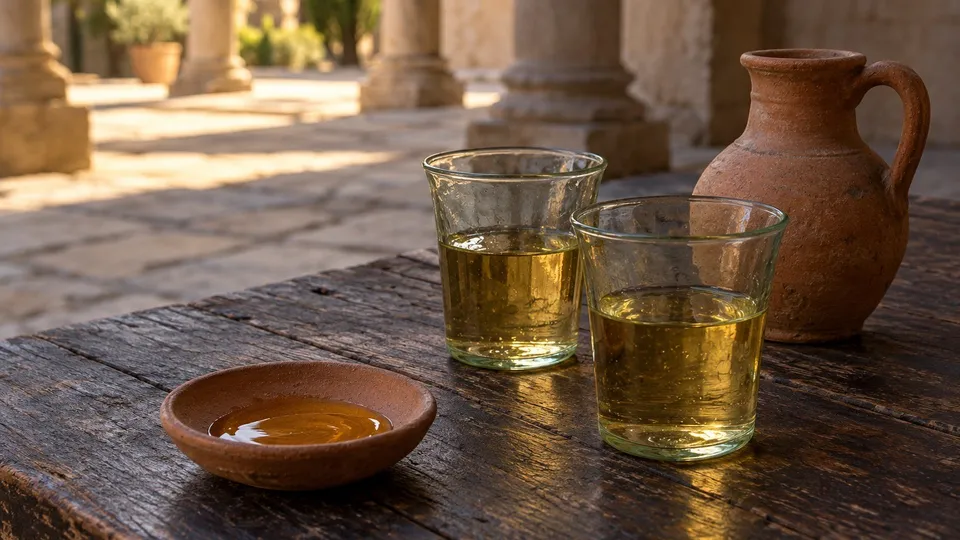
Appius admits it. Left a poor orphan with two brothers and two sisters, he says, “it was not until I had married one of them to Lucullus without portion and he had named me his heir that I began to drink mead in my own house and to supply it to my household: but there never was a day when I did not offer it to all my guests.” Honeyed wine, in other words, was what a Roman of good family poured for visitors even when he could not afford to drink it himself. You can make the honeyed wine as Mulsum, Roman Honeyed Wine.
 Make it todayMulsum, Roman Honeyed Wine
Wine was not for everyone even at a rich table. Pliny the Elder, writing in the first century AD, collected the old Roman stories that women were forbidden it, which are in What Did Romans Drink Besides Wine?
The Republican cup today
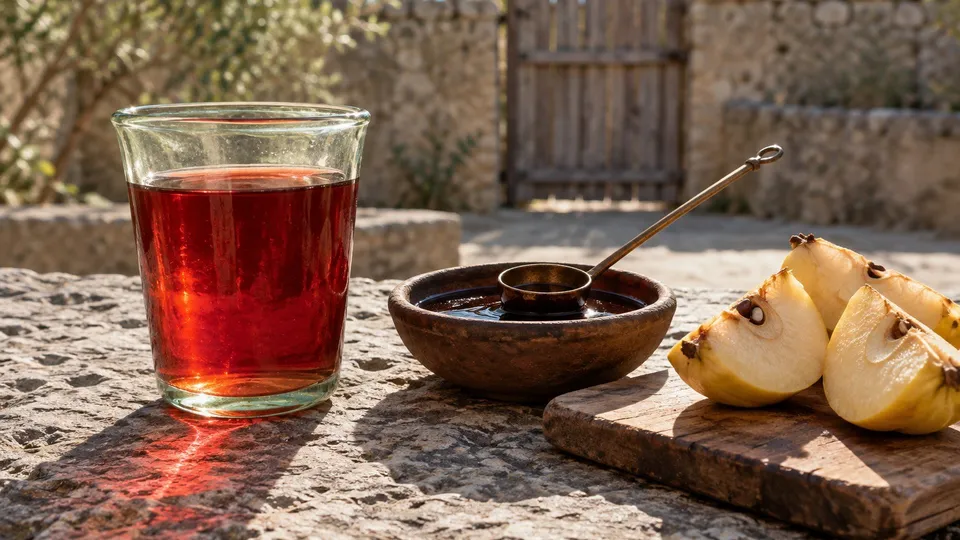
The drinks of Cato’s farm are easy to bring back because they were made from so little. Cato’s winter mix needs grape juice, vinegar, a grape syrup and salted water; his syrup is close kin to the boiled-down must we make as Defrutum Cooler, Roman Grape Syrup and Water. Lora needs only the skins left from pressing grapes and a few days. Posca needs vinegar and a cup of water.
 Always alcohol-freeDefrutum Cooler, Roman Grape Syrup and Water
What they share is thrift. The cellar of a Republican farm was planned so that nothing in the vintage went unused: the juice into wine, the boiled must into syrup, the soured wine into vinegar, the pressed skins into a drink for the workers and fodder for the oxen. The one Cato measured out most exactly is his winter wine, and it takes five minutes to mix: start with Cato’s Winter Wine for the Farm Hands, Made Alcohol-Free, a jug of the drink a Roman farm poured from autumn until midsummer.
For what was on the plate, our sister site The Forgotten Menu has the recipes from Cato’s farm (opens in a new tab).
Sources
- A Virginia Farmer [Fairfax Harrison], Roman Farm Management: The Treatises of Cato and Varro Done into English (New York: Macmillan, 1918), pp. 4–5, 11, 37, 164–165, 273, 329.
- Les agronomes latins: Caton, Varron, Columelle, Palladius, avec la traduction en français, published under the direction of M. Nisard (Paris: J. J. Dubochet, 1844), Cato chs. XXV and CIV, pp. 14, 30–31; Varro I.54, p. 95.
- Plutarch, Plutarch’s Lives: The Translation Called Dryden’s, rev. A. H. Clough, vol. 2 (Boston: Little, Brown, 1865), Marcus Cato, pp. 318, 321.