Cato’s Winter Wine for the Farm Hands, Made Alcohol-Free
Reader ratingsGrape juice, vinegar, grape syrup, plenty of water and a pinch of sea salt: the winter drink Cato mixed for a Roman farm’s workers, made without fermenting.
- Recipe makes
- About 1 liter, 4 glasses
- Prep
- Total
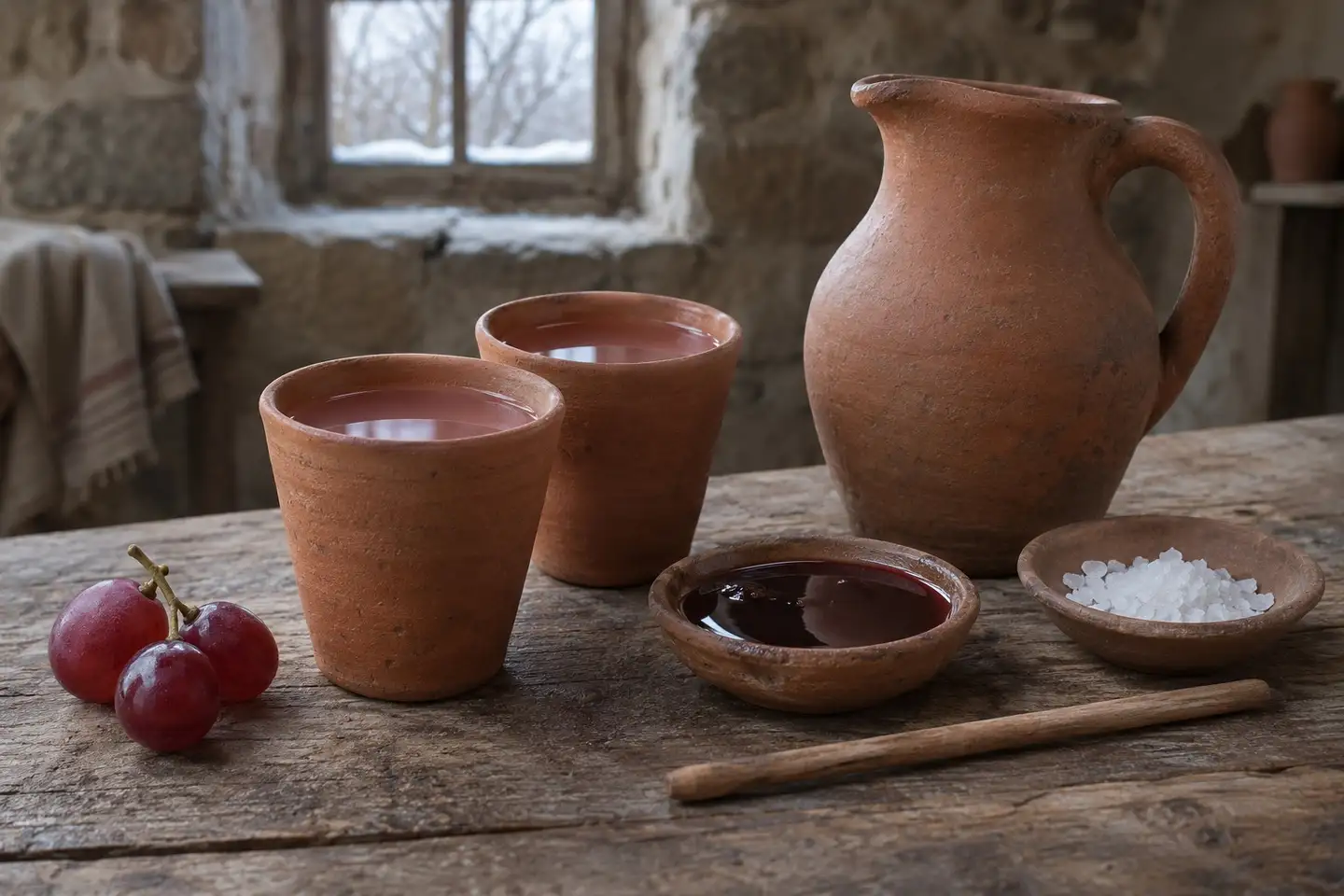
Cato’s winter wine made alcohol-free: grape juice, vinegar, grape syrup and salted water in earthenware cups, with the syrup and salt beside them.
The story behind the recipe
Cato’s winter wine is mostly water. To get a Roman farm’s workers through the cold months, Marcus Porcius Cato mixed a little fresh grape juice with sharp vinegar, boiled-down grape syrup, five times as much water as juice and a dash of sea water, and he still called it wine. He set the recipe down in his farming manual, De Agri Cultura, in the middle of the second century BC, more than a century before the first emperor.
Wine for the familia
The heading reads Vinum familiae per hiemem qui utatur, wine for the household to use through the winter. On a Roman estate the familia meant the enslaved workers, and an 1844 French translation calls it simply vin des gens, the people’s wine. Cato counted their drink as carefully as their bread. Each hand was allowed eight quadrantals of wine a year, about 210 liters, and ten if the work was heavy. This mix made a small amount of grape juice go a long way: ten measures of juice ended up in about sixty-five measures of drink, stirred three times a day for five days and sealed for ten. Cato expected it to last until midsummer and turn into vinegar after that. What else Romans of his day drank, from honeyed wine for guests to after-wine pressed from the skins, is in What Did Romans Drink Before Christ?
Read more about this recipe
A cup of it today
Cato’s must would have begun to ferment in those fifteen days, but with so much water and vinegar in the jar it could only have been very weak. We skip the fermenting and make it alcohol-free. The proportions are his: grape juice and water at about one to five, a fifth as much vinegar and grape syrup as juice, and a pinch of salt for the sea water. Grape molasses stands in for his sapa. The result, by its ingredients, is thin, sweet-sour and just salty, far lighter than a glass of juice. For the sharper Roman drink of vinegar and water alone, make Posca, the Roman Soldier’s Vinegar Drink.
To go with it, our sister site The Forgotten Menu has Cato’s must cake, from the same farm book (opens in a new tab).
Vinum familiæ per hiemem qui utatur. Musti quadrantalia x. in dolium indito, aceti acris quadrantalia II. Eodem infundito sapæ quadrantalia duo, aquæ dulcis quadrantalia L. Hæc rude misceto ter in die dies v. continuos. Eo addito aquæ marinæ veteris sextarios LXIV. et operculum in dolium imponito, et oblinito dies x. Hoc sinum durabit tibi usque ad solstitium. Si quid superfuerit post solstitium, acetum acerrimum et pulcherrimum erit.
In our translation:
Wine for the household to use through the winter. Put 10 quadrantals of must into a jar, and 2 quadrantals of sharp vinegar. Pour into the same 2 quadrantals of boiled-down must and 50 quadrantals of fresh water. Stir these with a stick three times a day for five days running. Then add 64 sextarii of old sea water, put a lid on the jar and seal it for ten days. This wine will last you until the solstice. If any is left after the solstice, it will be the sharpest and finest vinegar.

Original: About 1 liter, 4 glasses
Ingredients
My drinksFor About 1 liter, 4 glasses. Quantities are shown as written.
Quantities as written here, for About 1 liter, 4 glasses.
- Grape molasses30 ml
- Cold water750 ml
- Unsweetened red grape juice150 ml
- Red wine vinegar30 ml
- Fine sea salt1 pinch
Measurement notes
Ingredients as written here
- 30 ml grape molasses
- 750 ml cold water
- 150 ml unsweetened red grape juice
- 30 ml red wine vinegar
- 1 pinch fine sea salt
Equipment
- Large jug, about 1.5 liters
 Long spoon
 Measuring jug
Instructions
Put the grape molasses in the jug with a splash of the cold water and stir until it has dissolved.
Pour in the unsweetened red grape juice, the red wine vinegar and the rest of the water.
Add the fine sea salt and stir until it disappears.
Taste, and add a few drops more vinegar if you want it sharper. Pour into cups and serve cool, without ice.
Nutrition
55calories per serving
- Servings
- 4
Estimated from USDA FoodData Central values for grape juice and red wine vinegar and a typical grape molasses of about 290 calories per 100 g, for one of four glasses.
Recipe notes
When adjusting quantities
Keep Cato’s proportions: about 5 parts water to 1 of grape juice, with a fifth as much vinegar and grape syrup as juice.
Notes
Quantities mentioned in these notes don’t change when you adjust the batch.
Cato’s measures are by volume: 10 quadrantals of must, 2 of vinegar, 2 of sapa and 50 of water, then 64 sextarii of sea water, about 1⅓ quadrantals. We keep those proportions for about a liter; the amounts, the salt in place of sea water and the skipped fermenting are ours. The 1844 edition prints sinum where the sense and its own French translation (“Ce vin”) read vinum, wine, so we translate it that way.
Sapa was must boiled down to a thick syrup; Pliny the Elder, a later writer, puts it at a third of its volume. Grape molasses, sold as pekmez or petimezi, is the nearest thing in shops; you can also boil your own as in Defrutum Cooler, Roman Grape Syrup and Water, using a little more of it, since defrutum is boiled down only to half. White grape juice works in place of red.
The drink has no added sugar beyond the grape juice and syrup, but it is not sugar-free. Vinegar made from wine may keep a faint trace of alcohol.
Storage
Keep it covered in the fridge and drink it within two or three days.
Scaling changes the ingredients only; glassware, ice and timings need their own judgment. To adapt this recipe further, try the recipe tool at TuneMyRecipe (opens in a new tab), our sister site.
Sources and attribution
Cato, De Agri Cultura CIV, “Vinum familiae per hiemem,” in Les agronomes latins, published under the direction of M. Nisard (Paris: J. J. Dubochet, 1844), pp. 30–31; our translation
Recipe details
- Drink
- Alcohol-free
- Drink family
- Sodas & Soft Drinks
- Era
- Ancient Rome
- Difficulty
- Easy
- Season
- Winter