Lora, the Roman After-Wine of Grape Skins
Reader ratingsPressed grape skins soaked in water for a few days until they bubble: lora, the thin after-wine Cato and Varro gave Roman farm workers in winter.
- Recipe makes
- About 600 ml, 3 small glasses
- Prep
- Total
About 3 days: 20 minutes to crush and press the grapes, then 2 to 3 days for the skins to work in water at room temperature.
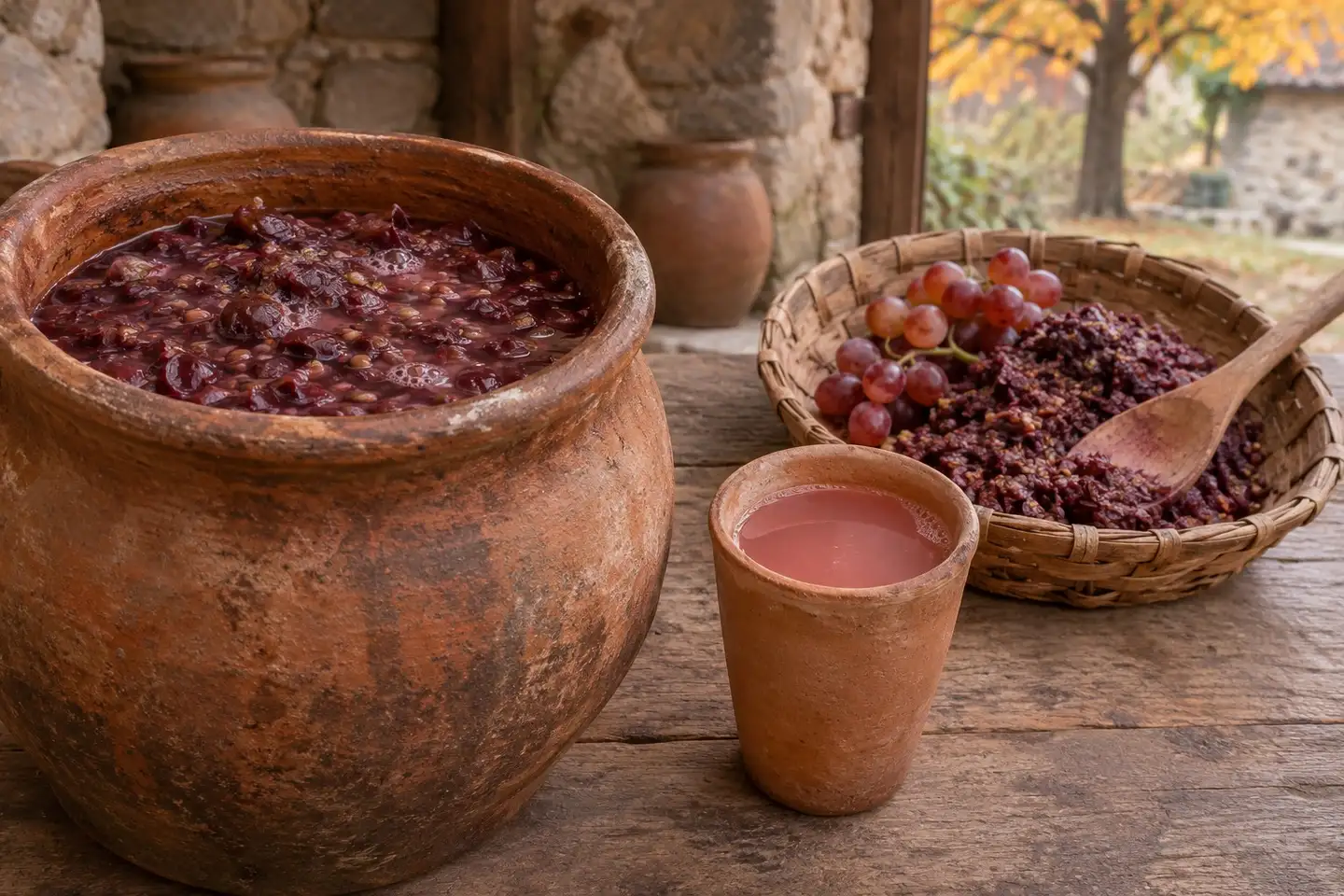
Lora, the after-wine of grape skins: pressed skins soaking in an earthenware jar, with a cup of the strained drink and a basket of pressed skins.
The story behind the recipe
Lora is what was left of the vintage. When the grapes had been trodden and pressed, Roman farmers soaked the skins in water, and after a few days the jars held a thin, pale drink that went to the farm workers through the winter in place of wine. Marcus Porcius Cato mentions it in his farming manual of the second century BC, and Marcus Terentius Varro, writing in 37 BC, describes how it was made.
Named for the washing
Cato had the pressed skins packed into jars as winter feed for the oxen. “From the same, if you like, wash out a little at a time,” he adds in our translation of his Latin. “That will be lora for the household to drink.” The household meant the farm’s slaves, and an 1844 French translation renders his line as “une piquette pour vos esclaves,” a piquette for your slaves. Varro, a century later, explains the word. The drink is called lora, he says, because the grape skins have been washed, lota. His farm pressed the skins twice before they went into the water; for the second pressing the skins were chopped with a knife, and the juice that came out was kept apart because it “smacks of the knife.” What else Romans of Cato’s and Varro’s day drank is in What Did Romans Drink Before Christ?
Read more about this recipe
Making it from a kilo of grapes
Neither writer gives amounts, so ours are our own: the skins of a kilo of red grapes in half a liter of water, left two or three days. Grapes carry their own yeasts on their skins, so the water starts to bubble without any help. By our arithmetic, if every bit of sugar left in the skins fermented, the lora would reach about 4% ABV; after two or three days it is usually well under that, a light, tart grape drink. It is not alcohol-free. The pressed juice is a drink in its own right, the Romans’ Mustum, Roman Fresh Grape Juice.
To go with it, our sister site The Forgotten Menu has Cato’s libum, the Roman farm cheese bread (opens in a new tab).
The stems and the skins of the grapes which have been trodden out should be put under the press so that any must left in them may be added to the supply in the vat. When this marc ceases to yield a flow, it is chopped with a knife and pressed again, and the must expressed by this final operation is hence called circumcisitum and is kept by itself because it smacks of the knife. The marc finally remaining is thrown into jars, to which water is added, thus preparing a drink which is called after-wine or grape juice, and is given to the hands in the winter instead of wine.

Original: About 600 ml, 3 small glasses
Ingredients
My drinksFor About 600 ml, 3 small glasses. Quantities are shown as written.
Quantities as written here, for About 600 ml, 3 small glasses.
- Red grapes1 kg
- Cold water500 ml
Measurement notes
Ingredients as written here
- 1 kg red grapes
- 500 ml cold water
Equipment
 Large bowl
 Potato masher
 Sieve
- Clean 1-liter glass jar
- Clean cloth and a rubber band
- Muslin or a clean cotton cloth, for straining
Instructions
Pull the red grapes off their stems into the bowl and crush them well with the potato masher, until every grape has burst.
Tip them into the sieve set over a jug and press hard with the back of a spoon to get out as much juice as you can. Keep the juice to drink fresh, in the fridge.
Pack the pressed skins and seeds into the clean jar and pour in the cold water. Stir, then cover the jar with the cloth held on with the rubber band.
Leave the jar at room temperature, about 64 to 75 °F (18 to 24 °C), out of the sun, and stir it twice a day with a clean spoon.
After 2 to 3 days it should be bubbling gently and smell of grapes with a winey, slightly sour edge. Strain it through the muslin laid in the sieve, squeezing the skins lightly.
Chill the lora well and serve it cool, in small glasses.
Nutrition
60calories per serving
- Servings
- 3
Roughly estimated from the sugar left in hand-pressed grape skins, using USDA FoodData Central values for red grapes, for one of three glasses; fermenting turns part of it into alcohol.
Recipe notes
When adjusting quantities
Use about half a liter of water for the skins of each kilo of grapes.
Notes
Quantities mentioned in these notes don’t change when you adjust the batch.
Cato and Varro give no amounts, times or temperatures; the kilo of grapes, the half liter of water, the days and the straining are ours. Varro’s farm pressed the skins twice and soaked them in big jars; a hand-pressed kilo leaves more juice in the skins, which is what feeds the ferment.
Any red grapes work, seeded or seedless. Wine grapes are closest if you can get them in the autumn; shop grapes may ferment more slowly. If nothing is bubbling by the third day, a small pinch of dried wine yeast stirred in will start it.
If it shows no bubbles at all by the fourth day, grows mold on top, or smells of anything but grapes and a little vinegar, throw it away and start again. Stirring keeps the skins from drying out and molding at the surface.
The strength is an estimate; we have not measured it. Hand-pressing leaves roughly a third of the grapes’ juice in the skins, so the soaking water picks up about 45 g of sugar, which would make about 4% ABV in the roughly 700 ml of liquid if all of it fermented. Two or three days ferment only part of it. Lora is not for children or anyone avoiding alcohol, and don’t bottle it with a tight cap: it is still fermenting.
Storage
Keep it covered in the fridge and drink it within three days. It is still alive and goes on turning sour.
Scaling changes the ingredients only; glassware, ice and timings need their own judgment. To adapt this recipe further, try the recipe tool at TuneMyRecipe (opens in a new tab), our sister site.
Sources and attribution
Varro, Rerum Rusticarum I.54, in A Virginia Farmer [Fairfax Harrison], Roman Farm Management: The Treatises of Cato and Varro Done into English (New York: Macmillan, 1918), pp. 164–165; Cato, De Agri Cultura XXV, in Les agronomes latins (Paris, 1844), p. 14
Recipe details
- Drink
- DrinkLow-alcohol
- Drink family
- Wine, Beer & Mead
- Era
- Ancient Rome
- Base
- Fruit & juice
- Difficulty
- Intermediate
- Season
- Autumn