Was the Soda Fountain a Pharmacy?
Partly: soda water began as imitation spring water, and an 1897 manual kept headache salts and castor oil at the fountain, which also turned a good profit.
In part it was. American soda water began as chemists’ imitation of medicinal spring water, and a manual written for druggists in 1897 still wanted headache salts kept within reach of the fountain.
This story is part of our What Did People Drink in the 1800s? 19th-Century Drinks and Recipes guide.
Imitation spring water
A. Emil Hiss wrote The Standard Manual of Soda and Other Beverages in Chicago in 1897, “a treatise especially adapted to the requirements of druggists and confectioners.” He opens with the history as the trade told it. The great trade in carbonated drinks, he writes, began with “an attempt of early chemists to imitate famous medicinal springs” charged with what was then called “fixed air.” The first soda water was “nothing but a poor imitation of seltzer water,” made by combining baking soda with tartaric acid and drunk while it fizzed; flavored syrups came next, then water charged with carbonic acid gas.
That origin kept soda water in the drugstore. “Owing to its origin and on account of its presumed medicinal character,” Hiss writes, it “has always been a portion of the stock of the pharmacist.” The word “presumed” is his own.
Headache salts within easy reach
The manual’s general directions treat the fountain as a place where customers asked for medicine. Hiss wanted the common remedies kept close to the apparatus, and he names the one people wanted most: “An effervescent salt for headache is probably oftenest demanded.” Baking soda came a close second.
He then runs through a short list of complaints and what to give for each. Someone who had been drinking too much got well-charged plain soda with a sobering additive from the dispensary shelf. Indigestion was treated according to its kind, with vichy water for a sour stomach. For the nervous, for brain workers and for “persons who have been bicycling,” he suggests the coca, kola and calisaya drinks, or beef, iron and wine.
Soda also helped a dose go down. His example is castor oil, slipped into sarsaparilla soda; he says its taste “will not be perceptible,” though he reports no test. Coffee soda, in his view, would cover a breath that smelled of onions or liquor.
All of this is advice to the druggist of 1897, and it cannot tell us how many drugstores followed it.
Drinks of a presumably medicinal character
Hiss gives the medicine side a chapter of its own. Chapter XVI, “Medicinal Drinks,” has beef and coca, beef, iron and wine, calisaya cordial and an Angostura soda, and it opens by admitting that the line is hard to draw. Drinks “of a presumably medicinal character,” he writes, turn up all through the book: tonic, coca, gentian, moxie, malto, ginger, kola and tamarind syrups among them. All medicinal drinks, he says, were served “solid” in 8-ounce glasses, topped up to the brim from the fountain’s stronger jet of soda.
The Angostura soda shows how thin the line could be. It is lemon or raspberry syrup with about a fluid dram of Angostura bitters, filled up with soda. Angostura is a spirit-strength bitters, so that glass held a little alcohol, by our estimate somewhat under 1 percent, and it was not an alcohol-free drink. It is not one of our recipes.
A popular story says colas began as drugstore medicines. Hiss’s list goes only as far as this: kola and coca syrups sat among the drinks “of more or less medicinal character,” next to the bitters and the beef tea.
Infants’ foods on the same shelf
The druggist’s book reached beyond the fountain. Hiss’s title page promises a chapter on articles “more or less within the especial province of the druggist,” from baking powders and beef teas to “infants’ and invalids’ foods, kumiss and kefir preparations, malted milks, peptonized foods.” On one page of that chapter he gives dilutions of cow’s milk for infants beside a home malted milk: cow’s milk and finely ground malt, warmed gently for a quarter of an hour, boiled and strained, so that it “does not form large, hard clots in the stomach.”
Malted milk was being sold to doctors in the same years. In January 1894 the Malted Milk Company of Racine, Wisconsin, advertised Horlick’s Malted Milk in Modern Medicine and Bacteriological Review, a Battle Creek journal edited by J. H. Kellogg, as a diet for typhoid, pneumonia, dyspepsia, insomnia and “Nervous Prostration,” “acceptable to the weakest stomach.” The advertisement is a maker’s claim, written for physicians, and the fountain manuals name no brand of malted milk. At the counter the drink became a winter mug seasoned with salt and pepper, as told in What Did Soda Fountains Sell in Winter?, and as our hot malted milk with salt and pepper.
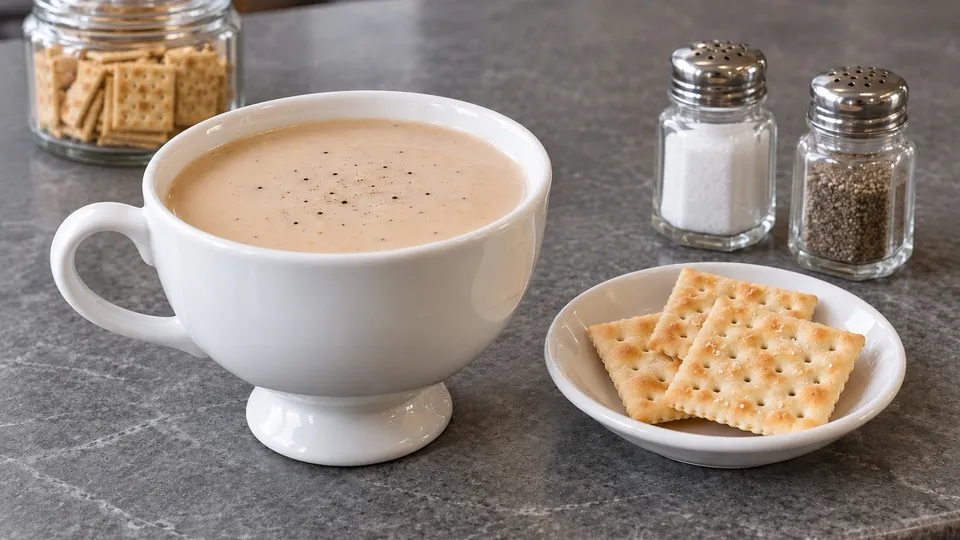 Always alcohol-freeHot Malted Milk with Salt and Pepper
Liquor belonged to the saloon
On one point Hiss was firm, at least in principle. Under “Serving Intoxicants,” he notes the yearly newspaper tales of soda water “winks,” drinks with liquor served at the fountain, and insists that very few pharmacists stooped to it. “The serving of liquors belongs to the saloon,” he writes, and for that reason his book leaves out syrups made with wines or liquors “except in a few instances,” formulas he thought too well established to omit.
Those instances are in the book. His Punch Syrup is made with California brandy and New England rum. His Crystaline, an egg drink, takes a sherry wine syrup of one part sherry to seven of syrup, and a variant of his Goldenade takes Catawba syrup, which in his first formula is half wine. The medicinal chapter has beef, iron and wine. The Angostura soda is a different case, a fountain syrup sharpened with bitters rather than a wine or liquor syrup, but it too carried a little alcohol. As we read it, the line Hiss drew was between a drink served to get drunk and a soda with a little wine or spirit in its flavoring, and the second kind stayed on his counter. Did Root Beer Have Alcohol in It? measures how far the fountain’s soft drinks were from the brewed kind.
Fifty cents on the dollar
Saxe’s New Guide, or Hints to Soda Water Dispensers (1894) is all business, and it opens with “The Author’s Experience.” In the fall of 1879, Saxe writes, he bought “the bankrupt stock of drugs in the old ‘Snowden Drug Store,’” at Thirteenth and Farnam streets in Omaha, paying fifty cents on the dollar. He was “barely twenty-one,” the store had been shut for three months, and by spring he was “slowly running behind hand.”
His rescue was the soda fountain that came with the stock. He opened it on April 21, 1880: a small apparatus with “one soda draught tube, two minerals, and eight syrup cans,” which, he believed, had originally cost $300. Between April and October he sold $1,094.80 worth of soda, about $37,000 in today’s money by US consumer prices, and about $700 more than his predecessor had ever sold. He kept a separate book for it. Soda, the boy who served it, ice, syrups, cream and breakage came to $545.12, which left “a net profit of $549.68, a little over 100 per cent. profit,” or about $18,000 today.
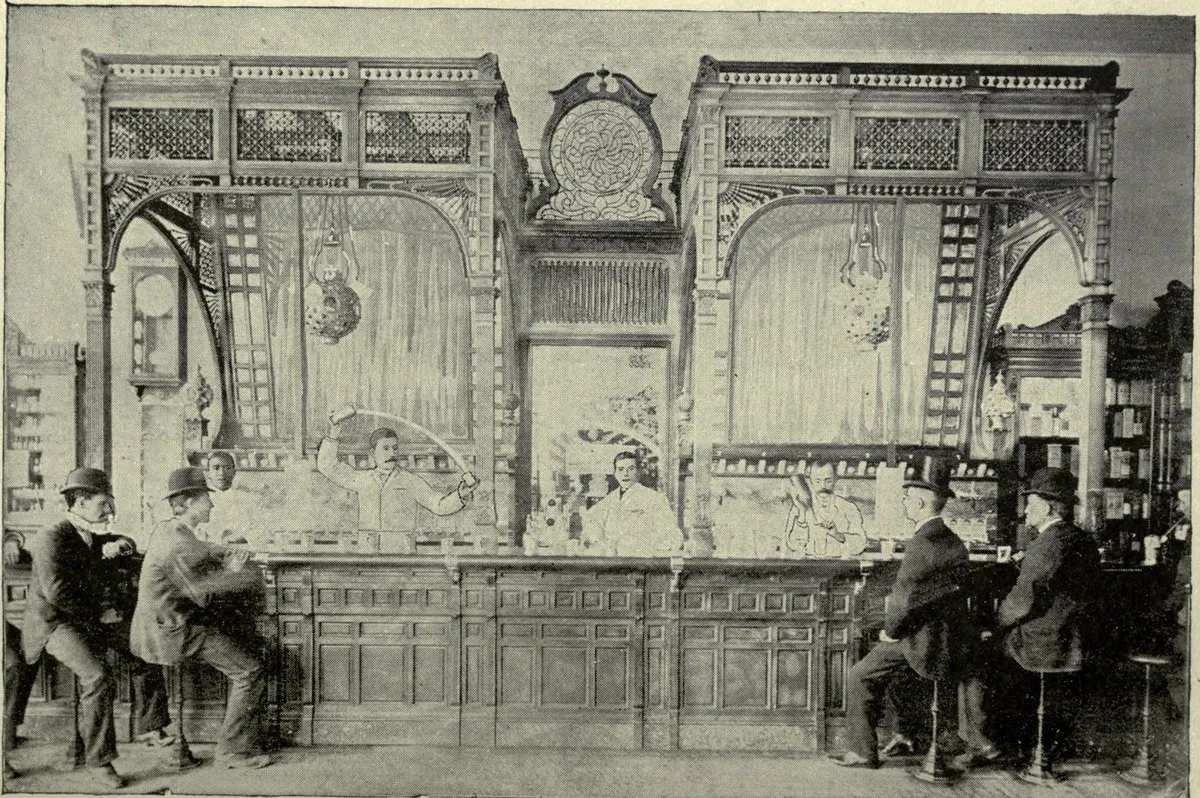
Saxe wrote this account fourteen years later, in a book that sold his methods. By 1894 the book could show off “Saxe’s Large Canopy Top Apparatus,” the fountain in the photograph at the top of this page, 30 feet long with a 35-foot counter and a long way from one draft tube. So the fountain sat in the pharmacy for two reasons: soda water had begun as a remedy, and by Saxe’s account it paid its way. His guide is full of the glasses that paid for it: a cherry phosphate and a red orange phosphate sharpened with acid phosphate, and the strawberry ice cream soda with its scoop in the middle. The druggists’ journals kept printing them, and The Pharmaceutical Era of July 1910 has a mint lemonade pounded in the glass.
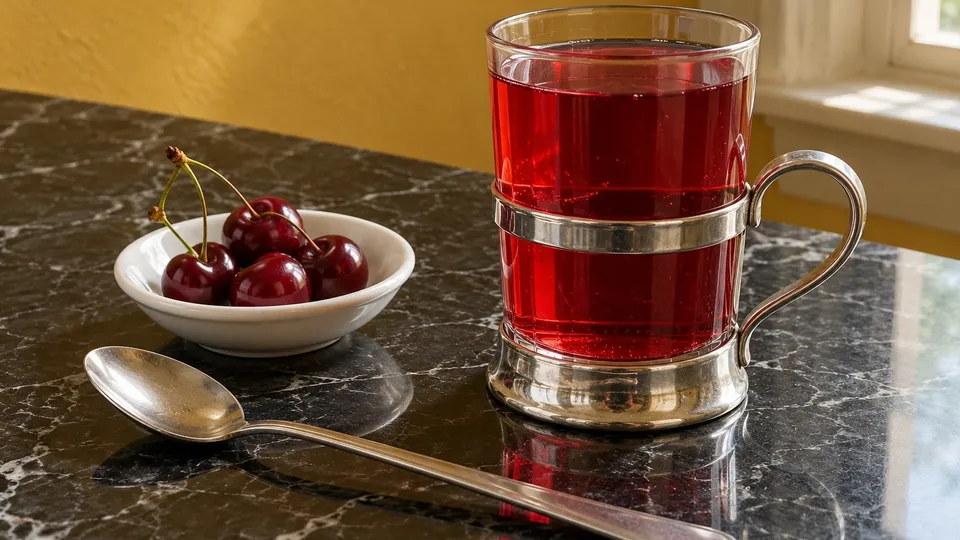 Always alcohol-freeCherry Phosphate, the Soda Fountain Cherry Sour
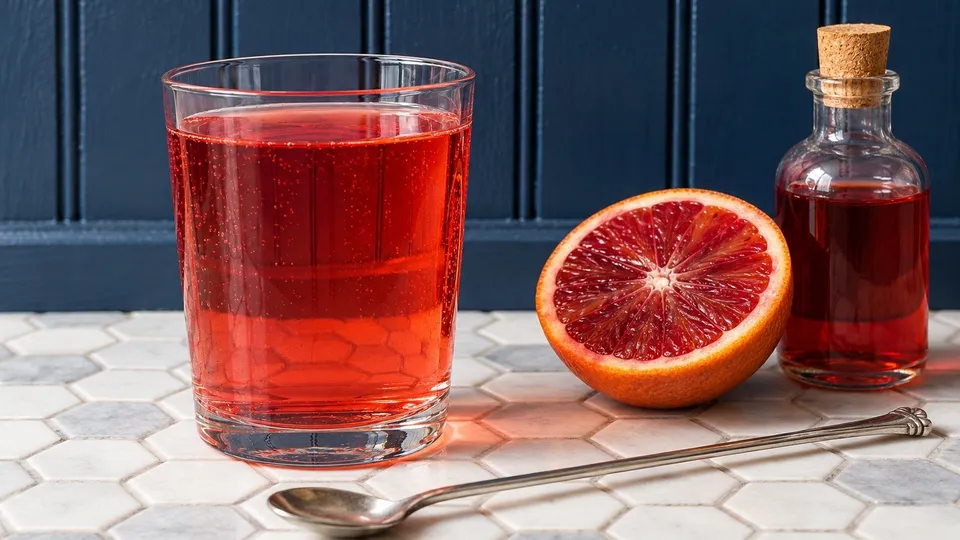 Always alcohol-freeOrange Phosphate, the Red Orange Soda Fountain Drink
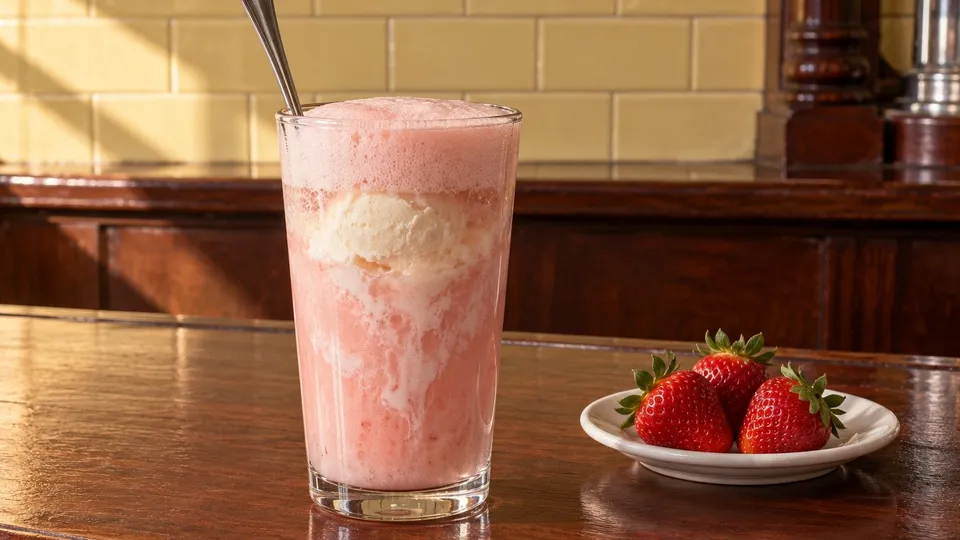 Always alcohol-freeStrawberry Ice Cream Soda from the Fountain
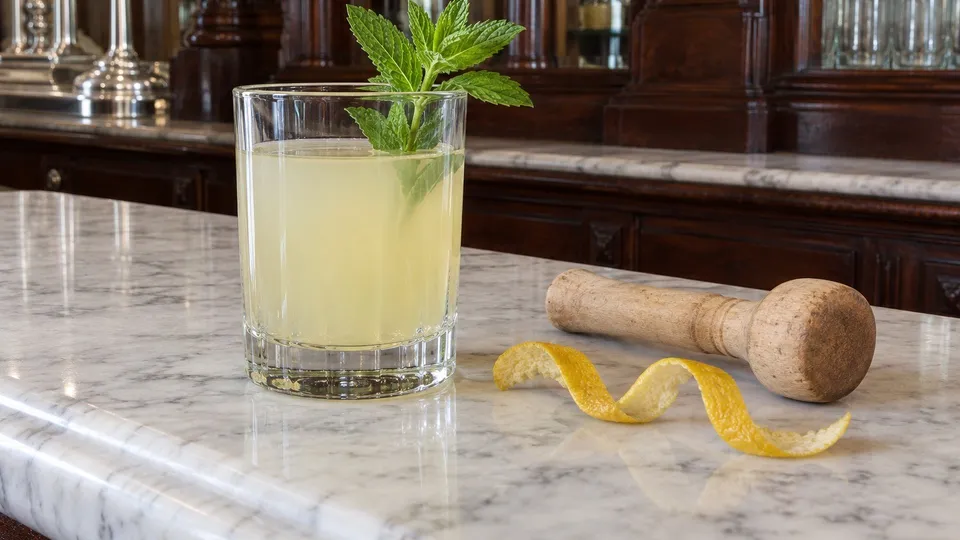 Always alcohol-freeMint Lemonade, the Soda Fountain Way
An egg drink from the counter
Between the tonics and the castor oil, Hiss’s manual is mostly drinks for pleasure, and its egg drinks are among the plainest. His Goldenade is the yolk of an egg shaken with powdered sugar, the juice of a lemon and a little shaved ice, then topped up with soda water and strained into a tall glass. No tonic or drug goes into it, and no wine either. Our version is Goldenade, made with a pasteurized yolk, since the egg goes in raw.
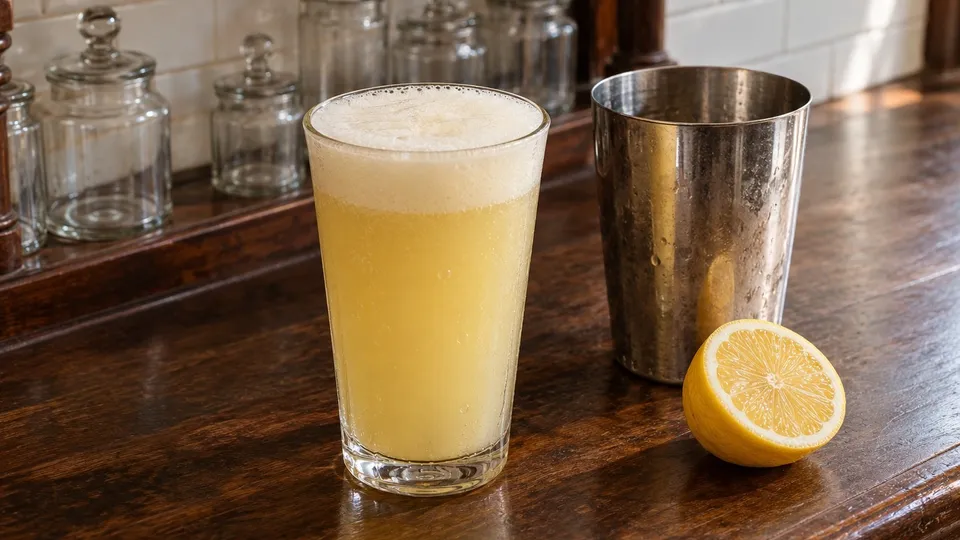 Always alcohol-freeGoldenade, Lemon and Egg Yolk Soda
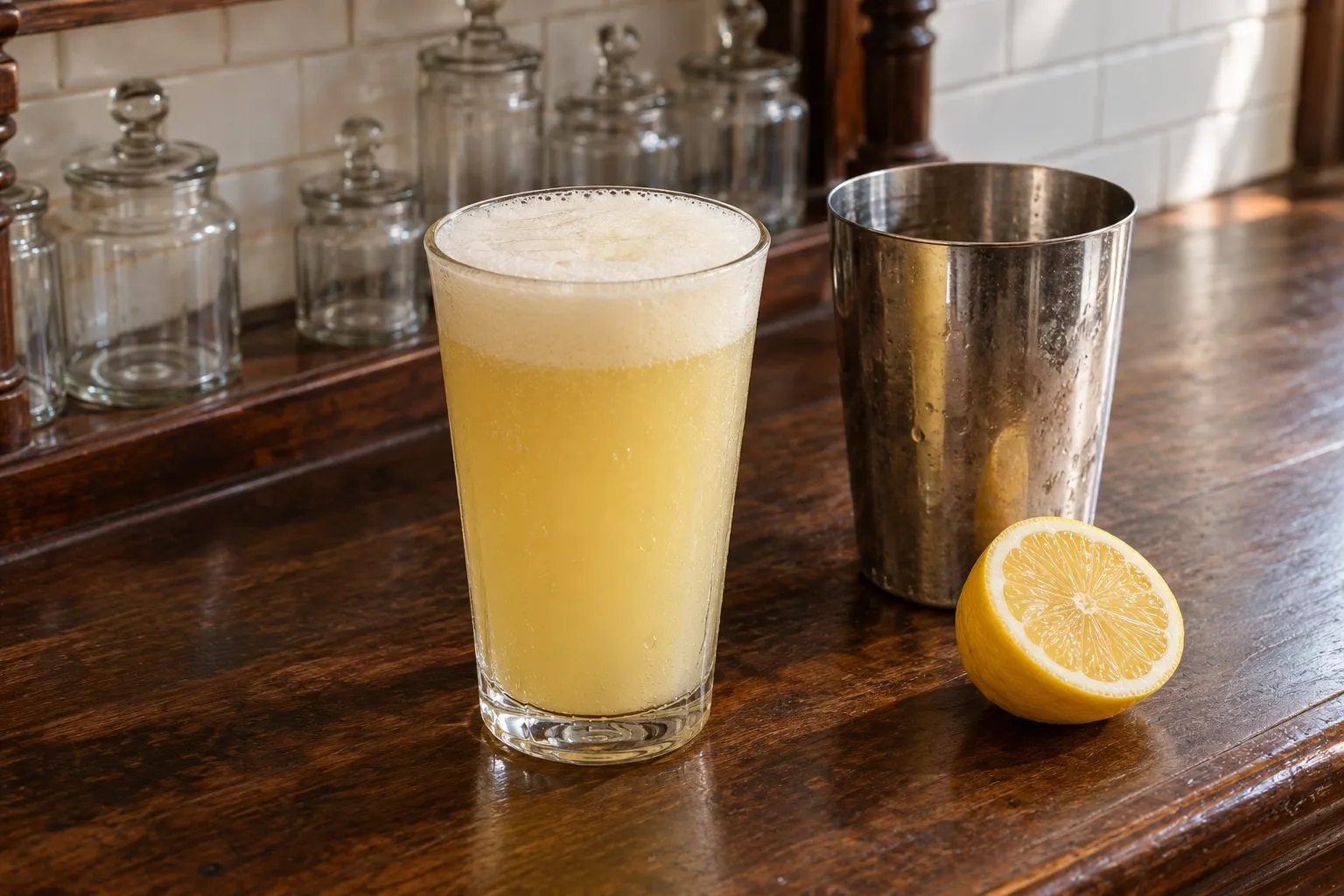 Goldenade, a yolk shaken with lemon and sugar and filled with soda, beside the open shaker and half a lemon.
Saxe has a drink of almost the same name. His Golden Ade, No. 126, is a yolk shaken with Catawba syrup and ice, filled up with milk and served in a “long, thin mineral glass.” Hiss prints it as a variant of his Goldenade, and it is the Catawba exception to his liquor rule. Fountain egg drinks ran from the sour lemon egg phosphate, which Bertha Stockbridge printed for home use in 1920, to Hiss’s Prairie Oyster: an egg broken into a little soda water, seasoned with salt, pepper and lemon juice, and served with its yolk whole and a glass of plain soda beside it.
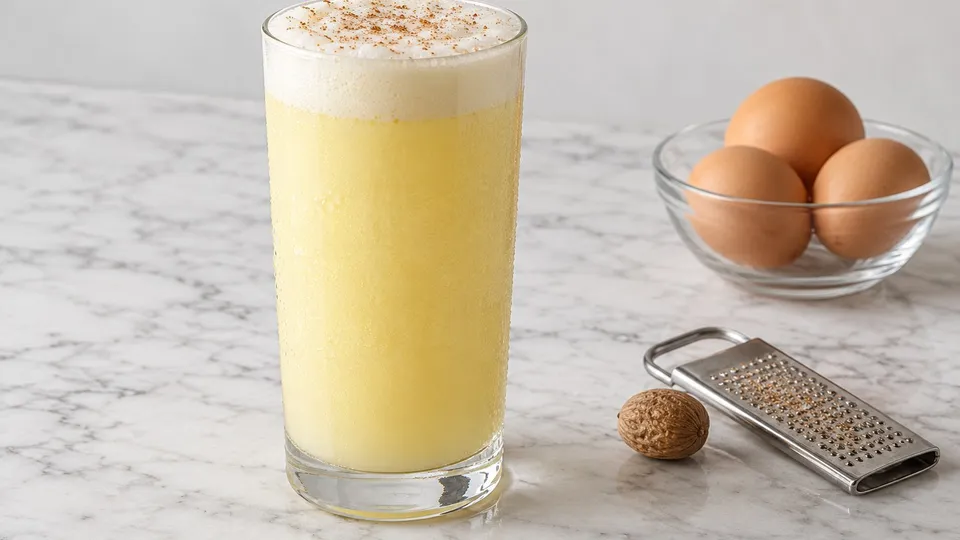 Always alcohol-freeLemon Egg Phosphate, the Soda Fountain Sour
To taste the counter Hiss described with the medicine cabinet shut, shake up his Goldenade: one yolk, one lemon and four spoonfuls of sugar, poured back and forth between glass and shaker as he directs until it foams.
For what was on the plate, our sister site The Forgotten Menu has old-fashioned ice cream recipes (opens in a new tab).
Sources
- A. Emil Hiss, The Standard Manual of Soda and Other Beverages: A Treatise Especially Adapted to the Requirements of Druggists and Confectioners (Chicago: G. P. Engelhard & Co., 1897), title page and pp. 9, 22–23, 116–117, 142, 213.
- De Forest W. Saxe, Saxe’s New Guide, or Hints to Soda Water Dispensers, 3rd ed. (Chicago: Saxe Guide Publishing Co., 1894), pp. 6–8, 78, and the plate between pp. 8 and 9.
- Modern Medicine and Bacteriological Review 3, no. 1 (Battle Creek, Mich., January 1894), ed. J. H. Kellogg, advertising p. 1 (Horlick’s Malted Milk).