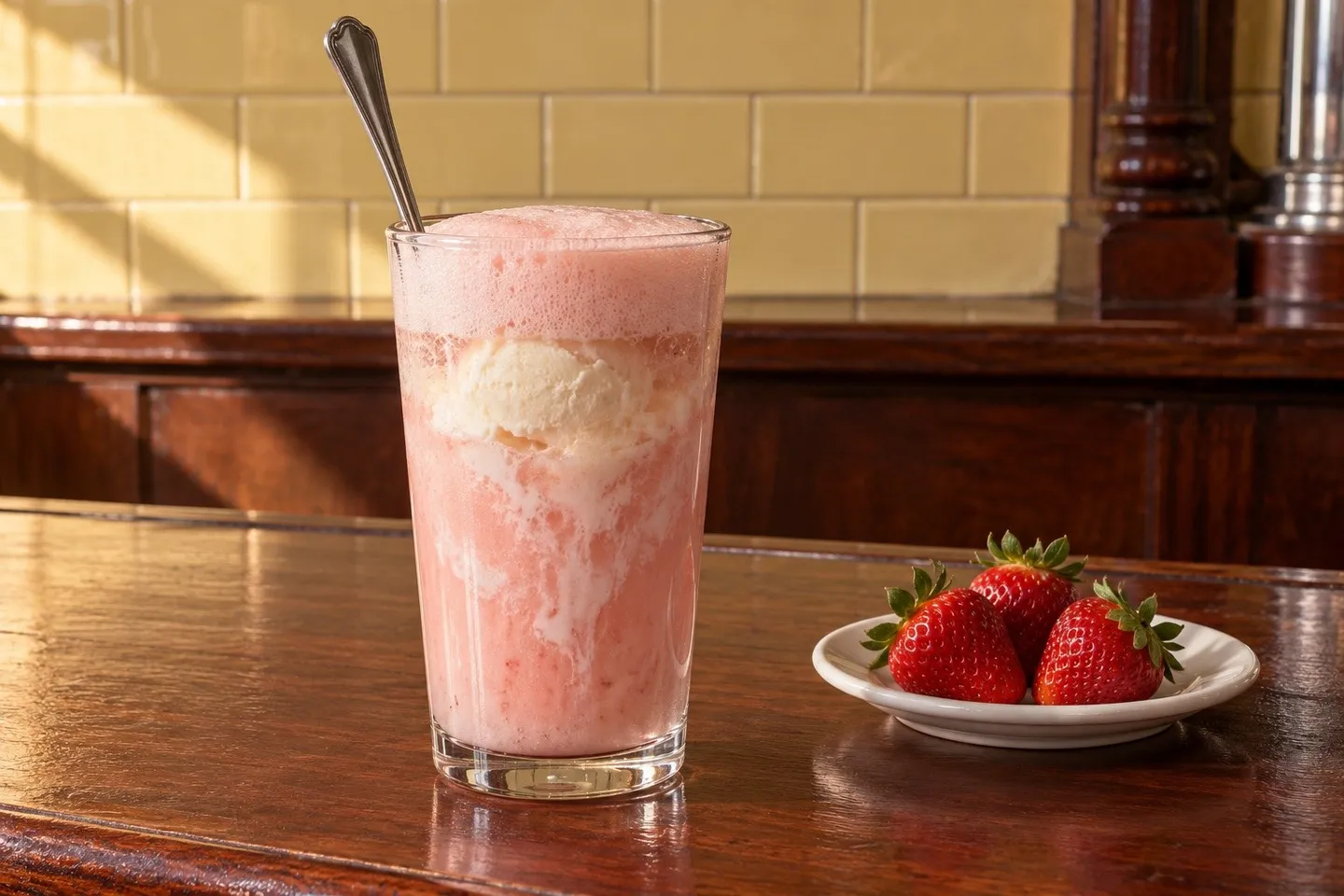
Strawberry Ice Cream Soda from the Fountain
Reader ratingsFresh strawberry syrup, soda water and a big scoop of plain ice cream floating in the middle, with a long spoon: the soda fountain’s ice cream soda as the 1890s drew it.
- Recipe makes
- About 1 cup strawberry syrup, enough for 8 glasses
- Prep
- Cook
- Total
Includes about 30 minutes for the syrup to cool. Each glass then takes a couple of minutes.
Strawberry ice cream soda in a tall glass, a scoop of ice cream in the middle under the foam, with a long spoon and fresh strawberries.
The story behind the recipe
Ice cream soda meant fruit syrup and soda water with a scoop of ice cream floating in the middle, served tall with a long spoon to stir and eat it. It was already in a Philadelphia bartender’s guide in 1884, Albert Barnes’s Complete Bartender.
By 1890 the fountain trade was building on it. “ICE-CREAM soda-water is very popular,” wrote James W. Tufts, whose Boston firm built soda apparatus, in his Book of Directions, “and some dealers have increased their business to a remarkable degree by its sale.” His advice was to let fruit-juice syrups do the flavoring and keep the ice cream plain. A cost table in his book, credited to O. J. Price, puts a ten-ounce glass at three cents to make, sold for five: about $1.10 and $1.80 today, by US consumer prices.
Wind, soda, ice cream, syrup
Fresh strawberry was worth advertising. In April 1891 a Boston shop told readers of The Woman’s Journal: “BE SURE and try the delicious Strawberry Ice Cream Soda made from fresh fruit, at Miss Fisk’s, 44 Temple Place.” De Forest W. Saxe, a Chicago dispenser whose winter trade is described in What Did Soda Fountains Sell in Winter?, printed a strawberry syrup from fresh berries in 1894 and complained that few soda men drew the drink properly. Drawn carelessly, he wrote, “1st you taste wind, 2d plain soda, 3d ice cream, 4th syrup, all separate.” The glass here takes a fresh strawberry syrup in his manner and a scoop of plain or vanilla ice cream. Strawberry syrup with soda water and no ice cream makes a different drink, American Lemonade as London Made It.
Read more about this recipe
Green’s claim
The usual answer is Robert M. Green. A 1921 article in The Soda Fountain ran under the headline “Ice Cream Soda a New Drink,” saying he had first combined the two at the Centennial Exposition in Philadelphia in 1876, and that his will asked for “Here lies the originator of ice cream soda” on his headstone. Other accounts put Green’s moment at a Franklin Institute exhibition in 1874, and George Guy, Fred Sanders and Philip Mohr each have backers of their own. Saxe, whose guide supplies the scoop, bought up a bankrupt drugstore’s stock in Omaha in 1879, and how that became a fountain business is in Was the Soda Fountain a Pharmacy?
Draw the syrup required, using less than for ordinary soda, put the ice-cream into the tumbler with a large spoon, fill up with soda-water, and give the customer an ice-cream soda-water spoon to stir and eat the ice-cream with. Use the ice-cream liberally. Do not make the mistake of using too small a quantity of ice-cream. Use about four ounces to the glass.

Recipe makes: About 1 cup strawberry syrup, enough for 8 glasses
Ingredients
For About 1 cup strawberry syrup, enough for 8 glasses. Quantities are shown as written.
Quantities as written here, for About 1 cup strawberry syrup, enough for 8 glasses.
Strawberry syrup
- Ripe strawberries, hulled2 cups
- Sugar3/4 cup
Per glass
- Strawberry syrup2 tbsp
- Soda water, very cold2/3 cup
- Vanilla ice cream1/2 cup
Measurement notes
Ingredients as written here
- 2 cups ripe strawberries, hulled
- 3/4 cup sugar
- 2 tbsp strawberry syrup
- 2/3 cup soda water, very cold
- 1/2 cup vanilla ice cream
Equipment
 Bowl
 Potato masher
 Fine sieve
 Small saucepan
 Clean bottle or jar for the syrup
 Large tumbler, about 12 fl oz
 Long spoon
Instructions
For the syrup, put the ripe strawberries in a bowl and mash them well with a potato masher.
Press the mash through a fine sieve into a small saucepan with the back of a spoon. Discard the pulp.
Heat the juice over medium heat until it is almost boiling, then take it off the heat and stir in the sugar until it has dissolved.
Leave to cool for about 30 minutes, pour into a clean bottle and keep it in the fridge.
For each glass, put the strawberry syrup in a tall glass. Pour in about half of the very cold soda water, stirring the syrup into it as you pour.
Drop in the vanilla ice cream in one large scoop, then gently pour the rest of the soda water over it. Serve at once with a long spoon.
Nutrition
220calories per serving
- Recipe makes
- About 1 cup strawberry syrup, enough for 8 glasses
- Servings
- 8
Estimated from USDA FoodData Central values for granulated sugar, strawberries and vanilla ice cream, for one glass with 2 tablespoons of the syrup and 1/2 cup of ice cream.
Recipe notes
When adjusting quantities
Scale the syrup ingredients together. The glass ingredients are for one drink; multiply them by the number of glasses.
Notes
Quantities mentioned in these notes don’t change when you adjust the batch.
Tufts wanted “plain ice-cream without flavoring,” so the fruit syrup did all the flavoring. A sweet cream ice cream comes closest to that; vanilla is the easy choice now.
Saxe’s concentrate holds 1½ pounds of sugar to 12 ounces of juice and is then cut with three parts plain syrup. This syrup is a little lighter than his cut syrup, with about 19 g of sugar in 2 tbsp. Tufts told dealers to draw less syrup for an ice cream soda than for an ordinary one, but his own cost table allows 1 oz. a glass, which is the 2 tbsp here.
Use the ripest berries you can find; Saxe asked for “dead ripe” ones. Frozen strawberries, thawed, work too.
Storage
Keep the strawberry syrup in a clean, closed bottle in the fridge and use it within 5 days.
Scaling changes the ingredients only; glassware, ice and timings need their own judgment. To adapt this recipe further, try the recipe tool at TuneMyRecipe (opens in a new tab), our sister site.
Sources and attribution
James W. Tufts, Book of Directions (Boston, 1890), pp. 49–50; De Forest W. Saxe, Saxe’s New Guide, or Hints to Soda Water Dispensers (Chicago: Saxe Guide Publishing, 1894), No. 14, pp. 21–22, and No. 163, pp. 92–93; Albert Barnes, The Complete Bartender (Philadelphia, 1884), No. 159, p. 32
Recipe details
- Drink
- Alcohol-free
- Drink family
- Sodas & Soft Drinks
- Region
- American
- Era
- 19th century
- Source decade
- 1890s
- Difficulty
- Easy
- Season
- Summer