Did Root Beer Have Alcohol in It?
Home-brewed root beer did, up to 1.77 per cent in a 1916 pharmacist’s test; the soda-fountain kind, syrup and soda water, held hardly a trace.
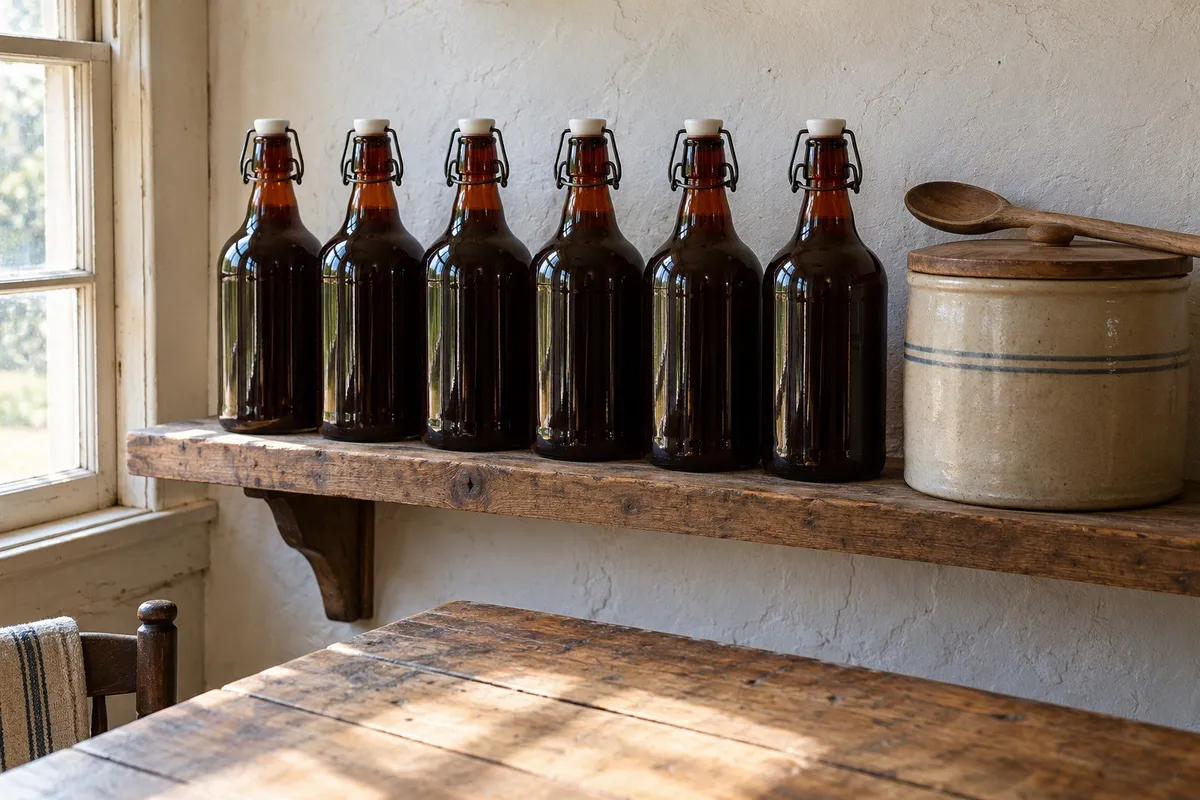
Home-brewed root beer did, a little, and sometimes more than a little. In 1916 the Philadelphia pharmacist Charles H. LaWall made root beer at home “strictly according to directions,” with yeast, sugar, water and a bottled extract, and measured 0.25 per cent alcohol after two days in the bottle and 1.52 per cent after eleven. Later batches, handled a little differently, reached 1.77 per cent. Root beer from the soda fountain was another drink: a flavored syrup drawn with carbonated water and drunk at once, and by LaWall’s reckoning no more than a trace of alcohol from the extract.
This story is part of our Old-Fashioned Sodas guide.
Yeast, sugar and a tight cork
LaWall read his paper, “The Percentage of Alcohol in Home-Made Root Beer,” at the annual meeting of the American Pharmaceutical Association in June 1916, and The American Journal of Pharmacy printed it that August. It began with a suspicion. “In making some home-brewed root beer recently,” he wrote, he had noticed the “physiological effect” of a glass on someone “very susceptible to alcohol,” and wondered whether there was more alcohol in it than people supposed.
The method he describes was the ordinary one for a household that bought its flavor in a bottle. Yeast, sugar, water and the extract, “which usually contains some inorganic salts for the stimulation and nutrition of the yeast,” were mixed under conditions that suited the yeast, and then, in his words, “the mixture is then bottled and the bottles are directed to be tightly closed.” The gas from the working yeast gave the fizz. LaWall’s explanation of what came next was his own: once the pressure of carbon dioxide in a sealed bottle reached a certain point, he believed, the fermentation stopped by itself. A mixture left standing before bottling, or a bottle left part empty, would ferment for longer, and the alcohol would rise.
Eleven days in the bottle
So he tested it, both “to ascertain just how high the alcohol would go under the most favorable conditions” and to find the “average alcohol content of a product made strictly according to directions.” He names no brand of extract and prints no recipe.
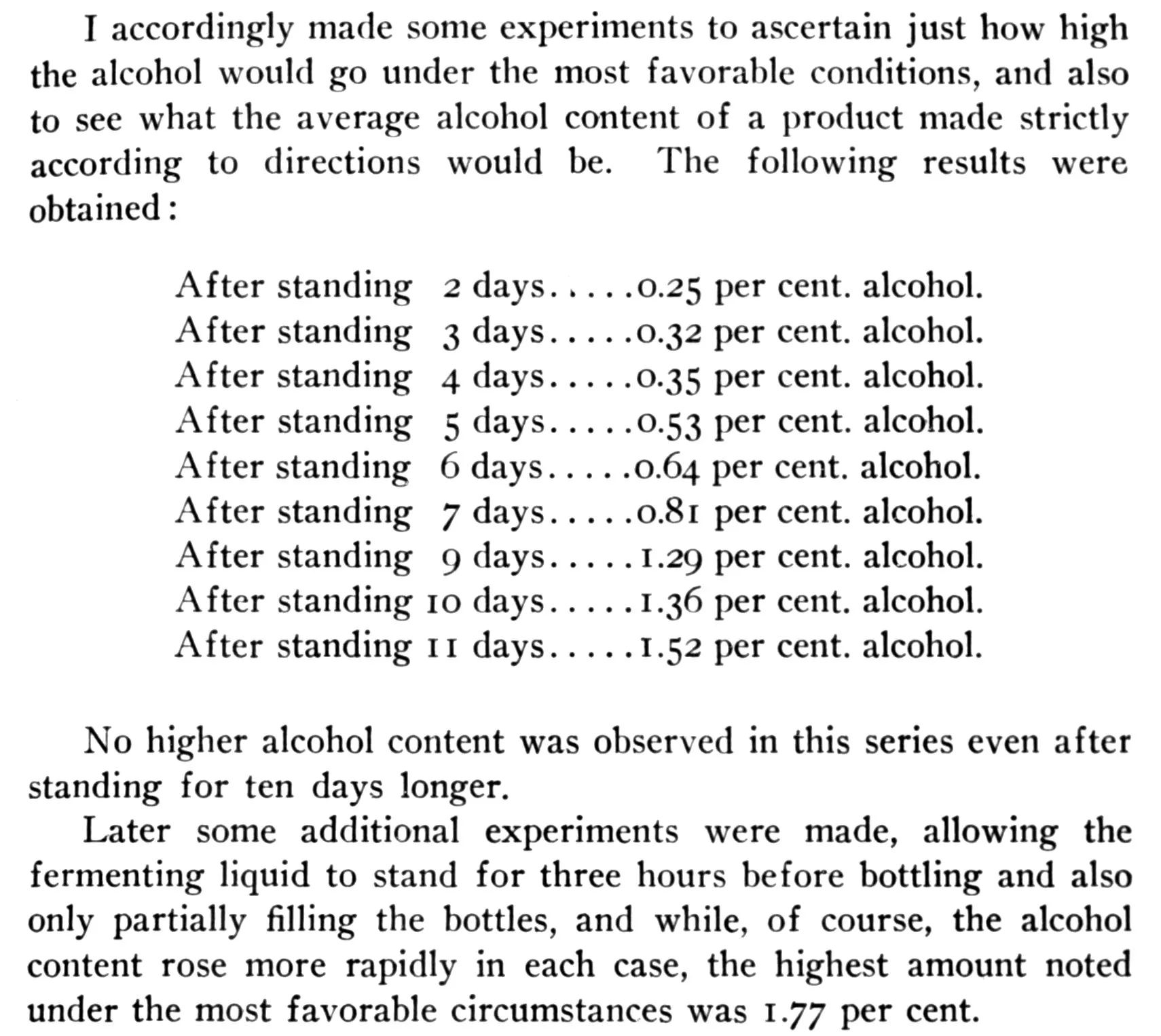 Charles H. LaWall, “The Percentage of Alcohol in Home-Made Root Beer,” The American Journal of Pharmacy 88, no. 8 (August 1916), p. 357.
His first series climbed steadily: 0.25 per cent at two days, 0.53 at five, 0.81 at seven, 1.36 at ten and 1.52 at eleven. Then it stopped. “No higher alcohol content was observed in this series even after standing for ten days longer.” The 1.77 per cent came from a second set of experiments, in which the fermenting liquid stood for three hours before bottling and the bottles were only partly filled. The alcohol rose faster “in each case,” he reported, and 1.77 per cent was “the highest amount noted under the most favorable circumstances.”
LaWall printed his results as “per cent. alcohol” and never says whether he measured by weight or by volume. All of them come from one experimenter, one unnamed extract and his own kitchen methods, and a different yeast, sugar or room would have given different numbers. In his series, the longer the bottles stood, the stronger the root beer.
Bread, grape juice and koumiss
LaWall set his figures beside other foods made with yeast or from fruit. “Even in bread making, where yeast is used, alcohol is present to an appreciable extent,” he wrote, and “from 0.2 to 0.4 per cent. has been detected in a freshly baked loaf of bread.” The unfermented grape juice of the market “always contains small amounts of alcohol,” from 0.05 up to 0.5 per cent, “the higher amount being found in the carelessly prepared article.” Koumiss, fermented milk made in much the same way, could hold “over 2 per cent.”
By that measure a two-day root beer, at 0.25, sat in the range of a fresh loaf. An eleven-day root beer was another matter, and LaWall did the arithmetic himself. “With beer averaging 4 per cent. alcohol,” he wrote, “three bottles of home-brewed root beer, which have been allowed to stand for ten days or over, are equivalent to one bottle of ordinary beer.” His conclusion was mild: the facts “may come as a surprise to many who have looked upon home-brewed root beer as a strictly temperance drink.”
He also raised the legal question. Whether such a drink “could be sold as a non-alcoholic drink,” in the popular sense of non-intoxicating, was “a very delicate question,” and he could find no ruling on root beer at all. Since 1902, American tax law had treated fermented liquor with as much as half a percent of alcohol as taxable, as What Were Victorian Non-Alcoholic Beers? explains, and LaWall’s first series passed it on the fifth day.
Wiley’s verdict
Three years later the chemist Harvey W. Wiley took up LaWall’s results in Beverages and Their Adulteration (1919). He reprinted LaWall’s text nearly word for word, credited “La Wall” with a footnote to the 1916 journal, and added a framing of his own. “La Wall has found in some recent investigations that many so-called root beers have a large percentage of alcohol,” he wrote. “Such beverages as these should be classed under alcoholic drinks.” He did not want them given to children: “I think it inadvisable to recommend even these small quantities for children.”
On these figures Wiley is reprinting LaWall, so the two count as one witness. He also went further than his source: LaWall had tested his own home brew, not “many” root beers, and Wiley dropped the bread and grape juice that had put the numbers in proportion.
On the name, Wiley only guesses. Root beers, he says, are “probably so called” because they were flavored with vegetable substances, “some of which may be derived from roots,” and “the ‘beer’ part of the name relates, of course, to the fact that they have undergone incipient fermentation.” Recipe books agreed that fermentation was the point. A New York collection of the same year, Home Made Beverages, has a root beer brewed with molasses and yeast that “will soon ferment and produce a good, drinkable beverage,” in a chapter headed “Non-Alcoholic Beers.”
Root beer at the fountain
At the drugstore counter the method was different, and LaWall said so. “The soda-fountain root beer, of course, is made by diluting a flavored syrup with carbonated water and therefore contains no more alcohol than the minute amount contributed by the extract used to flavor the syrup, which would not exceed 0.05 per cent.” It was “not to be confused with the home-brewed or fermented product.”
The trade’s own handbooks show how it was done. In A. Emil Hiss’s 1897 Standard Manual of Soda and Other Beverages, “Root Beer Syrup” starts “from one of the root beer extracts,” measured into the fountain’s plain sugar syrup, and the drink was served “with foam in a 12-ounce glass or ‘solid’ in an 8-ounce glass,” the carbonated water drawn onto the syrup to order. The syrup went into the glass and the soda on top while the customer waited. That is the basis of our fountain root beer, and for a syrup of your own from the roots themselves there is our homemade root beer syrup with sarsaparilla and ginger, and the same counter’s medicinal side is the subject of Was the Soda Fountain a Pharmacy?
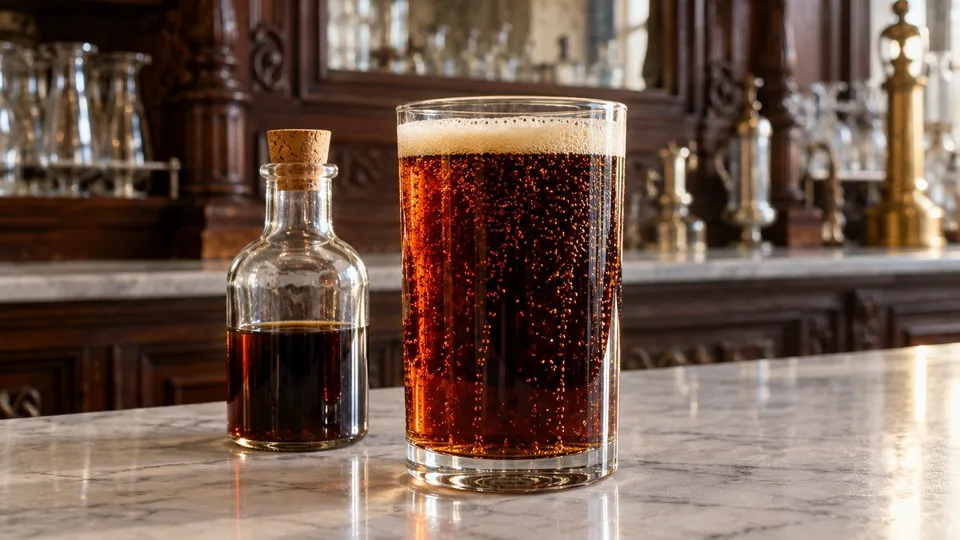 Always alcohol-freeFountain Root Beer, Syrup and Soda Water
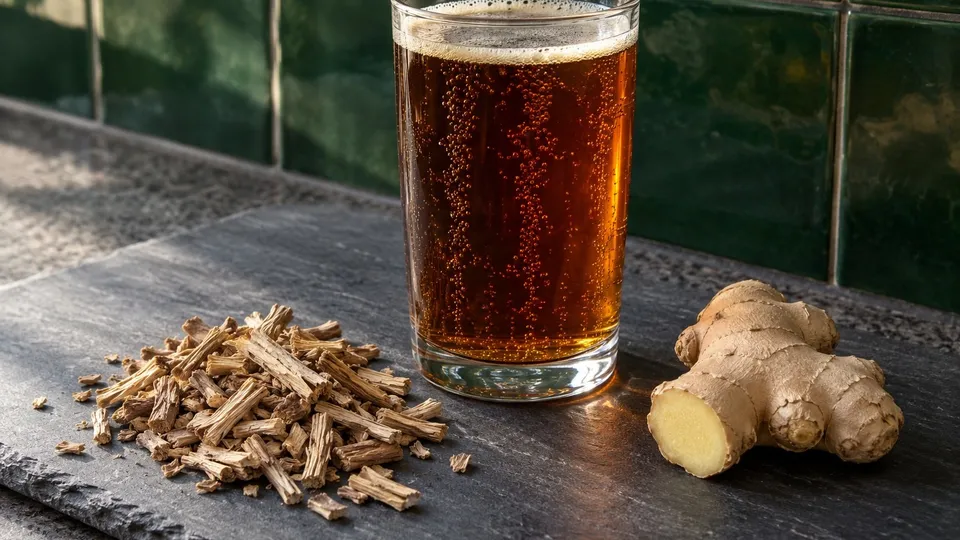 Alcohol-free versionHomemade Root Beer Syrup with Sarsaparilla and Ginger
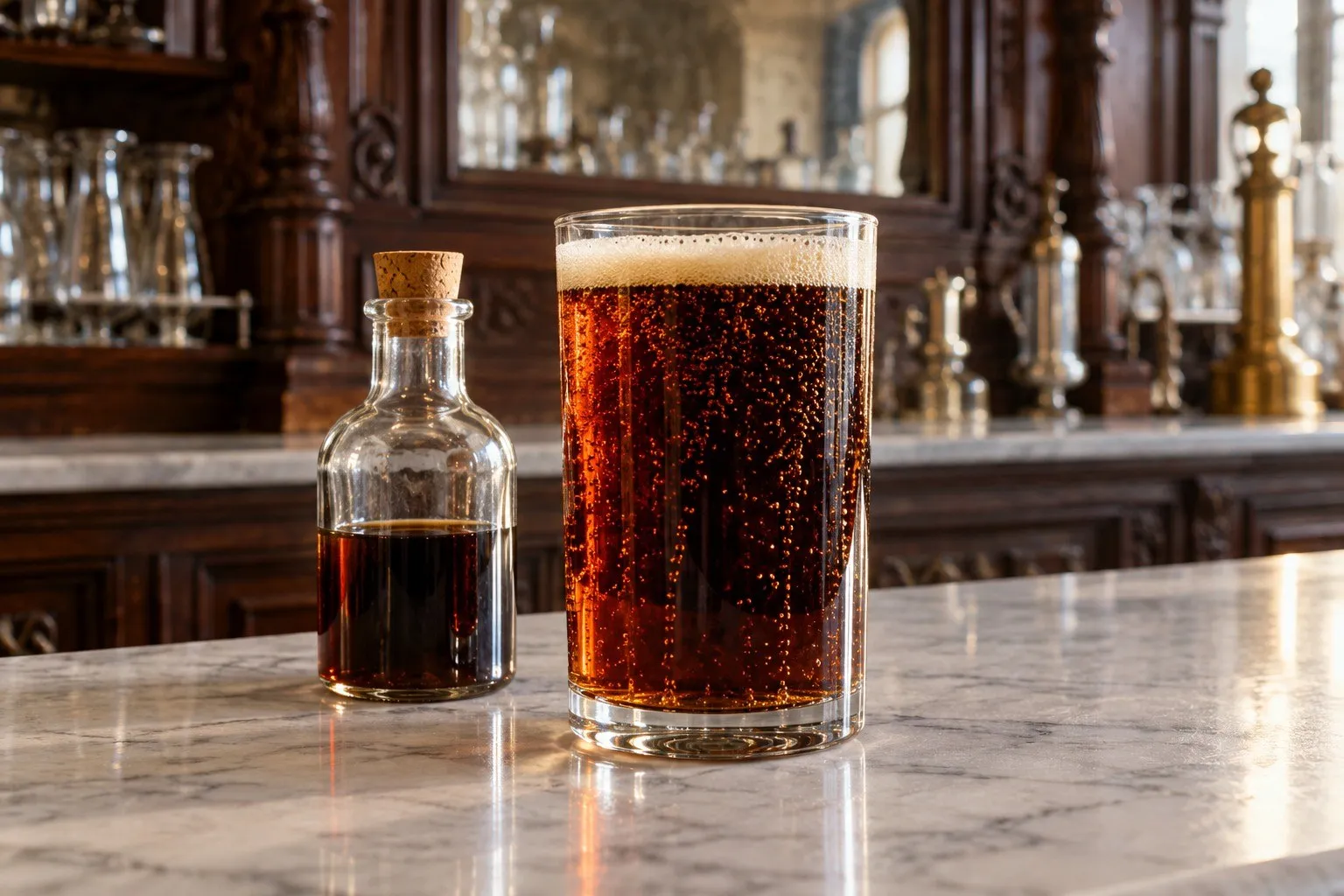 Fountain root beer, syrup and very cold soda water in a straight soda glass, with the syrup bottle beside it.
The trace LaWall allowed came from the extract. Several of Hiss’s root beer extracts are made up in alcohol, and so are some modern ones, while others use glycerin or another base and carry none. By our own arithmetic on Hiss’s formulas, a glass flavored with one of his alcohol-based extracts could hold a few tenths of a percent, still under the half-percent line.
The sassafras problem
The extracts carried something else as well. Nearly every root beer extract in Hiss’s manual is built on oil of sassafras, the root beer flavor of the period, alongside oils of wintergreen and cloves and fluid extracts such as spikenard and pipsissewa. Wiley’s list of root beer flavors runs from juniper berries and pipsissewa to “sarsaparilla, spikenard, wintergreen, vanilla, various barks and roots.”
Oil of sassafras and safrole can no longer go into food in the United States. Under 21 CFR 189.180, food with added safrole or oil of sassafras is adulterated, as is food that contains them from sassafras bark used chiefly to impart them, and the regulation puts oil of sassafras at about 80 percent safrole. Flavoring from sassafras is allowed only when it is safrole-free: 21 CFR 172.510 lists sassafras leaves on that condition. A root beer extract bought today should say safrole-free on the bottle, and our recipe uses one.
Root beer was not the only soft drink brewed in a bottle. Ginger beer had the same two lives, yeast-brewed at home and pumped from a street fountain, and our alcohol-free ginger beer takes the fountain road.
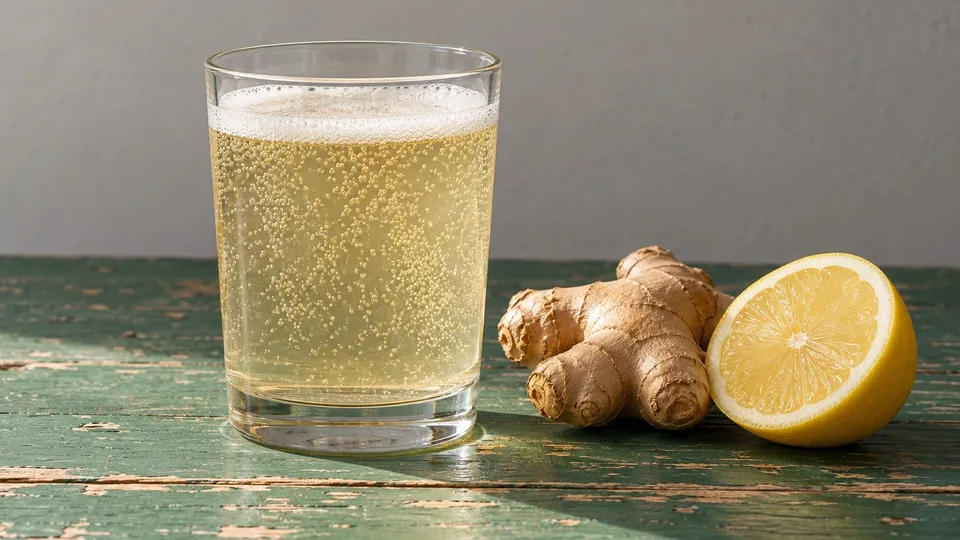 Alcohol-free versionAlcohol-Free Ginger Beer, the Fountain Way
For a root beer that stays at zero, for children or a dry month, make the fountain root beer: it is syrup poured onto soda water at the moment of drinking, so there is no yeast and no time in a sealed bottle, and with an alcohol-free extract the glass holds no alcohol at all.
Sources
- Charles H. LaWall, “The Percentage of Alcohol in Home-Made Root Beer,” The American Journal of Pharmacy 88, no. 8 (August 1916), pp. 355–358. Read at the annual meeting of the American Pharmaceutical Association, June 1916.
- Harvey W. Wiley, Beverages and Their Adulteration (Philadelphia: P. Blakiston’s Son & Co., 1919), pp. 102–104.
- A. Emil Hiss, The Standard Manual of Soda and Other Beverages (Chicago: G. P. Engelhard & Co., 1897), pp. 53–54, 87.
- Albert A. Hopkins, ed., Home Made Beverages: The Manufacture of Non-Alcoholic and Alcoholic Drinks in the Household (New York: Scientific American Publishing Co., 1919), p. 58.
- U.S. Code of Federal Regulations, 21 CFR 189.180, “Safrole,” via the Legal Information Institute, Cornell Law School, accessed October 21, 2026.