Mint Lemonade, the Soda Fountain Way
Reader ratingsA peeled lemon pounded in the glass with sugar and fresh mint, shaken with ice and water and strained over a new sprig: one glass of mint lemonade from a 1910 soda-fountain formula.
- Recipe makes
- 1 glass, about 10 fl oz
- Prep
- Total
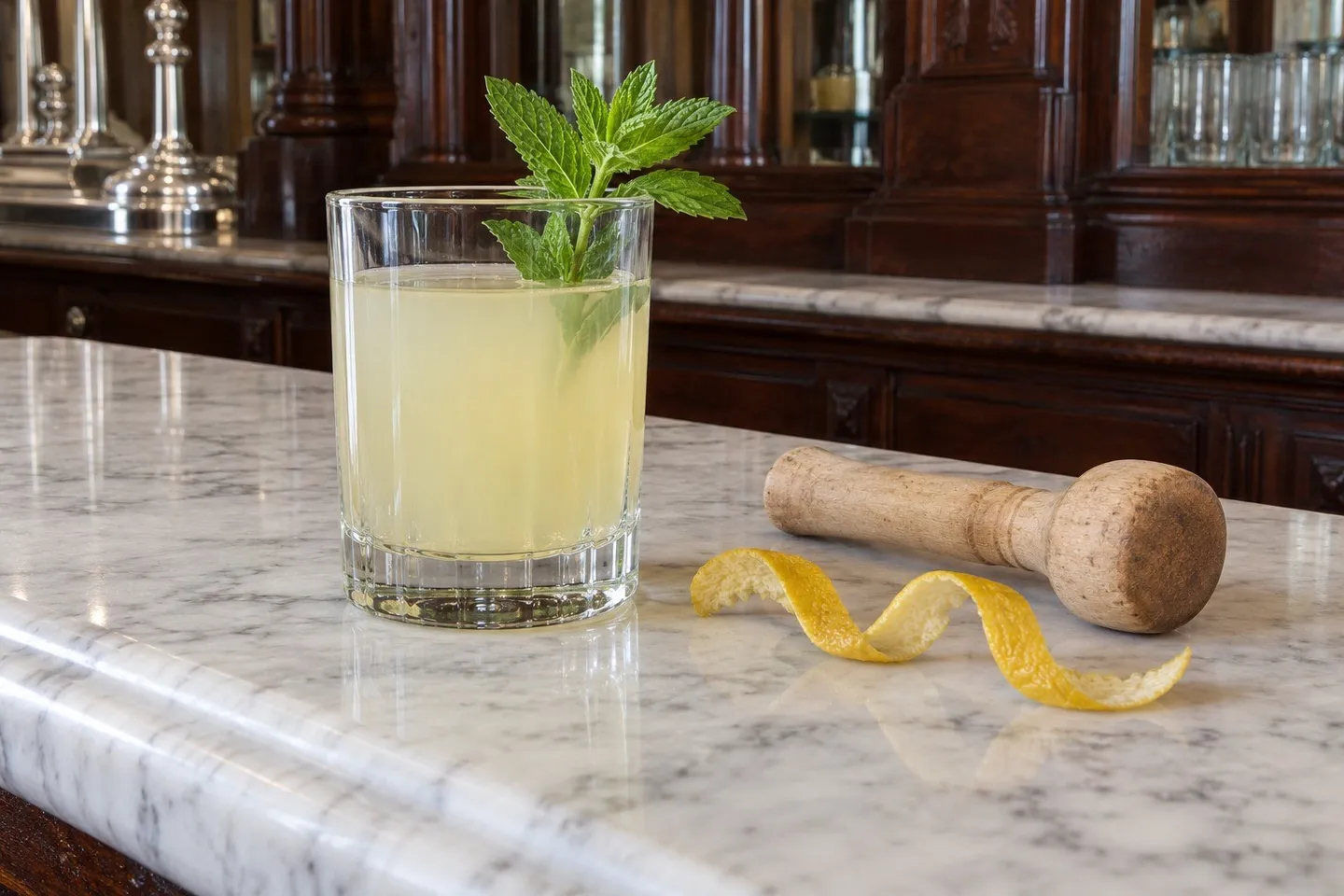
Still mint lemonade with a mint sprig in a heavy tumbler, with a wooden pestle and a curl of lemon peel on a marble counter.
The story behind the recipe
American druggists were told in July 1910 that mint lemonade would pay. The Pharmaceutical Era, their trade paper, printed a soda-fountain formula for a single glass, a peeled lemon pounded with sugar and mint in a thick lemonade glass, shaken and strained into a second glass “into which a tempting sprig of mint has been placed,” and closed with the pitch: “A very refreshing drink and can be readily sold for 10 cents.” That dime is about $3.50 in today’s money, by US consumer prices.
Peel off, mint in
The fountain peeled its lemon. Mrs. Beeton, in London half a century earlier, wanted the peel’s oil and rubbed lumps of sugar over the rind to get it. With the peel gone, the scent here comes from the mint. The page offers no fizz either: the glass is filled with plain water. Facing it in the same issue is a photograph of C. H. Packard’s soda fountain in his Maverick Square pharmacy in Boston, and the next formula is a King George Sundae, probably named for George V, king since that May.
Home cooks soon made mint lemonade by the pitcher, with the mint steeped in a boiled syrup. Marietta McPherson Greenough printed hers in Better Meals for Less Money (1917), and two years later Helen Watkeys Moore printed the same amounts and method in On Uncle Sam’s Water Wagon, a title built on “on the water wagon,” slang for teetotal, in the year the Eighteenth Amendment was ratified.
Read more about this recipe
Shaker for pestle
A cocktail shaker does the work of the fountain’s two glasses, and the handle end of a wooden spoon will do for the pestle. “5 or 6 spoonfuls” of sugar we read as teaspoons; tablespoons would bury one lemon. Five teaspoons give about 70 grams of sugar to the liter, roughly half the sugar of the 1917 pitcher. A ladleful of ice is taken as a cup.
Use spearmint or peppermint. Pennyroyal is a mint too, but never put it in a drink: its oil is highly toxic by mouth, and the US National Institutes of Health’s LiverTox records liver failure and deaths from it. When the weather turned, soda fountains served their lemon hot, from a plain Hot Lemon to an egg shaken with lemon syrup and topped up with hot water. The formula comes from a druggists’ journal, and why druggists ran the fountain is in Was the Soda Fountain a Pharmacy?
Mint Lemonade. Peel 1 lemon, slice it in several pieces and drop into a thick lemonade glass; add 5 or 6 spoonfuls of sugar and a sprig of mint. Rub the contents of the glass with a wooden pestle until the juice is well out of the lemon and the sugar is nearly dissolved. Add a ladleful of cracked ice and fill the glass with water. Shake well and strain into another lemonade glass into which a tempting sprig of mint has been placed. A very refreshing drink and can be readily sold for 10 cents.

Recipe makes: 1 glass, about 10 fl oz
Ingredients
For 1 glass, about 10 fl oz. Quantities are shown as written.
Quantities as written here, for 1 glass, about 10 fl oz.
- Lemon1
- Superfine sugar5 tsp
- Fresh spearmint2 sprigs
- Cracked ice1 cup
- Cold water7 fl oz
Measurement notes
Ingredients as written here
- 1 lemon
- 5 tsp superfine sugar
- 2 sprigs fresh spearmint
- 1 cup cracked ice
- 7 fl oz cold water
Equipment
 Knife
 Cocktail shaker and strainer
 Wooden spoon
 Large tumbler, about 12 fl oz
Instructions
Wash the fresh spearmint well. Put one sprig in the serving tumbler.
Cut the peel and most of the white pith off the lemon with a knife, then cut it into about 6 pieces and drop them into a cocktail shaker.
Add the superfine sugar and the other mint sprig. Press and grind with the handle end of a wooden spoon for 30 to 45 seconds, until the juice is out of the lemon and the sugar has nearly dissolved.
Add the cracked ice and the cold water, close the shaker and shake hard for about 10 seconds.
Strain into the tumbler over the waiting mint sprig. Serve at once, without ice in the glass.
Nutrition
90calories per serving
- Recipe makes
- 1 glass, about 10 fl oz
Estimated from USDA FoodData Central values for granulated sugar and lemon juice, for one glass.
Recipe notes
When adjusting quantities
The formula makes one glass. Make each glass separately, or see the recipe notes for the 1917 pitcher.
Notes
Quantities mentioned in these notes don’t change when you adjust the batch.
Peppermint works in place of spearmint.
Greenough’s 1917 pitcher, for about 6 glasses: simmer 1 cup (200 g) sugar in 6 cups (1.4 liters) water, uncovered, for 20 minutes; it loses some water to steam. Off the heat, add 1 loosely packed cup (about 20 g) of bruised mint leaves and leave until cold, about 1 hour. Strain, add the juice of 3 lemons (about 135 ml), and pour into glasses half filled with cracked ice, with a sprig of mint in each.
Scaling changes the ingredients only; glassware, ice and timings need their own judgment. To adapt this recipe further, try the recipe tool at TuneMyRecipe (opens in a new tab), our sister site.
Sources and attribution
The Pharmaceutical Era, vol. 43 (New York: D. O. Haynes & Co., July 1910), p. 694; Marietta McPherson Greenough, Better Meals for Less Money (New York: Henry Holt, 1917), p. 24, No. 26; Helen Watkeys Moore, On Uncle Sam’s Water Wagon (New York: G. P. Putnam’s Sons, 1919), p. 59
Recipe details
- Drink
- Alcohol-free
- Drink family
- Sodas & Soft Drinks
- Region
- American
- Source decade
- 1910s
- Difficulty
- Easy
- Occasion
- Summer party
- Season
- Summer