Orange Phosphate, the Red Orange Soda Fountain Drink
Reader ratingsBlood orange and raspberry syrup, plain soda water and a teaspoon of acid phosphate, stirred and served still: Saxe’s red orange phosphate from Chicago, 1894.
- Recipe makes
- About 1 cup red-orange syrup, enough for 8 drinks
- Prep
- Cook
- Total
Includes 15 minutes for the zest to steep and about 20 minutes for the strained syrup to cool. Each drink then takes a minute.
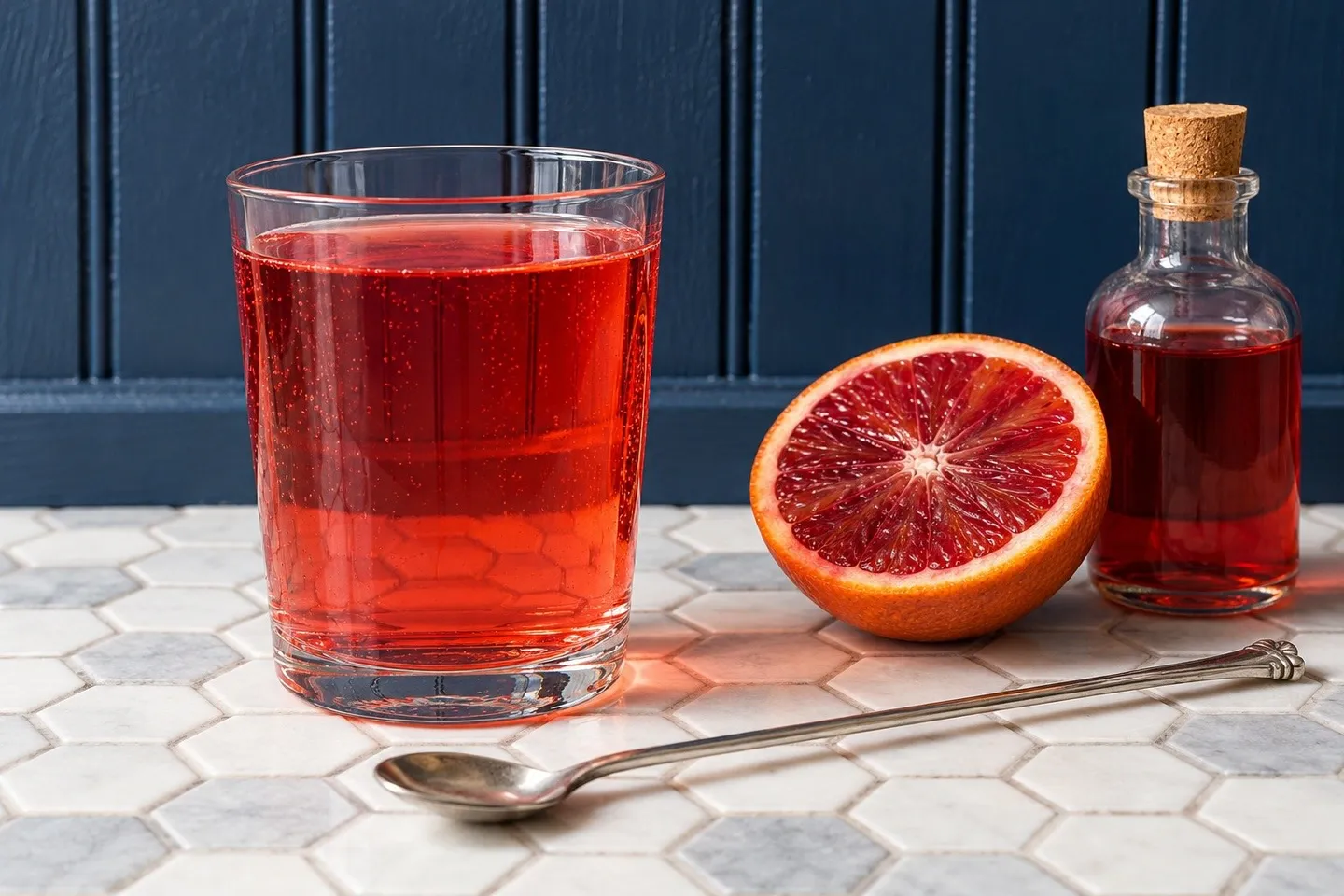
Red orange phosphate in a short mineral glass, with half a blood orange and a long soda spoon.
The story behind the recipe
An orange phosphate was plain soda water with orange syrup and a spoonful of acid phosphate, stirred in a short glass and served without a foamy head. The fountain favorite was the “red” orange, and much of its color came from raspberry juice.
De Forest W. Saxe, who ran a soda stand at State and Randolph streets in Chicago, printed his version in Saxe’s New Guide, or Hints to Soda Water Dispensers (1894). It was the drink, he wrote, that had “helped very materially to build up my trade,” and at five cents a glass it earned him a larger share of profit than ice cream soda at ten. Five cents then is about $1.90 today, by US consumer prices, and the ice cream soda about $3.70. How that trade grew through the cold months as well is told in What Did Soda Fountains Sell in Winter?
Raspberry in the red
Saxe says he paid $25 for the formula in Boston “several years ago,” roughly $900 today. Its syrup, No. 71 in the book, is bottled raspberry juice and a bought orange extract in simple syrup, with fruit acid and a few drops of color. The pairing, he says, makes “the finest flavored orange phosphate in the world,” and that is his claim alone. Philadelphia was still blending it the same way a generation later. In September 1921 the manager of Thompson’s Spa on Chestnut Street told The Soda Fountain that his counter was known for it: “The red orange phosphate is a blend of orange and raspberry flavors and tastes exactly like red Messina oranges.”
Read more about this recipe
Before Saxe
James W. Tufts, the Boston maker of the Arctic soda apparatus, had named Maltese (red) orange among the favorite phosphate flavors in his Book of Directions of 1890. His own orange phosphate went into a shaker with a fresh egg and sold for ten cents, about $3.60 today, which makes it a cousin of the Lemon Egg Phosphate. Saxe’s plain glass belonged to the fountain’s still, sour drinks, drawn into a short glass with no cream and no egg.
For orange with no fizz at all there is Fresh Orangeade. Saxe bought his orange extract ready-made (B. & C.’s brand); the one he prints for making yourself, No. 69, two recipes earlier, is the grated peel of 60 oranges macerated in water, alcohol and glycerine. This syrup takes its orange from fresh zest instead. The acid phosphate came off the pharmacy shelf, and how the fountain came to stand in the drugstore is told in Was the Soda Fountain a Pharmacy?
“SAXE’S ORANGE PHOSPHATE.” The Great and only true Orange Phosphate made. Plain Soda, 7 oz. ...

Recipe makes: About 1 cup red-orange syrup, enough for 8 drinks
Ingredients
For About 1 cup red-orange syrup, enough for 8 drinks. Quantities are shown as written.
Quantities as written here, for About 1 cup red-orange syrup, enough for 8 drinks.
Red-orange syrup
- Blood orange juice, strained1/2 cup
- Raspberries1/2 cup
- Sugar3/4 cup
- Orange, for its zest1
Per drink
- Plain soda water, chilled7 fl oz
- Red-orange syrup2 tbsp
- Acid phosphate1/2–1 tsp
Measurement notes
Ingredients as written here
- 1/2 cup blood orange juice, strained
- 1/2 cup raspberries
- 3/4 cup sugar
- 1 orange, for its zest
- 7 fl oz plain soda water, chilled
- 2 tbsp red-orange syrup
- 1/2 to 1 tsp acid phosphate
Equipment
 Small saucepan
 Fine sieve
 Fine grater or zester
 Clean bottle or jar for the syrup
 Tumbler
 Long spoon
Instructions
For the syrup, put the blood orange juice and sugar in a small saucepan and warm over low heat, stirring, until the sugar has dissolved. Do not let it boil.
Press the raspberries through a fine sieve into the pan with the back of a spoon, scraping the juice from the underside of the sieve, and discard the seeds.
Take the pan off the heat. Finely grate in the zest of the orange, stir, and leave to steep for 15 minutes.
Strain the syrup through the sieve into a clean bottle, let it cool for about 20 minutes, and keep it in the fridge.
For each drink, fill a half-pint tumbler about seven-eighths full with very cold plain soda water. Add the red-orange syrup, then the acid phosphate, and stir with a long spoon. Serve at once, without ice.
Nutrition
80calories per serving
- Recipe makes
- About 1 cup red-orange syrup, enough for 8 drinks
- Servings
- 8
Estimated from USDA FoodData Central values for granulated sugar, orange juice and raspberries, for one drink with 2 tablespoons of the syrup.
Recipe notes
When adjusting quantities
Scale the syrup ingredients together. The drink ingredients are for one glass; multiply them by the number of drinks.
Notes
Quantities mentioned in these notes don’t change when you adjust the batch.
Blood oranges give the deepest color. A navel orange works too and makes a paler, more orange glass; the raspberry still tints it.
Saxe’s No. 147 takes “1 oz.” of syrup, which is 2 tbsp, and a teaspoon of acid phosphate; his 7 oz. of soda fills an 8 fl oz glass to about seven-eighths, the way he drew his still drinks. This syrup holds about 150 g of sugar in a cup, so 2 tbsp carry about 19 g, a little under five teaspoons.
His syrup (No. 71) was made by the gallon: 6 oz. of bottled raspberry juice, 1½ oz. of B. & C.’s orange extract and ¾ oz. of fruit acid, made up to a gallon with simple syrup and tinted with a few drops of a colorant called Cactucine. This version leaves out the fruit acid and the color, so the glass is lighter than a fountain’s.
Acid phosphate is phosphoric acid in water, partly neutralized with calcium, magnesium and potassium salts, and bar suppliers still sell it for drinks. Buy a food-grade product sold for drinks and labeled for that use, and measure it by the half teaspoon. The US Food and Drug Administration lists phosphoric acid as generally recognized as safe when used under good manufacturing practice (21 CFR 182.1073), which covers products made for food, not laboratory stock. Never use laboratory phosphoric acid or the 85 percent concentrate in its place: at that strength it is corrosive.
Without acid phosphate, 2 tsp fresh lemon juice gives the sour edge. It is a substitute and brings its own lemon taste.
Tufts’ egg version, for one: 1/4 cup syrup, 1 pasteurized egg, 3/4 tsp acid phosphate and a small piece of ice, shaken hard, then about 2/3 cup soda water added to the shaker and the whole strained into a 10 fl oz glass.
Storage
Keep the red-orange syrup in a clean, closed bottle in the fridge and use it within a week.
Scaling changes the ingredients only; glassware, ice and timings need their own judgment. To adapt this recipe further, try the recipe tool at TuneMyRecipe (opens in a new tab), our sister site.
Sources and attribution
De Forest W. Saxe, Saxe’s New Guide, or Hints to Soda Water Dispensers (Chicago: Saxe Guide Publishing, 1894), No. 71, pp. 53–54, and No. 147, p. 85; James W. Tufts, Book of Directions (Boston, 1890), pp. 54 and 59
See the original pages (scan at Internet Archive) (opens in a new tab)
Recipe details
- Drink
- Alcohol-freeMocktail
- Drink family
- Sodas & Soft Drinks
- Region
- American
- Era
- 19th century
- Source decade
- 1890s
- Base
- Fruit & juice
- Difficulty
- Easy
- Season
- Summer