Tiff, Small Beer and Rum with Buttered Toast from 1759
Reader ratingsSmall beer, rum and sugar with a slice of buttered toast laid in: the Tiff or Flipp a Swedish pastor listed among the drinks of Pennsylvania and Delaware in 1759.
- Recipe makes
- 2 small cups, about 6 1/2 fl oz each
- Prep
- Total
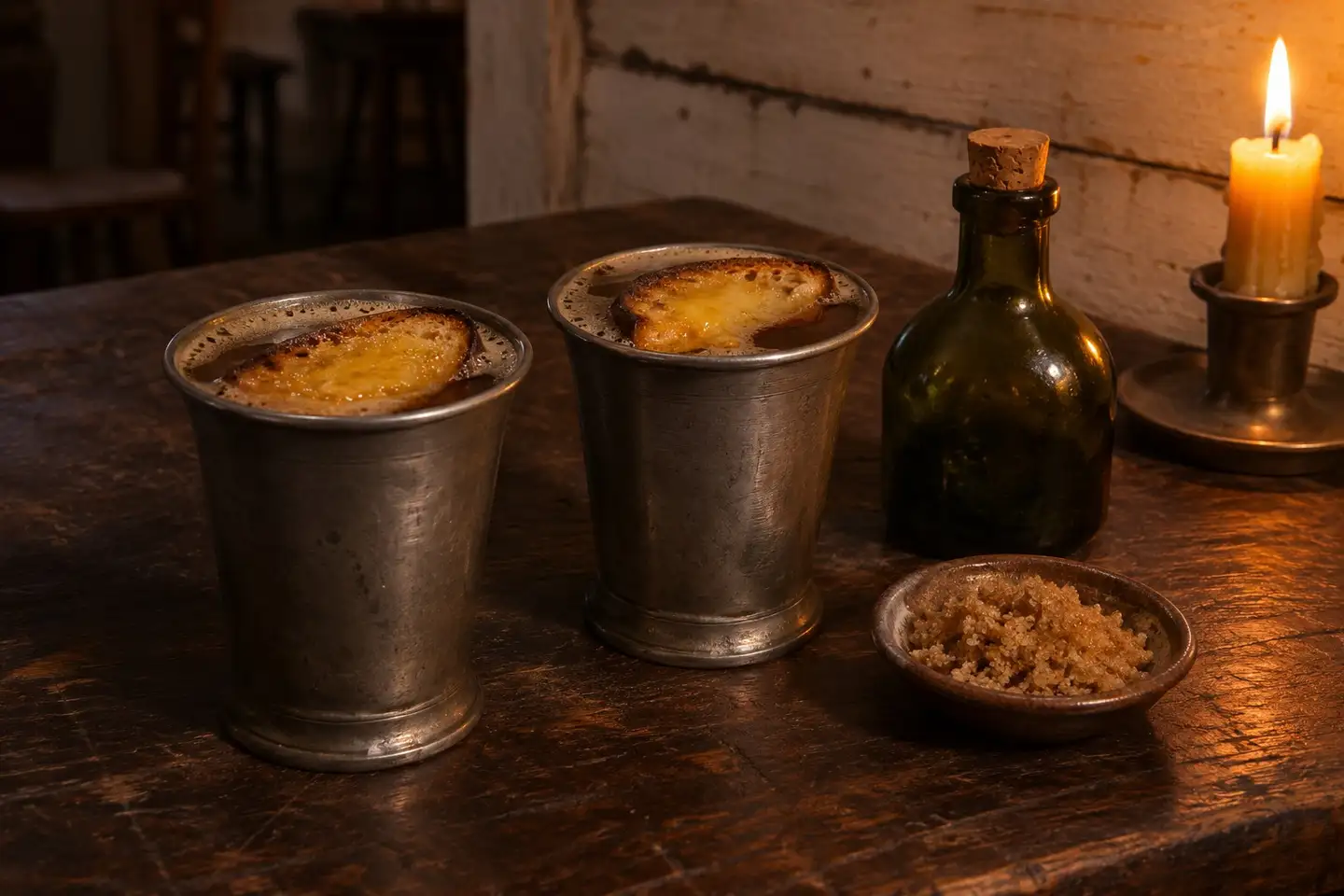
Tiff in two pewter cups with buttered toast on top, beside a corked bottle and brown sugar.
The story behind the recipe
Tiff, or Flipp, was small beer with rum and sugar in it and a slice of buttered toast laid on top. That is the whole recipe as Israel Acrelius printed it in 1759, entry 26 in a numbered list of the “drinks used in North America” in his history of the Swedish congregations on the Delaware. Acrelius was a Swedish Lutheran pastor there from 1749 to 1756, so this is a description written on the spot, not an English cookbook that happened to cross the Atlantic.
One slice of bread makes the difference
His list is short and exact. Entry 25, Manatham, is small beer with rum and sugar. Entry 26 is the same three things with the toast added, and it gets its own name. Entry 29, Hått-Pått, is warm beer with rum, and entry 30, Samson, is warm cider with rum. Nothing in entry 26 mentions an egg, cream, molasses, spice or heat. A red-hot iron, which later writers made part of the colonial flip story, does turn up in Acrelius, but on the page before, in his entry on cider. It isn’t part of Tiff.
The word he uses for the bread is stekt, a cooking word that can mean fried or roasted; the 1874 English translation of his book gives it as “toasted.” Small beer was the weak everyday beer of a household, and its strength then is unknown.
Read more about this recipe
Amounts, since Acrelius gives none
Acrelius gives no amounts, so every quantity here is ours: a bottle of mild 4% beer, three tablespoons of rum, a spoonful of sugar and one small slice of bread, for two cups. By our arithmetic that comes to about 8% ABV. We dry-toast the bread and serve the drink cool, since his entry says nothing about warming it, and the toast goes in last so it floats. The beer the Pilgrims brought, and the small beer that followed it, are in What Did the Pilgrims Drink?. The flip that later reformers told hay-makers to leave alone is in What Did Early Americans Drink at Harvest? For the warm cider from the same list, see Samson, Warm Cider with Rum from 1759.
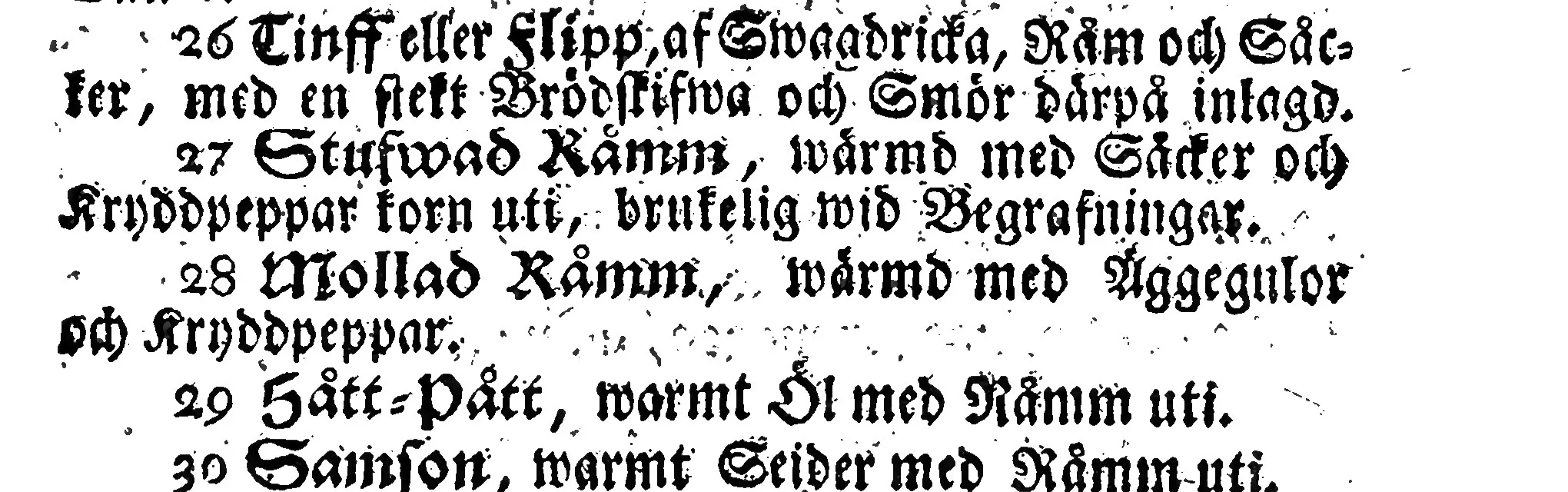
26 Tinff eller Flipp, af Swagdricka, Råm och Såcker, med en stekt Brödskifwa och Smör därpå inlagd.
The 1759 page prints the name “Tinff”; the 1874 English translation gives it as “Tiff,” the spelling we use.
In our English: “26. Tiff or Flipp, of small beer, rum and sugar, with a fried [toasted] slice of bread and butter on it, laid in.”

Original: 2 small cups, about 6 1/2 fl oz each
Ingredients
My drinksFor 2 small cups, about 6 1/2 fl oz each. Quantities are shown as written.
Quantities as written here, for 2 small cups, about 6 1/2 fl oz each.
- Small slice white bread1
- Unsalted butter1 tsp
- Sugar1 tbsp
- Rum3 tbsp
- Mild beer, about 4% ABV1 1/2 cups
Measurement notes
Ingredients as written here
- 1 small slice white bread
- 1 tsp unsalted butter
- 1 tbsp sugar
- 3 tbsp rum
- 1 1/2 cups mild beer, about 4% ABV
Equipment
 Toaster
 Jug
- Measuring spoons
 Long spoon
 2 mugs or large cups
Instructions
Toast the white bread until golden on both sides, spread it with the unsalted butter and cut it in half.
Stir the sugar into the rum in the jug with a splash of the mild beer until the sugar has mostly dissolved.
Pour in the rest of the beer slowly, stirring gently so it doesn’t foam over.
Divide it between the cups and lay half of the buttered toast on top of each. Serve it at once, while the toast is still crisp.
Nutrition
190calories per serving
- Servings
- 2
Roughly estimated from USDA FoodData Central values for a 4% beer, 40% rum, granulated sugar, white bread and butter, for one of two cups.
Recipe notes
When adjusting quantities
Two cups. Keep one slice of toast for every bottle of beer when you scale.
Notes
Quantities mentioned in these notes don’t change when you adjust the batch.
Changes from the source: Acrelius gives no amounts, temperature or method, so the beer, rum, sugar and bread quantities, the dry toasting, the order of mixing and the cool serving are all our choices. His entry has no egg, cream, spice or hot iron, and we add none.
We use a mild, malty beer rather than a hoppy one, and any rum works. For a warm cup, heat the beer gently to about 140 °F (60 °C) before adding the rum, which is closer to the flips of later books. The toast-in-the-cup idea lasted into the next century: Ale Cup, Cold Ale with Sherry and Brandy over Toast pours its ale over hot toast in 1903.
Scaling changes the ingredients only; glassware, ice and timings need their own judgment. To adapt this recipe further, try the recipe tool at TuneMyRecipe (opens in a new tab), our sister site.
Sources and attribution
Israel Acrelius, Beskrifning om de Swenska Församlingars forna och närwarande Tilstånd (Stockholm: Harberg & Hesselberg, 1759), chapter X, “Drycker brukelige i Norra America,” entry 26, p. 183
Recipe details
- Drink family
- Wine, Beer & Mead
- Region
- American
- Era
- 18th century
- Base
- Beer & aleRum
- Difficulty
- Easy