Ale Cup, Cold Ale with Sherry and Brandy over Toast
Reader ratingsLemon juice squeezed onto hot toast, then sugar, nutmeg and a sprig of balm, and cold mild ale, sherry and brandy poured over: the Ale Cup of Edward Spencer’s The Flowing Bowl, 1903.
- Recipe makes
- About 7 3/4 cups, 10 small glasses
- Prep
- Total
Chill the ale for a few hours first. The balm comes out after about 5 minutes, and the cup is served at once.
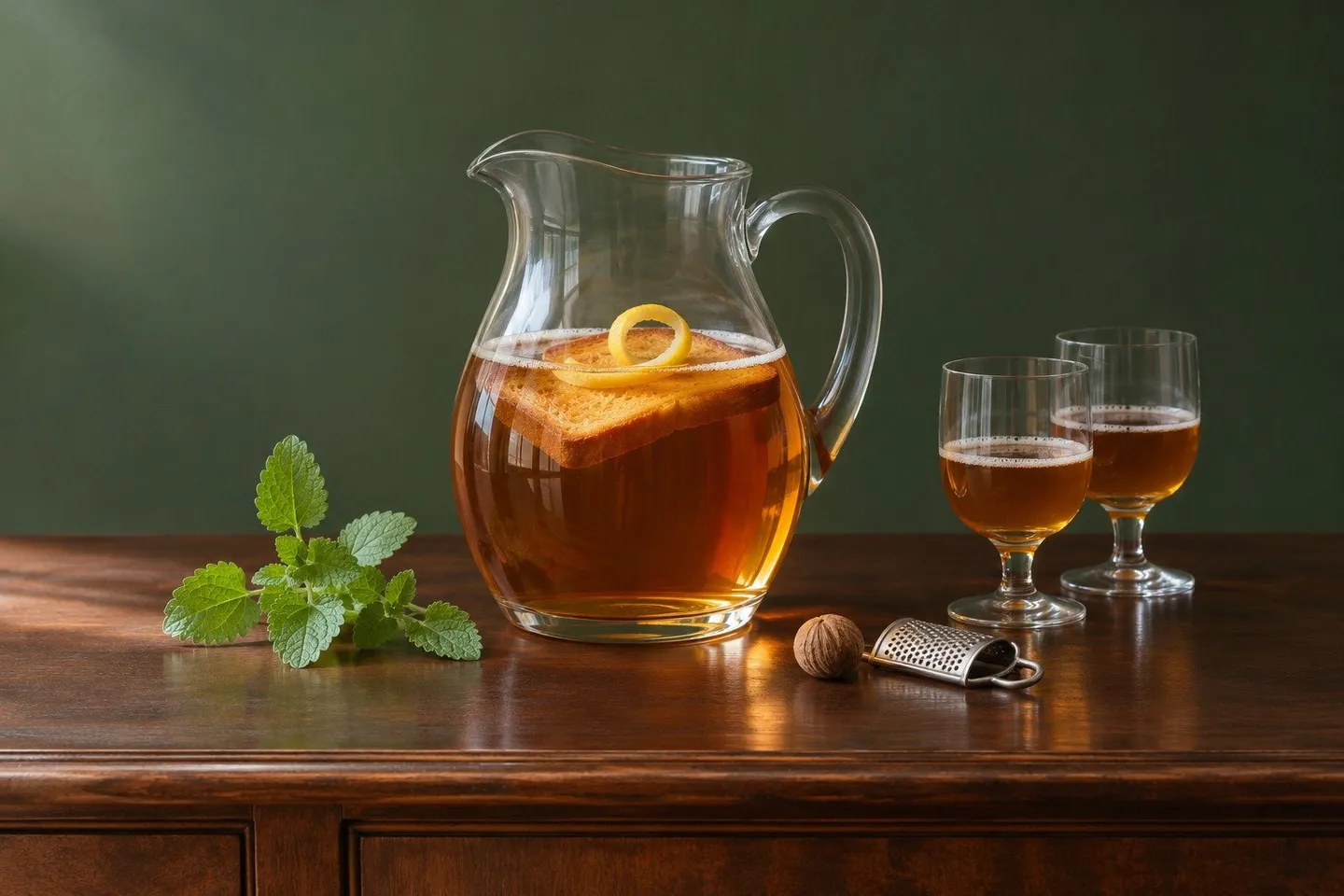
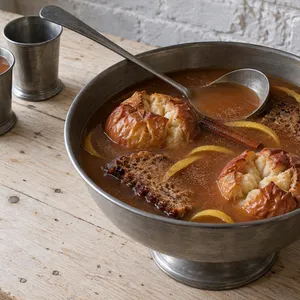
Ale cup in a glass pitcher with toast and lemon peel, a sprig of lemon balm and small stemmed glasses.
The story behind the recipe
Ale Cup is cold mild ale poured with sherry and brandy over a round of hot toast that has been soaked in lemon juice and topped with sugar, nutmeg, lemon peel and a sprig of balm. It comes from The Flowing Bowl, a book of drinks “of all kinds and of all periods” that Edward Spencer published in London in 1903. It is the first of what he calls “a few modern recipes for tasty beer-compounds.”
Modern, after the ancients
Spencer files it in his chapter “Glorious Beer,” before an Ale Flip, an Ale Posset and a Mulled Ale, all three hot. “Modern” was his word for the cup, and it was meant as a contrast. Thirty pages earlier he had put the Babylonians, the Egyptians and Cleopatra herself at the start of beer’s history, with more charm than accuracy, as Cleopatra’s Bitter and a Babylonian Sauce tells. The ale cup is what an Edwardian host actually poured.
The hot Wassail Bowl of 1869 also floats toast in ale and sherry; Spencer’s cup keeps the toast, leaves the ale cold, and adds brandy and balm.
Read more about this recipe
Making it today
Spencer’s three pints are imperial pints, about 1.7 liters, which we round to 7 cups. We read his “wine-glass” as 2 fl oz, so the brandy is a quarter cup and the sherry half a cup. A British dark mild is the right ale; a brown or amber ale of about 4% will do. With those strengths the cup comes to about 6% alcohol, a little stronger than the ale alone. The toast goes in hot and the ale cold: it is a cold cup, not a heated one. He gives no taste words, but by its parts it is a lightly spiced ale, sweetened by the sherry and sharpened with lemon.
For the same jug without alcohol, make the Alcohol-Free Ale Cup.
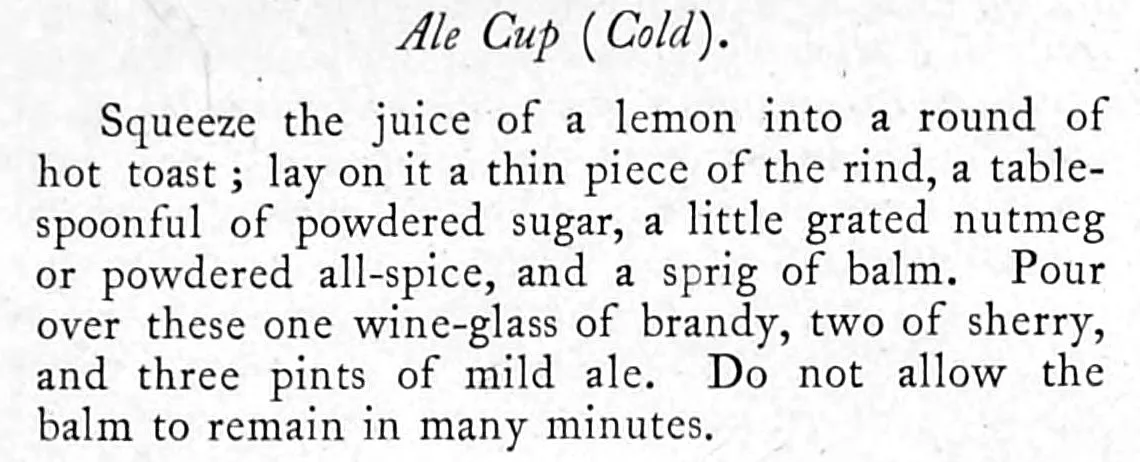
Ale Cup (Cold).
Squeeze the juice of a lemon into a round of hot toast; lay on it a thin piece of the rind, a tablespoonful of powdered sugar, a little grated nutmeg or powdered all-spice, and a sprig of balm. Pour over these one wine-glass of brandy, two of sherry, and three pints of mild ale. Do not allow the balm to remain in many minutes.

Recipe makes: About 7 3/4 cups, 10 small glasses
Ingredients
For About 7 3/4 cups, 10 small glasses. Quantities are shown as written.
Quantities as written here, for About 7 3/4 cups, 10 small glasses.
- White bread1 slice
- Lemon1
- Superfine sugar1 tbsp
- Freshly grated nutmeg1/8 tsp
- Lemon balm1 sprig
- Brandy1/4 cup
- Dry or medium sherry1/2 cup
- Mild ale, chilled7 cups
Measurement notes
Ingredients as written here
- 1 slice white bread
- 1 lemon
- 1 tbsp superfine sugar
- 1/8 tsp freshly grated nutmeg
- 1 sprig lemon balm
- 1/4 cup brandy
- 1/2 cup dry or medium sherry
- 7 cups mild ale, chilled
Equipment
 Large jug
- Toaster
 Citrus juicer
 Vegetable peeler
 Nutmeg grater
 Long spoon
Instructions
Toast the white bread and put it, still hot, in the bottom of a large jug.
Pare one thin strip of peel from the lemon with a vegetable peeler, leaving the white pith behind, then squeeze the lemon’s juice over the toast.
Lay the strip of peel on the toast with the superfine sugar, the nutmeg and the lemon balm.
Pour in the brandy and the sherry, then the cold mild ale, slowly down the side of the jug so it doesn’t foam over. Stir gently until the sugar has dissolved.
After about 5 minutes, lift out the balm. Serve at once in small glasses, leaving the toast in the jug.
Nutrition
90calories per serving
- Recipe makes
- About 7 3/4 cups, 10 small glasses
- Servings
- 10
Estimated from typical values for a 4% mild ale (about 35 kcal per 100 ml), brandy, dry sherry, lemon juice and sugar, for ten 3/4-cup glasses; the toast is not counted.
Recipe notes
When adjusting quantities
The recipe is built on three imperial pints of ale. Keep the brandy, sherry and ale at about 1 to 2 to 28 when you scale.
Notes
Quantities mentioned in these notes don’t change when you adjust the batch.
Spencer gives the juice of a whole lemon, about 3 tablespoons; a tablespoon of sugar; and “a little” nutmeg, or powdered allspice in its place. His “powdered sugar” is fine white sugar, so we use superfine. The amounts of brandy and sherry follow from a 2 fl oz wine-glass, our reading; a larger glass makes a stronger cup. The five minutes for the balm is our reading of “do not allow the balm to remain in many minutes.”
The sums: 7 cups of ale at 4% hold about 66 ml of alcohol, the brandy at 40% about 24 ml and the sherry at 15% about 18 ml, about 108 ml of alcohol in roughly 1.9 liters, or about 6%.
Spencer’s book also has a Superior Lemon Squash for the guests who take no ale.
Scaling changes the ingredients only; glassware, ice and timings need their own judgment. To adapt this recipe further, try the recipe tool at TuneMyRecipe (opens in a new tab), our sister site.
Sources and attribution
Edward Spencer, The Flowing Bowl: A Treatise on Drinks of All Kinds and of All Periods (London: Grant Richards, 1903), “Glorious Beer”, “Ale Cup (Cold)”, p. 55
See the original pages (scan at Internet Archive) (opens in a new tab)
Recipe details
- Drink family
- Punches & Cups
- Region
- British
- Era
- Edwardian
- Source decade
- 1900s
- Base
- Beer & aleWine
- Difficulty
- Easy