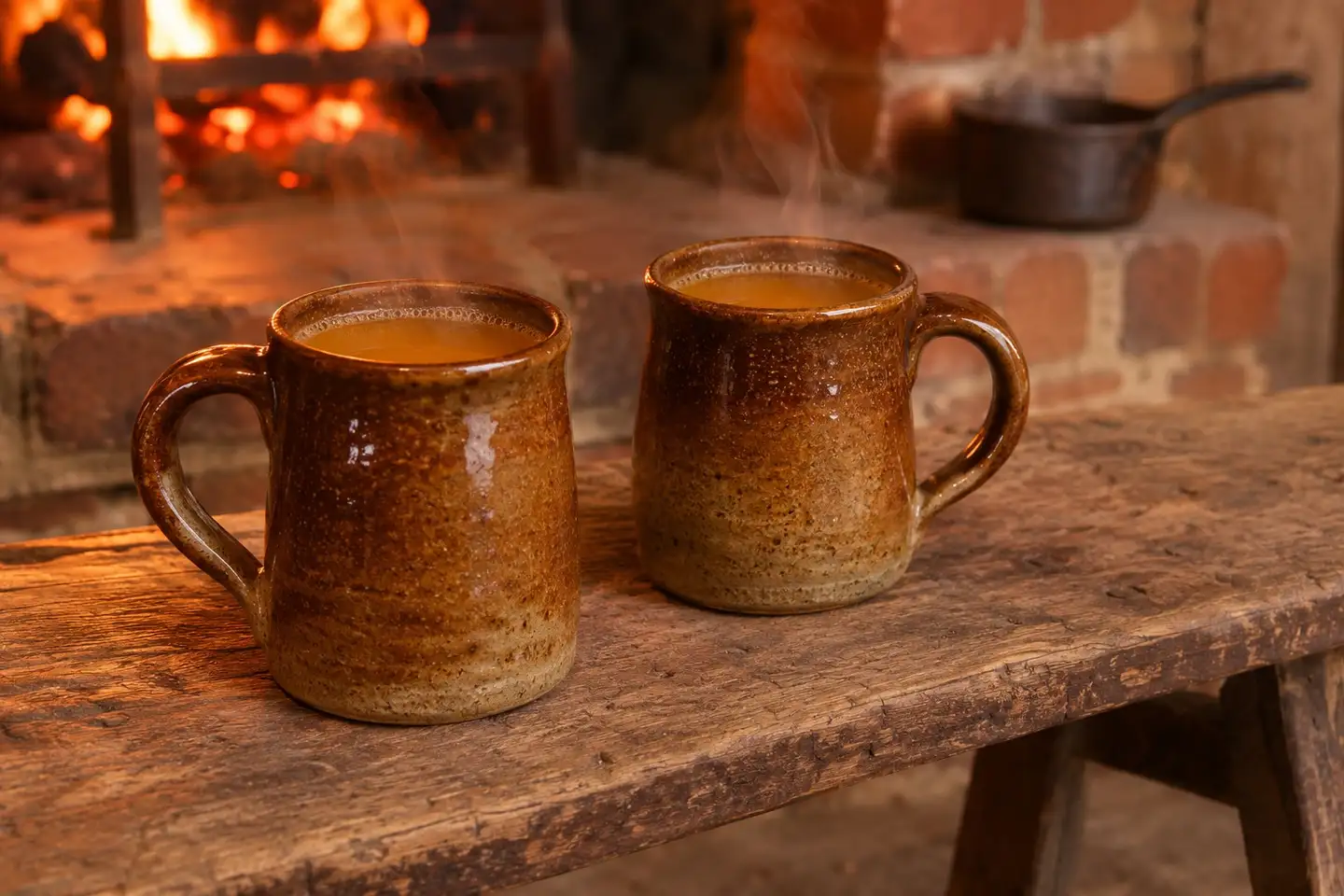
Samson, Warm Cider with Rum from 1759
Reader ratingsHard cider warmed and spiked with rum, and nothing else: the Samson that Israel Acrelius listed among the drinks of the Delaware colonies in 1759.
- Recipe makes
- 2 mugs, about 250 ml each
- Prep
- Cook
- Total
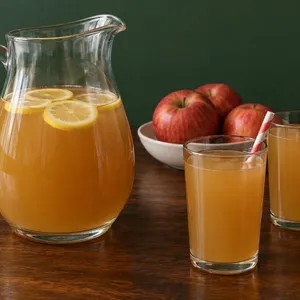
Samson, warm cider with rum, in two stoneware mugs by a brick hearth.
The story behind the recipe
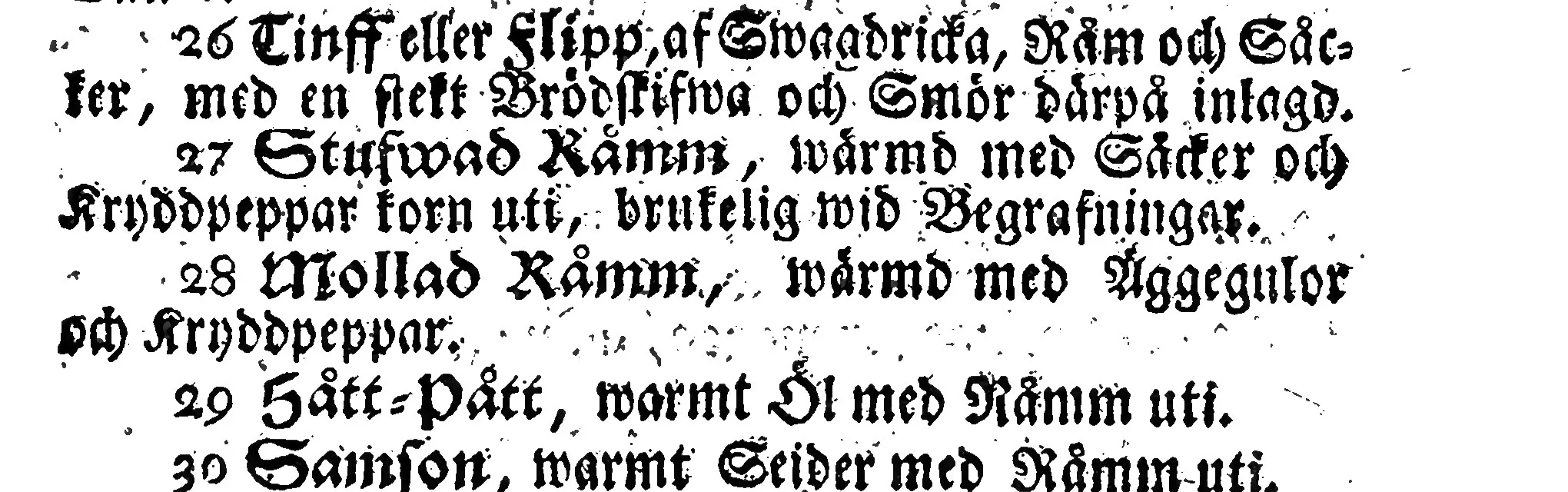
Samson was warm cider with rum in it. Israel Acrelius, a Swedish pastor who served the old Swedish congregations on the Delaware from 1749 to 1756, listed it as entry 30 in his 1759 catalogue of the “drinks used in North America”: “Samson, warmt Seider med Råmm uti.” The 1874 English translation of his book spells it Sampson; his own page says Samson.
Cider, not apple juice
Acrelius means the fermented kind. His long cider entry, on the pages before, has the pressed juice put in a cask to work and clear, and he is critical of how it was made. He gives other cider drinks in the same chapter, and they show how plain Samson is. Entry 17 is a mulled cider with sugar, egg yolks and allspice, rum optional. Entries 15 and 16, Cider Royal, are cider fortified with brandy and aged with raisins, or mixed with mead. Samson has none of that: no sugar, no egg, no spice, just heat and rum. Next to it in the list is Hått-Pått, warm beer with rum, the same idea made with beer.
Rum made such drinks dearer. A schedule of the most a tavern could charge, set in York County, Virginia, in 1706, put a quart of rum punch or rum flip at twice the rate of a quart of beer or cider. That was Virginia half a century earlier, not Acrelius’s Delaware, but the gap is plain.
Read more about this recipe
Warm, but not weak
Acrelius gives no amounts or method, so ours are choices: a still dry cider at about 5%, warmed to 140 to 150 °F (60 to 65 °C), and 50 ml of rum stirred in off the heat. By our arithmetic that is about 8.5% ABV before the little lost to warming, so it is not a weak drink, and heat does not make it alcohol-free. The sweet unfermented cider of a later century makes a different drink, our Cider-Flip, Sweet Cider with Lemon from 1903. How cider held its place on American tables is in What Did Early Americans Drink at Harvest?
30 Samson, warmt Seider med Råmm uti.
In our English: “30. Samson, warm cider with rum in it.”

Original: 2 mugs, about 250 ml each
Ingredients
My drinksFor 2 mugs, about 250 ml each. Quantities are shown as written.
Quantities as written here, for 2 mugs, about 250 ml each.
- Still dry hard cider, about 5% ABV450 ml
- Rum50 ml
Measurement notes
Ingredients as written here
- 450 ml still dry hard cider, about 5% ABV
- 50 ml rum
Equipment
 Small saucepan
 Instant-read thermometer
 Measuring jigger
 2 mugs or large cups
Instructions
Pour the still dry hard cider into the saucepan and warm it gently over low heat, stirring now and then, until it reaches 140 to 150 °F (60 to 65 °C). Don’t let it boil.
Take the pan off the heat and stir in the rum.
Pour it into the two mugs and serve it hot.
Nutrition
160calories per serving
- Servings
- 2
Roughly estimated from typical values for a 5% still dry hard cider (about 45 kcal per 100 ml) and 40% rum, for one of two mugs.
Recipe notes
When adjusting quantities
Two mugs. Keep the cider and rum at about 9 to 1 when you scale.
Notes
Quantities mentioned in these notes don’t change when you adjust the batch.
Changes from the source: Acrelius gives no amounts, temperature or method. The cider strength, the 9 to 1 ratio of cider to rum, the temperature and adding the rum off the heat are all ours. We add no sugar or spice because his entry names none.
A sweeter cider gives a sweeter cup; a little brown sugar is a modern addition, not his. For a spiced version from the same list, warm the cider with sugar and a few allspice berries and thicken it with egg yolk, as in his entry 17. For the cold beer drink from the same page, see Tiff, Small Beer and Rum with Buttered Toast from 1759.
Scaling changes the ingredients only; glassware, ice and timings need their own judgment. To adapt this recipe further, try the recipe tool at TuneMyRecipe (opens in a new tab), our sister site.
Sources and attribution
Israel Acrelius, Beskrifning om de Swenska Församlingars forna och närwarande Tilstånd (Stockholm: Harberg & Hesselberg, 1759), chapter X, “Drycker brukelige i Norra America,” entry 30, p. 183
Recipe details
- Drink family
- Hot Drinks
- Region
- American
- Era
- 18th century
- Base
- Fruit & juiceRum
- Difficulty
- Easy