Horse’s Neck, Ginger Ale and a Spiral of Lemon Peel
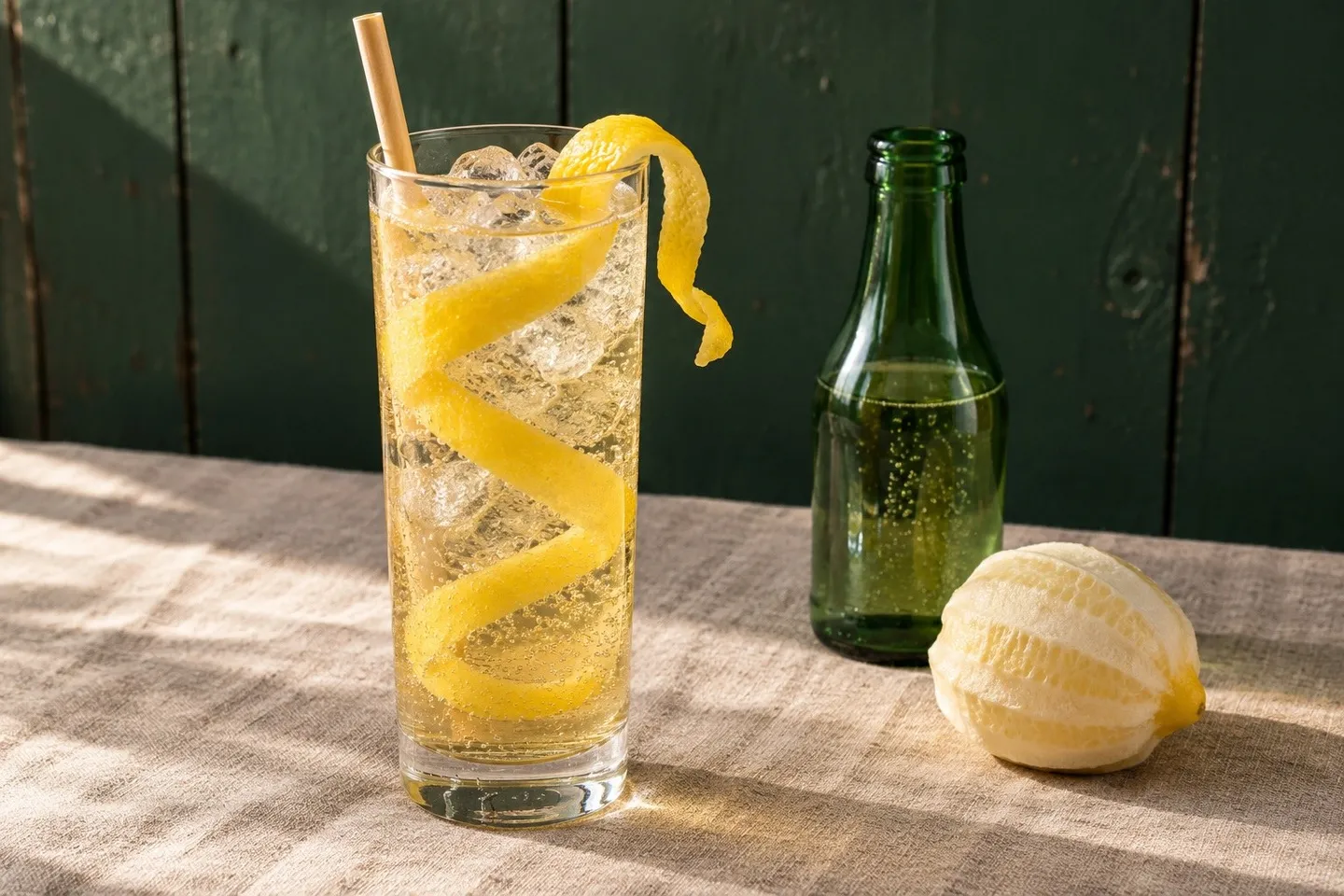
Reader ratingsA whole lemon peel in one long spiral, ice and a bottle of ginger ale: the Horse’s Neck as an alcohol-free drink, the way an 1895 home-drinks column and a 1901 bar book made it.
- Recipe makes
- 1 tall drink
- Prep
- Total
Let the drink stand for a few minutes after pouring, as the 1895 column advises, so the ginger ale takes up the lemon peel.
The alcohol-free Horse’s Neck: ginger ale over ice with a whole lemon peel in one spiral and a straw.
The story behind the recipe
The Horse’s Neck started out as a soft drink. “‘Horse’s neck’ consists of lemon peel and ginger ale,” a home-drinks column explained in 1895, in a piece headed “Drinks to Make at Home” that also taught plain lemonade and raspberry vinegar. The first book recipe, in The Cocktail Book of 1901, sits in its section of “Non-Alcoholic Drinks”: the rind of one lemon, two or three lumps of ice and a bottle of ginger ale, stirred with a spoon.
Hints for hospitable housewives
The 1895 column ran in the Moose Jaw Times in Canada, probably from an American syndicate, and its headline promised “Important Hints for All Hospitable Housewives.” Its writer admits that “‘Horse’s neck’ is not an attractive name and from a point of art the beverage not pretty, but it is extraordinarily palatable.” The peel was the point, “theory being that the ginger ale draws out the bitterness in the lemon peel,” which is why the drink is left to stand before it is served, and “Straws should invariably be used.”
The name is usually explained by the peel, curling out of the glass like a horse’s head and neck, an explanation the early recipes never give.
Read more about this recipe
When whiskey went in
In 1900, the year The Cocktail Book was copyrighted, Harry Johnson’s bartenders’ manual printed a Horse’s Neck with a wine glass of “whiskey, rye, Scotch, or Irish, as requested,” and in 1904 Thomas Stuart gave the rye version a name of its own, the Horse’s Collar. The brandy or bourbon Horse’s Neck best known today is later; we found no printed recipe for it before 1931.
A “soft” ginger drink of the period was not always free of alcohol: the ginger beers sold as soft drinks in Victorian London were brewed with yeast and held a little, as What Were Victorian Non-Alcoholic Beers? explains. Ginger ale carries the bowl in the Ginger Ale Punch, and TuneMyRecipe has a Ginger Ale Julep of 1920 (opens in a new tab). The bar books’ pages for the abstaining, from Jerry Thomas’s “Temperance Drinks” of 1862 to the one this glass was filed under, are in The Bartenders Who Wrote Down the Classic Cocktails.
Horse’s Neck.
Use Large Glass.
Rind one lemon; two or three lumps ice; one bottle ginger ale. Stir with spoon.

Recipe makes: 1 tall drink
Ingredients
For 1 tall drink. Quantities are shown as written.
Quantities as written here, for 1 tall drink.
- Unwaxed lemon1
- Ice cubes3
- Cold ginger ale3/4 cup
Measurement notes
Ingredients as written here
- 1 unwaxed lemon
- 3 ice cubes
- 3/4 cup cold ginger ale
Equipment
 Vegetable peeler
 Tall straight glass, about 12 fl oz
 Bar spoon
Instructions
Peel the unwaxed lemon with a vegetable peeler in one long, unbroken spiral, starting at one end and working round, leaving the white pith behind.
Curl the peel inside a tall glass, letting one end hang over the rim.
Add the ice cubes, then pour in the cold ginger ale.
Stir gently with a spoon and let it stand for 2 or 3 minutes, then serve with a straw.
Nutrition
70calories per serving
- Recipe makes
- 1 tall drink
Estimated from USDA FoodData Central values for ginger ale (about 34 calories per 100 ml); the lemon peel adds almost nothing.
Recipe notes
When adjusting quantities
One lemon peel and one bottle of ginger ale per glass.
Notes
Quantities mentioned in these notes don’t change when you adjust the batch.
A period bottle of ginger ale held roughly 6 to 7 fl oz; 3/4 cup is close. Stuart and Kappeler ask for “imported” ginger ale; any good ginger ale works, and a dry one is our choice. The 1895 column fills the glass with cracked ice instead of cubes, which works just as well. Johnson’s whiskey version below adds bitters, which are about 45% alcohol, so they stay out of this glass. The juice of the peeled lemon is not part of the drink; keep it for lemonade.
For Johnson’s 1900 version, put the peel in the glass as above, add 2 or 3 dashes of aromatic bitters, 2 fl oz rye or other whiskey and 3 or 4 lumps of ice, and fill up with about 2/3 cup ginger ale or soda water. It comes to about 11% ABV. Brandy or bourbon in place of the whiskey is the modern version.
Scaling changes the ingredients only; glassware, ice and timings need their own judgment.
Sources and attribution
The Cocktail Book: A Sideboard Manual for Gentlemen (Boston: L. C. Page, 1901; copyright 1900), p. 54, in the Non-Alcoholic Drinks section; also “Drinks to Make at Home”, The Moose Jaw Times, September 27, 1895, p. 6
Recipe details
- Drink
- Alcohol-freeMocktail
- Drink family
- Sodas & Soft Drinks
- Region
- American
- Source decade
- 1900s
- Base
- Fruit & juice
- Difficulty
- Easy
- Occasion
- Dry January