The Manhattan as Byron Printed It (1884)
Reader ratingsHalf a wine-glass of whiskey, half of Italian vermouth, two dashes of curaçao and two of Angostura, stirred with fine ice: the Manhattan as O. H. Byron printed it in 1884, among the first recipes in print.
- Recipe makes
- 1 drink, about 3 fl oz
- Prep
- Total
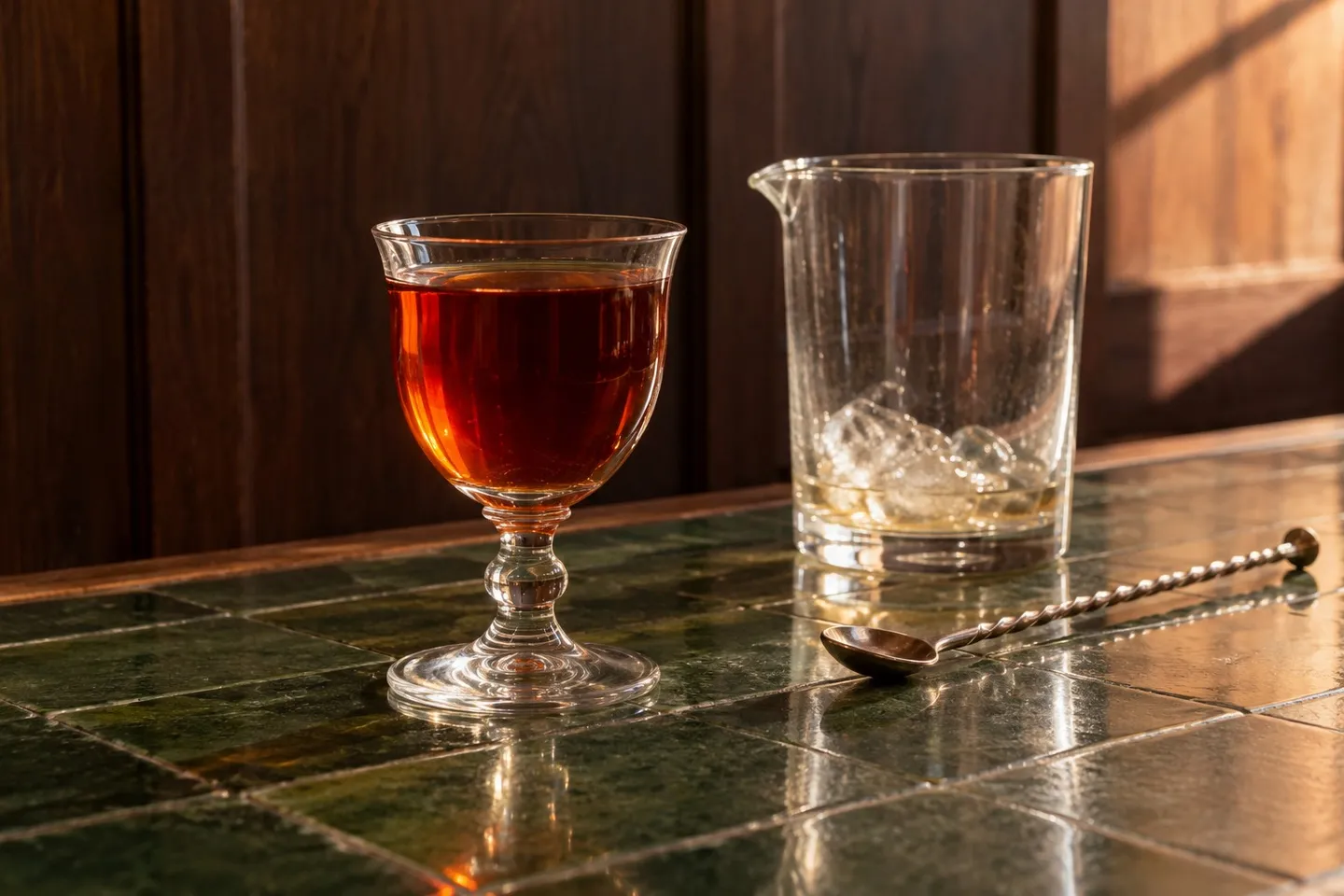
The 1884 Manhattan, equal parts whiskey and Italian vermouth, stirred and strained into a small stemmed cocktail glass.
The story behind the recipe
Equal halves of whiskey and Italian vermouth, with two dashes of curaçao and two of Angostura, stirred with ice: that is the original Manhattan as the first printed recipes made it. It is Manhattan Cocktail No. 2 in O. H. Byron’s Modern Bartenders’ Guide, copyright 1884, one of the first printed recipes under the name, and the one followed below. George Winter’s How to Mix Drinks, from the same year, also gives half whiskey and half vermouth, with Peruvian bitters and a dash or two of gum syrup.
French vermouth or Italian
Byron prints two. His No. 1 runs a pony of French vermouth to half a pony of whiskey, twice the vermouth, sweetened with gum syrup; No. 2 is the equal-halves drink with Italian vermouth. Byron’s next recipe is the Martinez, “Same as Manhattan, only you substitute gin for whisky,” the drink Thomas printed in full in 1887 as the Martinez. Three years later the 1887 edition of Jerry Thomas’s Bar-Tender’s Guide comes back to Byron’s No. 1 proportions, two of vermouth to one of whiskey, now with rye: a pony of rye to a whole wine-glass of vermouth, shaken and strained into a claret glass with a quarter slice of lemon. In all four of these 1880s recipes, the vermouth is never less than half the drink.
The famous telling sets the first one at a Manhattan Club party in New York given by Jennie Jerome, Lady Randolph Churchill. No record from the time places it there; treat it as legend.
It was a city drink, and it brought vermouth into the cocktail, as The Bartenders Who Wrote Down the Classic Cocktails tells.
Read more about this recipe
Stirring it today
Byron’s half wine-glass is 1 fluid ounce. Stirred with ice, the drink comes to about 3 fl oz at roughly 21% ABV, about one US standard drink. Most bars now pour two parts whiskey to one of vermouth and add a cherry; equal parts make the 1884 drink softer and sweeter. Harry Johnson’s equal-parts Manhattan of 1900, from the same family, is on TuneMyRecipe (opens in a new tab). Byron names no style of whiskey; rye is our choice, after Thomas, and bourbon works too. Fresh vermouth matters more here than in most drinks, since it is half the glass.
The Boulevardier of 1927 Paris keeps the whiskey and Italian vermouth and adds Campari. On a dry evening the Prohibition hostess poured the Grape Juice Highball, dark and grape-based like the vermouth it stands in for.
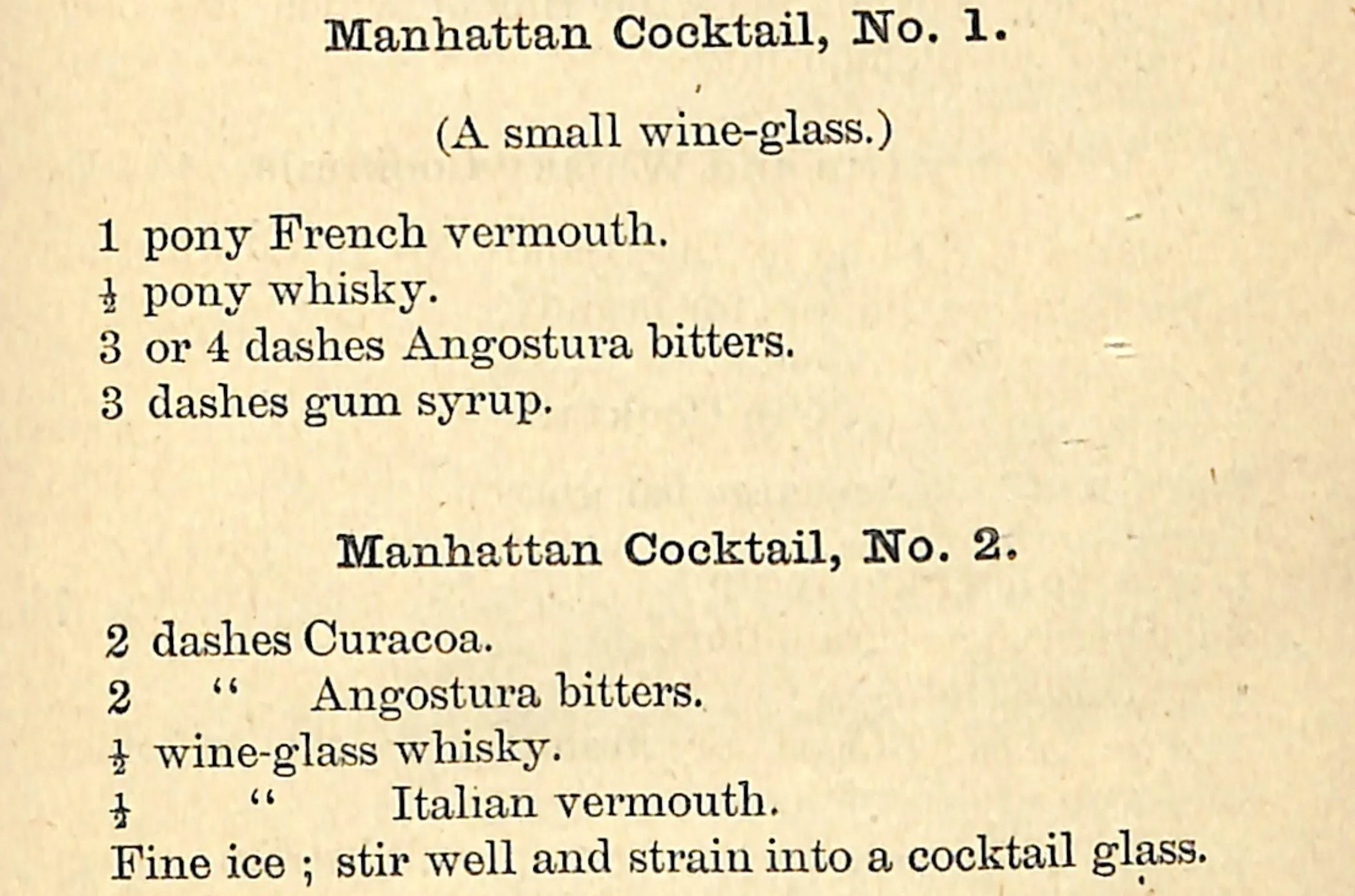
Manhattan Cocktail, No. 2.
2 dashes Curacoa.
2 “ Angostura bitters.
½ wine-glass whisky.
½ “ Italian vermouth.
Fine ice; stir well and strain into a cocktail glass.

Recipe makes: 1 drink, about 3 fl oz
Ingredients
For 1 drink, about 3 fl oz. Quantities are shown as written.
Quantities as written here, for 1 drink, about 3 fl oz.
- Rye whiskey1 fl oz
- Italian (sweet red) vermouth1 fl oz
- Orange curaçao2 dashes
- Aromatic bitters2 dashes
- Ice cubes
Measurement notes
Ingredients as written here
- 1 fl oz rye whiskey
- 1 fl oz Italian (sweet red) vermouth
- 2 dashes orange curaçao
- 2 dashes aromatic bitters
- ice cubes
Equipment
 Mixing glass or jug
 Bar spoon
 Strainer
 Cocktail glass
Instructions
Chill a cocktail glass in the freezer or with ice water.
Pour the rye whiskey, Italian vermouth, orange curaçao and aromatic bitters into a mixing glass and fill it two-thirds with ice cubes.
Stir steadily for about 30 seconds, until the mixing glass is very cold to the touch.
Strain into the chilled glass and serve.
Nutrition
130calories per serving
- Recipe makes
- 1 drink, about 3 fl oz
Estimated from USDA FoodData Central values for 90-proof whiskey and sweet dessert wine (for the vermouth), plus curaçao and bitters.
Recipe notes
When adjusting quantities
Keep the whiskey and vermouth in equal parts when you scale; stir no more than two drinks at a time.
Notes
Quantities mentioned in these notes don’t change when you adjust the batch.
Byron’s No. 1, the vermouth-heavy one: 1 fl oz dry (French) vermouth, 1/2 fl oz whiskey, 3 or 4 dashes of Angostura and 3 dashes of simple syrup, stirred and strained the same way.
A modern Manhattan at two to one: 2 fl oz rye, 1 fl oz Italian vermouth and 2 dashes of Angostura, stirred and strained, with a cherry if you like. Leave out the curaçao for a drier drink.
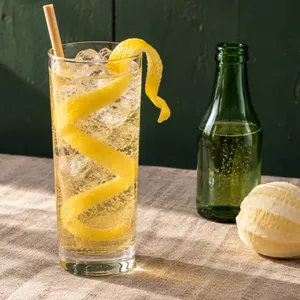
By 1901 a bar book was pouring a long drink with no whiskey, the Horse’s Neck: ginger ale over ice with a spiral of lemon peel.
Scaling changes the ingredients only; glassware, ice and timings need their own judgment.
Sources and attribution
O. H. Byron, The Modern Bartenders’ Guide (New York: Excelsior, 1884), “Manhattan Cocktail, No. 2”, p. 21; also George Winter, How to Mix Drinks (1884), p. 52, and Jerry Thomas, Bar-Tender’s Guide (1887), p. 24
Recipe details
- Drink family
- Cocktails & Mixed Drinks
- Region
- American
- Era
- 19th century
- Source decade
- 1880s
- Difficulty
- Easy