How Old Is the Old Fashioned?
The drink goes back to 1806, but the name is from the 1880s, when drinkers wanted a plain cocktail among new ones. The earliest recipe by name we found: 1888.
The Old Fashioned is as old as the cocktail itself, about 220 years, but its name is younger. The drink, spirits with sugar, water and bitters, was defined in print in 1806 and set down by Jerry Thomas in 1862 as the plain Whiskey Cocktail. The name “old-fashioned cocktail” turns up in the 1880s, once bartenders had moved on to newer cocktails, and the first recipe printed under that name is from Chicago in 1888.
The drink before the name
In 1806 a Hudson, New York, paper defined a cocktail as “a stimulating liquor, composed of spirits of any kind, sugar, water, and bitters.” Jerry Thomas’s How to Mix Drinks of 1862 printed exactly that for whiskey as No. 109: gum syrup, bitters and a wine-glass of whiskey, shaken with ice and strained. Both are in The Bartenders Who Wrote Down the Classic Cocktails.
Then the cocktail grew more elaborate. By the 1880s American bars were mixing whiskey with vermouth in the Manhattan, adding absinthe and maraschino to “improved” cocktails, and dressing sours with fruit. Next to those, the plain whiskey cocktail had become the old-fashioned one.
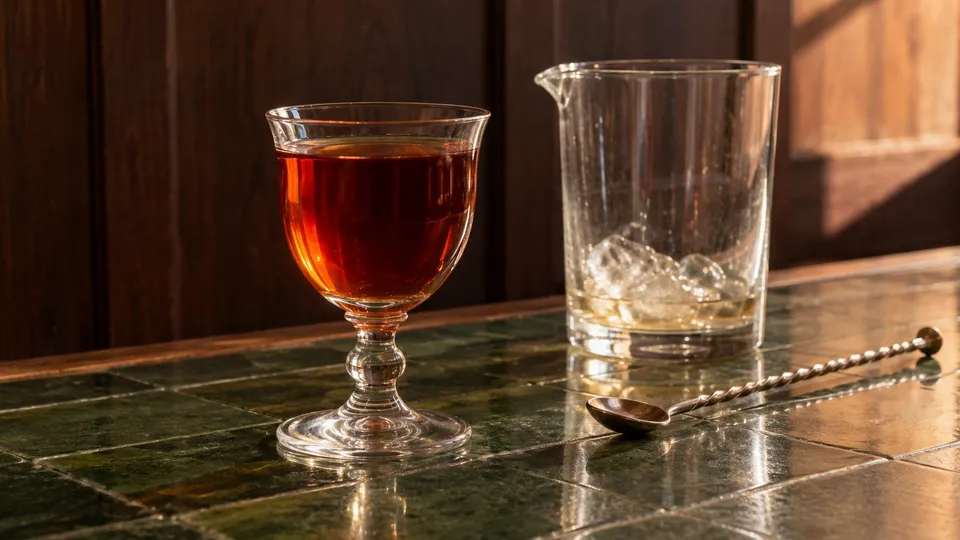 Make it todayThe Manhattan as Byron Printed It (1884)
The name in 1884
The earliest dated use we have found is in a New York letter of May 16, 1884, printed two days later in the Savannah Morning News. The writer is at “a favorite resort near the Academy of Music,” where the bartender breaks off his talk “in order to mix an old-fashioned cocktail, such as Senator Edmunds is said to love, which he did with a skill that argued long experience.” George F. Edmunds was a senator from Vermont.
A year later the phrase was in a small-town paper. When Marseilles, Illinois, opened a saloon in July 1885 “for the first time since the year 1877,” the Ottawa Free Trader reported that “It was a great day for mint juleps, old fashioned cocktails, and beer.”
The phrase is lower-case in both, a description rather than a brand name: the cocktail made the old way.
The first recipe by name
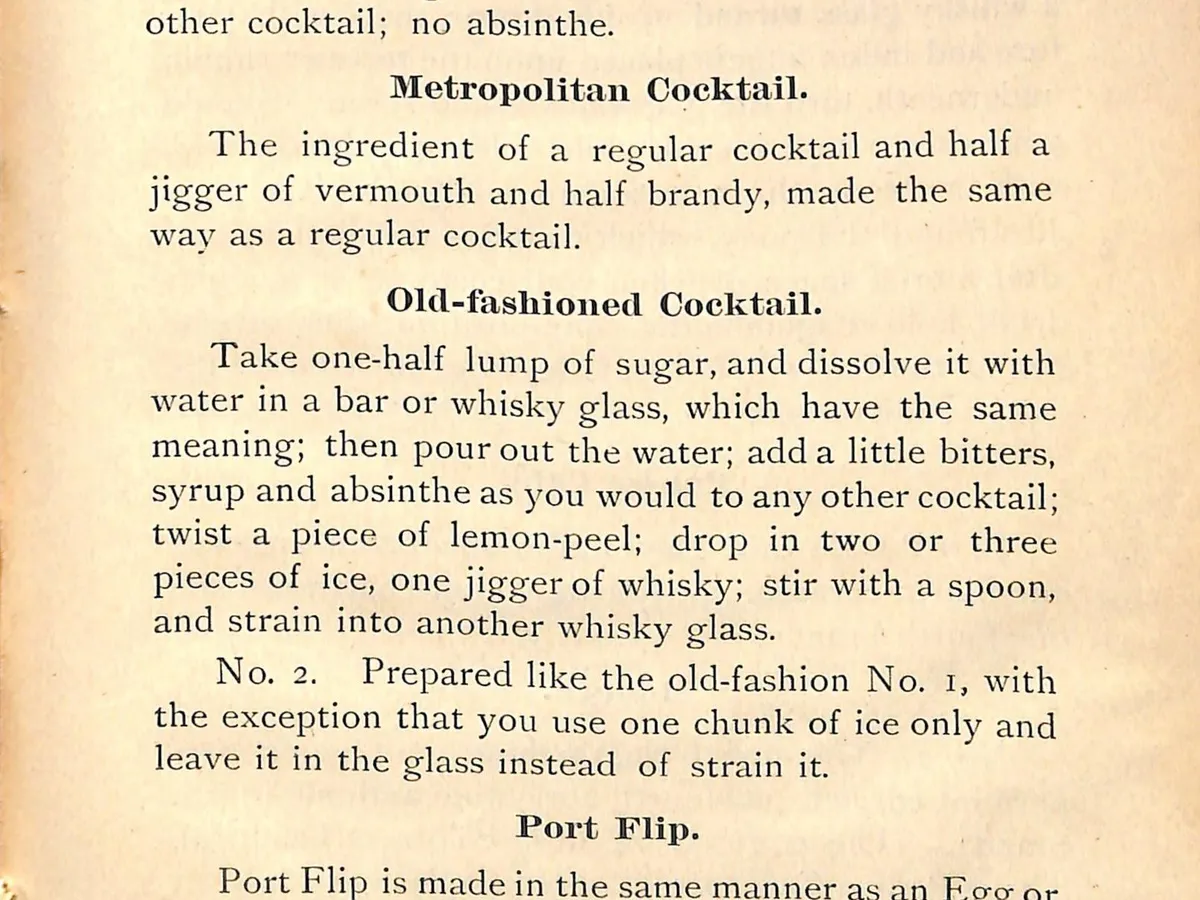
The first recipe we have found printed under the name is in Theodore Proulx’s Bartender’s Manual, published in Chicago with a copyright date of 1888. Ours is the revised edition, so the recipe was in print by that year and may be a little older.
Proulx’s “Old-fashioned Cocktail” sits on the same page as the Manhattan, the Martini and the Metropolitan. “Take one-half lump of sugar, and dissolve it with water in a bar or whisky glass,” he writes, “then pour out the water; add a little bitters, syrup and absinthe as you would to any other cocktail; twist a piece of lemon-peel; drop in two or three pieces of ice, one jigger of whisky; stir with a spoon, and strain into another whisky glass.” Then a second way: “No. 2. Prepared like the old-fashion No. 1, with the exception that you use one chunk of ice only and leave it in the glass instead of strain it.”
That No. 2 is the earliest printed Old Fashioned with the ice left in the glass that we have found. The absinthe surprises a modern drinker, but for Proulx it was part of “any other cocktail.” He was firm about fruit: “Some bartenders make the mistake of adding the fruits of the season. It is wrong, as a cocktail should always be served plain.” His No. 2 is our Proulx’s Old-fashioned Cocktail, the 1888 recipe, absinthe and all.
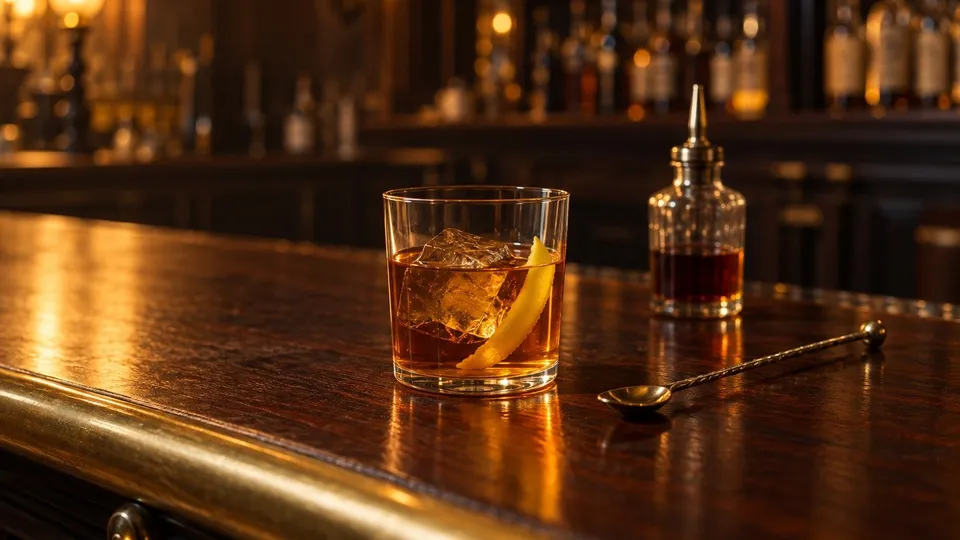 Make it todayProulx’s Old-Fashioned Cocktail, the 1888 Recipe
In 1895 George Kappeler’s Modern American Drinks, published in New York, gave the simpler form most bars follow now. His “Old-Fashioned Whiskey Cocktail” dissolves “a small lump of sugar with a little water in a whiskey-glass,” adds “two dashes Angostura bitters, a small piece ice, a piece lemon-peel, one jigger whiskey,” and is served “leaving spoon in the glass.” Kappeler printed old-fashioned cocktails of Holland gin and brandy as well. In 1895, old-fashioned was a way of making a cocktail, not yet a single drink.
A cedar pestle and a thumbnail of ice
In the summer of 1890 the New York Sun reported the drink as a fashion of its own. The item went round other papers; this copy is from Washington.
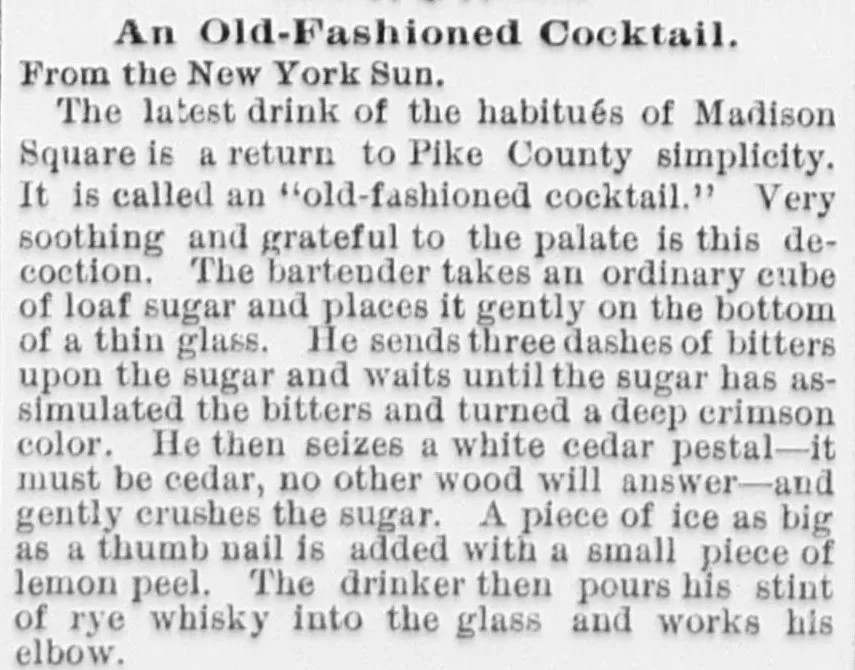 “An Old-Fashioned Cocktail. From the New York Sun,” reprinted in The Sunday Herald, Washington, D.C., August 3, 1890, p. 4. Library of Congress, Chronicling America.
“The latest drink of the habitués of Madison Square is a return to Pike County simplicity,” it begins, and calls it “Very soothing and grateful to the palate.” The bartender puts a cube of loaf sugar in “a thin glass,” sends three dashes of bitters onto it and waits “until the sugar has assimulated the bitters and turned a deep crimson color.” Then he “seizes a white cedar pestal—it must be cedar, no other wood will answer—and gently crushes the sugar.” In go “A piece of ice as big as a thumb nail” and a small piece of lemon peel, and “The drinker then pours his stint of rye whisky into the glass and works his elbow.”
This is the earliest description we have found of the sugar being crushed in the glass. Notice what is missing: no orange, no cherry, and only a scrap of ice.
The Louisville story
The best-known origin story puts the first Old Fashioned at the Pendennis Club in Louisville, Kentucky, made for Colonel James E. Pepper, a whiskey maker. The earliest source we have found for it is a book about New York’s Waldorf-Astoria bar, Old Waldorf Bar Days, published in 1931. It says Pepper brought the drink to the Waldorf, and that it “was said to have been the invention of a bartender at the famous Pendennis Club.”
That is a story told secondhand, nearly fifty years after the name appeared in a New York paper and four decades after Proulx printed the recipe in Chicago. The Waldorf did not open until 1893. Tom Bullock, who, by the introduction to his book, had served the members of the Pendennis Club and the St. Louis Country Club for a quarter of a century, printed his own “Old Fashion Cocktail” in The Ideal Bartender in 1917: a toddy glass, a lump of ice, two dashes of Angostura, a lump of sugar dissolved in water, a jigger and a half of bourbon and a twist of lemon. He made no claim that the drink began at his club. Until an earlier source turns up, the Louisville origin is a legend.
When the fruit came in
None of the recipes we have found from 1888 to 1917 puts fruit in an Old Fashioned. By 1930, in the middle of Prohibition, Dexter Mason’s The Art of Drinking has one with “1 slice of orange,” “1 slice of lemon” and “1 Maraschino cherry,” plus Italian vermouth. We have not found the fruit any earlier, so the orange and cherry belong to the Prohibition years, not to the original.
The guest who wasn’t drinking had a bar glass of his own in the same years: the Horse’s Neck, as an 1895 column and a 1901 bar book made it, was nothing but ginger ale over ice with one long spiral of lemon peel.
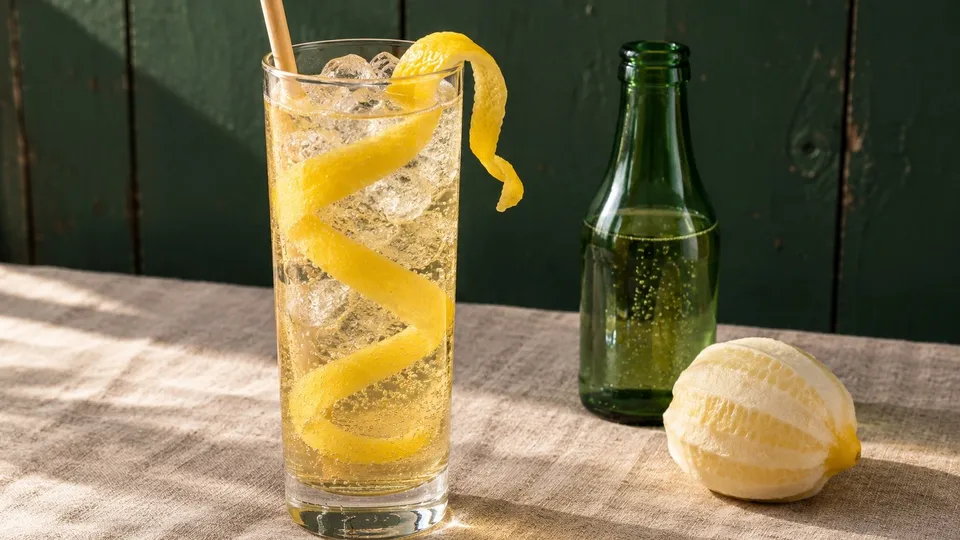 Always alcohol-freeHorse’s Neck, Ginger Ale and a Spiral of Lemon Peel
To taste the drink before it had a name, make The 1862 Whiskey Cocktail Behind the Old Fashioned. Below Thomas’s shaken version it also gives the plain tumbler build of 1900, sugar, bitters, two small lumps of ice and whiskey stirred in the glass, which is close to what Proulx and the Sun described.
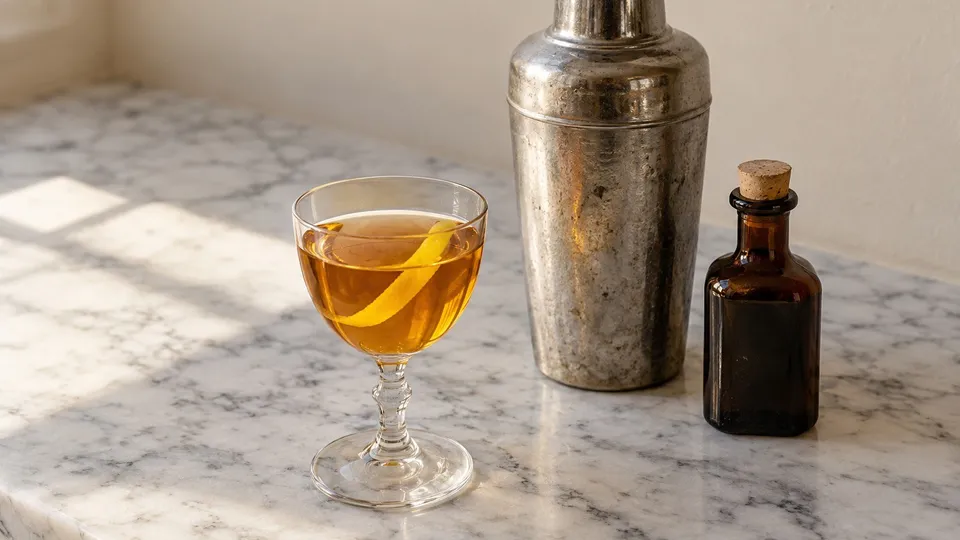 Make it todayThe 1862 Whiskey Cocktail Behind the Old Fashioned
Sources
- Savannah Morning News, May 18, 1884, p. 5, “Life in the Metropolis” (New York, May 16). Library of Congress, Chronicling America.
- Ottawa Free Trader (Ottawa, Illinois), July 11, 1885, p. 4. Library of Congress, Chronicling America.
- Theodore Proulx, The Bartender’s Manual, revised edition (Chicago: J. M. W. Jones Stationery & Printing Co., 1888), pp. 11, 25.
- “An Old-Fashioned Cocktail. From the New York Sun,” The Sunday Herald (Washington, D.C.), August 3, 1890, p. 4. Library of Congress, Chronicling America.
- George J. Kappeler, Modern American Drinks (New York: The Merriam Company, 1895), pp. 32–33, 43.
- Tom Bullock, The Ideal Bartender (St. Louis: Buxton & Skinner, 1917), pp. 5, 44.
- Dexter Mason, The Art of Drinking, or What to Make with What You Have (New York: Farrar & Rinehart, 1930), p. 51.
- Albert Stevens Crockett, Old Waldorf Bar Days (New York: Aventine Press, 1931), p. 153.