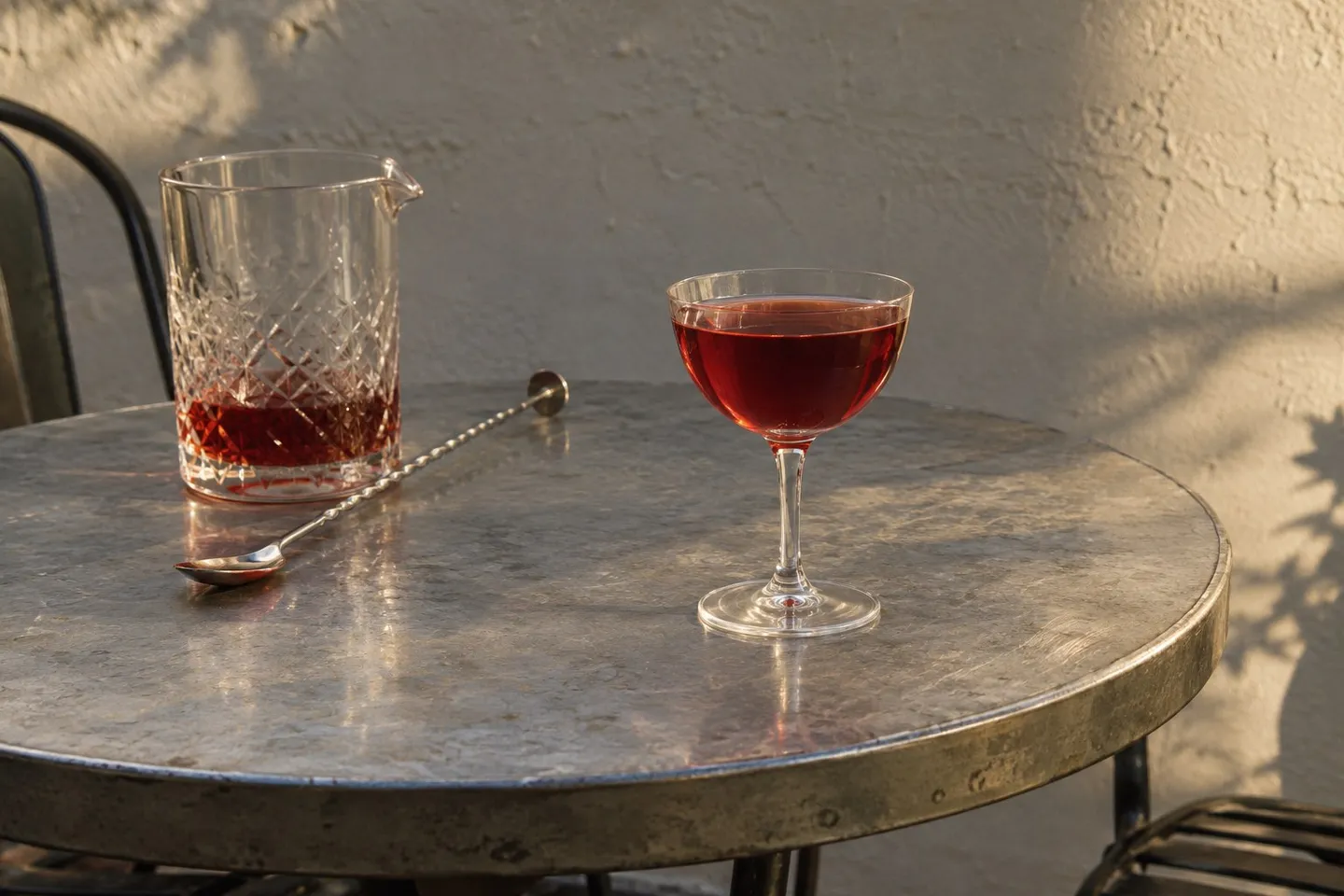
Boulevardier, Bourbon and Campari Cocktail
Reader ratingsBourbon, Campari and Italian vermouth in equal thirds: Erskine Gwynne’s drink, recorded in a single line of Barflies and Cocktails in Paris in 1927.
- Recipe makes
- 1 drink
- Prep
- Total
The Boulevardier in a small stemmed glass on a zinc café table, with a mixing jug and bar spoon.
The story behind the recipe
In the 1920s the Boulevardier’s whole printed record is one sentence: bourbon, Campari and Italian vermouth in equal thirds. Barflies and Cocktails, the 1927 book from Harry’s New York Bar in Paris, never lists it among its recipes. It turns up in a gossip column at the back, where Arthur Moss reports Erskine Gwynne arriving with his Boulevardier cocktail and gives the proportions. A few pages on, the same column has a Fernet-Branca drink dedicated to Serge Voronoff, the surgeon whose grafts gave MacElhone’s Monkey Gland its name.
A magazine with its own drink
The name points to a magazine. Gwynne and Moss launched The Boulevardier in 1927, an English-language magazine for Paris modeled on The New Yorker, and the same book carries a full-page notice for it: sixty francs a year in France (about €44, or $50, today by French consumer prices), with the magazine’s name spelled out down the page in the first letters of a list of drinks. Gwynne belonged to the bar’s circle as well. The book’s roll of the first chartered members of the International Bar Flies, a drinking society founded at the New York Bar around Christmas 1924, lists him at number 27.
Campari was still a rarity in these books. We found none in MacElhone’s 1923 ABC of Mixing Cocktails, and in the 1927 book it turns up only twice, both in Moss’s column: in the Boulevardier, and in a Canadian whisky, vermouth and Campari drink credited to “Sparrow” Robertson and called My Old Pal. The bourbon has its own story: in 1927 Prohibition was in force in the United States, and here was American whiskey poured legally in a Paris bar.
Read more about this recipe
Stirring it today
Moss gives no method, only the proportions. Like other drinks made only of spirits, vermouth and liqueur, it is best stirred with ice, which chills it with less water than shaking and keeps it clear. Equal thirds put the bitter orange of Campari level with the bourbon, so it drinks sweeter and more bitter than versions heavy on whiskey. Stirred, it lands near 18% ABV.
Use a bourbon at 40 to 45% ABV, Campari, and a sweet red vermouth from Italy, freshly opened if you can. A higher-proof bourbon makes it stronger and lets the whiskey show more. Guests who aren’t drinking can have the Ginger Ale Punch, made for dry parties in the same decade; Cocktails in 1920s London and Paris follows the rest of the Harry’s New York Bar circle.
Recipe makes: 1 drink
Ingredients
For 1 drink. Quantities are shown as written.
Quantities as written here, for 1 drink.
- Bourbon1 fl oz
- Campari1 fl oz
- Italian (sweet red) vermouth1 fl oz
- Ice cubes
Measurement notes
Ingredients as written here
- 1 fl oz bourbon
- 1 fl oz Campari
- 1 fl oz Italian (sweet red) vermouth
- ice cubes
Equipment
 Mixing glass or jug
 Bar spoon
 Strainer
 Small cocktail glass
Instructions
Chill a small cocktail glass in the freezer or with ice water.
Pour the bourbon, Campari and Italian vermouth into a mixing glass and fill it two-thirds with ice cubes.
Stir steadily for about 30 seconds, until the glass is very cold to the touch.
Strain into the chilled glass and serve.
Nutrition
185calories per serving
- Recipe makes
- 1 drink
Estimated from published values for 86-proof bourbon, Campari and sweet vermouth, counting alcohol at 7 calories per gram plus the sugars.
Recipe notes
When adjusting quantities
Keep the three in equal parts when you scale; stir no more than two drinks at a time.
Notes
Quantities mentioned in these notes don’t change when you adjust the batch.
The 1927 text gives only one-third Campari, one-third Italian vermouth and one-third bourbon whisky. The stir with ice and the cocktail glass, served straight up, are ours. The 1 fl oz (about 30 ml) measures make a 3 fl oz drink before ice.
Campari is 24% ABV in the United States and 25% in much of Europe; either works. Keep opened vermouth in the fridge. A modern version, heavier on the bourbon, is on TuneMyRecipe (opens in a new tab).
Moss’s alcohol-free drink on the same page, the Santa Monica, is only cola over ice. For a sharper Italian soda instead, try Bianco e Nero, orgeat and tamarind syrup with soda water.
Scaling changes the ingredients only; glassware, ice and timings need their own judgment.
Sources and attribution
Arthur Moss, “Cocktails Round Town”, in Harry McElhone, Barflies and Cocktails (Paris: Lecram Press, 1927), p. 80
Recipe details
- Drink family
- Cocktails & Mixed Drinks
- Region
- French
- Era
- Jazz Age
- Source decade
- 1920s
- Base
- Whisky
- Difficulty
- Easy
- Occasion
- 1920s party