Clarrey, Medieval Honeyed Spiced Wine
Reader ratingsWhite wine with clarified honey, ginger and cinnamon, run through a strainer: one documented form of clarrey, the medieval spiced wine akin to hippocras.
- Recipe makes
- About 800 ml, 6 small glasses
- Prep
- Cook
- Total
Includes 1 hour for the spices to steep and about 20 minutes for straining.
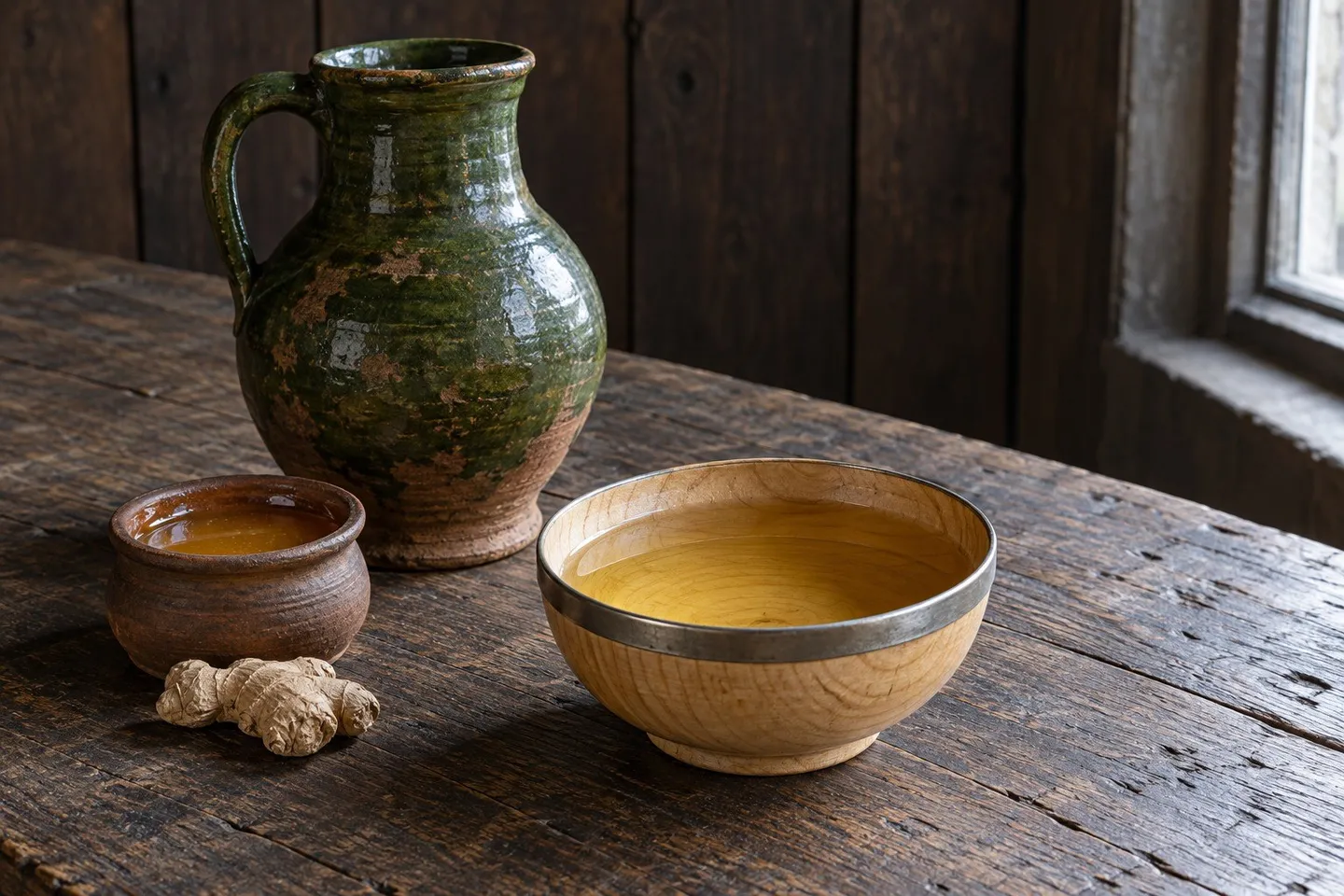
Clarrey in a wooden mazer, with its jug, honey and dried ginger.
The story behind the recipe
“Clary drinke of hony and wine”: that is how Percivale’s Spanish dictionary (1591, in Minsheu’s 1623 edition), quoted by the Victorian editor Frederick Furnivall, defines clarrey. It was a spiced wine, close kin to hippocras, and the two names overlapped; the honeyed version on this page is one documented form. A fifteenth-century cookbook even tells the cook how to fake it.
Two names, one family
That shortcut is in Harleian MS. 4016, a cookery book of about 1450 edited by Thomas Austin in 1888. To finish a sweet called leche lumbard, the cook takes wine, powdered ginger and cinnamon and a little clarified honey, runs them through a strainer and pours the syrup on “in stede of Clarre.” The same manuscript grinds almonds “with faire water,” one of the lines Did Medieval People Really Drink Beer Instead of Water? cites to show how much medieval kitchens used water.
John Russell’s Boke of Nurture, a household manual of the mid-fifteenth century, makes almost the same drink and still calls it hippocras: sugar for a lord, and for “commyn peple” ginger, canel, long pepper and “hony aftur claryfiynge.” Clarry was already old by then. The historian Henderson, quoted in Furnivall’s notes, defines it as “a claret or mixed wine, mingled with honey,” and found it at the royal table: an order of Henry III for the king’s table at York sets one cask of red wine aside “ad claretum faciendum,” for making clarry.
Honey was not the rule, though. Robina Napier, editing a fifteenth-century cookbook in 1882, calls the old French “Claree” “very similar to the Hippocras,” and a medicinal clarry printed in 1790 is sweetened with sugar.
Read more about this recipe
A bottle from the cook’s shortcut
This version follows the 1450 shortcut, scaled from a pouring syrup up to a bottle of wine. The source asks for only “a litel” honey, which we read as 45 ml for the bottle. The white wine is our pick too; Napier says claree was made “either white or red.” It takes less spice than the hippocras recipe. Warming the honey with water and skimming it is the old way of clarifying, quick on a modern stove. Long pepper, the hotter, catkin-shaped relative of black pepper, is optional. For the cinnamon and spice with no alcohol at all, the alcohol-free bishop heats red grape juice with a cinnamon stick, cloves and a roasted lemon, a modern take on an 1847 Oxford bowl. The honey and water leave it only about one percent ABV weaker than the wine you pour in. Hippocras, the sugared sibling, has its own page, and Rome’s far sweeter honeyed wine is Mulsum. What Did the Vikings Drink? sets the mead of the sagas beside it.
Recipe makes: About 800 ml, 6 small glasses
Ingredients
For About 800 ml, 6 small glasses. Quantities are shown as written.
Quantities as written here, for About 800 ml, 6 small glasses.
- Honey45 ml
- Water30 ml
- Dry white wine750 ml
- Ground cinnamon2 metric tsp (5 ml per tsp)
- Ground ginger1 metric tsp (5 ml per tsp)
- Ground long pepper (optional)1/4 metric tsp (5 ml per tsp)
Measurement notes
Ingredients as written here
- 45 ml honey
- 30 ml water
- 750 ml dry white wine
- 2 tsp ground cinnamon
- 1 tsp ground ginger
- 1/4 tsp ground long pepper (optional)
Equipment
 Small saucepan
 Large jug
 Sieve and paper coffee filter
 Bottle or carafe
Instructions
Warm the honey and water in a small saucepan over low heat until the honey has melted and just begins to bubble. Skim off any foam with a spoon, then take the pan off the heat.
Stir in the ground cinnamon, ground ginger and long pepper, if using, then pour in about a quarter of the dry white wine and stir until smooth.
Pour the mixture into a large jug with the rest of the wine and stir well. Leave to steep for 1 hour.
Pour the wine through a sieve, then through a paper coffee filter into a clean bottle or carafe, changing the filter if it clogs.
Serve at room temperature or lightly chilled, in small glasses.
Nutrition
130calories per serving
- Recipe makes
- About 800 ml, 6 small glasses
- Servings
- 6
Estimated from the ingredients using USDA FoodData Central values for dry white wine and honey; the strained spices add almost nothing.
Recipe notes
When adjusting quantities
Scale everything together; for two bottles, double every amount.
Notes
Quantities mentioned in these notes don’t change when you adjust the batch.
Clarre, clarey and clarry are all spellings of the same drink in these sources. Canel is cinnamon. Clarified honey was honey heated on the fire and skimmed.
Long pepper is sold whole by spice merchants; grind it in a mortar. Leave it out or use a few grinds of black pepper if you can’t find it.
The household ordinances printed by the Society of Antiquaries in 1790 contain that far heavier clarry, headed as a medicine for the stomach and the head, with a gallon of sweet wine, a long list of spices and medicinal roots, and two pounds of sugar. This recipe follows the cook’s quick version instead.
Scaling changes the ingredients only; glassware, ice and timings need their own judgment. To adapt this recipe further, try the recipe tool at TuneMyRecipe (opens in a new tab), our sister site.
Sources and attribution
Thomas Austin (ed.), Two Fifteenth-Century Cookery-Books (London: N. Trübner for the Early English Text Society, 1888), Harleian MS. 4016, p. 93; John Russell, The Boke of Nurture, in Frederick J. Furnivall (ed.), Early English Meals and Manners (London: Early English Text Society, 1868; 1931 reprint), lines 121–124, p. 9
Recipe details
- Drink family
- Wine, Beer & Mead
- Region
- British
- Era
- Medieval
- Difficulty
- Easy
- Occasion
- Dinner party