Digby’s Weak Hydromel, a Light Mead of 1669
Reader ratingsA gallon of light, gingery mead at about 4.4% ABV: one part honey to eighteen of water, boiled an hour with ginger, clove and rosemary, from Digby’s 1669 book.
- Recipe makes
- About 4 liters, 11 to 12 bottles of 330 ml
- Prep
- Cook
- Total
Includes 4 to 6 hours for the brew to cool (about 2 hours in a cold-water bath), 1 to 2 weeks of fermenting and 6 weeks in the bottle before it is ready to drink.
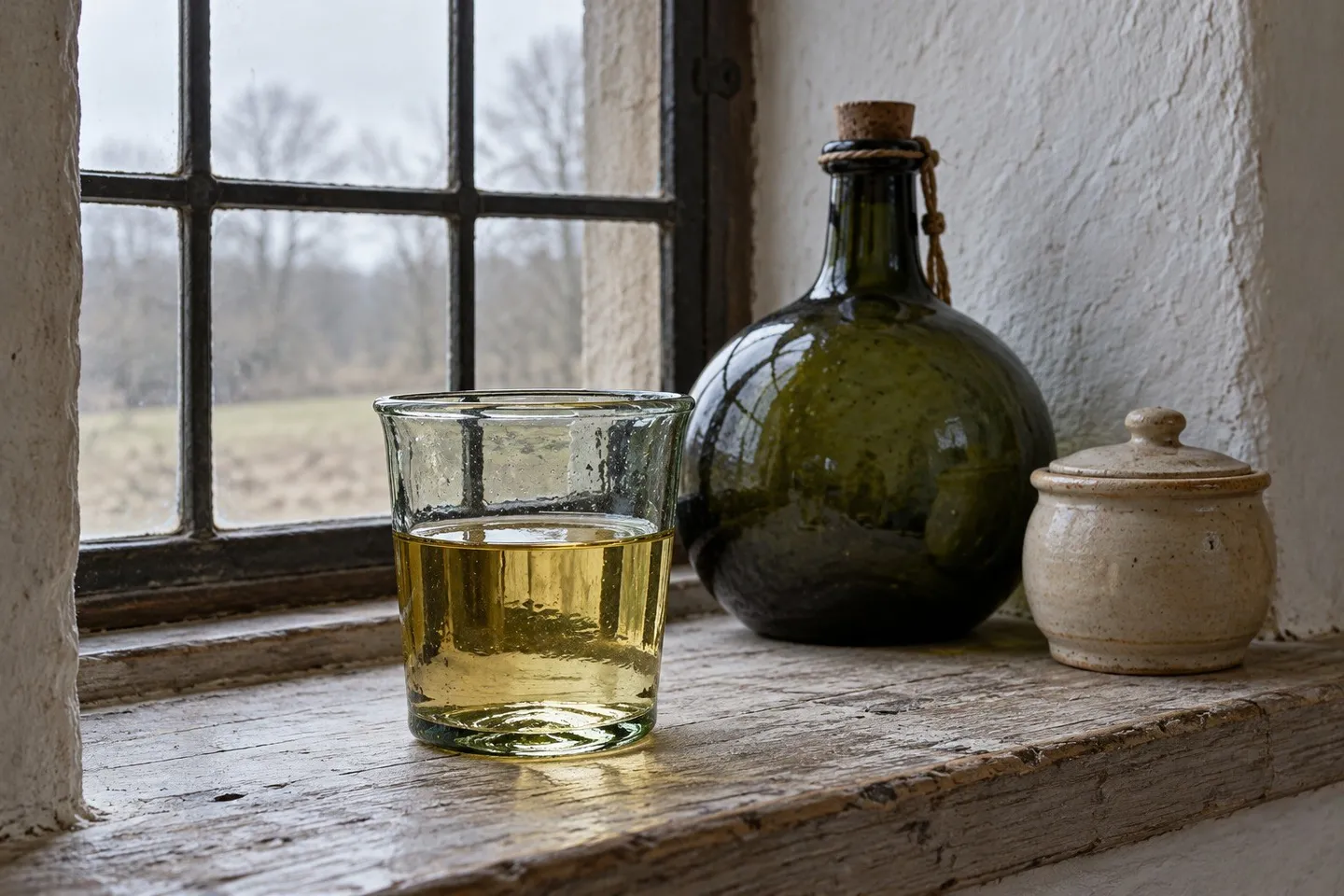
Digby’s weak hydromel in a greenish hand-blown beaker, with a dark green corked bottle and a honey pot in a leaded window.
The story behind the recipe
Digby called it weak, and he meant it. One quart of honey to eighteen of spring water ferments out at roughly 4.4% ABV by our arithmetic, about the strength of an ordinary beer and much lighter than most modern meads. He brewed it for the Queen Mother and bottled it young.
Digby’s closet
Sir Kenelm Digby never saw his recipes in print: he died in 1665, and The Closet of the Eminently Learned Sir Kenelme Digby Kt. Opened appeared in 1669. Nobody in the Norse world wrote a mead recipe down, so an English book has to stand in. Norse poems give mead to gods and poets, and What Did the Vikings Drink? sets that beside the ale people actually drank.
Honey and ale sat closer together in Digby’s world than the names suggest. He starts the hydromel with “a spoonful of Ale-yest,” the yeast from an ale brewing, and further on he records a Mr. Webb who “makes also Mead with the second weak running of the Ale.”
Read more about this recipe
A gallon at home
The ratio and the hour’s boil stay as Digby wrote them, at a quarter of his batch, which fits a one-gallon demijohn. A modern dried ale yeast replaces the barm, and goes in cooler than his “blood-warm,” which is our change.
One step had to change for safety. Digby bottled his hydromel “after two or three days,” while it was still fermenting, and the sugar left in it could keep working in the glass. Here it stays in the demijohn until fermentation has stopped. The University of Georgia Cooperative Extension’s Winemaking at Home gives the rule: “When fermentation has completely stopped, the wine should be … ready to bottle,” and a hydromel follows it. With no sugar added at bottling, the result is still.
It contains alcohol and honey, so it is not for children, and honey is never for babies under one. For the same liquor with no yeast and no alcohol, make Spiced Honey Water. A medieval honey drink made with wine instead is Clarrey.
Take 18 quarts of spring-water, and one quart of honey; when the water is warm, put the honey into it. When it boileth up, skim it very well, and continue skimming it, as long as any scum will rise. Then put in one Race of Ginger (sliced in thin slices,) four Cloves, and a little sprig of green Rosemary. Let these boil in the Liquor so long, till in all it have boiled one hour. Then set it to cool, till it be blood-warm; and then put to it a spoonful of Ale-yest. When it is worked up, put it into a vessel of a fit size; and after two or three days, bottle it up. You may drink it after six weeks, or two moneths.
Thus was the Hydromel made that I gave the Queen, which was exceedingly liked by every body.

Recipe makes: About 4 liters, 11 to 12 bottles of 330 ml
Ingredients
For About 4 liters, 11 to 12 bottles of 330 ml. Quantities are shown as written.
Quantities as written here, for About 4 liters, 11 to 12 bottles of 330 ml.
- Water4.25 l
- Runny honey235 ml
- Fresh ginger10 g
- Clove1
- Fresh rosemary, about 5 cm1 sprig
- Dried ale yeast3 g
Measurement notes
Ingredients as written here
- 4.25 l water
- 235 ml runny honey
- 10 g fresh ginger
- 1 whole clove
- 1 sprig fresh rosemary, about 5 cm
- 3 g dried ale yeast
Equipment
 Large saucepan
 Wooden spoon
 Thermometer
 Fine sieve
 Funnel
 Glass demijohn with an airlock, 4.5 liters
 Hydrometer
 No-rinse sanitizer
 Siphon tube (optional)
 Swing-top bottles or jugs
Instructions
Clean the demijohn, airlock, funnel, sieve, siphon tube and bottles well, without soap, and sanitize them with a no-rinse brewing sanitizer, following its label.
Warm the water in a large saucepan, stir in the runny honey and bring it to the boil, skimming off any foam as it rises.
Slice the fresh ginger thinly and add it to the pan with the clove and the rosemary. Boil gently, uncovered, for 1 hour in all, counting from when it first came to the boil.
Cover the pan and let the liquid cool to 20 to 25°C, checking with the thermometer: 4 to 6 hours or overnight on its own, or about 2 hours standing in a sink of cold water that you change as it warms.
Strain it through the sieve and funnel into the demijohn. Sprinkle in the dried ale yeast, fit the airlock and set the demijohn somewhere at 18 to 22°C.
Leave it to ferment until the bubbling in the airlock has stopped, usually 1 to 2 weeks. Check with the hydrometer: it is ready to bottle only when two readings taken a week apart are the same and at or below 1.000.
If the readings stop changing above about 1.005, the fermentation has stalled, not finished. Leave it in the demijohn somewhere warmer, 20 to 24°C, for another week or two and measure again. Don’t bottle it until it reaches 1.000.
Pour or siphon the hydromel into the bottles, leaving the yeast sediment behind, and close them.
Store the bottles somewhere cool for 6 weeks, as Digby advises, before drinking. Serve cool, in small glasses.
Nutrition
80calories per serving
- Recipe makes
- About 4 liters, 11 to 12 bottles of 330 ml
- Servings
- 11
Estimated for a 330 ml bottle at about 4.4% ABV, counting alcohol at 7 calories per gram; the honey ferments out almost dry.
Recipe notes
When adjusting quantities
Keep Digby’s ratio of eighteen parts water to one of honey by volume. The yeast amount is for one 4.5 liter demijohn.
Notes
Quantities mentioned in these notes don’t change when you adjust the batch.
The quarter-batch uses a 946 ml wine-measure quart: 4.25 l of water and 235 ml of honey, about 335 g. If Digby meant the larger ale quart the ratio is the same, so the drink is too.
The strength depends on how much the boil reduces the liquid and how dry the yeast ferments it: expect somewhere between about 3.8 and 4.6% ABV. You lose roughly 0.3 to 0.5 l in the hour’s boil, and another 0.2 to 0.3 l with the sediment left in the demijohn, so expect 11 or 12 bottles.
Bottling before fermentation has finished, as Digby did, is what makes bottles burst. Don’t do it. A steady reading alone isn’t enough, since a stalled ferment holds steady too: WineMaker magazine’s Wine Wizard column puts a dry wine “around 0.990–0.996,” and by our arithmetic a weak mead like this one finishes at about 0.995 to 1.000. A week between readings is our caution, because the last of the fermentation is slow.
Digby’s “Race of Ginger” was a whole root; 10 g is a quarter of a modest one, our estimate.
Stop before the yeast goes in and Digby’s honey makes Spiced Honey Water from Digby, a cold drink with no alcohol.
Storage
Keep the bottles somewhere cool and dark and drink them within a few months. Once a bottle is open, keep it in the fridge and finish it within a few days.
Scaling changes the ingredients only; glassware, ice and timings need their own judgment. To adapt this recipe further, try the recipe tool at TuneMyRecipe (opens in a new tab), our sister site.
Sources and attribution
Sir Kenelm Digby, The Closet of the Eminently Learned Sir Kenelme Digby Kt. Opened (London, 1669), “Hydromel as I made it weak for the Queen Mother”, pp. 36–37
See the original pages (scan at Internet Archive) (opens in a new tab)
Recipe details
- Drink family
- Wine, Beer & Mead
- Region
- British
- Era
- 17th century
- Difficulty
- Intermediate