Hippocras, Medieval Spiced Wine
Reader ratingsRed wine with cinnamon, ginger, grains of paradise and sugar, poured through cloth until it runs clear: the spiced wine that closed a medieval feast.
- Recipe makes
- About 700 ml, 6 small glasses
- Prep
- Total
Includes 2 hours for the spices to steep and about 30 minutes for the wine to run through the filter.
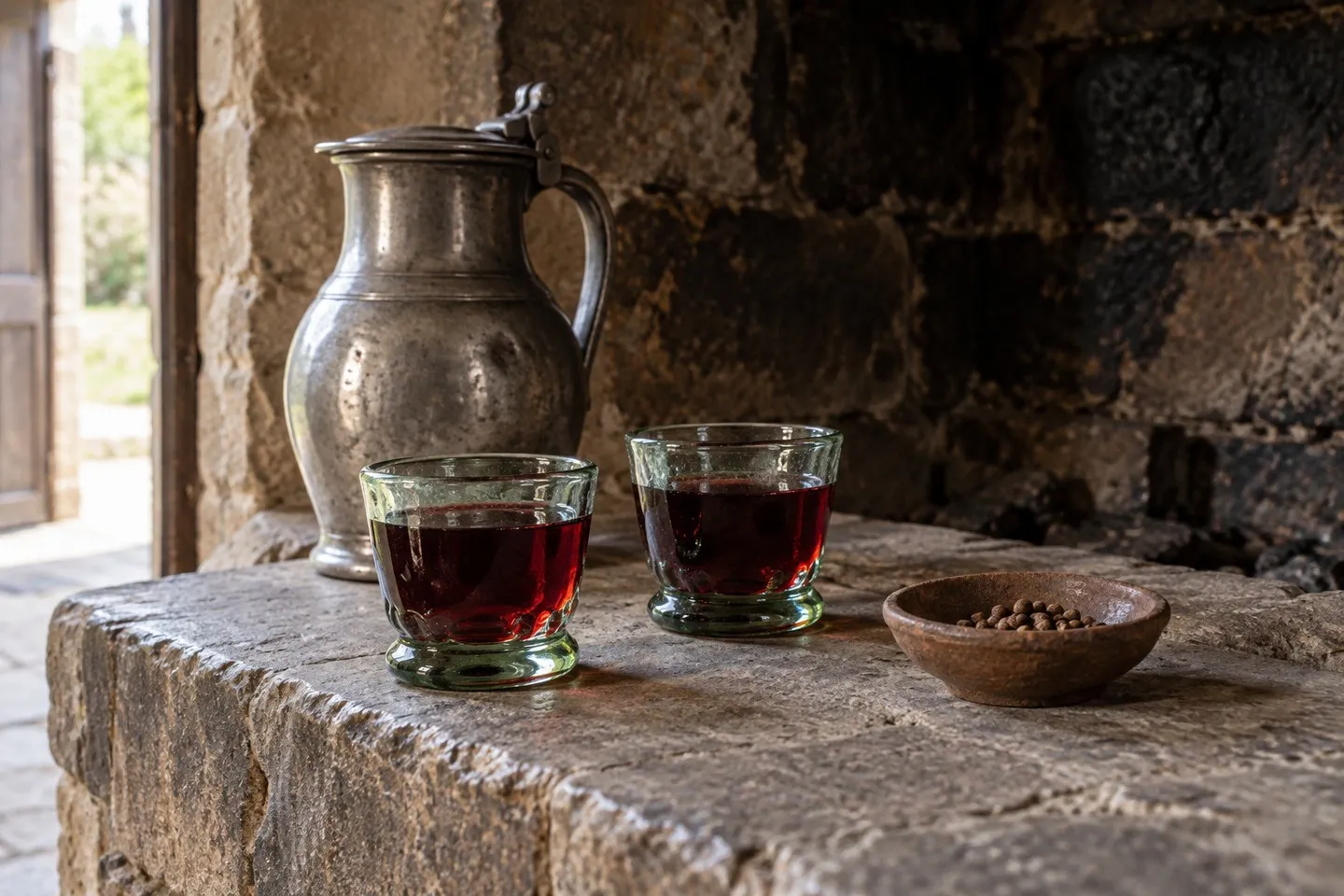
Hippocras in small glass cups, with its pewter jug and a dish of grains of paradise.
The story behind the recipe
Take red wine, sweeten it with sugar, load it with ground spice and pour it through a row of cloth bags until it runs clear: that is hippocras. Samuel Pegge, editing Richard II’s cookery roll in 1780, gives the usual explanation of the name: it “took its name from Hippocrates’ sleeve, the bag or strainer, through which it was passed.” In great medieval households it was often served at the end of the feast, with wafers.
Six bags on a perch
Richard II’s cooks set down only the spice powder; the method, bags and all, comes from John Russell’s Boke of Nurture. Russell was usher and marshal to Humphrey, Duke of Gloucester, and his Victorian editor, Frederick Furnivall, dates the work to the middle of the fifteenth century. Russell sorts his spices by rank. A lord’s hippocras takes ginger, cinnamon, grains of paradise and sugar; for “commyn peple” it is ginger, canel, long pepper and clarified honey, and canel, he warns, “is not so good in þis crafte.”
The wine runs through a row of cloth bags hung from a perch, the first holding a gallon, a basin under each. The maker keeps tasting, taming too much ginger with cinnamon and settling the sugar “by discressioun.” Nothing is thrown out: the spent spice “is good for Sewes in kychyn,” meaning stews.
When quantities do appear, they are heroic. A receipt for the Lord Mayor of London’s feast of 1505 lists ten pounds of cinnamon, four of ginger, one of grains and four of sugar, on the same list that orders forty gallons of hippocras.
Read more about this recipe
Spicing a single bottle
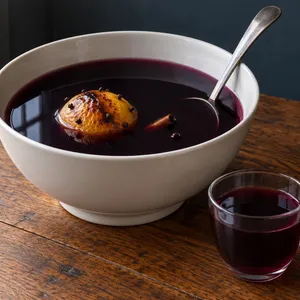
The Lord Mayor’s receipt is mostly cinnamon, and the spice powder in Richard II’s roll starts with three ounces each of cinnamon and ginger, so this is a cinnamon drink with ginger’s heat behind it and a peppery edge from the grains. Grains of paradise are the pungent seeds of a West African plant in the ginger family, sold by spice merchants; black pepper is the nearest stand-in. This version uses twice as much cinnamon as ginger by the spoonful, with a little grains of paradise, and leaves the sugar to taste, as Russell did. A 12% ABV wine gives a hippocras of about 11%. The alcohol-free bishop follows much the same plan with no alcohol: red grape juice, cinnamon among its spices and sugar to taste, though it adds a roasted lemon and is served hot. Ground spice clouds the wine, so a coffee filter does the work of his finest bags. Its honeyed relation is Clarrey. It is one of our Forgotten Drinks Worth Making Again.
[Lines 121–124, p. 9] Good son, to make ypocras, hit were gret lernynge, and for to take þe spice þerto aftur þe proporcionynge, Gynger, Synamome / Graynis, Sugur / Turnesole, þat is good colourynge; For commyn peple / Gynger, Canelle / longe pepur / hony aftur claryfiynge.
[Lines 149–152, p. 11] Furst put in a basoun a galoun ij. or iij. wyne so red; þen put in youre powdurs, yf ye wille be sped, and aftyr in-to þe rennere so lett hym be fed, þan in-to þe second bagge so wold it be ledde.
[Lines 169–170, p. 12] And vndur euery bagge, good son, a basoun clere & bryght; and now is þe ypocras made / for to plese many a wight.

Recipe makes: About 700 ml, 6 small glasses
Ingredients
For About 700 ml, 6 small glasses. Quantities are shown as written.
Quantities as written here, for About 700 ml, 6 small glasses.
- Fruity red wine750 ml
- Ground cinnamon4 metric tsp (5 ml per tsp)
- Ground ginger2 metric tsp (5 ml per tsp)
- Grains of paradise, freshly ground1/2 metric tsp (5 ml per tsp)
- Sugar, or to taste4 metric tbsp (15 ml per tbsp)
Measurement notes
Ingredients as written here
- 750 ml fruity red wine
- 4 tsp ground cinnamon
- 2 tsp ground ginger
- 1/2 tsp grains of paradise, freshly ground
- 4 tbsp sugar, or to taste
Equipment
 Large jug or bowl
 Sieve lined with muslin or a clean cotton cloth
 Paper coffee filter and funnel
 Bottle or carafe with a stopper
Instructions
Pour the fruity red wine into a large jug and add the ground cinnamon, ground ginger, grains of paradise and sugar. Stir until the sugar has dissolved.
Leave to steep for 2 hours, stirring now and then. Taste, and add a little more sugar or ginger if you like.
Pour the wine through a sieve lined with muslin or a clean cotton cloth into a second jug, letting it drip without pressing the spice.
Pour it again through a paper coffee filter set in a funnel, straight into a clean bottle or carafe. Change the filter if it clogs. The wine should run clear and ruby.
Stopper the bottle and serve at room temperature in small glasses.
Nutrition
130calories per serving
- Recipe makes
- About 700 ml, 6 small glasses
- Servings
- 6
Estimated from the ingredients using USDA FoodData Central values for red wine and sugar, with the full 4 tablespoons of sugar; the strained spices add almost nothing.
Recipe notes
When adjusting quantities
Scale everything together; for two bottles, double every amount.
Notes
Quantities mentioned in these notes don’t change when you adjust the batch.
Russell’s words, glossed: graynis are grains of paradise; canelle is the grade of cinnamon Russell rates below his synamome; and a rennere is one of the straining bags. His first bag holds a gallon of wine, the others a pottle each.
Grains of paradise are sold whole; grind them in a pepper mill or mortar just before using. If you can’t find them, use 1/4 tsp ground black pepper.
The Lord Mayor’s receipt of 1505 weighs out ten pounds of cinnamon to four of sugar but doesn’t say how much wine they went into, so the amounts here are our own, the sugar most of all. Russell’s turnsole, a plant dye used to deepen the red, is left out.
Scaling changes the ingredients only; glassware, ice and timings need their own judgment. To adapt this recipe further, try the recipe tool at TuneMyRecipe (opens in a new tab), our sister site.
Sources and attribution
John Russell, The Boke of Nurture, in Frederick J. Furnivall (ed.), Early English Meals and Manners (London: Early English Text Society, 1868), lines 121–176, pp. 9–12