Apple and Quince Water Sweetened with Honey from 1869
Reader ratingsTwelve pippins and a quince boiled in two quarts of water, pressed through a sieve and sweetened with honey: the first of two apple-waters in Terrington’s Cooling Cups of 1869.
- Recipe makes
- About 1.7 liters, 7 glasses
- Prep
- Cook
- Total
The fruit simmers about 30 minutes. Cooling and chilling take about 2 hours.
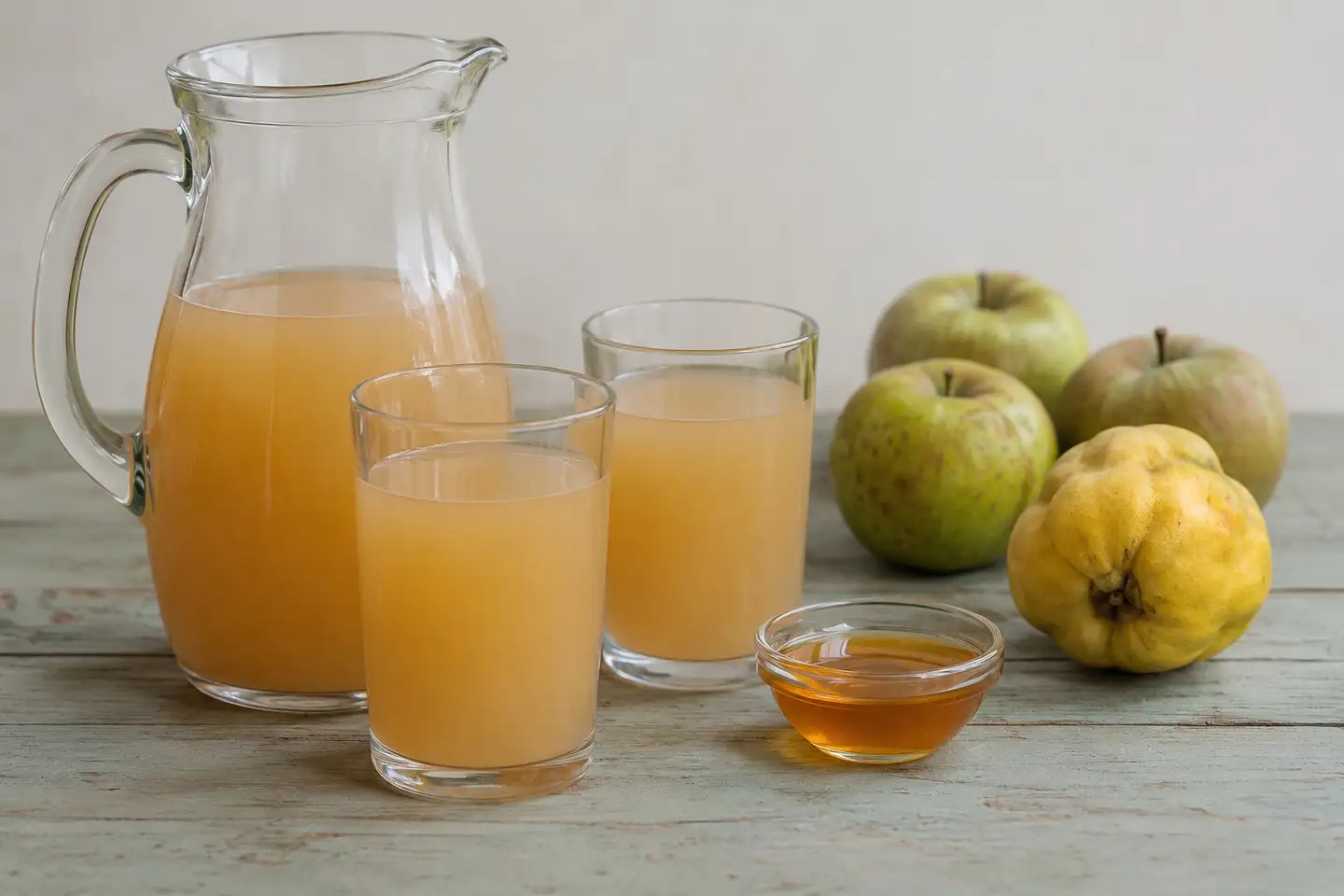
Apple and quince water in a jug and two glasses, with green apples, a quince and honey.
The story behind the recipe
Terrington’s apple water is apple and quince stewed in water, squeezed out and sweetened, with no yeast and no alcohol. “Boil 12 pippins and 1 quince in 2 quarts of water,” it reads, “strain with pressure; add honey or sugar.” That is the whole recipe, the first of two apple-waters printed one after the other in William Terrington’s Cooling Cups and Dainty Drinks, a London book of 1869 of cups, punches and soft drinks.
Two apple-waters, one page
His second apple-water bakes apples and a pear, adds lemon peel and ginger and pours boiling water over them; we make it as Baked-Apple Water with Ginger and Lemon Peel, where this first recipe is quoted. This is the other one, and the plainer of the two, given a page of its own. Terrington’s last instruction leaves the choice of honey or sugar to the cook. We take the honey, which makes it a cousin of the meads and honey drinks in the same collection rather than a plain stewed-fruit water.
A quince is a hard, fragrant fruit, usually cooked rather than eaten raw. For his pippins we use any small, sharp apple.
Read more about this recipe
Making it today
Terrington gives no time, so we simmer the fruit until it is soft, about half an hour, and press it through a sieve with a spoon. His own table of measures puts two of the old 16-ounce pints to the quart, so his two quarts are about 1.9 liters, and that is our water. The honey is ours too: about 100 ml, enough to sweeten it lightly, and you can add more to taste once it has cooled. Nothing in it ferments, so keep it in the fridge and drink it within three days. More drinks without alcohol, from Roman posca to the soda fountain, are in Posca to Phosphates: What People Drank Instead of Alcohol.
Apple-Water.—Boil 12 pippins and 1 quince in 2 quarts of water; strain with pressure; add honey or sugar.

Original: About 1.7 liters, 7 glasses
Ingredients
My drinksFor About 1.7 liters, 7 glasses. Quantities are shown as written.
Quantities as written here, for About 1.7 liters, 7 glasses.
- Small tart apples12Author measures: about 1.6 kg.
- Quince1Author measures: about 250 g.
- Water1.9 l
- Runny honey100 ml
Measurement notes
Ingredients as written here
- 12 small tart apples (about 1.6 kg)
- 1 quince (about 250 g)
- 1.9 l water
- 100 ml runny honey
Equipment
 Knife and board
- Large saucepan with a lid
 Fine sieve
 Large bowl
 Wooden spoon
 Large jug or bottle with a lid, for the fridge
Instructions
Wash the small tart apples and the quince. Quarter them, cut out the cores and any bruises, and chop them roughly, leaving the skins on. A quince is very hard, so use a heavy knife.
Put the fruit in the large saucepan with the water. Bring it to a boil, cover and simmer gently for 25 to 35 minutes, stirring now and then, until all the fruit is soft.
Set the sieve over the large bowl, pour in the fruit and liquid, and press the fruit with the back of the wooden spoon to push the juice and a little of the soft pulp through.
Stir the runny honey into the warm liquid until it dissolves. Taste it and add a little more honey if you like.
Let it cool, then pour it into the jug, cover it and chill it in the fridge for at least an hour. Serve it cold, stirred, or warm it gently in a saucepan on a cold day.
Nutrition
85calories per serving
- Servings
- 7
Roughly estimated from USDA FoodData Central values for honey and for the sugars of boiled apples and quince that pass into the water, for one 250 ml glass.
Recipe notes
When adjusting quantities
Terrington’s batch is 12 pippins and 1 quince to 2 quarts of water. Keep about 6 apples to each liter.
Notes
Quantities mentioned in these notes don’t change when you adjust the batch.
Changes from the source: the simmering time, coring the fruit, the amount of honey and chilling it are our choices; Terrington gives only the fruit, the water and “honey or sugar.” Use sugar instead of honey if you prefer, about 6 tablespoons.
Keep it covered in the fridge and drink it within 3 days, or freeze it. Don’t leave it out to keep, as fruit juice starts to ferment.
Honey isn’t suitable for babies under one year old. If you can’t find a quince, add one more apple and a strip of lemon peel.
Scaling changes the ingredients only; glassware, ice and timings need their own judgment. To adapt this recipe further, try the recipe tool at TuneMyRecipe (opens in a new tab), our sister site.
Sources and attribution
William Terrington, Cooling Cups and Dainty Drinks (London and New York: George Routledge and Sons, 1869), “Apple-Water” (the first recipe of that name), p. 199
Recipe details
- Drink
- Alcohol-free
- Drink family
- Sodas & Soft Drinks
- Region
- British
- Era
- 19th century
- Source decade
- 1860s
- Base
- Honey
- Difficulty
- Easy
- Occasion
- Dry January
- Season
- Autumn