Baked-Apple Water with Ginger and Lemon Peel
Reader ratingsBoiling water poured over baked apples, a pear, grated ginger and lemon peel, then pressed through a sieve: an alcohol-free Victorian drink from 1869.
- Recipe makes
- About 1.1 liters, 6 glasses
- Prep
- Cook
- Total
Includes 40 to 50 minutes for baking the fruit and about 1 hour for the water to cool before straining.
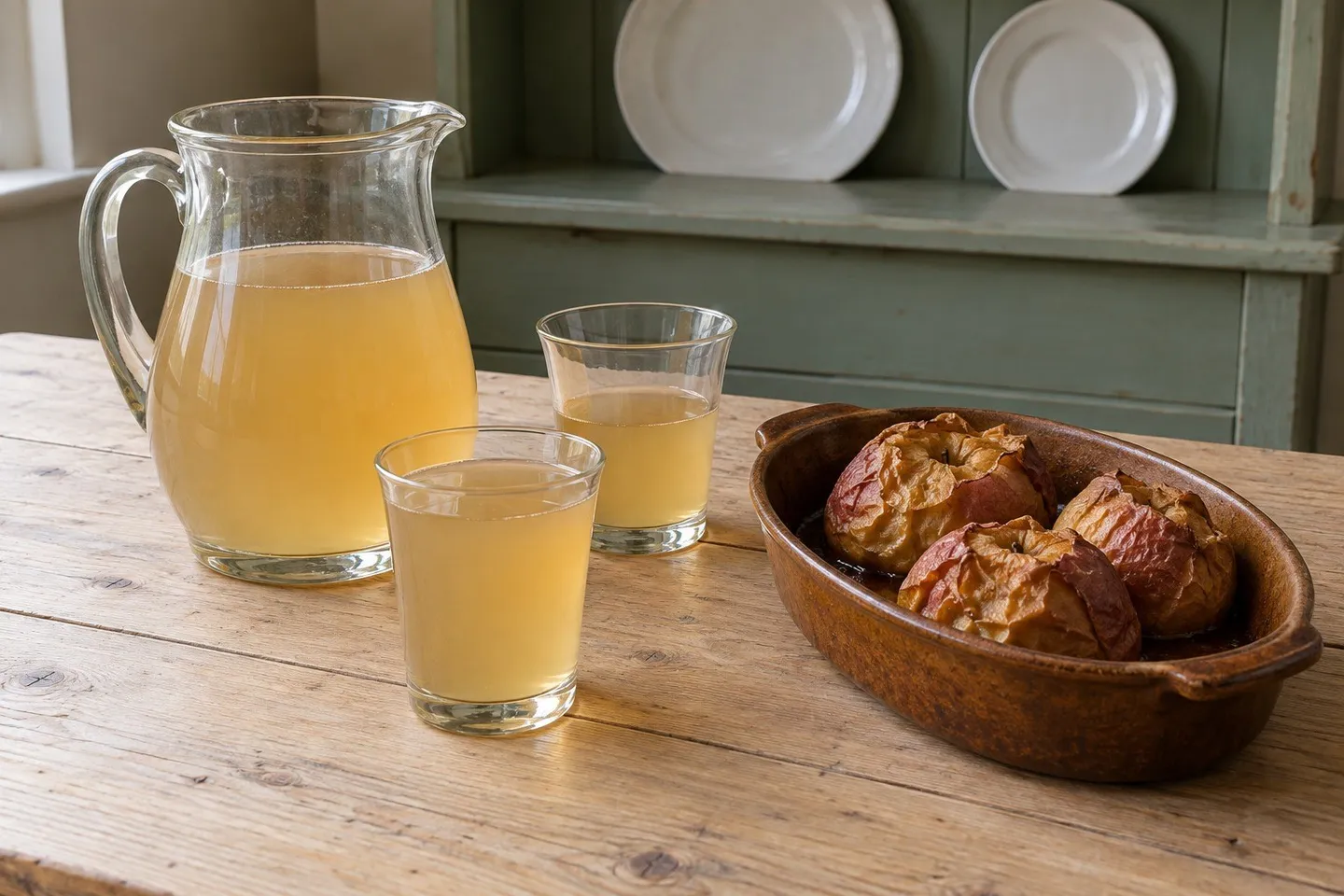
Cloudy baked-apple water in a glass jug and two tumblers, with three baked apples in a brown dish.
The story behind the recipe
Terrington’s baked-apple water is boiling water poured over baked apples, a pear, grated ginger and the thin peel of a lemon, left to cool and then pressed through a sieve. Nothing in it ferments, so there is no alcohol at all. It comes from William Terrington’s Cooling Cups and Dainty Drinks (1869), a London book of cups, punches and soft drinks.
Two apple-waters on one page
Terrington prints two recipes under the same name, one after the other. The first is plain: “Boil 12 pippins and 1 quince in 2 quarts of water; strain with pressure; add honey or sugar.” The second, the one made here, bakes the fruit first and adds lemon and ginger. Baking softens the fruit until it falls apart, and pressing it through the sieve pushes some of the soft pulp into the water, which is why the drink comes out cloudy.
The same book has a mulled wine of claret and port and a wassail bowl, and roasted apples went into the Christmas bowls of the time: Dickens’s Christmas Eve wassail at Dingley Dell had “hot apples hissing and bubbling” in it. Victorian Christmas Drinks, from Punch to Elder Wine sets this jug beside the punch, the elder wine and the Band of Hope teas.
Read more about this recipe
How much water
The second recipe gives no amount of water at all. We borrowed the first recipe’s two quarts for twelve fruit and halved it, so 1.1 liters for six apples and a pear is our assumption, not Terrington’s. His “1 oz. grated ginger” was probably dried root; grated fresh ginger is gentler and easier to find, so use the smaller amount here and add more if you want more heat. Sweetening is optional: the first apple-water calls for honey or sugar, the baked one doesn’t mention it.
Terrington strains it “when cool,” and it was printed as a cooling drink. Warming it gently before serving is our suggestion for a Christmas table. For a second alcohol-free jug from the same decade, Mrs. Beeton’s Lemonade is also made with boiling water and left to cool.
Apple-Water.—Bake 12 apples and 1 pear; when well baked, put them into a pitcher; add thin peel of a lemon, 1 oz. grated ginger; pour on boiling water; strain with pressure when cool.

Recipe makes: About 1.1 liters, 6 glasses
Ingredients
For About 1.1 liters, 6 glasses. Quantities are shown as written.
Quantities as written here, for About 1.1 liters, 6 glasses.
- Apples6
- Small pear1
- Unwaxed lemon, for the peel1/2
- Grated fresh ginger1 metric tbsp (15 ml per tbsp)
- Boiling water1.1 l
- Honey or sugar, to taste (optional)
Measurement notes
Ingredients as written here
- 6 apples
- 1 small pear
- 1/2 unwaxed lemon, for the peel
- 1 tbsp grated fresh ginger
- 1.1 liters boiling water
- honey or sugar, to taste (optional)
Equipment
 Baking dish
 Vegetable peeler
 Fine grater
 Kettle
 Heatproof jug, at least 1.5 liters
 Sieve
 Bowl
 Wooden spoon
- Serving jug
Instructions
Heat the oven to 200°C. Put the whole apples and the pear in a baking dish and bake for 40 to 50 minutes, until the skins split and the fruit has collapsed.
While the fruit bakes, pare the peel from the unwaxed lemon in thin strips with a vegetable peeler, leaving the white pith behind. Grate the fresh ginger.
Put the hot baked fruit, with any juice from the dish, into a heatproof jug. Add the lemon peel and ginger.
Pour the boiling water over the fruit, stir once, and leave it to cool for about 1 hour.
Set a sieve over a bowl and pour the apple water through it. Press the fruit hard with a wooden spoon to push the juice and soft pulp through, then discard the skins, cores and peel left in the sieve.
Taste, and stir in honey or sugar if you want it sweeter. Pour into a serving jug and serve cool, or warm it gently in a saucepan without boiling.
Nutrition
75calories per serving
- Recipe makes
- About 1.1 liters, 6 glasses
- Servings
- 6
Roughly estimated from USDA FoodData Central values for raw apples, pears and ginger, assuming about 70% of the baked fruit is pressed through the sieve, without honey or sugar.
Recipe notes
When adjusting quantities
This is half of Terrington’s batch of 12 apples and 1 pear. Double everything for the full 1869 amount; the water stays at about 1 liter for every 6 apples.
Notes
Quantities mentioned in these notes don’t change when you adjust the batch.
The 1869 recipe gives no quantity of water. The 1.1 liters here is taken from the first apple-water on the same page, two Imperial quarts (about 2.27 liters) for twelve fruit, halved for six apples and a pear. It is an assumption, so add a little less water for a stronger drink.
Six medium apples weigh about 1 kg, and a small pear about 150 g. Any apples that bake soft will do; cooking apples collapse fastest. The tablespoon of grated fresh ginger is about 14 g, half the 1869 ounce; if you only have ground ginger, start with 1 tsp.
Once cool, keep the apple water covered in the fridge. The USDA’s Food Safety and Inspection Service gives 3 to 4 days for refrigerated leftovers; as a fresh, unpasteurized fruit infusion, we would drink it within 2 to 3 days.
Scaling changes the ingredients only; glassware, ice and timings need their own judgment. To adapt this recipe further, try the recipe tool at TuneMyRecipe (opens in a new tab), our sister site.
Sources and attribution
William Terrington, Cooling Cups and Dainty Drinks (London: Routledge, 1869), “Apple-Water” (the second recipe of that name), p. 199
See the original pages (scan at Internet Archive) (opens in a new tab)
Recipe details
- Drink
- Alcohol-free
- Drink family
- Sodas & Soft Drinks
- Region
- British
- Era
- 19th century
- Source decade
- 1860s
- Base
- Fruit & juice
- Difficulty
- Easy
- Occasion
- Christmas
- Season
- Winter