Negus, the Warm Wine of Georgian Balls
Port and hot water with sugar, lemon and nutmeg, poured from a jug at balls and evening parties from the 1740s until it faded in the 1890s.
Negus was wine and hot water, sweetened with sugar, sharpened with lemon and finished with grated nutmeg, served warm from a jug. The wine was usually port, sometimes sherry or white wine. The word is in print by 1745, the drink was handed round at balls, assemblies and evening parties for more than a century after that, and by the 1890s people wrote of it as old-fashioned. It is said to be named after Colonel Francis Negus, who died in 1732, but nobody put that in print until 1798, and the best-known story about him, in which he talks a party of quarreling Whigs and Tories into watering their wine, first appears in 1854.
This story is part of our Hot Winter Drinks From Old Recipe Books guide.
It was a mild drink. A common rule ran to a part of port for every two of water, which lands a glass of negus at about 6 to 7% alcohol, mild enough that Victorians served it at children’s parties, the side of its history told in What Did Victorian Children Drink at Christmas?
Who drank negus?
Jane Austen sends Fanny Price up to bed from her first ball in Mansfield Park (1814) “feverish with hopes and fears, soup and negus, sore-footed and fatigued.” In The Watsons, the novel Austen began about 1804 and left unfinished, the assembly is held at an inn, and the narrator imagines Tom Musgrave, who has vanished from the ballroom, “gladly assisting the landlady in her bar to make fresh negus for the happy dancers above.”
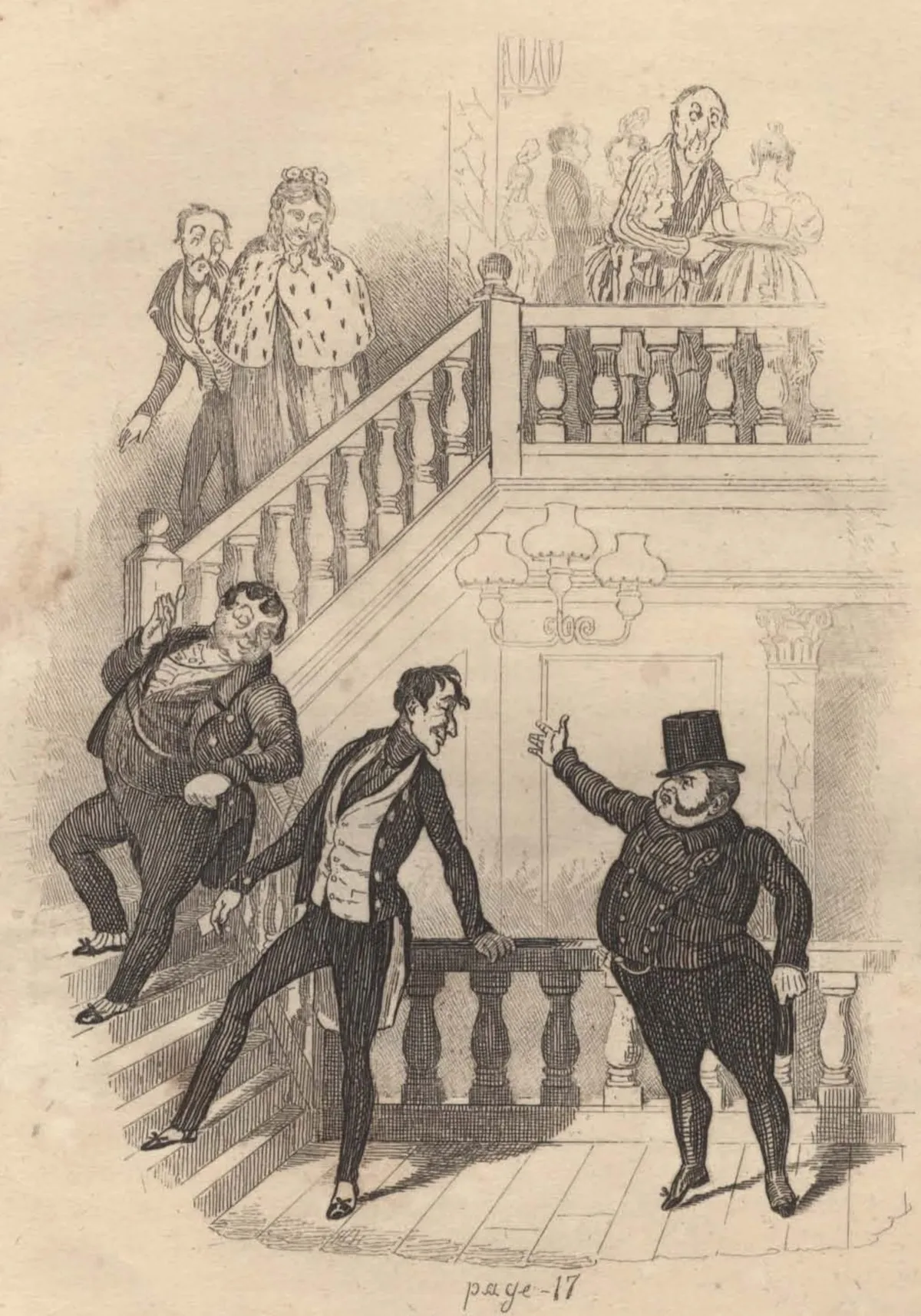
Dickens put negus into the very first monthly part of The Pickwick Papers in April 1836. At the charity ball at the Bull Inn in Rochester, a jealous doctor watches “all the handings of negus, and watching for glasses, and darting for biscuits, and coquetting, that ensued.” The stranger Jingle offers his verdict in his usual telegraphic style: “negus too strong here—liberal landlord—very foolish—very—lemonade much better.” Robert Seymour’s etching for that part is at the top of this page.
The same year, in Sketches by Boz, the cut-price dancing academy of Signor Billsmethi serves “red port wine negus and lemonade” at “eighteen-pence a head,” about £7.40 today, by UK consumer prices (Bank of England). Dickens was less kind about a girls’ school ball in another sketch, where the visitors drank “warm water disguised with lemon, and dotted with nutmeg, under the denomination of negus.” At Mr. Fezziwig’s Christmas Eve ball in A Christmas Carol (1843) “there was cake, and there was negus,” and Mrs. Beeton’s ball refreshments in 1861 were still “cakes and biscuits, with wine negus, lemonade, and ices, handed round.” Lemonade turns up beside negus in several of these rooms, and Beeton’s own lemonade made with boiling water comes from the same 1861 book as her ball menu.
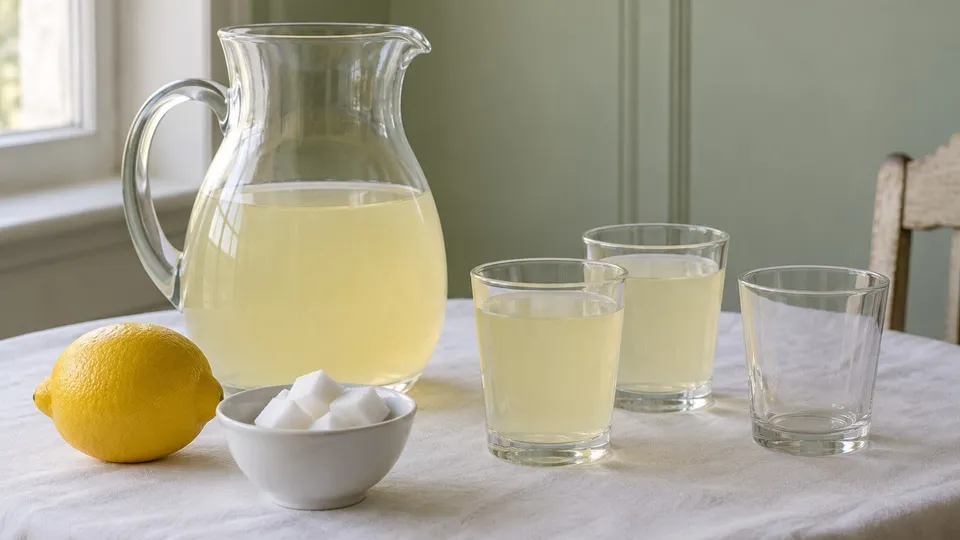 Always alcohol-freeMrs. Beeton’s Lemonade, Made with Boiling Water
A draught of negus in 1745
The earliest printed use found so far comes from a surgeon who signed himself “J. N.” and wrote a tract against tea in 1745, the year of the Jacobite rising. On his last page he allows that “Sage Tea, or a draught of negus, would be a beneficial dilutant,” while tea itself conceals a quality “as destructive to health, as the pretender, on the throne of these realms, would be to our rights and liberties.”
Four years later William Chetwood, in his General History of the Stage, told a story set in Dublin “about Thirty Years past.” The actor John Thurmond had pawned his stage costume, so his wife went to a neighboring tavern, “bespoke a very hot Negus” for him, and asked for it in the silver tankard with the lid, since silver “would retain Heat longer than any other Metal.” The negus reached the playhouse in “a vile earthen Mug,” and the tankard went under her apron to the pawnbroker to buy back the suit. Chetwood’s date rests on memory, but his use of the word dates from 1749.
A yet unanswered query
By the 1790s nobody seemed sure where the name came from. In August 1798 a reader of The Gentleman’s Magazine signing himself “H. D. B.” tried a second time.
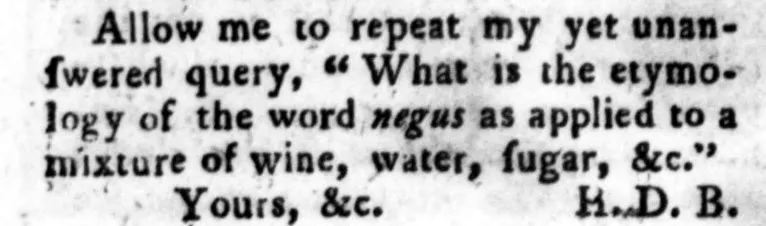 The Gentleman’s Magazine, vol. LXVIII, August 1798, p. 662.
The answers arrived over the next six months. In September a correspondent signing “E.” wrote that negus “is supposed to have been brought into fashion by, and taken its denomination from, Francis Negus, esq. who was commissioner for executing the office of master of the horse during the reign of George I.” In November another reader proposed a tavern keeper of that name, as with Bath’s “Sally Lunns.” In February 1799 “M. A. C.” recalled a portrait in a clergyman’s house at Frome, Somerset, seen “nearly 30 years ago.” The clergyman’s wife told him it was “a Colonel Negus,” her husband’s uncle, who used to call to his junior officers, “Come, boys, join with me, taste my liquor,” until the regiment named the drink after him.
In 1800 the scholar Edmond Malone gave the story its firmest form, in a footnote. Writing about the nutmeg at Will’s Coffee-house in Dryden’s day, he explained that “the mixture now called Negus, which was invented in Queen Anne’s time by Colonel Negus, was then unknown.” Oxford Night Caps repeated it in 1847, crediting Malone, and Jerry Thomas repeated it in New York in 1862.
Francis Negus was real: an army officer and courtier who held the Master of the Horse commission the 1798 letter names, and who died in 1732. The first printed links between him and the drink came 66 to 68 years after his death, and most of them hedge, “supposed” in 1798 and “said to have invented it” in 1862; Malone, who did not, gave no source.
A gentleman of taste
The nearest thing to a witness turned up in Notes and Queries in July 1854. A reader copied out an entry from a Bristol bookseller’s catalogue for a 1604 folio of Tacitus. Its owner, Thomas Vernon of Ashton, Bishop’s Waltham, Hampshire, who lived from 1704 to 1753, had filled the margins with notes, and one of them read: “After a morning’s walk, half a pint of white wine, made hot and sweetened a little, is recond very good,—Col. Negus, a gentn of tast, advises it, I have heard say.” The note itself is known only from that printed transcription, and its date is unknown, so it shows that a Colonel Negus was linked with hot sweetened wine by a man whose life overlapped his by 28 years. It does not show that he invented anything.
The editor’s answer, in square brackets on the same page, is the earliest printing of the legend we found. Wine and water, “it is said,” took the name from Colonel Francis Negus. In the story, with “party spirit running high” between Whigs and Tories, leading men of both sides fell to high words over their cups in his company, and he “recommended them in future to dilute their wine, as he did.” The argument turned to the merits of wine and water, and they ended by “nicknaming it Negus.” That story appears 122 years after Negus died, with no source behind it.
How was negus made?
Recipes came later than the word. A. F. M. Willich’s Domestic Encyclopaedia of 1802 gives the plain version: “one part of Port-wine, and two parts of water, to which is usually added a small quantity of sugar, lemon-peel, &c.”
Oxford Night Caps, a little book of the drinks made in the university, gives the fullest method in its 1847 edition. “Negus is a modern beverage,” it begins, and then builds it in a jug: sugar rubbed on lemon peel, sliced lemons, a few spices and calves-feet jelly, a quart of boiling water, and after a quarter of an hour a bottle of hot white wine and half a grated nutmeg. For port the jelly was left out. Its proportion, a bottle of wine to a quart of water, is a little stronger than Willich’s.
Mrs. Beeton’s 1861 negus, the one written for children’s parties, kept to one part port and two of boiling water. A year later Jerry Thomas printed it in How to Mix Drinks as his “Port Wine Negus,” almost word for word and without credit. On the facing page he has something different: a soda negus, port warmed with sugar and cloves and then topped up with soda water, which he promises will make “an effervescing and delicious negus.” In London in 1869 William Terrington’s Cooling Cups and Dainty Drinks was adding a drop of essence of ambergris or ten of vanilla, “all to be made and drunk warm.”
Three jugs to make
The lead recipe is an alcohol-free negus, and it is a modern one, since the name meant wine and water. It follows the 1847 Oxford method step for step, with hot red grape and blackcurrant juice where the port went. Unlike the alcohol-free bishop, it has no roasted lemon and no boiled-down spices. The Oxford recipe itself is our port wine negus, and Jerry Thomas’s soda negus tops warm port with soda water. Both warm the port until it steams, not “boiling hot” as the Oxford cook did.
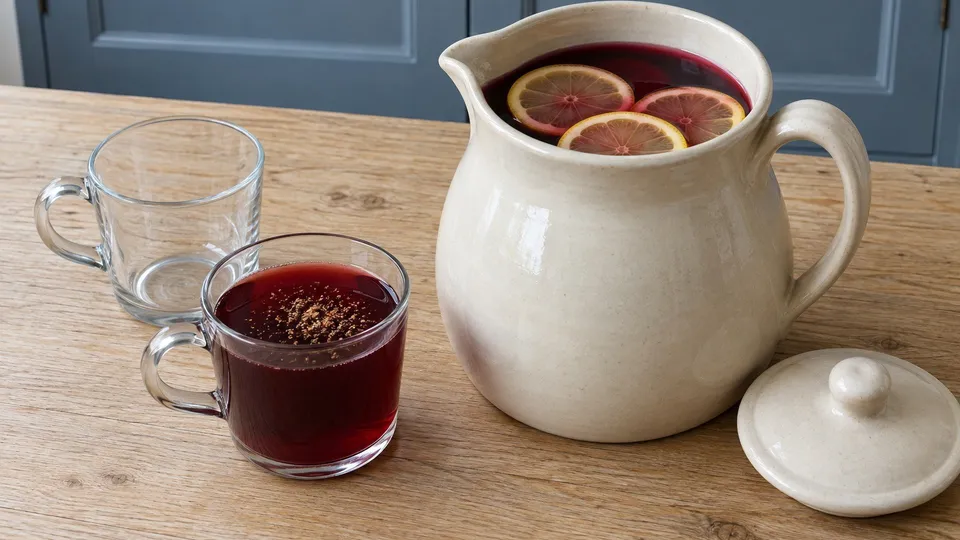 Alcohol-free versionAlcohol-Free Negus, Hot Grape and Blackcurrant with Lemon
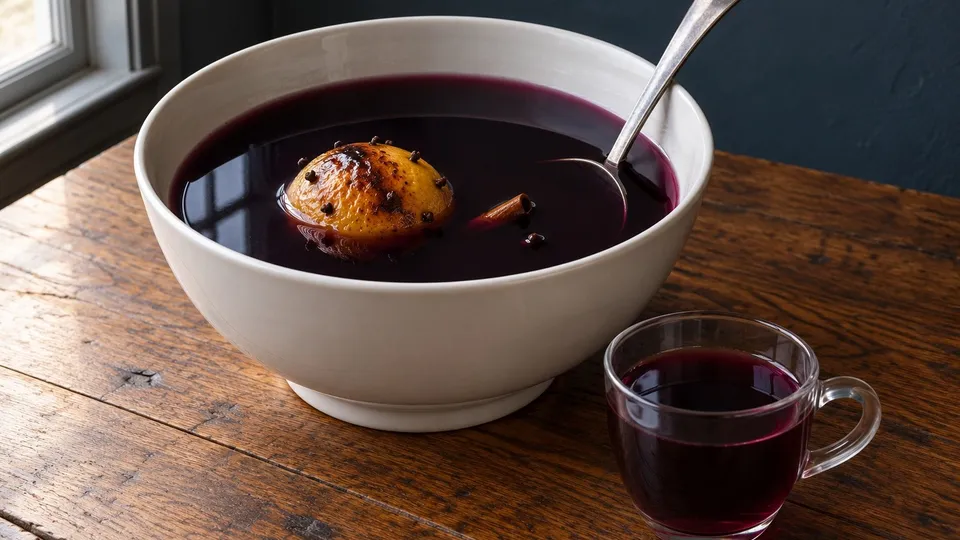 Alcohol-free versionAlcohol-Free Bishop, Spiced Grape Juice with a Roasted Lemon
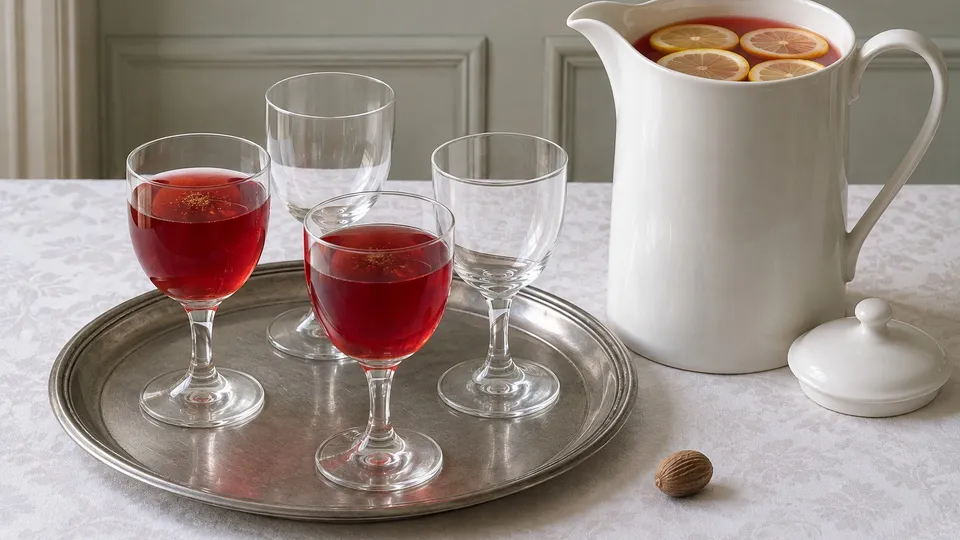 Make it todayPort Wine Negus, Hot Port with Lemon and Nutmeg
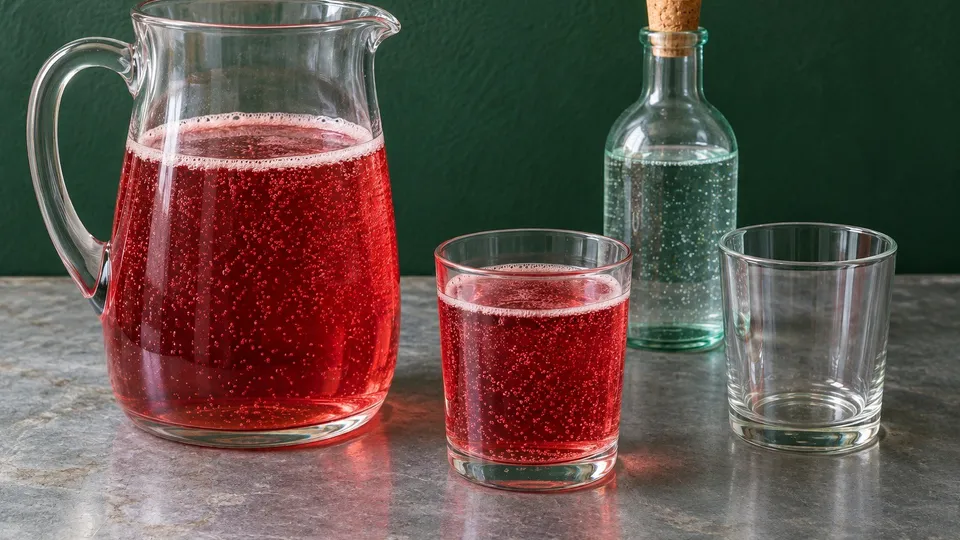 Make it todaySoda Negus, Warm Port with Soda Water
Commoner in Mrs. Siddons’s time
Negus needed nutmeg, and in July 1897 the readers of Notes and Queries were puzzling over a small object a correspondent had asked about: the pocket nutmeg grater, small enough to carry to a party.
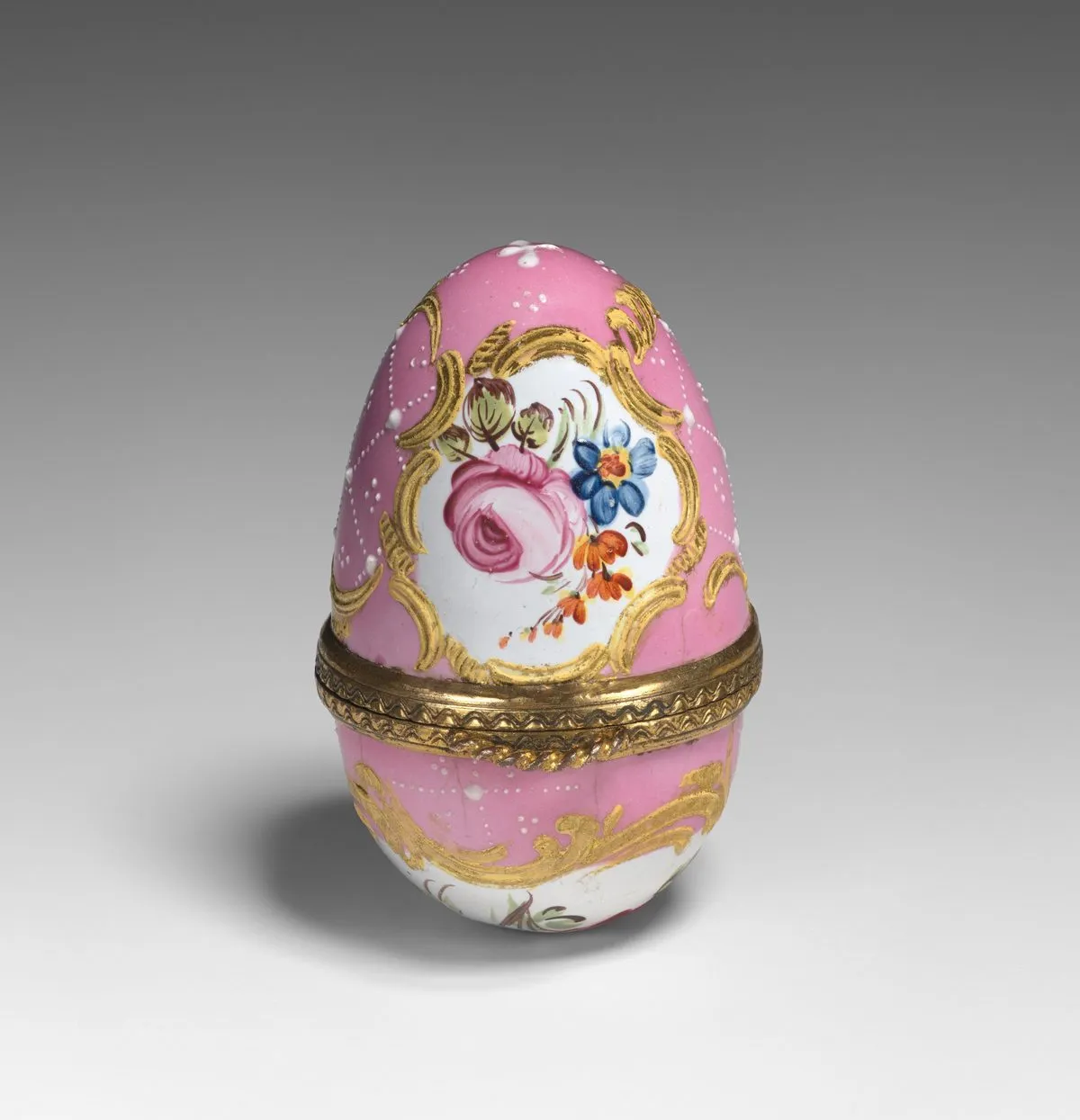 A pocket nutmeg grater of painted enamel on copper, about 1765–70, a little over two inches tall. The Metropolitan Museum of Art, New York (object 893676), public domain.
One reader, C. F. S. Warren, guessed that its owners carried it “to season to their own taste their evening tumbler of hot negus; which was commoner in Mrs. Siddons’s time than now.” Sarah Siddons, the actress, had died in 1831. Another, signing “W. C. B.,” asked simply, “Was not this for use in connexion with negus and the like?” Edward H. Marshall wrote the drink’s epitaph without meaning to. His own generation, “an age of cheap (and wooden) nutmegs, an age which thinks little of sherry-negus and despises custards at evening parties,” could hardly be expected to see how useful the little grater had been to a careful hostess.
Leave Marshall’s wooden nutmegs to his age and grate a whole, real one over the alcohol-free negus, which follows the 1847 Oxford jug step for step and is ready in half an hour.
Sources
- J. N., surgeon, Remarks on Mr. Mason’s Treatise upon Tea (London, 1745), p. 24.
- W. R. Chetwood, A General History of the Stage (London: W. Owen, 1749), pp. 224–225.
- The Gentleman’s Magazine, vol. LXVIII (1798): August, p. 662 (“H. D. B.”); September, p. 755 (“E.”); November, p. 931. Vol. LXIX (February 1799), p. 119 (“M. A. C.”).
- Edmond Malone, “Life of Dryden,” in The Critical and Miscellaneous Prose Works of John Dryden, vol. I, part 1 (London: Cadell and Davies, 1800), p. 484, note.
- A. F. M. Willich, The Domestic Encyclopaedia, vol. III (London: Murray and Highley, 1802), p. 260.
- Jane Austen, Mansfield Park, vol. II (London: T. Egerton, 1814), p. 234.
- Jane Austen, “The Watsons,” in J. E. Austen-Leigh, A Memoir of Jane Austen, 2nd ed. (London: R. Bentley, 1871), p. 327.
- Charles Dickens, Sketches by “Boz”, first series, vol. II (London: J. Macrone, 1836), “The Dancing Academy,” p. 166, and “Sentiment,” p. 337.
- Charles Dickens, The Posthumous Papers of the Pickwick Club, part 1 (London: Chapman and Hall, April 1836), p. 17 and the plate facing it by Robert Seymour.
- Charles Dickens, A Christmas Carol (London: Chapman and Hall, 1843), p. 60.
- [Richard Cook, attrib.], Oxford Night Caps, 4th ed., enlarged (Oxford: H. Slatter, 1847), pp. 5–7.
- Notes and Queries, 1st series, vol. X (July 1854), p. 10.
- Isabella Beeton, The Book of Household Management (London: S. O. Beeton, 1861), pp. 15 and 890.
- Jerry Thomas, How to Mix Drinks, or, The Bon-Vivant’s Companion (New York: Dick & Fitzgerald, 1862), pp. 62–63.
- William Terrington, Cooling Cups and Dainty Drinks (London: Routledge, 1869), p. 195.
- Notes and Queries, 8th series, vol. XII (July 24, 1897), p. 70, “Pocket Nutmeg-grater.”
- Pocket nutmeg grater, enamel on copper, ca. 1765–70, The Metropolitan Museum of Art, object 893676, metmuseum.org (opens in a new tab).